Discussion keeps the world turning.
This is Roundtable.
In the past few years, outdoor activities like biking and camping have grown in popularity and spurred growth in relevant industries.
This year as the weather becomes amicable again, a new style of picnicking is setting in like magnolia flowers and cherry blossoms in early Spring.
Hello, I'm Lai Ming and you're listening to Roundtable.
Today with Steve Heatherly and Yuxian on board, let's catch up with the new trends of outdoor activities.
In the past few years we talked about camping, glamping, and biking, and RV -ing.
Sure, an RVing. So outdoors is the new fashion, and now we are almost, in fact, we are in the season of outdoor activities, and there's a new trend.
We should enjoy these before we talk about the trends.
We should enjoy these, by the way, while the what feels like five days of spring exists before the mid -30s temperatures come along.
Yeah, Steve has only been here for about a year.
and you've already grabbed the core of the spring here in Beijing, only it lasts five days, that's a metaphor.
But when we're talking about picnicking, what is a picnic, what does a picnic look like to you guys?
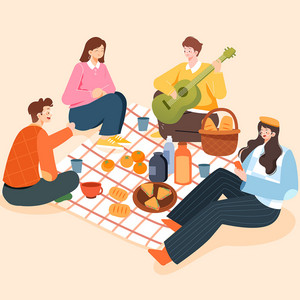
In my mind, I imagine maybe a checkered blanket on the grass with a woven picnic basket.
I open up the picnic basket and inside I see a baguette, maybe some hams and cheeses, a nice strawberry jam per chance and, yeah, little snacky foods like that.
That's what young Canadians experience in terms of outdoors and picnicking.
When you said picnic, Yushan, that's the image.
I don't know why, but that's the image that came to my mind.
My idea of a picnic event is, well, by the beach of a river, where it's sandy.
And little kids will bring shovels and pots, so we'll dig holes in the beach, and then we set up the pot, and we put firewood underneath, and we start boiling things or stir -fry things.
Ah, a little cooking involved in your picnic idea.
That's nice. So usually when we think about picnics, for me too, Steve, I will come up with images such as traditional, say the western style a little bit, like featuring a basket of nicely prepared sandwiches, pizza, little cakes, bakery, fruits, and even very fancy beverages such as wine or sparkling water, as you can see from many social media posts that's how a lot of Chinese young people think, if not used to think as well.
And they're practicing it like that as well.
But many times when this idea of going on a picnic is borrowed under these current Chinese context, the vibe just doesn't feel so right from any young Chinese out there.
And that's from a recent journal from Sun Lian Life Lab, which is a lifestyle journal in China that's been observing this whole picnicking style among Chinese youth nowadays.
So initially the young people, they want to replicate the delicate style, like getting pricey set of meal and sitting on a checkered tablecloth and enjoy springtime with delicate food and drinks, but nowadays, more and more of us, more and more young people, they simply find it easier to just drop what picnics should look like filter and just give all that delicacy up and enjoy some bit of roughness when they're eating.
Examples include, I was shocked when I saw the picture on social media.
They use steamed bun and cut in slices to fill in with stir fried chili pepper and egg as the filling of a sandwich or the idea of a sandwich. So it's...
And they prepare all of that onsite?
They could do it on onsite indeed.
And the cooking, say equipment, is simplified to as simple as just the oil painting basket that's made by metal instead of the very good -looking, stylish camping tools that we see.
Nothing fancy. Nothing fancy indeed, so that is what's going on with this say Chinese style picnic trend.
So young people are embracing this quote -unquote, not doing anything fancy approach. Interesting.
Where do you get these images because I'm, I'm under the impression that people might get these inspirations from red yeah the red book or red note but I'm also under the impression that people who upload content on xiao hong xu they appear to be millionaires they appear to be well off they appear to be living the luxurious or it is social media I know Yeah.
I know there's a filter to the content people upload on these platforms. Why is there a sudden shift in style?
Do people suddenly become attracted to the rustic kind of style?
Well, I wouldn't say it's a sudden shift. So let me tell you one example that I found very interesting while I was looking online.
So this post was shared on RedNote.
And this young person, I would assume he or she is born after the 2000s, so relatively young.
He or she suggested for his or her entire family that let's go on the picnic.
And that assignment of preparing for that picnic was to the parents.
And instead of imagining, well it's such a beautiful sight sitting on the grass and let's prepare a basket of food, a cup of wine.
The parents prepared something so local as they're making dumplings outdoor.
So that's what the - Making dumplings outdoors.
I know, right? That's something - So they dig a hole in the ground and place, set up the pot and then boil water and then do dumplings, make dumplings on the side.
Yeah, on the picture I saw a tent made up and set up and there's a big pot on an electronic heater of sorts that probably run some battery, because I wonder how they get electricity supply out there.
But that's how they do it.
They set a pot. And there is a whole set for making dumplings.
The dough is ready.
And all the equipment is ready.
The filling is made on site.
And all of the elders, the grandparents, the parents, they're sitting together underneath a waterproofing.
Like a tarp. Yeah, yeah, something like that underneath the cover.
And so it's a whole professional camping site, But inside...
That doesn't sound simple at all.
I know. Yeah, explain to me how that is simple.
Sounds like a professional kitchen.
Yeah, because I'm from southern China and to southern Chinese people making dumplings is not a daily routine.
Because we only do it like, oh, this is the weekend, or it's the holiday, there's nothing we can do.
Let's make some dumplings.
We do it like, like it's a task.
We don't think it's simple.
So maybe for this example, the parents' side or rather the older generations, point of view sees picnic as just moving what's indoor to outdoor so they're having this family reunion still and they're doing what they're so used to and so familiar with anyhow but it's just switching this whole scenario to the outdoor and and I think a lot of young people me included find that very say understandable that I would totally see how young people nowadays they want save money and they don't want to approach that costly say preference of showing off through that very fancy gears anymore and instead they
pursue this very down -to -earth approach of doing picnics and i think this new trend is a reflection of that right whereas in the past your social media post for your picnic would be more about curating the perfect scene right and when you're doing that you're paying more attention to curating the perfect scene looks of it rather than actually enjoying the experience right so this seems to be a shift away from the former where it's not now so much about creating a perfect picture but having a genuinely relaxing experience a genuine interaction with nature or with the people that you're actually
there with, imagine that, and the people who have tried it have quoted, been quoted as saying using words such as this, a rawer approach, a rawer approach to sharing experiences and the goal is to quote simply enjoy being outdoors without the stress of elaborate preparations or presentations.
That's a quote from Sunnian Life Lab.
If that's the case, then I can understand.
I mean, I'm not sure the division of labor, when you guys go camping with your family or friends.
But when I go camping, I do all the stuff.
I do all the heavy lifting.
I get the stuff out of the car, I put it on in a small cart.
I drag it all the way through grass, through rugged terrain, and then try and I set it up alone oh by my work and then I went when it's done I do the I tear down the tent I put them all together again and I tracked this stuff yeah again across rocket terrain you're not the only one it's big business here in China there was data from eye media research the core market size of China's camping economy reached almost 215 billion yuan that's about 29 billion dollars in 2024 and it's expected to continue to grow all the way up to almost 250 billion yuan or 33 billion dollars in 2025 that that's a relatively
short period of time.
There's a booming camping trend here, a booming picnic trend here.
And we're seeing now a bit of a polarization, aren't we, between the high -end luxury style and the lower -end budget style.
Yeah I mean, that's one point that I feel is hard to agree with with the Sun Lien article because in the article, it's mainly praising one while comparing the new Chinese, quote, unquote Chinese style picnic with the traditional image of a picnic.
But I don't truly see it that way, and I'm sure many of the listeners might agree, too.
It's just a personal preference thing.
Yeah, well, you can't say one's better than the other.
Yeah, exactly. So there's perhaps no one's better than the other here.
And like you mentioned, Steve, there is the higher -end side, the glamping, the short for glamorous camping style that's really becoming popular here in China as well.
We see tons and tons of consumers, they're willing to pay for hundreds, thousands of expensive experiences just to enjoy, say a good and high quality, not high quality, luxurious style, staying outdoor just to embrace the nature while they still do not need to worry about lowering their usual lifestyle standard for that.
That's like the hybrid, isn't it?
For those who aren't ready to fully embrace the sleeping on the ground with the bugs, with the critters all around.
Yeah that's the... I don't think the glamping style is to fade away here just because Sanyin wrote an article about it because be able to sustain that kind of glamping style.
A huge amount of investment is required.
You need to have, for instance, a portable battery, something in the in the number of several thousand Yuan is required to for you to be to have that piece of device and then for it to sustain other utensils that you are prone to bring to the camping side the coffee machine or other cooking utensils or even the grill people are not in a hurry to get rid of them because they've spent big money on them.
So that's from a consumer demographic perspectives.
So campaign preferences they vary significantly across income levels and consumption attitudes which is similar to what we're talking about today, the young people's preference over just a simpler and quoting from you Steve, the rawer style of picnics.
So there's really back to my previous point there's no good or bad as long as you're happy.
Hmm and there is the other end, even for picnics, I was looking online, I don't know why.
I always gravitate towards the luxury pages.
I think it's because I don't live like that, so I'm always curious to know.
In London, this is from the Smithsonian.
Well, first of all, on Pinterest alone, that's a media outlet, searches for picnic date ideas.
This is really booming, and the pandemic is a big reason for that.
The ideas on Pinterest for picnic dates have grown by 385%, so that's Gen Z looking for new date ideas.
TikTok's picked up on it.
Instagram's picked up on it too, but the point that I was going to make.
There's a luxury picnic company in London where your picnic can cost you up to $10 ,000 for 12 people.
And I'm talking luxury picnic like the fanciest of food set up The setup is in this beautiful park.
There was a buffet table and like Silk or linen kind of sheets on the tables and beautiful pillows like an outdoor wedding Oh, it looked like it was fit for a king and I just sat there for a moment and pretended I was there something to see my point is is that there is no right or wrong there is no one's better than the other it's just you know some people have different preferences and lifestyles you know for some people you talked about it let me you know you'll spend a whole lot of money my friend and his family just got into camping a couple of years ago and this is one of the first things
he said to me was yeah we love it but I had no idea how expensive a hobby this was gonna be.
I know. And for those families for those people camping is more of a lifestyle like a weather appropriate lifestyle choice but for other people it's just a picnic in the park and having something simple doing something cheap and simple that's awesome.
But hey, you remind me of something that I read from another article to the first group of young Chinese young people who embraced this Chinese style picnic, are also matching with the demographic of the first batch of Chinese young people who tried getting all the expensive camping gears, which makes sense because they tried it.
They know how it looks like.
Wow, it's so picturesque to have all the set.
And yeah, I paid a lot for that.
But what for? At the end of the day, a good, hot, local meal on say a plastic bag, sort of picnic matches.
Because that's all I need for embracing the nature and enjoy some quality time with my friends and family.
So that makes sense, right?
I'll take a wild guess on what the next trend is going to be.
And my guess is maybe next year, or perhaps as soon as this year, we're going to see discussions about people ordering delivery food to parks where they go camping.
That happens in Korea.
There's a river, huge river, that runs through Seoul and more.
It's called the Han River and the parks along the river you can and I've done this you can order fried chicken to your Location to your picnic mat and the delivery person comes and brings it to you That's what happened to me last year when I was spending a day at the high dent District Park and I I placed an order on the food delivery platform and the guy I found me yeah, it's amazing It's for those who don't want to cook at all You're listening to Roundtable coming up a GTP or Game Transfer phenomenon after the short break.
Many years ago, when I arrived in Washington D .C.
and set foot in their local subway station for the first time, I immediately recalled my experience of dodging ghouls or irradiated zombies in the RPG game Fallout 3.
The virtual experience came alive in the physical context, it was like I was living in a game.
Such moments of elements from video games subtly seeping into real world thoughts and reflexes is called Game Transfer Phenomena, GTP, not to be mistaken for GPT, which is more like a generally pre -trained transformer.
Right, yeah. AI. This is different.
This is more like game inspired misperception in your daily life.
It's the bleeding together of elements of a video game that you've been playing into your real life.
For example, if you start to see things or hear things from the game, or even your behavior may change, your hands might twitch, for example, as if you're touching a keyboard, touching the keyboard if you play with a PC, or if you're holding a game controller, you feel like your fingers are in that position.
These types of things are usually harmless, they're usually fleeting, but some experts warn that if game elements are bleeding into your daily life it could become more of an issue.
And it's not really new.
This has been spoken about as far back as 2011 and that's what I could find.
Dr. Mark Griffiths, he was the head of Nottingham Trent University's International Gaming Research Unit and at the time his team had been carrying out another video game study and that's when they discovered that many of their 42 interviewees were talking about a similar experience.
Often after playing a game for a long time, they would momentarily transfer elements of the game content into their real lives.
And Griffis at the time thought, huh, this is a pretty common thing a lot of people are talking about that he himself had experienced it after playing Tetris, but at the time there was no name for it, it hadn't been categorized, but the team came up with it.
The person who came up with the term, her name was Angelica Ortiz de Gortari, and she called it Game Transfer Phenomenon and after that they started looking into it a little bit more.
Wow on that notion I think I might have driving transfer phenomenon because even when I'm not in the car when I'm not driving I feel like my feet is always mimicking hitting the brake movement but it's hard for me to imagine people going through game transfer phenomenon.
So for her for Angelica Ortiz de Gortari it she's again she's the person who termed this.
She was walking down the aisle of a supermarket one day and as she was looking at the items on the shelves she felt as though she was looking through the scope of a rifle because the game that she was playing her character would always look through the scope of a rifle.
that's an example, another example of game transfer phenomenon.
They say that this is probably, partly at least, like a classically conditioned response.
If you think of Pavlov and his dogs.
Like a Pavlovian response, right?
Ring the bell and the dogs come.
Yeah. So if you're in a game and doing something repetitively, you're using controls automatically, then this could be part of the reason why.
because you're just doing it over and over and over again that repetitive action.
You could also compare it to, you ever get a song stuck in your head yeah it'll stay there for maybe a couple of days?
yeah you could compare it to that as well.
And usually this is harmless?
Usually it's harmless yeah there's not really any issue with this but it kind of depends on who you are and how you handle it.
The research suggests that it can induce stress and dysfunction for about half of the gamers who say that they've experienced it.
Some have reported confusion, some have reported hyper vigilance, being really careful you know if in the game they have to be careful of zombies or something like that, they apply that when they're walking down the sidewalk in real life.
Some have reported irrationality as well in their behavior.
In one study a participant said that when she was with her partner she could see the health bar floating above her partner's head, just like she would see it in World of Warcraft. In that sense it's fleeting, and it will disappear.
And this has nothing to do with game disorder, by the way, which is a much more serious issue.
That's a recognized mental health condition, recognized by the World Health Organization.
This isn't that, but they speculate that as games become more and more and more realistic, and people start playing games more and more and more, that this might become more of an issue than it is right now.
And you mentioned something earlier that playing for a long time and I looked into how long exactly that long time can trigger such a GTP reactions.
So according to some research, the playing time particularly above five hours that will trigger like something well that would become a key factor in the on -site of game transfer GTP.
So less than five hours I guess that's okay.
Yeah you found five hours, I found playing above four hours does appear to be the key factor in the onset of of GTP.
I think that the hours don't necessarily mean that much. I think as long as you are wholly concentrated on the game and you spend most of your attention on the game, then it's likely that you transfer some of that memory or that experience in your real life.
Because I don't recall playing two hours or more than three hours of The Legend of Zelda every day.
But when I see a tall green plant with a red flower on top of it my brain will instantly tell me that this is perhaps the haughty radish that I've been looking for in the game.
So attention can be an issue and also be aware that in some situations that can be risky, the game transfer phenomenon.
For instance, I, for one, I guess we always sense there's the danger of mistaking the game or mistaking the reality for the game, at least personally, I for one have never allowed myself to play these virtual car games you know, to imagine myself sitting in front of a car and playing with the wheels and pedals and stuff, because I do drive a real car and I don't want to take it for granted while I'm playing the game that it's okay to hit into a building where it's okay to strike down a pedestrian that kind of thing because you never know when you are driving a real car you might have the same
kind of impression.
This is a quote from a spokesperson for Game Addicts Anonymous they said the human brain isn't built to differentiate between reality and today's virtual worlds and that's one reason why games are so captivating and it's also why it's no surprise that the two experiences overlap so this raises questions industry experts say about whether the games industry should be addressing GTP in some way because so many games are played by young children and young people they argue that developers should take more responsibility in addressing the potential impact of GPT on GTP excuse me on success susceptible
gamers because as VR and AR integration neural interface technologies are on the horizon these are going to get more realistic and it might be difficult for people to differentiate between what happens in a game and what happens in real life in extreme cases like you said earlier the human brain isn't built to differentiate between reality and and today's virtual worlds and this is going to be a lot more complicated when technology continues to develop with stuff like haptic feedback suits so be aware when you are a gamer but enjoy it while you can.
You're listening to Roundtable.
That's all the discussion we have. If you haven't heard enough, find us at Roundtable China or any podcast platform.