Discussion keeps the world turning.
This is Round Table.
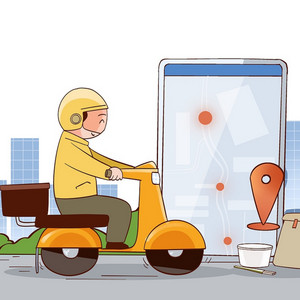
Food, medicine, groceries, if it fits on a scooter, is part of the great delivery war.
Tech titans, such as JD .com, and Alibaba, are storming into Maituan and Ulama's territory with blazing fast delivery promises and billion yuan subsidies.
but in a mature market where every minute counts who's fast enough and fierce enough to come out the winner.
Coming to you live from Beijing this is Roundtable.
I'm He Yang. For today's program I'm joined by Steve Hatherly and Yuxian first on today's show.
Behind the flurry of scooters and app notifications lies something bigger.
The essence of instant retail is quietly rewriting the relationship between people, goods, and the spaces where e -commerce happens in China.
What used to be a model of planned purchases and patient delivery has rapidly evolved into a system built for impulse, immediacy, and proximity.
As tech giants such as JD and Alibaba push into Meituan and Ullama's stronghold these are platforms that built their empires on food delivery and local services.
It's It's about a new infrastructure of urban life in China.
This is a war for your doorsteps, folks who live in China.
And no one wants to be left behind the delivery bag, holding the delivery bag, so to speak.
So what's happening in the delivery world in China right now?
I mean, let's look back at the past over 10 years.
China's food delivery market has already been a near dual poly of sorts that's dominated by Mei Tuan, which is a leading lifestyle platform here in China, and also Elemma, that's a delivery system owned by Tech Giant Alibaba or as I like to call them, the yellow one and the blue one.
Yes, as judged by their logo color, exactly.
And these two alone, they together controlled over 90 % of the market as of 2023 according to an industry analyzing report.
Meituan, the yellow one, grew its market share from 30 % in 2014 to over 65 % by 2023, and Ulama, the blue one, held around 33%.
The market itself ballooned to 1 .64 trillion yuan that roughly equals to 230 billion US dollars by 2024 and is projected to be nearly 2 trillion yuan or roughly 280 billion US dollars by 2027.
When we look at this whole market, we're talking about all of the deliveries sent out by the deliverers, or what we call the riders here in China because they're always on their e -bikes with a huge box containing the food that they're delivering.
These people, they're the freelance couriers or riders that's hired via third -party labor agencies with relatively less social benefits or protections due to the gig, we'll say part -time nature of this job.
So that's how it's like right now in China with the delivery market.
Yeah and there's a lot of pressure on these delivery drivers to do it quickly and they're under tight time schedules and when you live here in Beijing, and I'm sure this is true for other cities here in China as well.
You see these riders everywhere, every day, all the time.
They are constantly on the go.
You walk down the street you will see multiple riders delivering stuff, going into shops, coming out of shops.
If you're in the area of a shopping mall that has a lot of restaurants inside, you'll see multiple scooters parked outside from these delivery companies and the guys are coming in and out.
It's just such a big part of the culture here.
Yeah that's true. What's so astonishing lately is that there are new players entering this game.
So it's no longer just the yellow vs. blue, but there are more.
So recently, several tech giants that previously failed to take their share of the food delivery market are now staging a comeback and bringing big strategies with them.
well, one of which is Alibaba, which launched their Taobao Flash at the end of April, which is an instant retail service that's upgraded from its original service called Hourly Delivery.
That's my translation of it.
But they're trying to develop that delivery system into a better or higher functional one.
So it's not just about delivering food, but also offering short -time delivery on groceries electronics and daily necessities stuff like that and also the software is backed by the ulema system that's the delivery system of Alibaba that's already been running for over a decade and they're under the umbrella of the same company anyway so this new function via Taobao is now merging their original e -commerce business with the newly emerged instant delivery function they're trying to develop right now so that offers steep discounts and incentives to capture younger users.
Hey, we're out and we're pushing to towards you this new function.
So come use our coupons.
So the already competitive market just got more competitive.
Yes and also to offer you two small truths of the e -commerce world here in China.
One thing is here we're talking about instant delivery.
So the riders who bring the goods to your doorstep, like you guys mentioned, dressed in single color uniforms. And this is different from the longer time delivery, where you shop for all kinds of stuff on e -commerce platforms. Originally, these writers only delivered food, but in recent years it's expanded to medicine.
Anything like condiments.
For example you run out of soy sauce...
doing stir -fry for your dinner, you can immediately order it online and it can be delivered to your doorstep before the fire goes cold.
Yeah, that's one thing right?
You can get anything.
You can get medicine delivered from the pharmacy and they're there in in no time it feels.
The other thing that struck me as a difference from the other places that I've lived in the world is that you can get food or I assume anything delivered from anywhere in the city which is a tip if you've just moved and you're ordering food to in Beijing look how far away the restaurant is I thought I was ordering food from a restaurant that was maybe 20 minutes away this was this was two hours away on the other side of Beijing but I was still able to order that food and get it delivered to my house, that is impressive too.
So geographically speaking, there's not many boundaries either.
So also, for the delivery writers of this type of instant delivery, they are under even more pressure because the clock is literally constantly ticking and they need to deliver within like half an hour or less kind of thing.
But when we're talking about a bigger group of deliverers courier guys or women out there, then they have the quote -unquote luxury of delivering like within a couple of days or something.
Of course they want to deliver as many packages as possible, but the pressure is not as intense as this one.
And also one of the reasons why our delivery cost has been quite low is is that these, like you guys mentioned, these delivery writers, they are gig workers.
Although they're dressed in uniform.
So there's something kind of murky going on and this is a discussion that's been going on all around the world, it's like your Uber driver.
Like you know, how much corporate benefit should they enjoy?
How much corporate protection should they enjoy?
And here in China, this has been a constant battle of discussion for some years But judging by the amount we're paying in delivery fee delivery fees I don't think it's that much and this is a part that we can get into a bit further a bit later in the discussion But in recent months, actually, there's only been going on for almost a month JD calm or JD Jingdong has entered the chat and it wreaked havoc earlier or actually in the later part of February is that?
Something like that right?
In recent months. Yeah around the beginning of 2025.
Right. Exactly and then and most recently it is Tao Bao that is joining the chat as well so could you kind of walk us through this heated battle that's been going on in this world in the last few months?
So we just mentioned how the Taobao flash was launched in late April.
Just within 48 hours after it was launched, well Ullamah the delivery system that's based on the same company saw delivery orders reaching new highs across 13 cities, and one of the leading domestic coffee brands, the Cody coffee sales, just simply skyrocketed increasing 10 -fold in a single day and leading the platform's coffee sales.
And also, we just went through the Mayday holiday.
So during the five days holiday, the demand for discounted beverages, such as milk tea and coffee, soared by over 110 % comparing to the previous years.
And that is also fueled by limited -time promotions and the flash deals over the new delivery platforms as well.
Yeah, that's showing how popular and how successful it is.
But to get to what's going on within the companies themselves and what's changing and what's becoming different.
So JD, they launched their own takeout platform.
It was around the beginning of 2025 in February, and they are challenging the labor model that you were talking about, Hu Young.
They're doing that head -on.
So they promised, this is what they did, they promised to recruit 100 ,000 full -time couriers.
They offer social insurance, and that's a big deal because that's a significant shift away from the gig -based system that you were referencing.
They also claim it will cap platform profit at 5 % Versus May 2 on alleged eight to thirty percent.
So this is what's being done differently the newcomers They're shifting from gig to full -time models and this could potentially improve worker protections They're competing on logistics and supply chains and subsidies You mentioned before didn't you use on that?
It's not just food delivery anymore.
I mean it hasn't been for a long time in terms of the other items that you can order.
But still more diversification now.
And now they're bundling their services too, combining delivery with e -commerce and including that in their ecosystem.
So they're aggressively really targeting these new user segments.
They're targeting travelers, young consumers, and they're targeting smaller cities too.
And there's something you mentioned earlier that reminded me that, that's also from JD .com that I think by shifting from gig to full -time models they are really treating these riders as their employees.
One more evidence on that is that JD also announced that starting from March 1, 2025, it will gradually begin providing full social insurance and housing fund contributions for its full -time JD delivery riders, while offering accident and health insurance for part -time riders.
So there are coverage of what a proper employee should have for working for their company, and that's also including for the carriers of their delivery platform as well.
And interestingly, just after JD .com launched its delivery service and claimed to, you know, do all that for their deliverers.
MeiTuan, the yellow one, it also quickly announced it that in February it's working on a system to provide social insurance for all of its riders.
And in the meantime, they're starting to set up pilot zones all over China to carry it out in the following months.
I think they mentioned in the second quarter of this year.
So around that time, we're going to see more riders under the protection of their platforms. this is starting with JD Jing Dong.
It's really stepping up its game to protect its previously called gig workers.
And I remember when was it Lyft or Uber in the US?
When they came in front of court to argue their case in not providing full employee protection for its gig workers was that if they do, then their business model will break down.
They argue that because they employ gig workers who do not enjoy full -time employee status and benefits, that's how they make money or a huge part of it.
So this is hugely fascinating how Chinese delivery companies, or actually these are tech companies and delivery is only part of the business how they're doing this and I wonder whether the same kind of business model argument would hold water here and I wonder if of course we would love the workers to have better protection and benefit packages but would this mean that average users well you will need to pay more and now maybe they can argue oh there's the subsidies but we've all seen the subsidy wars with all these different online platforms for more than a decade it runs out after the initial
period and then you'll have to pay more.
You mean like the initial coupon offerings things like that?
Yeah like when Didi or Uber first started in China when all these delivery platforms first started in China and when shared bike platforms first started in China.
We've seen this. This is old story so okay well I wonder what's gonna happen ultimately on the users end.
Yeah well I mean from the users end you mean our end right the the average customers end.
For us, you could argue that it's going to be even more convenient than it already was because what they're doing now is they're fusing and we mentioned this already ecommerce with instant retail so it's not just food.
The big players They're merging these two worlds, real world retail with their deliveries and Taobao Flash, they're integrating fast delivery options directly into product listings.
And JD, they're promoting instant retail across its app, letting users order everything from snacks to smartphones for near instant arrival.
When we think of, I mean, I'm relatively new in the country, but I think it still applies.
When we think of these delivery drivers, we always think food, right, and that's probably the number one thing that they deliver on a daily basis.
We don't think, oh, I need a new smartphone.
I can have one in 15 minutes if I want to, right?
And do - well, Ashley and Trey, we'll kind of do - Oh, really?
Sorry to say that, but we kind of do.
In Canada we definitely don't think like that.
But that's what's going to be the more convenient aspect now is that it sounds to me like whatever However you want, that instant delivery will be available too.
Yeah. And talking about instant delivery, I think we were just having this chat earlier in the office as well, that instant delivery means that the courier, he or she, only has one mission.
That's to head to the shop or restaurant and pick up what is being delivered and head directly to the one who paid.
But nowadays, for most of the deliverers, they just, they receive tens, if not dozens of other orders at the same time and they go — say, a planned route to try to minimize the distance they go.
So comparing with that, the instant way of operating delivery system is perhaps a bit more costly.
And also, from my personal point of view, I see that these companies — these leading companies in China — Meituan, JD, or Alibaba, whoever — they're trying to — well, at least they're stepping out and they're willing to — at least, they're claiming to shoulder more responsibility and covering that extra cost. You can't raise your shelf tag value or price label simply because you're trying to cover more services and cover more instant trading on your platform.
You can't have your recipient pay more in order for you to be able to run these services.
So I would assume they are willing to cover these extra expenditures just so that their service is getting elevated in a way that's more popular to the general market.
And they're using this by integrating things that they already have. For example JD, they're using their integrated supply chain and their already existing rider network to help fulfill this ultra fast delivery promise.
And that can be as low as nine minutes the delivery time.
Taobao flash, they're tapping into Alibaba's consumer facing super apps like Taobao and Tmall and then route orders through their company's fulfillment network.
So each is using what they already have as their core strength to build a competitive advantage in this what we call last mile logistics battle.
And also, when you look at the big -name players and also the biggest one...
Meituan, right? Tencent, the huge tech company is behind Meituan, so now in China when you look at e -commerce and here instant delivery particularly, you can see that this is a mature market.
It's all the big players, the major tech industry players, they are behind these companies and to this point it's difficult to even fathom that a nobody little potato can grow out of the field anymore because everything so established and it's also interesting to see that YJD Jingdong who's also a huge tech company wants to get into this?
It knows that it's gonna sort of ruffle some wrong feathers and it's gonna start the dust. And you know when you look at the Chinese tech scene, the e -commerce scene, it's now maybe past the teenager growth period, it's now very mature.
So for me as a casual observer, I just find it to be interesting or like I don't work the industry but i just find it why now well because it's doing this it's a huge market i mean it's a massive massive market this is a 230 billion dollar industry in 2024 and they expect that to be a 280 billion dollar industry by 2027 i'm no expert business person but that seems like a pretty good reason to get involved in the market i would say true true but also i think you guys mentioned a very important point too because these companies they're also trying to break through from their traditional e -commerce
business model as well.
Like we mentioned how the JD and Alibaba, these companies they're facing market saturation already in their traditional track, which is e -commerce.
So why not breaking into this whole new body of water, this whole big consumer potential and just try out their luck again.
And it's also matching how the consumers are living nowadays, it matches with their lifestyle, in a way.
Because consumers nowadays, they use the delivery for everything, as we mentioned earlier, on the show many times.
We have this tendency of just calling a delivery for whatever we need, and thinking that it's very convenient to be paid online, so why not just get it delivered to you instead of going there to buy their stuff.
It's already in the younger consumers' mind that this is the...
This is the way it is.
Well, one major way to shop.
So yeah, there's this advantage that they can take.
You say it's new territory, we say it's new territory, but I wonder really how new this is because this is still part of e -commerce.
You make that order on an app via the internet, you pay and you get stuff delivered to the door.
It's just this time it's in a flash.
It is instant retail that is the sort of new battle that two new big players are coming and joining the battle.
It gives me the idea that previously, you have the image in your mind of just opening up an app on your phone, ordering something, and it'll be at your door in 45 minutes, but human beings are spoiled.
And 45 minutes, that's kind of the norm now, right?
Sometimes faster, if you're unlucky.
Sometimes a little slower.
Maybe bad weather, something like that.
But now, it's like, think about it like this.
3G, well 3G is amazing, wow.
This is cool. Oh this is not so good anymore.
Oh, but here comes 4G, here comes 5G.
Now 6G's, you know, on the way, in development or whatever.
It's kinda the same idea, I think.
So what was okay before, what was the standard before of 45 minutes 30 minutes whatever is now oh let's make it even faster and people will get used to that too.
It's just it's an attractive thing for customers I think.
Do we need it to arrive at your doorstep that fast?
Of course not but what how many how much stuff in our life do we not need but we love having?
Well because also we've talked about this that this is an established mature market and therefore every single type of consumer need is diversified it's being calculated it's been included into the algorithms and these big big tech companies they try to make smart decisions about therefore maybe it's when your you're still trying to finish stir -frying that dish and you know you want your soy sauce immediately you can use the instant delivery it's when let's Say an unfortunately touch wood had this home injury let's just say paper cuts and then I'm bleeding a little bit and I really need bandit.
Right now I use the instant delivery.
I think that makes sense but I'll give you a quick example.
The other night just a couple of days ago it was raining and my mom and I, well my mom came in the order, Ho Young, get some Alaskan shrimp and we can have that for dinner two days later.
And then I placed the order and guess what?
A fine nice super professional delivery guy had to rush in the rain to deliver that shrimp we need in three days time to our door in 30 minutes.
And I felt really bad for Why?
He wasn't doing you a favor.
It wasn't. But he, I didn't need that shrimp that fast, okay, am I just too charitable or whatever?
I now feel like, am I humanity completely wasted or something?
I don't know. But at the time, I just felt really bad because I wasn't looking at the rain out there, and I really don't need this that fast, and I wasn't expecting it to come this fast. But somebody had to go through the trouble.
Okay. I can't even finish now because I feel like I'm one of those show, you know, and I don't mean to be, I totally echo with you on that Huyang.
When it is rainy, like how it is today in Beijing.
I'm when it's and when it's windy, like how it used to last month in Beijing, I find it really hard to open those blue and yellow apps and just order things because I feel that it's not worth their sacrifice of rushing into the rain or the wind or whatever extreme weather it might be and just to get me food that I can perhaps just create for myself using ingredients in the kitchen.
And I don't allow, like you Huyang, like we don't allow what's manageable within our reach to get into the, say the whole system, but that is how this whole delivery system runs nowadays.
And regardless of weather condition or whatever, I think, yeah that's just how society moves on in a way.
And I wasn't even using one of the apps we're talking about today.
So I thought it was just a regular delivery app, but because the warehouse is so nearby and thanks to the algorithm all these riders riders are being did their timetable is dictated by the algorithm and because I suppose the warehouse is so nearby and therefore they have to make the delivery within 30 minutes or so otherwise you know I don't know if they get money deducted or they get a reprimand or something so it's sometimes you can't help but wander yes on the one hand, we're enjoying this superb, speedy delivery service where you can not enjoy anywhere else if you think differently, feel free
to challenge me, but it's only made possible in Chinese cities, especially the bigger cities where you have such an incredible millions and millions of population, this kind of population density, super fast internet, and this very established warehouse and tech infrastructure that we fully enjoy.
And I'm very grateful for that, but on the other hand, don't you wonder, are these delivery drivers just a cog in the machine?
Just think about the grueling hours, algorithmic pressures, and safety risks that are part of the job, and thankfully now JD and some of these other companies, can make it better.
Any final thoughts?
Crystal balling. How'd this go?
Just to echo what you just mentioned, I saw from Meituan that there are over 4 million riders on the system alone.
and according to their calculation over 60 % of these four million riders they see their salary earned through sending deliveries as their main income sources so judging from that and a lot of times we also hear that on special conditions or unfriendly weather cases they also receive bonuses.
Hopefully these can make you feel better.
This is their job And plus they're also receiving a little bit of extra money because of the rainy weather.
And it's gonna get more competitive, I think, because there's 535 million people in China that were using an online food delivery service as of June, I think that's from 2024, and that's an increase of 13 .7 million from the previous December.
That's only a six -month difference.
So, as there are more players in the game and as those players in the game try to do better to increase their service quality, then I think that's only going to attract more customers.
The market may become even more saturated, but that seems to be, again, going back to the numbers for the market size, $280 billion by 2027.
That's evidence there's going to be even more players, perhaps in the future.
And plus, as long as these companies, they're stirring up healthy competition among different platforms, then yeah, as long as it sparks innovation breakthroughs, that benefits their writers, their employees, and also the ones who...
Ones like us, who place the orders, then yeah, why not?
But do you know what I see for the future?
You made the decision...
Sorry, your mom made the decision, let's order some shrimp.
in the future I envisioned AI cameras in your home that will recognize that you need shrimp through technology it will contact the rider on your behalf and when you turn around in the kitchen you realize oh I need some shrimp there's a rider at your door here's your shrimp okay and that is the ultimate nightmare for Huyen but that could be a dream for Steve and like you guys said And more competition in the industry usually us as users, we benefit from it, and if you work in...
if you live in China, I think we can all sing the praises of those very positive consequences in the last decade.
But what I really like to see and I think we're seeing this going in that direction, that is, competition can also help the hard working people who are performing the service, and that's that's that's my wish for the day