This is Round Table.
Fast trains. Big gains.
But what about canals?
These man -made waterways are the slow, steady lifelines making a surprising comeback.
So why are we still building canals in the high -speed rail era?
And, from unforgettable tunes to life's little joys, we're spilling all the feels in Round Table's happy place.
Join us for our weekly dose of sunshine.
Coming to you live from Beijing, this is Round Table.
I'm He Yang. For today's program, I'm joined by Steve Hatherly and Yixian in the studio.
First on today's show, in an era where an extensive high -speed railway network offers significant travel options in China, you might wonder, have the ancient canals become a thing of the past?
Surprisingly, no. A new wave of canal construction is catching on.
From the Beijing -Hungzhou Grand Canal dating back to 486 B .C., to modern waterways, these water… well, channels, water channels, are making a strong comeback.
Canals continue to play a crucial role in economic growth and environmental balance, I would say.
So one canal that stands out in Chinese history is the Beijing -Hungzhou Grand Canal, or Jinghang Bao Yunhe.
We've all learned that in our history classes in Chinese middle schools.
A remarkable engineering feat with a rich story to tell.
And here to tell the story is Yixian.
Yes, thank you, Yixian.
Excuse me. So the Beijing -Hungzhou Grand Canal, it does have a very long history.
So the construction of this canal began, like you mentioned, Huoyang, in 486 B .C.
But it wasn't until the 7th century expansion that the canal was brought to the magnitude it's known for today.
As early as in the year 605, a 1 ,000 km canal was cut from Luoyang in central China's Hunan Province to Qingjiang, which is the nowadays Huayin District in the city of Huayang in South China's Jiangsu Province.
So three years later, 1 ,000 km were built on today… well, on to today's Beijing but not yet reaching.
And then in the year 610, another 400 km was cut from Zhejiang Province to the city of Hangzhou in East China.
That's the first step of gradually making the way to Hangzhou.
That is an incredible feat.
I mean, remember the years… we're not talking 2014 here.
We're talking the year 605.
So all of the construction equipment that we would have available to us today was not available obviously to them back in that year.
And it was a 1 ,000 km canal that was constructed at that time.
Good news to me. We can imagine how many people were manpower was put into that project.
And it took… well, according to report, it says here that there are over 3 million workers that's to join the construction of the canal.
And this is also according to the BBC report that almost half were died from the labor and the hunger during that time period, in the ancient time period.
And the canals' further facelifts, including a major intervention in the 13th century, took even more manpower.
So this is a turning point here.
So when Kublai Khan… I hope I'm pronouncing his name right.
When Kublai Khan founded the Yuan Dynasty and ruled in Beijing in the year 1271, it was no longer needed for a canal section to go to the previous capitals of the previous dynasty of Kaifeng or Luoyang in Hunan Province in central China.
So he ordered that the canal be made directly from Hangzhou all the way to Beijing in central eastern part of China.
So that's central northeastern part of China.
So that's how today's 1 ,794 kilometers canal is created from Beijing to Hangzhou.
What a history behind this.
And I guess back at that time of Kublai Khan, you know, so the capitals… Beijing was not always the capital area.
There were other capitals.
And I guess when he moved to this area, to this capital, where we are sitting right now, by the way, which is amazing, the history behind this, I guess part of that would have been the reasoning, you know, of the canal waterways to get food to people and trade and things like that.
That's really fascinating to me.
That's true. During the Ming and Qing dynasty after Yuan dynasty, this canal we're talking about, the one between Hangzhou and Beijing, actually played a very important role on shipping goods and also acting as some cultural and kind of like a military strategic protection of the city as well.
Yet after railroads took over in China in the late 19th century, the canal was kind of largely forgotten, with many sections fell into disrepair.
And then in 1958, the canal was restored.
Today, some sections, particularly in the south, are plied by barges, mostly transporting construction material, while others remain unused.
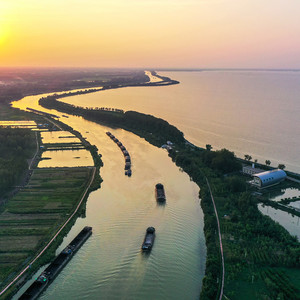
And while here in Beijing, at the very eastern side of Beijing, in Tongzhou district, there is this huge park called the, is it the canal part or the Beijing -Hongzhou Grand Canal Park?
That's, you know, the water is just there, it's no longer for any particular use.
But the environment around has been constructed as a public place for people just to hang out and enjoy the, you know, the natural environment.
That's amazing. So many stories, so much rich history here in this city.
Oh, definitely. And yeah, just one more thing.
By the end of 2020, China has more than 120 kilometers, sorry, 120 ,000 kilometers of navigable inland waterways, which marks the most extensive system of any other countries in the world.
So canals here in China not only have a long history, but they played a really important role and still do play an important role here in the country.
Yes, indeed. And for that 120 ,000 kilometers of navigable inland waterways, bear in mind, some of this waterway can carry large boats and vessels and some can only carry little boats.
So, you know, it's for different purposes.
And tell us why canals are back in the news.
Yeah, canals don't get a lot of love, do they, in the media?
You know, when we talk about high speed rail and things like this, but still very important.
Yeah. So why are we discussing canals?
Well, I believe that this is just to leverage the comparative advantages of water transport.
Well, water transportation to reduce logistic costs because water transport offers such benefits as some high capacity, low cost and reduced emissions as well comparing to other means such as the trains or say we're always talking about how much carbon emission the aircrafts are making these days.
So comparing with all that, water is a very low emission and green and sustainable way in logistics as well.
And it's also an economical and efficient outlet to the sea for the inland regions as well.
In so many ways, the canals, they connect the ports and also the coastal regions with the inland in such a subtle way that it just increases local connectivity and boosts economic growth and everything.
So canal in so many ways, it's irreplaceable.
Right. And there are some really eye catching major projects underway and that's catching people's attention aside from renovation and upgrading established canals such as the Beijing Hangzhou Grand Canal.
And we're also seeing the Jianghua Canal and also the Pinglu Canal are being constructed.
And we're talking about billions, hundreds of billions of yawn that goes into these kind of construction projects.
The country is investing a lot in the first three quarters of this year.
China's fixed asset investment in waterway infrastructure.
It exceeded one hundred and fifty billion yuan.
That's about twenty one billion US dollars.
They have projects like the ones that you mentioned.
And it's really, really important and people are excited about it as well.
Locally speaking, because beyond national canal projects, local governments as well, they're actively conducting research and feasibility studies on initiatives like the canals that you talked about in different parts of the country.
So it's on a larger scale, nationally speaking, but there is enthusiasm on a local scale, too.
Yes, indeed. And just to give you a little bit more, maybe geographic and strategic context of the big project of Pinglu Canal, this is going to become the transportation corridor connecting the southwest part of China to the ocean.
And that is definitely a big deal.
And why are canals still a key part of China's infrastructure in the high speed rail era?
Well, take the Pinglu Canal as an example, the completion of this Pinglu Canal, which is the transportation corridor connecting southwest China to the sea, will definitely shorten the distance for goods from Guangxi in southern China to reach the sea, which is a very important way for the locals to
revitalize the economy there regionally.
So from this, we can tell that canals under a modern context, it's still boosting portrait and promoting regional economic development in so many different ways, especially for smaller places and for the regions that remains inland and it's hard to get to the sea and do the trace.
This is really helping them in so many ways.
And water transport can offer a lot of different benefits, high capacity.
Right. You mentioned too young that some of these areas of these canals can only support smaller boats, but some can indeed support really large ships.
And those large ships, they carry a lot of containers and inside those containers are a lot of goods that can be transported at a cheaper cost.
That's another advantage of using water transport is that it's more cost efficient.
It's better for the environment.
In many cases, reduced emissions.
And also, as we touched upon, it provides some economical support and efficient outlets for the inner regions of the country.
And if we want to look at how cheap water transport can be, the estimates suggest that the average freight cost per ton kilometer per waterways is about a quarter for if you compare that to railways and one fifteenth that of highways.
Those are not close, right?
So it's a lot more cost effective.
If you use the northern section of Beijing Hangzhou Grand Canal as an example to transport goods to Shanghai, that can reduce costs by 70 to 80 percent.
That's a massive difference.
It is a lot. But with everything, there's sort of like two sides of the coin.
Of course. You've shed light on the bright side and the not so bright side is it takes forever in comparison, right?
Yeah, we don't have high we don't have a high speed shipping rail system.
No, wait, I didn't say that correctly, but you know what I mean.
Yeah, like with high speed rail, it's like more than 300 kilometers per hour of a speed it can travel.
And for canals, it usually takes days.
So I guess for cargo, for let's say grain and maybe equipment, you know, things that don't go bad in a matter of days, then with that significantly lower cost, as Steve, you have just told us, then it makes sense.
It absolutely makes sense.
And we talked about the power grid here in the country, right?
And I think we can draw a kind of comparison there comparing shipping raw materials from maybe the northern or western side of the country, shipping those raw materials over to the eastern side of the country and then creating the power there is not as efficient as creating these high power cables that can do
it quickly. It's kind of a similar comparison.
I don't know if it's a perfect comparison, but if we can get the goods to the destination faster, then oftentimes that's a benefit to everyone.
And shipping, as you mentioned, can be quite slow at times.
Well, building canals, I would imagine it's far more complex than simply digging waterways because it will involve constructing navigation hubs to overcome differences in water levels.
And here is some data from the Ping -Lu Canal we mentioned earlier.
So take Ping -Lu Canal as an example here.
It stretches 134 .2 kilometers with a total estimated investment of 72 .7 billion yuan.
And the project requires the excavation of nearly 340 million cubic meters of earth and rock and has an expected construction period of approximately 54 months.
Yeah, that's a major challenge.
Excavating 340 million cubic meters of earth and rock is no easy feat.
Right. And with these major constructions underway, it's only logical for researchers to do the studying and also to sort of try to project what impact it might have on the environment in the future.
And also for this kind of project to be in full swing.
Yeah, they do. You really need to have this kind of work done.
Yeah, they need to take ecological protection into consideration because canals primarily serve navigation and other functions like water supply and irrigation and flood control.
But ecological protection, you have to think about those things because protecting ecosystems during the canal construction, it's become a real challenge for developers.
And another thing that is a challenge for the developers, too, is that they have to overcome differences in water levels.
Not everything is equal and even in all parts of the country.
So this type of construction project is a serious challenge for the people who are for the people who are doing it.
And we're talking about construction in 2024.
Going back to the history of that 1 ,000 kilometer canal.
Imagine that. These people were doing that at that time without the help of technology or anything, which makes it all the more impressive.
Construction is still difficult these days.
In those days, they would have had the similar problems and challenges, but without the help of anything impressive to help them.
No AI for sure. No AI at that time.
Yeah. And it's interesting whenever we evaluate or when we're in awe of these ancient sort of humanity, you know, outstanding achievements, you can't look at it without the historic context.
It's like when you look at, let's say, the construction of the Great Pyramids in Egypt or the Great Wall or the Great Canal in China, the Beijing, Hangzhou Grand Canal.
Some say that it's only in a feudal society when the imperial emperor or a major king rules and the human rights of a basic person or of the citizen is really, you know, that was a concept that hasn't been conjured up yet in back in ancient history.
People's well -being.
That was not the top consideration for sure.
And then it was in those eras when these sort of jaw -dropping achievements can be done.
And today, well, we have labor rights protection laws and also we have all this technology in some place which can help to get on board with these kind of really quite magnificent projects.
And talking about the environment, you know, maybe at that time in the year 600, protecting the environment during the construction of the canal, maybe that was not on the top of the priority list as well.
But these are things that need to be considered these days.
You know, we talked about the 340 million cubic meters of earth and rock that needs to get dug up.
Well, where does that go?
Well, to be honest, here is a really smart way that I found that they're dealing with those earth and rocks.
So the excavated earth and rock are increasingly used for land reclamation, coastal land creation and the production of green building materials.
There was once a time when, well, on round table, there's this topic about like construction site waste, how to transport construction.
I think this is something similar.
They're reusing that earth and rock dug up in order to build the canal and then putting that somewhere else to build like coastal land or just building into green materials.
I don't know why it reminds me of this, but you know, that cosmetic procedure when you want to have lip filler and you take fat from a different part of your body and then inject it into your lips kind of the same thing.
They take the rock and earth that they dig up here and just put it somewhere else so they can put it to good use and it doesn't go to waste.
That's a very strange analogy I acknowledge, especially now that I've said the words out loud.
But I still think it's apt somehow.
Somehow it does. Yeah.
And it's still kind of baffling for some people looking at this.
When when you look at around the world, it's been almost 100 years that people tend to put the canals concept aside and they've moved on to newer, brighter, shiny things such as the high speed rail in China.
And can I please remind you that according to data from the official website of China National Railway Group, China's total railway operating mileage has exceeded 160 ,000 kilometers with high speed rail accounting for over 46 ,000 kilometers.
And from January to October this year, the total number of railway passenger trips nationwide reached three point seven billion.
And that is a 13 percent year on year increase.
And that we're talking about transporting people.
Yeah. And of course cargo as well.
But people and for canals, I doubt that they'd be transporting people.
Right. Yeah. Not not so much.
But you're you're right.
You know, high speed rail is not only impressive, but it's becoming it's almost everywhere here in the country now.
Right. Maybe maybe outshining canals, perhaps we could argue.
But canals still play a really important role here in the country economically speaking.
And in other parts of the world as well, you know, they're not being ignored.
A famous one that everybody knows about is the Panama Canal that went underwent a pretty significant expansion that was only completed in in June of 2016, not the canal itself.
That was completed a long time ago.
But the expansion was created completed only a few years ago.
They put a new lane of traffic through the construction of a new set of locks, and it doubled the canal's capacity.
So it's not like canals are being forgotten for sure.
They still play a seriously important role.
Yeah. And I think at least here in China, the government is also investing more in expanding in expanding canals, such as the Beijing Hondo Grand Canal as well.
So, yeah, there's definitely still maintenance and expansions going on there for at least for the construction, maintaining in the, you know, the operating of these canals here.
Yeah. And if we think about, you know, the shipping system as kind of a hybrid system and again, to compare it to the power conversation that we had about the big giant cables here in in China, they have AC lines and DC lines and you can't just have AC lines and you can't just have DC lines.
So they figured out this hybrid AC DC.
Somebody going to start singing.
No, don't get us in copyright trouble.
But it's a hybrid system and it's kind of the same with shipping, right?
I mean, it's wonderful to have rail, but it's also wonderful to have these canals for shipping, too, working together.
Right. And also in 2024, we can see high speed rail networks have become more and more established and there's limited space for or maybe there needs a new direction for large scale construction because we know that with these huge construction projects, they will need a lot of I'm not sure cement is the right thing
to talk about here, but definitely it sort of lifts many of the construction industry and water transportation remains underutilized in the national logistics network, which points to a need for maybe new infrastructure directions and expanding water routes offers a way to further strengthen the country's
infrastructure and logistics capacity.
And that's complementing existing rail and road systems.
Yeah, exactly. And I think that's kind of what we're looking at at the future of canals here in China is that they will further integrate with other transportation systems so that they can really complement each other.
They'll improve the connectivity between ports and inland regions and then canals.
They'll contribute to sustainable growth by offering low emission transport options.
We mentioned that's one of the big benefits and they will also help to meet China's environmental goals.
And if we look at, you know, where the history was for canals in China and we compare it to where we are now, I think historically speaking, having those roots and having that knowledge and then embracing modern technology as well, then that'll make canals not only important to the country, but indispensable,
you might argue. Yeah, that is something really nice because, well, it's what I believe too.
That is why that canals are still what remain to be an important part of China's logistic and economic framework here because it is an alternative to road and rail systems.
And when to places that the high speed trains cannot reach, here are the canals.
So while canals may not be the most visible or fastest form of transport in China today, they remain a vital part of the country's broader transportation network.
And that's, you know, you hear these discussions nowhere else but on Roundtable and we keep you updated on all these things that's happening in China.