Get the unmissable news stories of the day This is the Beijing Hour Examining the events that impact and shape China and the rest of the world.
This is the Beijing Hour, one hour of news and information brought to you every weekday Now here's your host, Shane Bigham, with you on this Thursday, August 21st, 2025.
You're listening to The Beijing Hour, coming to you live from the Chinese capital.
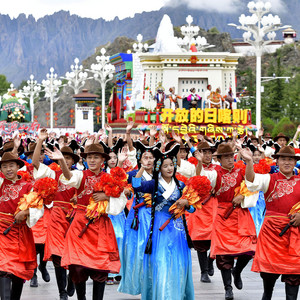
On today's program, China celebrated the 60th founding anniversary of the Shizhong region. with the country's leader attending a celebration in Lhasa.
The foreign ministers of China, Afghanistan and Pakistan have reached a deal on cooperation during their dialogue in Kabul.
And the Israeli military is calling up tens of thousands of reservists as it prepares to take control of Gaza City. in business, Hainan Free Trade Port's new pilot program for cross-border asset management.
Today we have a part five of our special series, The Unyielding East, China's World War II Relics. a collection of stories about the nation and its people that stood their ground against fascism.
Today we bring you to the former home of a commander who was seriously injured when fighting in a critical battle.
Now the day's top stories. China celebrated the 60th founding anniversary of Shizhong Autonomous Region in the southwest.
Chinese President Xi Jinping attended an event at the Petala Palace Square in Lhasa, along with around 20,000 people.
Chairman Wang Huning of the National Committee of the Chinese People's Political Consultative Conference and head of the central government delegation delivered a speech.
He said over the past six decades, the highland region, also known as Tibet, has made significant strides in economic and social development. demonstrating the strong leadership of the Communist Party of China and the clear political strength of China's socialist system.
Wang called for renewed efforts to foster a strong sense of community for the Chinese nation and advanced the four main tasks for governing Shizhong. namely ensuring stability, facilitating development, protecting the environment, and strengthening frontiers.
Zhang Yibing has more. Some 20,000 people gathered in part of the palace square for the grand ceremony marking the 60th anniversary of the Cezanne Autonomous Region.
Chinese President Xi Jinping led a central dedication to the event, underscoring the strong commitment to Xizang. and central government's sincere care for cadres and people of all ethnic groups in the region.
The people of Tibet, who have made progress in their development, The congratulatory letter was read, celebrating six decades of remarkable development and prosperity in Xizang. and expressing good wishes for even greater achievements ahead.
Wang Huning, Chairman of the National Committee of the Chinese People's Political Consultative Conference and the Head of the Central Delegation, presented a commemorative plaque to the region and delivered a speech.
An official from the Cezanne autonomous region expressed heartfelt gratitude to the central government, along with firm confidence in the region's continued development.
A representative of the region also made speech during the event.
For myself, I experienced the whole historical transition, the shaked of the feudal serfdom and people became the masters of their own.
And the change of my own destiny. Also, that's the picture of that's the reborn of the whole season.
Not long after the founding of the autonomous region, with the support and care of the party and the government, I asked myself wishes become announcer.
From then, I always full of passion the special care given by the Party Central Committee and also to spread the stories. that the Party Central Committee bring the happiness and sweetness to tens of thousands of households in Shenzhen.
Later, a spectacular float parade took place along the main street in Lhasa.
The floats showcased achievements and developments made across Xizhan's seven prefecture levels and administrative areas.
Now we see comprehensive strategy from the central government that focuses on stability, development, ecology and border area consolidation.
It is believed that the season will continue to have steady progress as well as tangible benefits for people.
That was Zhang Yibing reporting. President Xi Jinping, also General Secretary of the Communist Party of China Central Committee, arrived in Lhasa on Wednesday.
He listened to a work report from the regional party committee and government, urging the region to advance high quality development based on local conditions.
He also called on local authorities to build a modern socialist Shizhong that's united, prosperous, and beautiful.
President Xi met representatives from all sectors and encouraged them to work together to achieve the goals of Chinese-style modernization on the plateau.
He also attended a gala entitled Joyful Songs of the Snowy Plateau Region.
In the first half of 2025, Shizhong continued to lead China's economic growth with a 7.2% increase in GDP which was nearly two percentage points higher than the national average.
The autonomous region's on track to stay in the leading position for a third consecutive year.
The southwestern highland is also experiencing strong growth momentum in incomes, industry and agriculture.
In 2024, the added value of surveyed industrial enterprises grew nearly 18%, while agricultural output was up over 11%.
Per capita disposable income of all residents rose by 8%.
And all were significantly above the national average.
The population has more than tripled from the 1950s to 3.7 million in 2024. and life expectancy has risen from around 68 years in 2010 to around 72 years in 2020.
Over the past decade, Shenzhen's total road length has doubled to 125,000 kilometers. and every town and township is now covered by the 5G wireless network with 2 million 5G mobile phone users.
These economic achievements are not at the expense of the environment.
In 2024, clean energy sources powered more than 99% of electricity in the region.
In the meantime, tourism revenue is also rising.
It jumped more than 14% last year to around 75 billion yuan, or over 10 billion US dollars.
And for more, Do Hongyu spoke with Joseph Mahoney, professor of politics at East China Normal University.
Professor, given that Shizong's GDP has grown 155 times since 1965, far exceeding global averages.
What are the key factors behind this economic growth in such a challenging high altitude environment?
Well, the biggest factor is that before liberation, Qijiang was governed by arguably the most retrograde, theocratic, feudal regime produced in history.
Now, it's certainly the case that traditional Tibetan culture has certainly made significant contributions to Chinese civilization.
And likewise, those of other countries, including Mongolia.
But its futile political economy was determined to stay stuck in time. but in a time dating back centuries ago.
And with the consequence that the people there lived very short, poor lives, and ignorant lives.
Now, when Xicheng was liberated, when feudalism gave way to Chinese socialism, the potential for rapid change was even greater than what we saw in the rest of China, insomuch as Xizhong was that much further behind. as we saw China accelerating its development, including its domestic STEM capabilities, as we saw the accumulation of capital, technology, and know-how from the rest of the nation being leveraged into, brought into Xizhong to accelerate development, that's when we really began to see things take off.
Now, one of the things that we know is that before liberation, life expectancy was around 35 years of age.
Today, it exceeds 72 years of age in Zhejiang, a number that is expected to continue to climb towards the Chinese national average. of 78.
Another problem historically was the lack of education.
Prior to liberation, the illiteracy rate was 95%, one of the worst in the world.
Now, through a long struggle, that number has now declined to less than 30%, still the highest rate in China, given the national average of less than 3%. but it's still trending downward given the continuous improvements in access to quality education resources that the central government and local authorities continue to prioritize.
Apart from the economic growth and the improvements of living conditions and education, Shizong is also a crucial ecological zone for Asia.
How does China's development strategy for the region balance rampant economic growth with environmental protection and sustainable practices?
Well, first, we have to note that the Qinghai Tibetan Plateau consists of approximately 25% of China's territory.
Now, there are some critics who argue from a pastoralist position that these areas should not be developed at all.
But this is not realistic, above all given the challenges of desertification and the growing risks of extreme weather in the coastal regions that we see in other parts of China due to climate change.
Furthermore, these areas on the plateau, they want to develop.
The people want to experience development.
They want to see improved livelihoods and prospects.
They want to live longer. healthier, more enriched lives.
Of course this must be done in sustainable ways.
The environment must be protected. So we see that the plateau has been mapped according to different zones.
For example, more than 88% of the plateau is designated as ecological security and pastoral zones where significant development does not take place.
Ecologically sustainable development takes place in the agricultural and urbanized zones.
But again, it has to remain green because it's important to note that the plateau is a vital ecological barrier one that is providing substantial ecological benefits and protections to the broader region, and it's imperative that these be protected unless we can't, if we begin to develop Tibet or Xizhang in irresponsible ways, not only would it destroy the local environment, it would have ramifications for the broader region, certainly in the rest of China.
That was Professor Joseph Mahoney talking about the economic and social development of Shizhong over the past decades.
Rapeseed oil is the lifeblood of Tibetan farmers in the city of Shigatsep, helping them to turn golden crops into sustainable income.
Each bottle supports Highland communities, creating jobs and keeping agricultural traditions alive.
Zhang Shijie spoke with a staff member at a local food and oil processing factory to learn more.
When you think of Xizang in China, what comes to mind first?
High altitude, snow-capped mountains, or Tibetan cultures?
Here in Shigei's, a special and unique fragrance is leading the locals towards prosperity and poverty alleviation.
Seasons high altitude, cold climate and long hours of sunshine neutral many unique and precious gifts of nature.
Every July, the ripseed flowers in Shigei's reach full bloom.
The Tibetan ripseed oil produced here, a treasure born of this land, has won the hearts of consumers both at home and abroad, thanks to its exceptional nutritional value.
Tibetan rapeseed oil benefits from Zizing's unique geography, which provides a natural advantage.
The oil is highly nutritious, helps with blood circulation, and is good for eye and vision protection.
We mainly sell it across Zhejiang, as well as in Beijing, Chengdu, Zhejiang, Since 2017, Shigesu in Seaside has adopted a company plus space plus farmer business model to boost local farmers' incomes.
We follow a company plus base plus farmer model.
We have leased 66 acres of land in Kutsong village 553 households.
Their annual income has increased by 3,850 yuan.
We purchase raw materials through bulk order agreements across the region, which boosts the income of local farmers and herders.
Turning these local specialties into thriving industries wouldn't be possible without support from all sides.
In 2017, the government introduced a poverty alleviation loan program worth 7.42 million yuan.
Following the requirements of the Samdrops District Industrial Poverty Alleviation Project at the time, From 2018 to 2023, we distributed dividends to 316 people unable to work and 12 near-poor households, boosting the income of local farmers and impoverished families.
Additionally, we enrolled 72 registered poverty alleviated households.
319 people from NAR Township as shareholders through capital investment.
Each year, the company distributes 28,530 yuan in dividends to them.
Pabu Sidhar, who has worked at the company for 10 years, shared how things have changed between now and a decade ago.
We used to have only one oil press, but we later upgraded to semi-automatic production and added six more oil presses.
The factory began operations at the end of last year with all processes now fully automated.
Living conditions have improved significantly, we've renovated our homes, and at the end of the year, we receive bonuses.
The company covers all social insurance and housing fund contributions, For Tibetan people, ripseed oil is more than just a kitchen essential.
It drives local economy and preserves cultural heritage.
Each drop reflects the plateau's purity and people's wisdom, shaped by the region's unique climate and traditional methods.
That was Zheng Shijie in Shizhong. Coming up, China, Afghanistan, and Pakistan reach a deal on strengthening cooperation.
On the roof of the world, a quiet miracle has unfolded.
A sisa marks 60 years as an autonomous region and China completes its 14 five-year plan.
CGTN journeys across the plateau to witness change.
From snow-capped peaks to modern railways, from ancient traditions to vibrant new schools, Xizang's story is one of resilience, harmony and hope.
Once isolated, now connected. Once impoverished, now thriving.
Shizong is a symbol of China's modernization and sustainable progress.
Join CGTN as we tell the story of a land transformed, where the future rises as high as the mountains that hold it.
Witness the ascent only on CGTN. 15 minutes past the hour.
Foreign ministers of China, Afghanistan and Pakistan. have agreed to strengthen cooperation and jointly boost regional peace, stability, and prosperity.
The agreement came following the six trilateral foreign ministers' dialogue in Kabul.
Chinese Foreign Minister Wang Yi urged the three countries to expand trade and investment. and boost interconnectivity and people-to-people exchanges.
He also called for joint efforts against terrorism.
Afghan Foreign Minister Amir Khan-Mataki expressed hope to deepen friendship with China and Pakistan and further boost trilateral cooperation.
Pakistani Foreign Minister Ishaq Dar called on the three sides to further advance trade and Belt and Road interconnectivity.
He also urged joint efforts against terrorism to achieve common development.
Meantime, Afghan Prime Minister Mullah Mohammad Hassan Akhund vowed that his country will not allow any force to use his territory to threaten China.
Akund thanked China for speaking up for Afghanistan on the international stage and said China is a force for justice in the world.
He said Afghanistan looks forward to strengthening cooperation with China.
Wang Yi said China's respected the choice of the Afghan people and consistently adhered to the principle. of non-interference in internal affairs.
He added China will continue to uphold justice, oppose unilateral bullying, and cooperate with Afghanistan in various fields.
The Chinese foreign minister has been on a visit to South Asia that also includes India and Pakistan.
Earlier in India, Beijing and New Delhi stressed that they're partners and not rivals.
The Afghan deputy minister of foreign affairs says Kabul remains committed to expanding diplomatic relations with Beijing.
During an interview with Zamarli Lai Abassin, Mohamed Abbas Tenkazai also called for more cooperation in various fields.
You better know that Afghanistan and China have had a relationship for centuries and even more than a thousand years ago.
We've had positive and historical relations with each other for a very long period of time.
We also had a historical transit path known as the Silk Road, which passed through Afghanistan and headed to China and has historical value. years ago, after the Chinese Communist Revolution led by Mao Zedong and a new system was established in China,
Afghanistan was one of the first countries that recognized the new Chinese Republic, and we've had positive relations with China since then.
Meanwhile, as you know, Afghanistan has a 90 to 95 kilometer border with China along the Wakhan Corridor and Pamir Mountains.
We've had positive relations with China throughout history, and we are two neighboring countries that have had no border skirmishes or other conflicts with each other, certainly.
Afghanistan has had conflicts with its other neighbors throughout history, but it has never had any issue with China.
The 70 year long ties between the countries have been very close and remarkably historical.
Before long, China politically supported Afghanistan during the invasion by the Soviet Union.
It has also supported Afghanistan politically against the US invasion and has played a positive role during this period.
We visited China several times and exchanged views with the Chinese side because China was also against the US invasion and we were the same currently since the return of the Islamic Emirates of Afghanistan the state of relations are even better China and Afghanistan are much closer now.
The Afghan embassy is open in Beijing, and the Chinese embassy is also actively open in Kabul.
Additionally, both countries have cultural, economic and political ties that have reached an even more positive era in comparison with the past.
If God is willing, we remain committed to expanding our diplomatic relations.
China is one of the largest countries that has tremendous technical, economic, political and military capacity.
We're trying to learn from their experiences and also provide opportunities for our academics and professionals to visit China and upgrade their knowledge.
Meanwhile, we urge China to cooperate with us in every aspect because it's a highly developed country.
That was Mohammad Abbas Stanekzai, the Afghan Deputy Minister of Foreign Affairs on China-Afghanistan relations.
Now for our special series, Resolve and Resilience, the main eastern battlefield of World War II.
And today we focus on the Battle of West Hunan. a major engagement of the Chinese people's war resistance against Japanese aggression.
This battle marked a pivotal turning point where Chinese forces transitioned from strategic defense to full-scale offense, paving the way for Japan's ultimate surrender.
Xu Hua spoke with war veterans and historians in the central province to find out more.
The sun on the west side is about to set.
98-year-old Zhou Guangyuan still vividly remembers August 21, 1945, The day when China received Japan's surrender document after the 14-year war of resistance.
This document also marked the first Japan ever signed in the Second World War.
The turning point began months earlier. On April 9, 1945, Japan launched a 100,000 troop attack from three directions into western Hunan.
Their goals were to capture Zhejiang Airport and control regional railroads, potentially opening a path to Chongqing, China's wartime capital. to force China's collapse.
China, however, was well prepared. Under General He Yingqin's command, a 200,000 strong defensive force had been assembled. and stood ready to engage the invaders in what was later known as the Battle of West Hunan.
From the skies, the Japanese advance was relentlessly pounded by solo American air sorties based at Zhujian.
This air power was a key deterrent against the Japanese expansion after the attack. on Pearl Harbor in December 1941.
Amid the crossfire in western Hunan, soldier Zhou Guangyuan had one critical mission.
Our combat mission was to protect a three-member U.S. military team stationed in the Xiefeng Mountains.
This American team directed precision Allied airstrikes against Japanese forces using field radios and signal panels.
At that time, American and Chinese air forces fought side by side.
During the campaign they jointly conducted 3,100 sorties, dealing a devastating blow to the Japanese invaders.
On the ground, the Japanese offensive was met with determined resistance from Chinese troops.
One of the fiercest battles occurred in Jiangkou town.
Right here in Jiankou Town, on May 1, 1945, an assault by Japan's 133rd Division met the Chinese army's firestorm.
The fiercest fighting occurred on May 5th That night, the Japanese launched eight assaults but failed.
By dawn on May 8th, the Japanese forces had fully retreated.
This battle resulted in the elimination of over 3,500 Japanese soldiers.
From May 8th onward, Chinese forces pressed a full-scale counteroffensive By June 7th, they scored a decisive victory in the Battle of Guest 3-9.
This battle along the Shefeng Mountains successfully defended the Zhejiang Airport safeguarded Chongqing, inflicted heavy losses on the Japanese invaders and ultimately accelerated Japan's unconditional surrender.
On August 15, 1945, Japan announced its unconditional surrender.
Six days later, envoy Takeo Imai flew to Zhejiang Hunan, submitting military maps and signing surrender terms.
On September 9, 1945, the ceremony for the surrender of the invading Japanese forces in the China Theater was held in Nanjing.
Decades on, the sounds of children now carry no echoes of war. of invasion in western Hunan is replaced by bullied trains and bustling streets.
This hard-won peace forged through global solidarity remains a shared treasure of all humanity.
That was Shu Hua reporting. During 14 years of fierce fighting, China killed, wounded, or captured over 1.5 million Japanese soldiers. accounting for 70% of Japan's total military casualties in World War II.
After Japan's defeat, nearly 1.3 million Japanese troops surrendered in China.
China's military and civilians made a national sacrifice of over 35 million casualties. and they were a major contributor to the victory in the world anti-fascist war.
Coming up, the Israeli military has approved the first steps in its plans to seize control of Gaza City.
United in purpose during World War II. the Chinese military and people stood as one, fearlessly resisting Japanese fascism.
China's unwavering whole-nation effort forged the pivotal Eastern Front.
Through fierce battles, immense sacrifices heroic endurance and decisive support to the allies on the european and pacific battlefields China has helped secure liberation, the final victory and the lasting legacy for global peace and human progress.
Resolve and Resilience, the main eastern battlefield of World War II, only on CGTN.
At 25 past the hour, the Israeli military has approved the first steps of an operation to take over Gaza City. and called up around 60,000 reservists.
Wednesday's announcement came even as Israel considers a new ceasefire proposal to pause nearly... two years of its brutal assault, which Gaza authorities say has killed over 60,000 Palestinians.
Hamas says Israel's decision shows blatant disregard for its efforts to achieve peace and secure the release of Israeli hostages. despite international and domestic pressure.
Jonathan Mergev has more. headline coming out of there is that the operation in Gaza has basically begun.
It is not very surprising, as we've heard reports in the last few days or so. that there have been operations beginning in the southern part of the Gaza City neighborhoods, such as Zeytun and Sabra, which are on the southern side. of Gaza City, and another operation began in the neighborhood of Jabalia, which is on the northern outskirts of Gaza City.
The city itself, we have to understand, is bordered to the east.
It almost makes it to the Israeli border on the east.
Mediterranean Sea on the west. That means that if you take over the southern and the northern part of the city, you basically... have the city on siege and that is essentially what has happened and this was a confirmed by the IDF spokesperson in his statement, also confirming the IDF spokesperson That's some 60,000 warrants, what is known here in Israel as Warrant 8, meaning a call-up for reservists. have been handed out.
The first reservists will arrive to duty in early September in about Two weeks from now, that is right when the summer vacation is over, when the school year begins. but essentially the operation, at least in its early stages, has already begun with the takeover of the southern and the northern outskirts of of Gaza City, all this before the final plans have even been presented to the prime minister and the world cabinet.
That was Jonathan Regev reporting. More countries have expressed opposition to the escalation of Israel's military operation in Gaza, French President Emmanuel Macron warned that the planned Israeli military offensive will drag the region into a permanent war.
He called for the deployment of an international stabilization mission for the enclave.
A German deputy government spokesperson, Stefan Mayer, slammed Israel's plan to occupy Gaza City. calling for an immediate and lasting ceasefire.
Jordanian Foreign Minister Eamon Safadi said Israel's assault on Gaza's caused a massacre. and starvation and further actions are killing all prospects for peace in the Middle East.
He said the Palestinians' legitimate rights and interests should be safeguarded. and Palestinians who have been starved, attacked, and displaced multiple times since the conflict began in October 2023. have expressed fears and frustration over what they consider Israel's catastrophic plans to take control of Gaza City.
Ahmad Alfara also expressed hope for an end of the conflict.
We are now in a phase where we're listening and hoping for a truce, for a deal to be agreed on and end all this.
We are now suffering more than before. Our youth in these current conditions are being martyred every day in dozens.
No one cares about us. People, we just want this humiliation to end.
This war has eaten into us. We are a people who can't handle anymore.
You're listening to the Beijing Hour. We're at 29 past.
Now checking the forecast ahead of the break.
Beijing is getting moderate rainfall and 24 degrees on Thursday evening. with a high of 30 tomorrow.
Shenyang gets torrential rainfall in 24 overnight, followed by thundershowers in 30.
Nanchang's down to 28, then cloudy in 35.
Kunming's 18 overnight, heavy rainfall in 20 on Friday.
Elsewhere, Islamabad's down to 24 degrees, then a slight rain in 32.
Vientiane's at 24 overnight, followed by some rain and 29.
It's time for a short break. So far this hour, China celebrated the 60th founding anniversary of the Shizhong region, with the country's leader attending a celebration in Lhasa.
The foreign ministers of China, Afghanistan and Pakistan have reached a deal on cooperation during their dialogue in Kabul.
And the Israeli military is calling up tens of thousands of reservists as it prepares to take control of Gaza City.
Shane Begum with you. Stay with us here on The Beijing Hour.
Listen up. Can you hear the heartbeat of our world? it's vibrant and pulsating with the essence of life itself from the stem of trees to the gurgle of rivers, from the silent strength of mountains to the icy whispers of glaciers. even the solid ground beneath our feet.
Right there, in the midst of all, beats the heart of humanity.
What if those other heartbeats were to stop?
Would ours keep on ticking? Ever wondered what's actually going on in Africa through the perspective of an African?
How are things really going between China and Africa?
What's the narrative of this relationship?
Well, get a perspective with China Africa Talk.
Hear from African diplomats, entrepreneurs, academics, Chinese natives, and more.
Get on our wavelength every week. To find out what's real with China Africa Talk, find us on your favorite podcast.
We'll see you there. Examining the events that impact and shape China and the rest of the world.
This is the Beijing Hour, one hour of news and information brought to you every weekday Now here's your host, Shane Bigham, with you on this Thursday.
Still to come, in business, Hynan Free Trade Port's new pilot program for cross-border asset management.
And today we have part five of our special series, The Unyielding East, China's World War II Relics, a collection of stories about the nation and its people stood their ground against fascism.
And today we bring you to the former home of a commander who was seriously injured when fighting in a critical battle.
To contact us, you can email radio at cgtn.com or follow our X account at cgtnradio.
First, checking the day's headlines, here's Tianlu.
Thank you, Shane. China has held a grand gathering to celebrate the 60th founding anniversary of Shenzhen Autonomous Region.
Chinese President Xi Jinping attended the event at Potala Palace Square in Lhasa, along with around 20,000 people.
Highlights included a public parade to showcase the achievements of the region, also known as Tibet over the past six decades.
President Xi, also General Secretary of the Communist Party of China Central Committee, arrived in Lhasa on Wednesday for the celebration.
He listened to a work report from the regional party committee and government, urging the region to advance high-quality development based on local conditions.
NATO military leaders have met to discuss the situation in Ukraine following the meeting between US President Donald Trump and Russian President Vladimir Putin in Alaska.
At a video conference on Wednesday, U.S.
Air Force General Alexis Grinkovich, who oversees NATO operations in Europe, briefed the defense ministers on the Alaska summit.
Concerns have emerged in Kyiv and across Europe that Trump might push Ukraine into accepting a deal on Russia's terms.
But Washington pledged the U.S. will continue to provide security guarantees to Ukraine.
Sources say Ukraine's security guarantees were not on the main session agenda.
Russian Foreign Minister Sergei Lavrov has warned discussing Ukraine's security without considering Moscow is pointless.
We cannot agree with the fact that it is now proposed to resolve collective security issues without Russia.
This will not work. We have already explained more than once that Russia does not exaggerate its interests, but we will ensure our legitimate interests firmly and harshly.
And I am sure that the West and above all the United States understands perfectly well that seriously discussing security issues without the Russian Federation is a utopia.
Lavrov also criticized the EU for trying to shift U.S. policy and drag Washington deeper into the conflict. by using Ukraine as a tool to contain Russia, and the possibility of a trilateral meeting with Ukraine Lavrov said Russia is ready to engage in negotiations in various formats.
But he added any high-level meeting must be carefully prepared. to avoid further escalation.
The US military has announced the deployment of warships carrying 4,500 sailors and marines for undisclosed missions abroad.
However, US media reports say these forces are headed to the Southern Caribbean with their sights on disrupting Latin American drug cartels.
Critics warn the action risks sparking regional tensions.
Wildfires fuelled by extreme heat and strong winds continue to ravage Spain and neighbouring Portugal.
In Spain, four people have died, thousands have evacuated communities and more than 3,800 square kilometres have burned. the largest area since 2006.
Prime Minister Pedro Sanchez warned that the country remains at a critical stage.
The two Iberian nations have deployed thousands of firefighters and military units and have requested more EU support.
Spanish police have also detained 32 suspected arsonists.
Portugal remains on nationwide alert after fires in the western and central regions killed three people and scorched over 2,000 square kilometres of land.
Denmark will abolish a 25% sales tax on books to encourage more reading.
The country's culture minister says the move aims to combat a reading crisis, as data shows a quarter of Danish 15-year-olds cannot understand a simple text.
The measure is expected to cost about 330 million kroner or 52 million US dollars a year.
Denmark's 25% VAT on books is one of the highest in the world. very much that was etienne lee with headlines coming up in business highland free trade ports new pilot program for cross-border asset management The Beijing Hour, your window on China and the rest of the world.
36 past the hour, and with Business Now, here's Wang Zihang.
Thank you, Shane. Chinese stocks closed mixed on Thursday, with the benchmark Shanghai Composite Index up by over 0.1%. the Shenzhen Component Index closed almost flat.
Stocks related to stablecoin, oil and gas, and aesthetic nursing led the gainers.
Elsewhere in China, the Hong Kong stock market ended lower, with the Hang Seng index down by over 0.2%.
Meantime, stocks in Japan extended their losing streak, pressured by weakness in exporters and pharmaceutical stocks. the Nikkei fell by more than 0.6%.
Authorities have launched a pilot program for cross-border asset management in Hainan Free Trade Port in southern China.
The program allows eligible overseas institutions and individual investors to invest in various asset management products. institutions within the port.
Dongxi Miao is chief researcher with Merchants Union Consumer Finance Company.
For overseas investors, the pilot program will open a new channel to invest in Chinese financial products and enrich their choices for RMB asset allocation.
For domestic asset management institutions, It also helps expand their customer base and business growth opportunities.
Investors can open RMB bank settlement accounts for free trade accounts to participate in the program.
The initial quota for the pilot is set at 10 billion yuan, with future adjustments possible based on economic conditions and market demand.
Now six banks in Hainan are piloting a program to further enhance cross-border payments with Hong Kong.
Shaopeng has details. The Cross-Border Payment Link or Payment Connect links up the Chinese mainland's payment system with those of other monetary authorities, including the Hong Kong region.
This is strong through coordinated policies offering efficient, convenient and secure cross-border payment services.
Compact with traditional payment methods, their service removes intermediary banks. enabling real-time transfers, simplifies operations and has no requirement for background documentation.
It currently covers a wide range of daily use scenarios.
The service allows users to initiate RMB and HKD remittances through online channels, using mobile phone numbers or through bank accounts.
As of the end of July, the pilot banks in Hainan have completed 3,759 cross-border renminbi transactions via the program. totaled in 23.5 million yuan or around 3.27 million US dollars.
We are promoting the deep integration of the Payment Connect services with high-end industries and trade innovation.
We support pilot banks in expanding application scenarios such as international education, cross-border health care and salary payments.
Next, the Hainan branch of the People's Bank of China will step up the cross-border payment promotion, providing fresh support for the island's upcoming special customs operations.
That was Xiaopeng reporting. China's electricity consumption, a key barometer of economic activity, surpassed the 1 trillion kWh mark in July.
According to the National Energy Administration, total power usage saw an 8.6% increase from the same period last year.
The administration attributes the surge to multiple rounds of heat waves and steady industrial activity.
In July, renewable energy made up nearly a quarter of the total power supply, highlighting China's accelerating shift towards green power.
An ultra-high voltage direct current power line is now up and running between Ningxia and Hunan province.
Stretching over 1,600 kilometers, the project delivers over 36 billion kilowatt hours of electricity annually from the northwest to central China.
That's enough to meet the annual electricity needs of over 10 million households.
More than half of the electricity comes from renewables.
Mi Ning is Deputy Chief Engineer of State Grid Ningxia Electric Power Company.
The project significantly boosts across regional consumption of new energy, turning Ningxia's resource strengths into economic gains.
It has attracted over 70 billion yuan in investment, driving local infrastructure and related industries. and is crucial for stabilizing the industrial chain, supply chain, and employment.
This project follows the operation of another ultra-high voltage transmission line linking Xinjiang with Chongqing. as part of the government's efforts to transmit electricity from the energy-rich northwest to other parts of the country.
Gamescom, one of the world's largest trade fairs for computer and video games, is underway in Cologne, Germany.
A record 1,500 exhibitors are attending the event which runs until Sunday.
Felix Volk is the Managing Director of German Games Industry Association.
The biggest games festival of the world and we are proud that this happens in Germany with the newest games from blockbusters, AAA titles to small indie titles from e-sports and cosplay to concerts.
The whole beauty of the games universe happens here in Cologne in Germany.
This year's lineup includes 50 Chinese exhibitors, up more than 10 compared to last year.
On the eve of the fair, Chinese studio Game Science unveiled its latest title, Black Myths Zhongkui, The developer launched Black Myth Wukong on August 20th last year, a AAA game that has become a global hit.
The title is inspired by a classic Chinese novel.
Its new title Zheng Que is rooted in Chinese folklore and features the legendary ghost-hunting figure.
And finally, Britain's annual consumer price inflation rose to 3.8% in July, the highest since January 2024, when it's 4%.
The rate was driven mainly by higher airfares, food and non-alcoholic beverages, and increased costs for hotels and restaurants.
On a monthly basis, prices edged up 0.1% in July.
Analysts say there is little sign inflation will approach the Bank of England's 2% target soon.
You're listening to The Beijing Hour. Up next, we have the fifth installment of our six-part series called The Unyielding East, China's World War II Relics.
Eighty years after the guns fell silent, echoes of China's fight against fascism still resonate.
What can a yellowed newspaper reveal about China's first end in World War II?
What does a blood-soaked vest tell us about the soldiers' final battle?
And what does an old record sing about the power of unity on the Eastern Front?
The Unyielding East, China's World War II relics, brings you the forgotten objects and the unforgettable stories of a nation that stood its ground. discovered China's role in the global fight against fascism and the people whose sacrifices helped secure final victory.
Listen to The Unyielding East, China's World War II relics, wherever you get your podcasts.
44 past the hour. We now continue with our special series, The Unyielding East, China's World War II Relics.
And today we visit the former home of a commander. who was seriously injured in one of the largest and bloodiest battles of the Chinese people's war of resistance against Japanese aggression.
His family carefully safeguards his relics. and the enduring story of national courage.
Do Hongyu has the story. Hello and welcome to the Unyielding East, China's World War II relics, where silent war objects give voice to the stories of China's fight against fascism.
I'm Dou Hongyu. In Kanju village, Zhejiang province, an old traditional courtyard clings to the mountainside.
Its wooden beams are darkened with age. Moss creeps up the stone steps, and two towering trees cast flickering shadows across the yard.
Once the home of anti-Japanese General Zhu Fuxian, the house sits quietly amid rustling leaves and the steady hum of cicadas.
Though uninhabited for years, it's been preserved as a historical site, guarded now by a white statue of General Drew and the entrance.
His youngest son, Zhu Weiji, still keeps one of his father's old vests, worn thin, patched many times, but never discarded.
This is what my father wore in a battle of Shanghai.
In July 1937, Japan expanded its invasion from northeastern China to the east.
As China's economic powerhouse and international gateway, Shanghai held immense strategic value.
If it fell, China would not only lose vital maritime supply routes but also suffer a crushing blow to national morale.
On August 13th, Chinese forces launched a fierce counterattack.
The Battle of Shanghai began. At the time, Zhu Fuxing was a colonel in the National Revolutionary Army, commanding the 33rd Regiment, part of the 17th Brigade with the 6th Division.
In late August, he was ordered to reinforce defenses at Wusong Pao Taiwan.
Leading his regiment, Drew broke through the Japanese siege, but at a staggering cost.
Two-thirds of his men were lost, but still they held their ground.
By September 4th, Zhu had fought for seven days and nights straight, with no rest, no proper food.
Around 4pm on September 4th, on the air cover, Japanese forces launched a major infantry landing.
By 5pm, they unleashed a brutal artillery barrage.
Over 1400 shells in just half an hour, targeting my father's unit.
Amid the smoke and chaos, they kept fighting.
That's when my father was hit. At first, he didn't realize how badly he was wounded until a company commander shouted, Colonel, you're steaming.
You're wounded. My father touched himself.
His hand came back soaked in blood. He pulled out his first aid kit and tried to bandage himself.
But the blood loss was too great. He blacked out and collapsed.
Everyone thought he was dead. as they carried him off the battlefield soldiers shouted the colonel has fallen avenge him With that cry, they launched another assault and drove the Japanese back once again.
Zhu Fuxin was rushed to a hospital in nearby Hangzhou, where doctors found three bullets lodged in his chest.
They removed two, but the third was too close to his heart to risk.
It stayed there for the rest of his life, embedded in his lawn.
The vest he wore that day soaked in blood and torn by bullet holes was never discarded.
It's a lasting symbol of his sacrifice. After he came home, he really cherished that vest.
He'd clean it carefully and even wear it on special occasions.
Over the years it got torn and worn, but my mother kept mending it, stitching it back together again and again.
Zhu Weiji also keeps a large woven rattan suitcase, another relic of his father's life as a soldier.
That suitcase was buried on the soil churned up by bombs during the Battle of Shanghai.
After my father was wounded, his orderly dug it out and brought it to the hospital, still containing the duck and ham we'd given him before his deployment.
But my father scolded him. He said, you shouldn't have brought this to me.
It belongs on the front line. insisted they send it back to the soldiers still fighting.
Zhu Fuxing and his regiment were just one part of a much larger fight.
The Battle of Shanghai was massive. China deployed more than 700,000 soldiers across 70 divisions.
In three months of brutal combat, nearly half were killed or wounded.
Before Zhu left for the front, he already knew he might never return.
Before the separation, my father asked his civil servant Before he left, my father gave his orderly a set of clothes to take to my mother.
He told her to keep them safe. Years later, she opened the bundle and found a letter hidden in a pocket.
In it, he wrote that he was ready to give his life for the country.
And if he died, he asked her to care for his parents and raise us well so we could serve the nation in the future.
After leaving hospital, Zhu returned to his hometown to recover and was elected as township head.
Even behind the front lines, He never bowed to the Japanese.
He often wore a long black coat now preserved by the local archive.
His second son, Zhu Wei Yi, says the coat always reminds him of his father's resistance against the Japanese.
I used to live in Japan. When Dongyang fell, a Japanese unit sent my father a note demanding 100,000 silver dollars within 15 days.
They said every other town had paid except ours and threatened to kill everyone if we didn't comply Wearing that same black coat, my father called a meeting with local leaders.
He declared the Japanese want 100,000 silver dollars We won't give them a single cent If they want to kill me, let them kill me If they want to burn my house, let them burn it but we will never found our enemy.
His courage inspired everyone. No money was handed over.
The Battle of Shanghai ended with Chinese forces forced to withdraw, overwhelmed by casualties and outgunned by superior enemy firepower.
Though Japan captured the city, it paid a heavy price, over 40,000 casualties, and its advance was significantly delayed.
That bought China precious time to relocate coastal industries, move key resources inland and prepare for the long fight ahead.
Internationally, it became known as the grinding mill of flesh and blood.
More than 80 years later, Chu Weiji's voice still trembles when he recalls the sacrifices made by Chinese soldiers.
I went to the archives and libraries to copy records of the soldiers who served under my father and gave their lives.
As I wrote down their names, I saw they were just 16, 17, maybe in their early 20s.
I couldn't hold back my tears. They were their parents' beloved children but they went to the front lines for their country, unafraid of death, and they never came home.
Although the battle was lost, Zhu Weiji believes the Battle of Shanghai held extraordinary significance for China both on the battlefield and far beyond it.
Japan had boasted it would conquer China in three months, yet the Battle of Shanghai alone lasted more than three months.
It shattered that illusion and lifted our nation's spirit.
Our people saw that even though the enemy was powerful and better equipped, we could still fight back.
We would not be defeated. The Battle of Shanghai also served as a powerful unifying force.
After Japan launched its full-scale invasion in July 1937, the Communist Party of China called for resistance, and even nationalist leader Chiang Kai-shek urged the nation to rise up.
During the battle, the CPC and Kuomintang worked together, ending years of stalemate over forming a unified front. and the impact went beyond China.
In 1937, while Europe had yet to go to war China was already confronting the main forces of Japanese fascism.
The world took notice. As news of the battle spread, it became clear China wasn't just fighting for its own survival.
It was taking a stand in a much larger global struggle.
That realization helped spur support from countries like the Soviet Union and the United States.
After Shanghai, China didn't back down. The victory at Pingxingguan shattered the myth of Japan's invincibility.
In 1938, Taichung marked the first major win on the main front.
The hundred regiments offensive showed the strength of guerrilla warfare.
And in the war's final years, battles in western Hunan marked the turning of the tide.
One by one, these relentless offensives wore the enemy down until final victory came within grasp.
Every year, China commemorates key moments in the war against Japanese aggression.
For Zhu Weiji, it's not just about remembering the past.
It's about ensuring that such tragedy is never repeated.
We must never forget our history, because if we do, it could happen again.
Why were we invaded? Because we were weak.
Only a strong China can protect itself. If we are strong, no one can defeat us easily.
That's the lesson we must remember. He says it's because of the painful sacrifices made by the Chinese people that the nation values peace even more deeply today.
Let me tell you, to achieve peace, I want everyone to cherish peace.
The Chinese have always been a peace loving people.
We don't invade others. Only by valuing the peace we fought so hard to win can our people truly live well.
Just look at the devastation during the Battle of Shanghai, World War II and around the world.
True happiness comes only in peace. I hope everyone remembers that lesson.
The bloodstained vest, the rattan suitcase, the long black coat.
These are more than just relics. They are echoes of lives laid down in sacrifice.
By honoring their courage, we forge our own resolve.
By remembering their sacrifice, we choose to cherish peace.
And that's it for this edition of The Unyielding East, China's World War II Relics.
I'm Dou Hongyu. Thank you for listening.
We'll see you in the next one. That was Forged in Fire, China's battlefield sacrifice in World War II. from our special series, The Unyielding East, China's World War II Relics.
Search for a deep dive on your favorite podcast platform for the entire series.
At 57 past the hour, Beijing's getting moderate rainfall tonight, a low of 24.
Friday has cloudy skies and 30. Shenyang will have torrential rainfall this evening down to 24 degrees, then thundershowers in 30.
Nanchang's 28 overnight, then cloudy in 35.
Kunming's down to 18, followed by heavy rainfall Friday and 20 degrees Celsius.
That's it for this edition of the Beijing Hour.
Making news today, China celebrated the 60th founding anniversary of the Shizhong region. with the country's leader attending a celebration in Lhasa.
And the four ministers of China, Afghanistan and Pakistan have reached a deal on cooperation during their dialogue in Kabul.
On behalf of the staff, this is Shane Bingham in the Chinese capital, hoping you'll join us for the next edition of the Beijing Hour and open a window to the world together.
Find The Beijing Hour at precisely 6 p.m.
Beijing time. We meet you on podcast and on air every weekday.
The Beijing Hour, your window on China and the rest of the world.
He can't live without the Yellow River in his eyes.
The Yellow River is so noble and elegant.
Both my grandpa and dad made a living from the river.
Would you like to move away from the Yellow River?
I don't think I will. I love it so much.
The Yellow River, the second longest river in China, is regarded as a shaping force in the history, economy and culture of northern China.
Today, about 100 million people live within its water basin, making up nearly 9% of the country's population.
How is climate change felt at its headwaters?
And what are the locals doing to cope with it?
What are the descendants of the boatmen doing? what has kept some people from leaving their home village by the river and what has drawn others back.
Could the fading fishing community revive in a time of digital transformation?
From 2021 to 2024, our reporters visited the upper, middle and lower reaches of the Yellow River Talk to the herders, farmers, boatmen, fishermen and eco-activists who share a close bond with the river and present their stories in pictures, podcasts, and videos, or in our 12-part series, The Yellow River Mosaic, available only on CGTN Radio.