Get the unmissable news stories of the day.
This is the Beijing Hour.
Examining the events that impact and shape China and the rest of the world.
This is the Beijing Hour, one hour of news and information brought to you every weekday.
Now here's your host.
Shane Bigham with you on this Thursday, September 25th, 2025.
You're listening to the Beijing Hour, coming to you live from the Chinese capital.
On today's program, the Chinese president attended a grand gathering to celebrate the 70th founding anniversary of Xinjiang Uyghur Autonomous Region.
China's introduced its 2035 nationally determined contributions in a video at the United Nations Climate Summit in New York.
Chinese weather authorities have finally downgraded Typhoon Murgasa to a tropical storm, hours after it slammed into the southern coast.
In business, China has listed more U.S. companies on the Export Control and Unreliable Entity list.
In sports, Zheng Shuai advances at the China Open in Beijing.
In culture and entertainment, China media groups film concerts honoring the U.N.'
's 80th founding anniversary.
And now, check in the day's top stories.
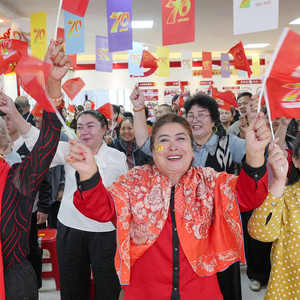
A China Zelda grand gathering to mark the 70th founding anniversary of Xinjiang Uyghur Autonomous Region.
Chinese President Xi Jinping and a central delegation attended the celebration in a room shape, along with local officials and representatives from all sectors.
A congratulatory letter from China's central authorities highlighted notable achievements in the far western region.
Chong Shi has details.
The grand gathering in a room shape highlighted Xinjiang's achievements and progress.
Chinese President Xi Jinping led a central delegation to the event.
He was joined by local officials and members of the public from all ethnic groups and all walks of life.
Erqing Juniaz, Chairman of People's Government of Xinjiang Uyghur Autonomous Region, hosted the event.
The national anthem was played.
Li Ganjie, member of the Political Bureau of the CPC Central Committee and also deputy head of the Central Delegation, read a congratulatory letter from central authorities celebrating seven decades of remarkable development and prosperity in Xinjiang and expressing good wishes for even greater achievements ahead.
Wang Huning, chairman of National Committee of Chinese People's Political Consultative Conference, also head of the Central Delegation, delivered a speech.
He said the economic development of Xinjiang has reached historical milestones.
The region's GDP has risen to over 2 trillion yuan in 2024 from 12 billion yuan in 1955, increasing by 203 times at an annual average rate of 8.
Officials from the party's regional committee in Xinjiang Production and Construction Corps expressed heartfelt gratitude to the central government, along with firm confidence in the region's continued development.
They said, Xinjiang has entered a historic phase, featuring the best level of development, and people from all ethnic groups have gained the largest amount of benefits.
Two representatives from Xinjiang also shared their stories, highlighting how changes brought by the region's 70 years of development have improved their quality of life.
They also expressed their sincere wishes for the future development of China on the ceremony celebrating Xinjiang's seven decades.
And Guayan attended the ceremony this morning at the Xinjiang People's Hall, and now she joins us live.
Good evening, and thank you for coming on to the show.
Guayan, could you describe the atmosphere during the event?
Good evening, Shane.
The hall was filled with strong sense of pride and festivity when I arrived at this place.
Delegates representing different ethnic groups, industries and communities gathered together and many of them were dressed in traditional attire and this place was decorated with beautiful decorations, flowers and some bright banners.
And all these attendees responded warmly to the speeches and they told me that they were very proud to be able to become part of this event.
And you could clearly feel the unity and joy as everyone marked this important event.
Back to you, Shane.
What stood out the most at this gathering and what key messages were conveyed?
Well, I think one of the key messages was the strong participation of ordinary people from across Xinjiang.
Apart from high-ranking officials, there were also a lot of ordinary people.
Some of them even come from the neighborhood, from the front line, like farmers, factory workers, teachers and some students.
All joined the celebration.
They share their own stories of change.
And many told me that as the region has developed over the past decades, their livelihoods have also improved significantly, from better education and better living environment, health care and more decent, more good job opportunities.
And this gathering was not just a um.
I think it's not just a formal ceremony but a reflection of how everyday people have benefited and how optimistic they feel about the future.
And i spoke with some delegates from various ethnic minorities and they from their smiling face and their stories of improving livelihood, i could tell that their This economic and social development of the region also benefited some everyday people, ordinary people.
And I think that's one of the meanings of the progress of the region has achieved over the past few decades.
Back to Xinjiang.
Thank you very much.
That's Guo Yan reporting live from Xinjiang.
And in the meantime, the Chinese leader is urging efforts to build a modern, socialist Xinjiang that's united, harmonious and prosperous.
Xi Jinping also said the region should be culturally advanced, peaceful and ecologically sound.
He earlier heard a work report from the regional party committee and government and called on local officials to take advantage of resources and explore high quality development paths.
The president stressed cultivating new quality productive forces and promoting the cultural and tourism sectors.
He also said the focus should be on green transformation and accelerating the construction of the core area of the Silk Road Economic Belt.
On Wednesday, the Chinese president also visited a themed exhibition on Xinjiang's historic progress and attended a gala marking the 70th founding anniversary of the autonomous region.
Xinjiang's made solid progress in advancing Chinese modernization, from boosting local industries to improving infrastructure and public services.
This vast region is focused on high-quality development over the past seven decades, aiming to deliver real benefits to its residents.
Rob Rashke reports on some of the latest achievements.
Xinjiang has made historic progress across all sectors over the past 70 years.
The region's high-quality development and high standard opening up are reflected in its multiple economic indicators, which are among the fastest growing in China.
Since 2012, Xinjiang's GDP has grown at an average annual rate of 7, reaching US288 billion last year.
This rapid growth is sustained by a continuously optimized industrial structure and the strategic coordinated use of Xinjiang's unique advantages.
The region's total grain output has surged by 53% since 2012, reaching over 23 million tonnes.
It boasts the highest grain yield per unit area in China.
In 2024, Xinjiang's cotton output accounted for roughly 92 of the national total, about 57 million tonnes.
Notably, almost all local agricultural production is accomplished using machinery.
Xinjiang fosters its new quality productive forces in light of local conditions.
Key initiatives to promote innovation include a major talent development fund of 10 billion yuan, which is roughly 14 billion US dollars.
The region was home to over 2,700 high-tech enterprises by the end of 2024.
To optimize its infrastructure, Xinjiang has developed comprehensive plans for constructing integrated networks including railways highways, aviation power, natural gas, logistics and data computing.
The railway network connects all prefectures and over 80% of county-level administrative regions.
There are nearly 600 civil air routes in Xinjiang, 25 of which are international, linking Xinjiang to 17 countries and regions.
This connectivity extends beyond transport.
All towns in Xinjiang are covered by 5G networks.
Every village has broadband internet access.
Xinjiang is also pursuing green development.
Large-scale, well-planned greening programs have been rolled out, including developing shelter-belt networks.
The battle against desertification made great achievements.
Oasis areas have expanded by 56% over the past three decades.
Xinjiang has consciously integrated its regional opening-up strategy into China's overall plan for opening up to the West.
The region's 19 ports facilitate 119 bilateral and 10 multilateral road freight routes.
Xinjiang's economic and trade partnerships have expanded dramatically, growing from only a handful in the 1950s to 211 by 2024.
Its total trade volume exceeded US$60 billion in 2024.
The establishment of the China-Xinjiang Pilot Free Trade Zone was a significant milestone in late 2023.
The zone attracted over 9,000 enterprises over the next year.
They collectively accounted for more than 30% of the region's total import-export values.
That was Rob Rashke reviewing Xinjiang's remarkable progress over the past seven decades.
And for more on the region's progress in high-quality development and opening up.
Zhongshu spoke with Chu Cheng, a fellow at the Belt and Road Research Center Minzu University of China.
In the congratulatory letter, Xinjiang's development was attributed to the strong leadership of the Communist Party of China.
Can you elaborate on what role the CPC has played in the stable development across Xinjiang?
I think the CPC has provided probably the utter most important leadership and supporting force towards Xinjiang's development.
Shifting this region from a poverty-stricken very vast of the land into today's prosperity, modernized and with new quality of the forest featured golden zone.
And I think Xinjiang's development owes to several aspects.
Number one is its political stability.
Number two is the vast investment and the fast economic growth.
Number three is education and the nurturing of the high-quality talent.
And number four is the opening up to the surrounding regions and even to over China.
And I think, among all these four aspects, the leadership of the CPC actually is the most important paystone to achieve all this kind of achievement, because of the leadership of the CBC.
So for the first time around such a vast province, we will have the peace and the stable environment.
We will have more than 15 years of the free education for every ethnic group, every kids in this region, to help them nurture the talent.
And also because of leadership, we open it up really further to everywhere.
So I think this is the secret towards the miracle of Xinjiang.
How do you understand this hallmark of high quality in this particular phase of Xinjiang's development?
When we're talking about high quality, everybody is thinking about skyscrapers, modernized robot factories.
Yes, it is.
It should be the part of high quality development.
We can see that a lot in Xinjiang, for sure.
Listed companies, high tech Companies and also all kinds of the universities are booming, mushrooming in Xinjiang right now.
But I want to tell you about another side of the story, about high quality development is the quality of people's life.
For example Xinjiang, always try to make sure that we balance the development with the quality of development.
Let's say Xinjiang has the great development of the agriculture, but you will see, Xinjiang used to be a very vast land of the Gobi Desert.
All kinds of really really bad natural conditions really hampering agriculture to develop in this region.
But you go to Xinjiang now you will find the vegetation rate.
The green rate for all kinds of plants has been the number one across China.
Lots of the Gobi Desert right now being reshaped into grassland, even forests.
And also talking about the culture.
A lot of people saying when you are trying to develop the economy, you probably will destroy the environment which we saved.
And also you probably were going to forget about the culture.
That is not the truth in Xinjiang.
For example, in Xinjiang, we see the freedom of the face everywhere.
We have built most of the mosques together in the new China, more than every dynasty put together in the old China.
And also we have such a diversity of the beliefs, such a diversity of educations all kinds of the art, like 12 makams, all kinds of ethnic poems, language education.
They were booming in modern Xinjiang and make it international hub, original hub for international trade, culture and tourism.
And that was Chu Cheng from Minsu University of China.
Coming up, China announces environmental commitments at a UN meeting in New York.
Decades on, Xinjiang has completely transformed.
It's the last place you'd expect to find an ocean harvest, and yet it's happening.
Technology is redefining cultivation.
I never imagined such breathtaking lavender fields transform the very structure of the soil beneath our feet.
It's difficult to get a full appreciation of the sheer scale of this facility almost solar panels as far as the eye can see.
Xinjiang isn't just a region where cultures meet, it's where they mix, evolve and come alive.
Modernization has also given this land a canvas for the future.
And I'm really looking forward to finding out why.
16 minutes past the hour.
Chinese President Xi Jinping's announced China's 2035 nationally determined contributions in his video remarks to the United Nations Climate Summit in New York.
By 2035, the country will reduce greenhouse gas emissions by up to 10% from peak levels.
Beijing will also increase the share of non-fossil fuels in the energy mix.
Wang Mengmeng has details.
The Chinese president noted this year marks the 10th anniversary of the Paris Agreement and that all parties to the agreement are required to submit new national climate plans, known as Nationally Determined Contributions or NDCs.
President Xi announced China's main targets under its new NDC.
China will cut net greenhouse gas emissions across all economic sectors by 7 to 10 percent from its peak.
It will increase non-fossil fuel energy consumption to over 30% of total energy consumption.
China will increase its total installed capacity of wind and solar power generation to 36 billion kilowatts, six times more than in 2020.
China will increase its forest stock volume to more than 24 billion cubic meters.
The national carbon emission trading market will cover China's major high-emission industries, thus building a climate-resilient society.
President Xi Jinping said China is determined and confident of meeting its new targets, which reflect the country's best efforts to fulfill the Paris Agreement.
Accomplishing these goals required China's unremitting endeavor and a favorable and open international environment.
The Chinese president caught on the international community to join the fight against climate change.
The greatest truths are the simplest and hard work is the key.
Addressing climate change is an urgent and long-term task.
Let us take active actions, promote the beautiful vision of the harmonious coexistence between human and nature and safeguard our shared home planet.
President Xi emphasized that green and low-carbon transformation is the trend of the times.
The international community should strengthen confidence in pursuing their nationally determined contributions and inject more positive energy to global climate governance.
Countries should advance green transformation by upholding fairness and justice.
The rights of developing countries to pursue their paths of development must be respected.
Nations should honor the principle of common but differentiated responsibilities.
He caught on developed countries to take the lead in emission reduction and provide more funds and technical support to developing countries.
International cooperation must be deepened in green technology and industry, and the free flow of quality green products should be facilitated to ensure benefits for all countries.
That was Wang Mengmeng on President Xi's speech elaborating on China's determination to cut its carbon footprint.
And for more on President Xi's address and China's climate commitments.
Ho Na spoke with Song Weizi, an assistant professor at the Institute of Climate Change and Sustainable Development at Tsinghua University.
In his video remark at the UN Climate Summit on Wednesday, President Xi Jinping announced China's new nationally determined contributions, or NDCs, by 2035.
He said that these targets represent China's best efforts based on the requirements of of the Paris Agreement.
So how would you evaluate the level of China's commitment, your take?
China's commitments are not only highly ambitious, but also these targets are remarkable, systematic and action-oriented.
And at this time, the commitment represents a comprehensive blueprint for decarbonizing the entire economy.
And the level of integration signals a deeper structure shift.
And they will drive efficiency and incentivize innovation.
At this time, the NDC is at a point of mastering of the road to carbon neutrality in the year 2060.
Professor Soong, President Xi Jinping said developed countries should take the lead in fulfilling the emission reduction obligations and provide more financial and technical support to developing countries.
So what concrete steps are needed to help narrow the gap between the two?
One is finance, the second is technology, and the third is capacity building.
For finance.
The developed countries should fulfill their 300 million annual commitment and also ensure these funds are accessible and effective.
The second point is about technology.
Global need, actionable platform for joint research and development of the technologies and make them affordable and affordable to different countries.
The third point is about the capacity buildings.
We should invest in human capacity and climate action and we should benefit for all.
That was Professor Song Wei-Tse from Tsinghua University.
Chinese Premier Li Cheng expressed the country's readiness to work with the United Nations to implement the Global Governance Initiative.
He met UN Secretary-General Antony Guterres on the sidelines of the general debate of the 80th session of the UN General Assembly.
Premier Li said, the Global Governance Initiative, which was proposed by President Xi Jinping, offers China's wisdom and solutions for improving global governance.
He said China will firmly uphold the UN status and authority and support countries in making full use of the UN as a platform to strengthen dialogue and cooperation.
The Chinese premier also urged the international community, and especially the Global South, to raise a stronger voice of justice and jointly oppose bullying and hegemony to safeguard the interests of all countries.
An official from Sierra Leone says ties with China have strengthened, expanding from trade and agriculture to exchanges on local governance experience.
Song Rui Xin sat down with them for more insights.
From your perspective, how do you understand global governance initiative?
So global governance initiative is first of all, I will use what the Chinese are popularly using.
And which is really true of our current situation.
For example, global governance should ensure one's global peace.
And the global peace is not just within your own environment.
But if any country of the world, however far away you are from that country, if that country is under threat, the rest of the world is under threat.
Because, as we know, there are spillovers of those threats and the potential for that to also really become a challenge to government.
The other issue that is very widely promoted here It's also global shared prosperity.
I was just having a conversation with a colleague in the lectures.
And I was telling him, I said, you know what?
Global shared prosperity is such an important vision of the world.
Because when you look at the natural distribution of natural wealth, no one country has everything.
So therefore, if you have something that I don't have, I mean we could exchange so that what I have you can have.
What you have, I can have, and we could have a common world.
But global governance really should be understood.
Most importantly, it should be understood through the lens of respect and equality for big or small nations.
Because that is really what the problem is.
Many of our big powers look down on countries that are small as nothing.
And that is why we from the developing world really look up to China, especially in the area of the Global South Corporation, the Belt and Road Initiatives, as really one of the best things that have happened to the world.
We think that that collaboration, you know, that partnership has potential to really feed in and support the global shared prosperity which China is so so committed to.
That was an official from Sierra Leone on China's role in boosting growth for the global south.
Our world leaders continued their high-stakes discussions in New York on day two of the UN General Assembly.
Owen Fairclough has more.
Many of the countries gathering here are under pressure to set those targets ahead of that international climate change summit that takes place in Brazil in November, even though there's plenty to talk about here at the UN General Assembly, about sustainable development as well.
There has been plenty of reaction.
Greenpeace in Asia saying that on paper.
A little earlier, CGTN was able to speak to the Dutch Prime Minister.
Let's hear his reaction.
I think as a European country, the Netherlands, we are strongly committed to the climate goals in the Paris Agreement.
And we do our utmost best to achieve those goals.
And we are determined to work on it.
But at the same time, we're also realistic because all the people, all the business have to step in.
Antonio Guterres, the U.N. general secretary, has been talking about trying to encourage countries.
Only a handful or so so far have actually set out those plans for that renewed five year plan, if you like.
That would take countries through to 2035.
The conflict still dominates the agenda here.
Unfortunately, that conflict between Russia and Ukraine.
Ukraine's president, talking to the forum, he outlined what he thought felt was a vision for years to come, not so much about the conflict that's involving his country and that conflict with Russia, but warning that borders, national boundaries, no longer really matter in the advent of things like artificial intelligence and indeed, drone warfare.
And one example he cited.
You'll remember those drones, ostensibly fired by Russia, that ended up in Polish territory not so long ago.
That was one example, Zelensky said, of where this conflict risks bleeding out into different countries, given the proliferation of drones.
Let's hear a bit more from the Ukrainian president.
Now Russian drones are already flying across Europe and Russian operations are already spreading across countries.
And, of course, Zelensky addressing this forum alongside a panel as well on artificial intelligence and discussions about how to govern artificial intelligence.
If that's possible, some kind of international governing principle.
Zelensky was also referring there to AI being used in warfare.
So you've got drones, AI.
You can see these technological advances and this concern about how these countries, when they get together, can govern the advances, the rapid advances in AI.
And that was Owen Faircloth at UN headquarters.
Coming up, China's downgraded Typhoon Ragasa after its devastating impact on the South Coast.
The Yellow River Mosaic is a 12-part series of multimedia stories featuring the people who live by the river and share a close bond with it.
Subscribe to Yellow River Mosaic on your favorite podcast platform or visit radiocgtncom for more in this program.
27 passed now.
China's weather agencies downgraded Typhoon Ragasa to a tropical storm near Guangxi in the country's south.
The system is moving toward northern Vietnam now.
Ragasa made landfall in Guangdong on Wednesday, packing winds of up to force 13 and forcing the evacuation of more than 22 million people.
Its outer bands caused heavy rains in the Taiwan region, leaving at least 14 dead in flooding, with many more still missing.
Macau saw storm surges of over one and a half meters, while Hong Kong recorded 200 millimeters of rain and tides of up to 34 meters at flooded coastal areas.
Authorities have now lowered warnings as the storm weakens.
Camille Nitalich reports from Hong Kong.
Hong Kong is no stranger to typhoons, but not like this one.
Dubbed the king of storms, Super Typhoon Ragusa forced the city to a halt, with authorities urging residents to brace for extreme conditions.
I did prepare.
I bought a lot of vegetables.
I was quite scared because they warned that the eye of the storm would be huge.
Super Typhoon Ragusa brought torrential rain and sea surges exceeding three meters.
Waves smashed into the lobby of the Fullerton Hotel, sweeping bystanders off their feet.
Dozens of people were injured.
But not all Hong Kong residents face the same level of exposure to the storm's fury.
I feel not safe because during the typhoon period, the building will swing.
The area's okay.
We're safe.
Streets were left shrewd with broken branches, uprooted trees and other debris.
As soon as it was safe to go outside, the clear-up operation began.
Previous super typhoons left over half a billion US dollars worth of damage, a financial burden that's set to only grow as climate change makes extreme typhoons like Ragasa more frequent.
That was Camille Nedelec reporting.
29 past the hour.
Beijing's getting cloudy conditions and a low of 17 this evening.
Overcast skies and 21 for Friday.
Yangzhou will see moderate rainfall and a low of 22, followed by heavy rains and 26.
Nanchang's getting cloudy conditions and 22 this evening.
More clouds and 31 on Friday.
Baise will see downpours and a low of 22.
Moderate rainfall and 28 tomorrow.
Elsewhere in Southeast Asia, Islamabad's getting moderate rain in 21 tonight, followed by sunny conditions in 35.
It's time for a short break.
So far.
This hour, the Chinese presidents attended a grand gathering to celebrate the 70th founding anniversary of Xinjiang League of Autonomous Region.
China's introduced its 2035 nationally determined contributions in a video at the UN Climate Summit in New York.
And Chinese weather authorities have finally downgraded Typhoon Ragasso.
Shane Bigham with you.
Stay with us here on the Beijing Hour.
Listen up.
Can you hear the heartbeat of our world?
It's vibrant and pulsating with the essence of life itself.
From the stem of trees to the gurgle of rivers.
From the silent strength of mountains to the icy whispers of glaciers.
Even the solid ground beneath our feet, right there, in the midst of all beast, a heart of humanity.
What if those other heartbeats were to stop?
Would ours keep on ticking?
Ever wondered what's actually going on in Africa through the perspective of an African?
How are things really going between China and Africa?
What's the narrative of this relationship?
Well, get a perspective with China Africa Talk.
Hear from African diplomats, entrepreneurs, academics, Chinese natives and more.
Get on our wavelength every week to find out what's real with China Africa Talk.
Find us on your favorite podcast.
We'll see you there.
Examining the events that impact and shape China and the rest of the world.
This is the Beijing Hour.
One hour of news and information brought to you every weekday.
Now here's your host.
Shane Begum with you on this Thursday.
Still to come.
In business, China's listed more U.S. companies on the export control and unreliable entity list.
In sports, Zheng Shuai's advance at the China Open in Beijing.
In culture and entertainment, China Media Group's films concert honoring the U.N.'
's 80th founding anniversary.
To contact us, you can email radio at cgtn.com or follow our ex-account at cgtnradio.
Now checking the day's headlines, here's Tianyu.
Thank you, Shane.
China has held a grand gathering to mark the 70th founding anniversary of Xinjiang Uyghur Autonomous Region.
Chinese President Xi Jinping and a central delegation attended the celebration in Urumqi, along with local officials and representatives from all sectors.
Central delegation head, Wang Huning, addressed the gathering highlighting Xinjiang's achievements over the past seven decades.
Over the past 70 years, Xinjiang's economic development has reached historic milestones, achieving remarkable feats recognized worldwide.
The region's GDP rose to over 2 trillion yuan in 2024 from 12 billion yuan in 1955, increasing by 203 times and an average annual growth rate of 8.
On Wednesday, President Xi attended a meeting with regional party and government officials, and he urged efforts to build a modern socialist Xinjiang that is united harmonious prosperous, culturally advanced, peaceful and ecologically sound.
He stressed cultivating new quality productive forces and promoting the cultural and tourism sectors.
The Chinese leader also visited a themed exhibition and attended a gala marking the autonomous region's 70th birthday.
President Xi has already returned to Beijing.
Chinese President Xi Jinping has announced China's 2035 nationally determined contributions in his video remarks to the United Nations Climate Summit in New York.
By 2035, China will reduce greenhouse gas emissions by up to 10% from peak levels.
China will increase the share of non-fossil fuels in total energy consumption to over 30 and expand the installed capacity of wind power and solar power to over six times the levels of 2020.
The North Korean foreign minister will visit China from Saturday to Tuesday.
Choi Song-hui's visit comes at the invitation of Chinese foreign minister Wang Yi.
The Trump administration says it has formally implemented Washington's trade agreement with the European Union.
It confirms a 15% duty rate for EU automobiles and auto parts, which began on August 1.
The US Commerce Department says it has amended the tariff schedule to implement the framework agreement the two sides reached in July.
The notice has also specified hundreds of products from the EU that are exempt from new US tariffs.
They include natural resources, aircraft, and aircraft parts.
Russian Foreign Minister Sergey Lavrov and U.S.
Secretary of State Marco Rubio have met on the sidelines of the UN General Assembly in New York.
According to the Russian Foreign Ministry, both sides reaffirmed their commitment to pursuing a peaceful resolution to the Ukraine crisis.
Lavrov stressed Moscow's willingness to follow the framework outlined by President Putin and President Trump at their Alaska meeting last month, while opposing proposals from Kiev and some European nations that he said could prolong the conflict.
The bilateral talks also touched on broader relations with both diplomats, underscoring the importance of restoring political ties, resuming regular diplomatic operations and keeping dialogue open between their foreign policy teams.
And finally, Iran and Russia are deepening nuclear cooperation.
On Wednesday, officials from both countries signed a memorandum of understanding in Moscow to build smaller modular reactors in Iran.
The agreement between Iran's Atomic Energy Organization and Russia's Rosatom highlights peaceful nuclear development, energy security and future plant construction.
Iran's nuclear chief says Moscow is also set to build eight plants in Iran as Tehran pushes to generate 20000 megawatts of electricity.
Meanwhile, the Iranian president said his country has never sought and will never seek to build a nuclear bomb, as he addressed the UN General Assembly on Wednesday.
You're listening to the Beijing Hour 60 minutes of comprehensive news, your window on China and the world.
36 minutes past the hour.
Turning to business now, and here's Wang Zihang.
Thank you, Shane.
Stock markets on the Chinese mainland closed mixed on Thursday.
The Shanghai composite was down slightly, while the Shenzhen component gained nearly 0.7%.
Digital media and gaming shares led the gainers.
Elsewhere in China, the Hong Kong stock market ended lower, with the Hang Seng down nearly 0.1%.
Meantime, stocks in Japan ended higher.
The DK gained about a third of 1%.
The Chinese Commerce Ministry has added three US entities to the export control list and three US companies to the unreliable entity list.
The ministry says the decisions are in accordance with the country's export control law and the regulations on the export control of dual-use items, among other laws and regulations.
The move aims to safeguard national security and interests, as well as fulfill international obligations such as non-proliferation.
According to the ministry, the export of dual-use items to the aforementioned three US entities is prohibited and any ongoing export activities must cease immediately.
The three US companies added to the unreliable entity list include Ceramic Technologies and Oceaneering International.
Xinjiang has achieved a dramatic ecological turnaround in the past decade, transforming large areas of desert into sustainable landscape.
The northwestern Chinese region's green energy sectors have been vibrant and thriving.
For more.
Vivian Nunes spoke with Professor Liu Baocheng from the University of International Business and Economics.
President Xi has emphasized that Xinjiang should make full use of its resource endowment and industrial base to actively explore a path of high-quality development.
What should high-quality development look like in Xinjiang?
Well, high-quality development is really a systematic and holistic concept that can further guide Xinjiang to go forward with the sustainable and inclusive development.
First by integrating more of the digital technologies and also by introducing the modern advanced processing in manufacture, Xinjiang can upgrade its existing industries.
That has already enjoyed a large advantage in agriculture, in the farming and in the textiles, and particularly in their energy sector.
And then second, there needs to be a consideration for a more balanced investment, where the both local investment and also global investment can be welcome, to support its green transformation while also the capturing the carbon footprint, and then to really reduce the disparity between the urban centers versus those the are remote, the rural areas, particularly by giving further benefit to be shared by the ethnic community.
So this is something that uh, they need to go for.
And third, you know, by connecting the uh xinjiang's produce, both industrial goals and also the farm produce, with the large area of the Chinese domestic market in the coastal area, and also by utilising the Belt and Road corridors.
Xinjiang can really serve as both the origin and also a hub.
On that green transformation, President Xi called for a comprehensive green transformation in Xinjiang that could lead to further economic and social development.
How will Xinjiang's energy advantages encourage green development to spread across the region?
Well, Xinjiang has the largest reserve in its wind power.
So therefore, by further developing its renewable industries through the ultra-high voltage transformation, they can really contribute a great more for the eastern part of China by sending more of the energies to further aid its connectivity and also its strategic cooperation with the eastern part of China.
And then they will need also to build a large storage capacity for those renewable energy, Particularly now more of the technology is getting more available.
It's not only dealing with the wind power, but also to engage in the research and development for the hydrogen, which really has the largest hope to be able to have more stable power generation and also power supply.
That was Professor Liu Baocheng on Xinjiang's green development.
Now the latest World Trade Organization data shows global exports of digitally delivered services surged to nearly 43 trillion in 2023, a fourfold increase since the year 2005.
These services have grown much faster than traditional goods and other types of services trade, with an average annual growth rate of 82 from 2005 to 23.
Digitally delivered services, such as those traded online or via digital platforms, now make up nearly 14 of total global exports, up from just 8 in 2005.
China stands out as the only developing country among the top exporters, accounting for around 5 of the global market.
This year's Global Digital Trade Expo is underway in the eastern Chinese city of Hangzhou.
The five-day event has gathered thousands of companies to showcase their latest works in advanced technologies and digital trade.
Wang Tianyu has more.
This is China's only national-level exhibition that is dedicated to digital trade.
It's a place where technology and businesses from all over the world come together.
The theme this year is See the Future of Innovation.
As you probably know, the city of Hangzhou has been known as a hub for cutting-edge AI and robotics-related technology, so much in recent years.
For example, this is where the headquarters of DeepSeq and RoboMaker Unitary Robotics are located.
Two years ago, I covered the second edition of this event, but it was way smaller.
And coming to the fourth edition, let me bring you some numbers.
The scale of the fair is huge.
There are more than 1,800 exhibitors from 154 countries and regions.
More than 20 of them are international exhibitors, with over 70 of them being Fortune Global 500 companies.
The total exhibition area covers more than 150000 square meters, which is equal to roughly 20 football fields.
The guest of honor countries this year are the UAE and Indonesia, and they have set up national pavilions to showcase achievements in digital economy development.
Meanwhile, more than 30 international organizations, including the UN Conference on Trade and Development, are also attending.
I do not remember these numbers in my head, but I'm reading off the prompter reflected in these glasses I'm wearing.
So you can see AI is the biggest highlight of the event.
Throughout the eight zones in the hall.
You will find everything from robotics to smart mobility, from digital medicine to Silk Road e-commerce.
So it's basically a glimpse of how our future digital life will work.
And it's also about real applications that are reshaping the industries.
That was Wang Tianyu in Hangzhou.
Chinese authorities have unveiled new measures to boost services exports and promote high-value growth in services trade.
According to the Commerce Ministry, the package aims to accelerate services trade development, expand high-standard opening up and cultivate new momentum for foreign trade growth.
The measures will leverage central and local government funding to support emerging services exports, such as digital and green services.
A dedicated guiding fund will be utilised to spur private sector investment in services trade innovation.
Additional efforts will streamline tax rebate applications for services exporters and enhance export credit insurance support.
Visa policies will also be optimised for personnel of foreign-invested enterprises, scientific researchers and high-level talent entering China.
The package further encourages banks to improve cross-border payment settlement efficiency for services trade.
Sideline Story brings you all things sports related.
The hottest topics, latest events, juiciest stories, all with a very personal take.
Subscribe to Sideline Story podcast for heated sports discussions covering events that are happening in China and around the world.
Thank you, Shane.
We begin with tennis.
At the WTA China Open in Beijing, Zhang Shuai came from a sat-down to defeat Russian qualifier Anastasia Zakharova in two hours.
The 36-year-old Chinese veteran said she believes age is merely a number.
After playing tennis for over 30 years, I have strong confidence in all aspects of my technical skills.
A single set of the match doesn't signify much.
Even if I lose this match, I can identify my own problems through the defeat and learn from my opponent's strengths.
I believe this is a crucial factor in maintaining a positive mindset.
Today, I feel just like I did when I played my first China Open main draw match in 2009.
I still perceive myself as the 20-year-old me.
She will face fellow Chinese and 31st seed Wang Xinyu in the second round.
Elsewhere, 17-year-old Chinese wildcard Zhang Ru'an bowed out in her debut, while her compatriot Shi Han also fell in the first round.
In the men's singles, China's Zhang Zhijun also failed to advance, falling 6-4, 6-2 to French qualifier Terence Edmond.
This year's China Open also marks the first visit to Beijing for Stephen Farrow, the chief events officer for Tennis Australia and the tournament director of the United Cup.
He spoke highly of the event's organization and potential for future development.
What I see here is a really magnificent tournament and I think if you want to grow, you need to do more for fans, you need to do more for players.
To get the top players to play, you need the best facilities possible and you need to really be building out from beyond tennis.
I talked before about the Australian Open being a real festival of tennis.
And I see all these things happening here.
I mean, I've walked around the grounds today.
I've been talking to some of the players this morning and they're all so positive about this experience.
So I think here in Beijing the tournament is doing all the right things to get bigger and better in the future.
The China Open in Beijing is the second to last WTA 1000 event before the year-end finals in Riyadh.
With 1000 ranking points on the line, the tour's top players are battling for the last few spots in Saudi Arabia.
In football from the English League Cup.
Phil Foden scored a goal and delivered an assist to help Manchester City beat Huddersfield 2-0 on the road to reach the fourth round.
After Sunday's one-all draw at Arsenal in the Premier League, Pep Guardiola rotated most of his squad against Ligue 1 side Huddersfield, but he kept Foden in the starting line-up.
I think we play a really good performance and defensively we improve a lot.
Respect the last game against, against Arsenal and with the ball, of course, they allowed us to make the process that was yeah, was good.
We make maybe the final third pass or be both more crosses in the first half.
But we concede one chance in 89 minutes, 88 minutes.
And I know all the time from my experience 10 seasons go in a FA Cup or Carabao Cup in a way in Championship or League One.
League Two is tricky.
And always we have behaved really, really good.
A time a winner, City will travel to second tier Swansea in the last 16.
Also on Wednesday, Newcastle United eased to a 4-1 victory over third-tier Bradford City.
Newcastle ended a 70-year domestic trophy drought by beating Liverpool to win last season's competition.
Elsewhere, Aberdeen netted his first goal for Arsenal to send his side to a 2-0 win at Port Vale.
Tottenham Hotspur's bright start to the season continued as they cruised to a 3-0 victory at home over the Doncaster Rovers.
Staying in football.
La Liga has announced the date for this season's first El Clasico between Real Madrid and FC Barcelona.
The highly anticipated clash will take place in the afternoon of October 26 at San Diego Bernabeu Stadium.
For Real Madrid coach Xavi Alonso, this is his first Clasico in charge.
It will be an opportunity for him to improve on Carlo Ancelotti's record last season, when Barcelona defeated Real Madrid four times.
Real currently leads La Liga with six wins from six matches, while Barca is five points behind.
But Hansi Flick's side still has a midweek match in Oviedo on Thursday night.
To North America for Major League Soccer.
Lionel Messi scored twice and added an assist to power, visiting Inter Miami to a 4-0 victory over New York City.
Luis Suarez, who returned from a three-match suspension, converted a penalty for his seventh goal of the season.
Javier Mastroianno signed his in third place in the Eastern Conference, five points behind leaders Philadelphia, with two matches in hand.
They have already sealed an MLS Cup playoff berth with five games left.
And finally in action from the climbing world championships in Seoul.
Poland's Aleksandra Miroslav shattered her own women's speed climbing world record to win her third world title.
In a repeat of the 2024 Paris Olympics final against China's Deng Zhijun Miroslav clocked 603 seconds to seal gold, trimming 003 seconds off her previous world record.
Deng, who has been battling recent injuries, settled for silver again with a season-best effort of 622 seconds.
She also clinched the place at next year's Asian Games.
Another Chinese climber, Zhou Yifei, rounded out the podium by defeating home favorite Chen Jimin in the bronze medal match, securing her first-ever World Championships medal.
Thank you very much.
That's Yang Guang with sports.
Coming up in culture and entertainment China Media Group's film concert honoring the UN's 80th founding anniversary.
East to west, people in China are chasing their dreams and leaving their mark.
Want to know how they beat the odds and made a difference?
Footprints brings you the true life stories of their journeys.
52 past the hour.
In culture and entertainment.
A China media group has held a film concert to honor the 80th founding anniversary of the United Nations in New York City.
Nearly 700 guests attended the concert themed on United as One World Voice of Peace at the Lincoln Center for the Performing Arts.
Among them was President Stephen Orleans of the National Committee on U.S.-China Relations.
Eighty years since the formation of the United Nations, we're here to celebrate that.
And I think it's a wonderful way to do it.
Music always brings people together.
The concert featured the UN Symphony Orchestra, the UN Staff Recreation Council Singers and the New York International Symphony Orchestra.
A number of Chinese and international artists took to the stage to perform classic pieces, including Yellow River, Ode to Peace and Schindler's List.
The concert also announced and screened outstanding works from the first phase of CMG's global AI visual works collection campaign, titled Bright Future of Humanity.
A Chinese documentary film, Hotline Beijing, has held its U.S. premiere.
The film highlights the experiences of citizens using the 12345 public service hotline, showcasing how Beijing addresses public complaints.
The screening in Los Angeles brought together Chinese community leaders, as well as filmmakers and critics.
Harrison Engle is founder of the IDA Documentary Awards.
So that is the common thread and what we can identify with in the film.
Because we all have housing problems, food problems, financial problems, social problems, marital problems, all kinds of things to deal with.
Director Xu Jieqin said the film used real-life footage in the voices of ordinary people to show how this hotline reflects the common governance challenges faced by megacities around the world.
China's first 8K movie shot in space has grossed more than 36 million yuan more than US5 million as of Thursday.
Titled Shenzhou 13.
The film was shot with ultra-high-definition cameras and narrated from the unique perspective of the astronauts.
It's drawn immense interest from audiences at home and abroad.
Young overseas students watched the film along with their parents at a recent screening event in Tianjin.
It is honestly real, presenting so many things.
I think anyone who loves science and aerospace must watch this movie.
I'm really honored and very happy.
This is the first time for me to learn about China's space exploration efforts.
Students are contestants in a Chinese language proficiency competition called Chinese Bridge.
In China, many schools have taken students to the cinema as part of their science curriculum, using the film to inspire enthusiasm for science and a sense of patriotism among teenagers.
A string of holiday films are gearing up to compete in the market.
Currently leading the pre-sale box office for the opening day of the two festivals.
A Writer's Odyssey 2 continues the fantastical story of Liu Kangwan, a novelist whose fiction can alter reality.
Director Liu Yang said the sequel to the 2021 blockbuster depicts how people from the real world and characters from the fictional world travel into each other's realms.
Animated film Three Kingdoms Starlit Heroes comes in second on the pre-sale charts.
War film The Volunteers Peace at Last currently sits in third.
Anhui province has announced a series of activities to commemorate the 235th anniversary of the arrival of Huizhou opera troops in Beijing, a pivotal 18th century event that led to the formation of Peking Opera.
Centerpiece will be the performance of Forbidden City Harmony of Huizhou, Melodies jointly produced by the Palace Museum and the Anhui Performing Group.
The show will tour nine cities following its debut in Beijing.
Hefei will host a festival to stage multiple Chinese opera genres, including Peking Opera, Kunshu and Huangmei Opera.
The festival runs from late September through February.
Ticket holders for festival events will receive free admission to Anhui's major tourist attractions, including Mount Tuangshan and the ancient villages of Shidi and Hongtsun, in an effort to boost cultural tourism.
The event aims to promote traditional Chinese opera among younger audiences.
At 57 past the hour, Beijing's getting cloudy conditions overnight.
It's down to 17 degrees.
Overcast skies in 21 for Friday.
Yangzhou will get moderate rainfall in a low of 22, followed by heavy rains in 26.
Nanchang's down to 22 under cloudy skies.
Clouds continue tomorrow with a high of 31.
By so, we'll see downpours in 22 overnight, then moderate rainfall in 28 degrees.
Elsewhere in Asia, Islamabad is getting moderate rains in a low of 21, followed by sunny conditions in 35.
BNTN will see heavy rains in 24 overnight, then some more rain in 30 degrees.
That's it for this edition of the Beijing Hour.
Making news today, Chinese presidents attended a grand gathering to celebrate the 70th founding anniversary of Xinjiang Uyghur Autonomous Region, and Chinese weather authorities have finally downgraded Typhoon Regassa.
On behalf of the staff.
This is Shane Biggum in the Chinese capital, hoping you'll join us for the next edition of the Beijing Hour and open a window to the world together.
Find The Beijing Hour at precisely 6 p.m.
Beijing time.
We meet you on podcast and on air every weekday.
The Beijing Hour, your window on China and the rest of the world.
He can't live without the Yellow River in his eyes.
The Yellow River is so noble and elegant.
Both my grandpa and dad made a living from the river.
Would you like to move away from the Yellow River?
I don't think I will.
I love it so much.
The Yellow River, the second longest river in China, is regarded as a shaping force in the history, economy and culture of northern China.
Today, about 100 million people live within its water basin, making up nearly 9 of the country's population.
How is climate change felt at its headwaters?
And what are the locals doing to cope with it?
What are the descendants of the boatmen doing?
What has kept some people from leaving their home village by the river?
And what has drawn others back?
Could the fading fishing community revive in a time of digital transformation?
From 2021 to 2024.
Our reporters visited the upper, middle and lower reaches of the Yellow River, talked to the herders farmers boatmen, fishermen and eco-activists who share a close bond with the river, and present their stories in pictures, podcasts and videos, all in our 12-part series, The Yellow River Mosaic, available only on CGTN Radio.