Hello, welcome to Roundtable where we serve up piping hot debates on the issues that sizzle in China and beyond.
I'm Niu Honglin.
If you have ever felt your stomach drop looking down from a tall building, imagine driving across a bridge nearly twice the height of the Eiffel Tower.
That is what travelers in Guizhou can now experience.
A trip that used to take two hours now takes two minutes.
It's thrilling, it's efficient, it's beautiful and it's making people rethink what bridges are really for.
For this episode, I'm joined by Yishun and Steve Heatherly.
Now grab your virtual compass and follow us to the heart of the discussion.
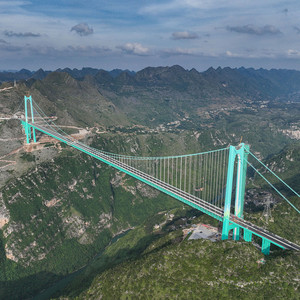
Just last month, the incredible huajang grand canyon bridge officially opened to traffic, instantly snatching the title of the world's tallest bridge.
At a dizzying 625 meters, this engineering marvel now soars above the canyon floor.
Moreover, this high flying structure is being touted as a blueprint for bridge tourism, a place where you can drive across a world-class mega project and then immediately jump, climb or get a cup of coffee right at the top of it.
So a nerd like myself wonders how did engineers manage to build a bridge taller than 200 stories while battling hurricane force winds social economists are curious about?
Can this world record bridge be the key to unlocking an entire region's economic and tourism potential, and a hardcore extreme sports enthusiast just can't wait to try out all the high bridge swing, bungee jumping and among other items as well.
So let's get to it.
Here comes the fascinating sky high story of the Huajiang Grand Canyon Bridge.
What's the bridge all about?
Yeah, so this bridge, the opening of this bridge, marked the full operational completion of the Liuzhi and Anlong Expressway, that's called Liu'an Expressway, for which the bridge served as a critical control project.
And the completion of this mega project, as you said before, set multiple new world records in the history of bridge construction and this bridge.
Experts have stated that the bridge is a world first, both horizontally and vertically.
It surpassed the previous world's tallest bridge, which is kind of like miles away, the bay panjang bridge, which is 5654 meters, which opened in 2016 and is located just over 100 kilometers away on the same river.
Now it's the second highest.
Yeah.
Yeah, exactly.
The people in that region are probably feeling like, oh, darn it.
I was looking at reports because this has been covered internationally as well.
There was a report from NBC News that's saying it's also the world's longest bridge in a mountainous region.
So it's setting lots and lots of records.
Yes, and the bridge is located in Guizhou province in southwest China, close to the hometown of Panda Sichuan, spanning the Huajiang Grand Canyon, which is also known as the Earth's Crack.
Interesting.
And when it comes to Guizhou, I have to say because in our special series China Horizons, Guizhou was our first stop.
I was going to say you were down there not that long ago.
Yes, yes, we were there.
And when we were there, one of a major topic we discussed about whether or not to do it is about bridges.
Because Guizhou is kind of like the hometown of bridges.
There are so many different bridges.
People call it a museum.
Yes, it's quite significant because it's a very hilly area, meaning that if you're traveling in Guizhou comparing to you're traveling in a province that is with a similar land area of Guizhou.
Traveling in Guizhou would be much harder because you need to go from one mountain to the other, you have to cross rivers and it's just not as smooth.
But nowadays it's getting better and better.
Yushan mentioned this bridge is part of the expressway.
That is because the province is managing to bridge the province, bridge different mountains in the province and making sure that your traveling experience can be much smoother.
Yeah, i was, i was reading about that and i was watching lots of videos about this project as well.
And the hangzhou expressway um, i forget the name of it.
It's a letter and a couple of numbers, i think.
But anyway, they were saying that this is kind of like the centerpiece for that expressway as well, because that area, as you mentioned hilly, hilly doesn't describe it.
I don't think i was watching it.
Wow, it is stunningly gorgeous.
Uh, down there the, the cliffs yeah, are like sheer rock faces and then the waterways go in between them.
Oh, it's very beautiful.
Oh, my goodness.
And the color of the water is this emerald green.
And they've built these.
I'm not sure, i'm not sure which exact region it was, but they built these kind of walkways along the rock faces next to the water.
So it's just a stunning area.
But the point there is that it's really difficult to kind of get around.
It's not easy to get from community to community.
A lot of the roads, they said, were really windy and along the mountainside.
So it would be a kind of an arduous task to get from one place to another, even though it wasn't that far away.
And also this uh project has been like finished quite fast, i would say because uh, it officially began in the construction officially began in january 2022 and was completed in just over three years, opening on september the 28th.
After three years and eight months of work.
I would consider a quick construction period.
That's really fast.
Yeah, that mega project it is.
I watched one video this morning, and I was curious about the comments.
There were lots of international people who had watched that video.
I think I saw that, too.
Oh, my gosh.
My favorite comment was, yeah, don't forget, these are the people that built the Great Wall.
Not that impressive.
No, the comments were overwhelmingly positive, saying it's unbelievable that they completed this, that the construction only took three years.
You know, if that was done in the UK or India or in America, it would have taken much longer and it would have been way over budget and lots of comments like that.
Now, is it worth it?
It took three years completed.
And after the completion, what does it bring?
Absolutely.
And first of all, it is a connection and a huge project for transportation, right?
The time needed to travel between the two sides of the river or the canyon has been dramatically cut, from two hours to just two minutes.
The bridge successfully sewed together the two banks of the deeply cut canyon and greatly improved regional traffic conditions.
Yeah, I want to paint a picture.
If you haven't seen this canyon or you haven't seen this bridge, please press pause on your podcast and go look up images if you're listening later on.
Because the canyon itself is a real canyon.
This is way up high.
The two towers... on both sides of the bridges are very far apart.
It's 1,402 meters in length is the statistic that I saw.
And then it just goes straight down to the river, the Baipan, I think you called it, right?
Yeah.
The Baipan River.
Baipan.
Baipan, excuse me.
It flows below.
So this is a real architectural feat.
And one thing that those of you who are not living in China might not be familiar with is the concept of having a life circle or living circle within 15 minutes, or one hour or two hours, or a three day living circle.
But the circle can be as large as several promises.
The reason we're having this concept is to improve people's living experience in the sense that, for example, near your home or near your residential community, you can get to, you can have access to all these different places within, for example, 15 minutes.
And these places would include a hospital, good restaurants and public cultural facilities like a, for example, library or something in that regard.
And this bridge if well, it's not, if it's now it can shorten the distance or shorten the time between these two mountain peaks from two hours to two minutes.
It means the life circle of people living adjacent to these areas are significantly enlarged.
Yes, and what that means is access to education or health care or just the economy as a whole.
Now, because you're connecting communities together, that can very easily think about shipping products or things like that.
It just makes doing business much easier as well.
Not only connecting regions, but also the bridge itself.
It is creating a lot of economic stimulations, right.
The bridge is expected to drive the development of local industries along the route and also including the sales of agricultural products, and also BBs and catering services, and cultural and creative products.
The traffic department predicts the bridge area will receive over 1 million visitors annually.
That's according to a Xinhua report.
I would definitely go or would have gone there if it was opened during our China Horizons.
You were there just before it, right?
Just before, several months before.
But I was told all about it by local people and also local tourists as well as local journalists.
They talked about how amazing it would be.
And darn it, just this tiny little difference in timing.
But definitely because these days we're already looking at a lot of different kind of activities you can enjoy in Taiwan.
I think in different ways.
People are being very creative when it comes to tourism experiences.
More and more tourists value experience much more than go there.
Take a picture prove that I've been there on their social media accounts.
So what are some so-called bridge tourism integration are we looking at here?
What are some items that I can enjoy next time I visit Guizhou?
If you are brave, then you can go to the top bridge.
And you can check out the observation facility.
So on the deck.
That's where you'll find a glass viewing hall that covers more than 1000 square meters.
And there's also a 207-meter-high glass sightseeing elevator that carries tourists from the canyon bottom to the deck and to the viewing hall, which is really cool.
There's also the high-altitude viewing corridors that would be A little nerve wracking for me.
I think that it off it's for thrill seekers, right?
It's obviously very, very safe.
I'm not saying that, but just that being that high up.
Would be kind of scary for the transparent floors.
When you're getting there, you can see right under your feet.
Yes, that's right.
It's just like when we visited the actual Grand Canyon.
They have that as well.
And stepping.
Have you ever done that before?
Have you ever?
Yes.
Yes.
Not that high.
Really?
Not that high.
Your brain says, don't do it.
Don't do it.
Don't do it.
And then once you get used to it, it's totally fine.
I have no problem with stepping.
Yes, stepping on it, walking around, looking down, taking pictures.
But when people jump next to me, that is just... You're talking about bungee jumping.
That too.
Oh, you're talking about jumping on the glass.
Yes.
Yeah, that looks dangerous, but that's very safe to do.
Bungee jumping is also one of the options if you're brave enough.
And when you're getting in there, There are many activities that you can choose, not only bungee jumping and a lot of high altitude activities.
And considering the height, when we are all talking about, we're just saying that it's astonishingly high, but when you're considering, the deck rises 625 meters above that Beipan River And if you're still not quite familiar with that height, that's nearly nine times the height of the US.
Golden Gate Bridge.
Nine times?
Yeah.
There's also a cafe at the top.
I'm not sure if there's a cafe at both bridge towers or if it's just at one bridge tower.
But yeah, there's a stargazing bar.
That I'll enjoy.
If you want to go there and enjoy the nighttime views.
There's also a water screen light show. that creates a very immersive experience.
So the bridge itself.
You know we mentioned a little bit about the economic benefits for the local communities and the bridging of communities, but the bridge itself is a tourist attraction.
Yes.
And just like every highway has service areas, right?
So located on the Zhenfeng side, this service area focuses on also bridge tourism integration integrating, like local history and historical showcases.
And the service area features creative carvings of famous local fossils, such as the sea lilies and local found dinosaurs, reflecting the area's status as a renowned fossil cluster.
And it also offers local quizzing and educational opportunities when students can group up and they will organize, like a study, tours to that area, not only to the bridge, but also the historical sites there.
Just on behalf of guizhou province, as well as the entire china, i have to say yes, this one is making world record, it's the highest one and it's really long and it's very impressive.
But when it comes to bridge related construction as well as tourism, there are so many examples around the country and if we're not talking about the museum of bridges in guizhou already, There already are a lot of successful experience and successful examples of using bridge, like Steve said, as already a tourist destination.
We on Roundtable talked about some bridges even offer the kind of daredevil bungee jumping even if you're scared of height.
Yet you're not that scared.
You want to have a little try.
So what they do is slowly descend you to a certain height and slowly pull you up so you can.
Is that better?
I'm not sure that's better.
No, you can enjoy the thrill of the height without the feeling of losing in gravity, totally losing control.
Or losing your life.
I think it is.
That's what I thought you were going to say.
I don't know if it's better for everybody, but definitely it's a choice you can make.
Not to mention that in a lot of bridges around in China and around the world they even have the climb the bridge kind of activity.
You kind of climb up to the higher place of the bridge instead of enjoying the view on the bridge.
And at the same time, we see, for example, bridges such as the Wuhan Yangtze River Bridge, the Nanjing Yangtze River Bridge and the Hong Kong Zhuhai Macau Bridge.
I've been there.
Very, very beautiful place as well.
They have all become famous local landmarks and popular tourist attractions after their completion.
Yeah, I mean, you can say that about bridges around the world, too.
Perhaps London's Tower Bridge would be a good example, or maybe the Brooklyn Bridge in New York.
I've been there.
I guess what you're talking about is transforming the uh original structure or the original function of the structure into a must visit destination.
There's a couple of other things you can do with this bridge as well.
Um, you can.
It's kind of rock climbing, i guess it's.
They call it anchor block climbing that's going to be available.
Um, also a swing.
Now, I'm thinking that swing.
I've seen that in other destinations around the world.
You kind of swing out over the canyon, I'm guessing, and then swing back to the location.
So that's bungee jumping plus.
You're not descending.
You're just kind of swinging out and then back.
It's like a playground swing.
Oh, yeah.
Well, if it's the height of over 600.
Yeah, exactly.
And then they're going to have parachuting available as well, apparently.
So lots to do.
Absolutely.
And when you are realizing that is a place not only for transportation, but also transportation.
I would say recreational activities.
A lot of people will visit there and treat it as a landmark.
And it will, of course, become a lot of.
There are going to be a lot of cultural, creative products, like the magnets of the bridge, because we've seen a lot of cities around the world are creating a lot of things like this.
Yeah, and apparently the designers of the bridge.
This is what they had in mind from the very beginning, going back three plus years when construction began.
They knew that they wanted this to be a tourist destination and they knew that sightseeing was going to be something that people would come to the location for.
Yeah, otherwise they would not use the transparent floor for the bridge.
Right, yeah.
And that is the trend nowadays here in China.
When it comes to the designing of a major construction, when it comes to the designing of the layout, for example, of a new city or a new township, people are being much more comprehensive in designing everything, because now we know everything is kind of integrated or kind of intertwined with other things as well.
And if you can make the plan in advance, a lot of trouble can be saved and a lot of hurdles you have already jumped in advance.
So you can avoid a lot of troubles in the future.
Yeah, but speaking of hurdles, there were a ton in their way, because building a bridge of that length, at that height, is not easy to do.
Absolutely.
And fighting against the canyon's Strong winds was the biggest challenge during construction.
That's said by Yuan Quan, head of the bridge's investment and construction unit.
So the canyon is only like 300 meters wide as its narrowest point, but stretches to three kilometers as its widest, with complex terrain and steep cliffs.
And also the climate there is unpredictable, and winds can suddenly reach to level 14, which is the strength of a super typhoon.
Not only is construction difficult, but even standing on the ground could be risk being blown away, so that, like the workers there, when I mean building it and doing the construction, is already a risk.
So what they wanted to do, what they did, was to figure out as best they could about the wind patterns there.
So what the what they did to try to do that was to build a wind tunnel and and do physical tests in there.
And then they introduced a Doppler laser radar system to measure the wind.
The disadvantage of doing tests in a wind tunnel is it only shows, it's basically a lab, right?
So it only shows you the exact results in that lab at that particular moment.
It kind of gives you a snapshot, if you will.
But the Doppler laser that I mentioned, that system That was used outside in a real-life situation and it kind of sees the particles in the air.
It bounces off the little tiny things in the air, like dust or water droplets or pollen or what have you, and then it measures the shift.
So when they see how the laser light changes when it bounces back that's the Doppler effect then the system can calculate how fast the wind is moving and what direction it's going.
And the biggest benefit of that is It's like a wind camera and it can give you feedback, immediate time feedback, 24 hours a day, seven days a week.
So it's better than a wind tunnel.
And when they employed, that it just allowed for safer construction, because they knew when they could work at the best conditions and then when not to.
It's really important because when I was in college, I learned a little bit about architecture as well.
And we were told, we were very clearly stated.
Let us know for sure that when you're designing for something, a construction, you have to um, it depends on the situation, but usually it you have to find out the worst scenario in the past 100 years.
You go trace back the record of it and making sure that your building, your bridge, your library, can withstand the worst, for example, the strongest wind That has happened within the last 100 years, making sure it can last longer than well.
Hopefully then it's even longer than the designed period of time, just to make sure, because safety is definitely very important.
And in these days, another factor that we need to take into consideration is that the technology is developing.
So some new things must be applied into the building of the construction of the bridge.
Yeah, because the gorge is so deep that the canyon depth reaches about 80% of the span.
So preventing the use of conventional temporary cable stay systems.
That is how hard it could be when building things like that scenario.
So the team developed that intelligent cable crane system to achieve millimeter level construction accuracy at high altitudes and also implemented an innovative anti-wind solution, which is the upper and lower horizontal stabilizer plates plus central stabilizer plate.
Of course, it's quite hard to understand how that works.
But when we're thinking about the situation there, the hard work that they've been done, it's quite obvious.
And the project marked the first use of FBG Fiber Bragg Grading technology to continuously monitor the temperature, also humidity and stress of the main cable linked to the dehumidification system.
There was a two-person team.
From what I learned learning about this project, that was in a control center.
And they have so many cameras around the bridge that are monitoring everything, right?
And those two people are in charge of making sure that everything is very, very precise in terms of the placement of the oh, I forget, there's a technical term for them but the pieces of the bridge.
And they use that high altitude crane system to move those pieces of the bridge one by one by one.
And then the control team was in the control center making sure that those pieces were fit correctly, perfectly in place, because you can't make any mistakes there.
But it was really impressive.
I mean, we could do a whole show just on the construction of this project itself.
And here in China on social media, you get to see some of the videos showcasing the science behind constructions and architecture.
Sometimes they use the kind of animation videos to show you the logic behind it.
And sometimes it's a fast speed video of how a real construction is made.
And I always, always stop wiping when I watch or when I met such videos.
And those are the things if you're interested in and go check it out.
And, at the same time, we know that for this construction of this bridge, it's secured 21 authorized patents, with several technological outcomes included in national bridge construction standards.
And that means not only will they by saying they, I mean the team and the research team of the bridge, as well as the designing team would be able to share that experience with other bridge builders, not only in China, but definitely around the world.
And We talked about Guizhou's bridge legacy a little bit.
By the way, do you know how many are there?
How many bridge in Guizhou?
I would bet definitely more than several hundreds.
30,000.
30,000 bridges.
More than 30,000.
Guess how many mountains are in the region?
You should know this.
I'm Canadian.
1.26 million mountains.
So that makes sense.
Proof of why they need 30,000 plus bridges there.
And that is why they have the reputation of the World Bridge Museum, characterized by mountains and hills making up 925 of his territory.
So the province now holds the top three spots on the world's highest bridge list and accounts for nearly half of the world's 100 tallest bridges.
What an amazing location, because when you were down there for your business trip, I remember learning from watching your live stream that what is it?
90 of the world's guitars 70 70 sorry 70, but only from a tiny, well comparatively speaking county.
Yeah, that's what an amazing place.
I have to get down there for a visit.
Yes, and i think if guizhou's mountains once symbolized the barriers, now they hold up the world's tallest bridges, and it's A reminder that innovation doesn't always rise from the world's capitals.
Sometimes it emerges from the quiet presence of those who refuse to let geography define destiny.
And that, perhaps, is China's most remarkable engineering feat of all.