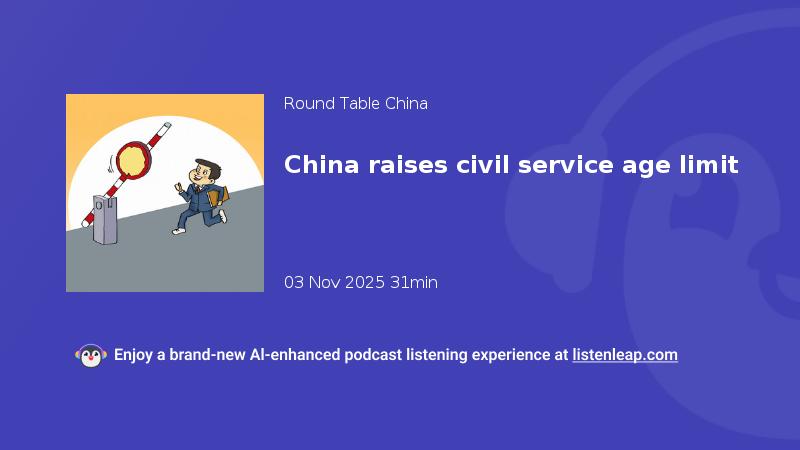
For millions of professionals in China, turning 35 years old has long meant hitting a career dead end, the so-called curse of 35.
That's dramatic.
But that curse is now being challenged.
The government just raised the age limit for its civil service exams, and it's a big change.
But what does it mean for the workers who have been locked out thus far?
And will corporate China get the message, too?
We're live from our studios here in Beijing.
This is Roundtable.
I'm Steve.
Thanks so much for sharing your time with us today.
And for the show, I'm with Yushun and Yushan.
First up.
For years in China, the age of 35 has represented an invisible barrier in the job market.
Some call it a curse that slammed shut doors to coveted civil service positions.
Now, in a landmark move, the central government is officially raising the upper age limit for national civil service applicants.
This policy shift serves as a direct nationwide push against systematic age discrimination.
But what does this change really mean for millions of professionals over that age of 35?
And as the public sector leads the way, we're very curious to find out if private enterprises will be compelled to follow.
Yushan and Yushan, good afternoon to you both.
This exam, it's a big one.
The civil service exam is a big one here in China for millions of people.
Yes, it's such a big deal for a lot of, especially young people previously, let's say.
And they are so much devoted into this, just like preparing for a postgraduate entrance exam or something.
Some people use a whole year preparing for it.
And usually the pass rate, it varies depending on the major and the particular job you're applying.
So basically, the Guo Kao, or the National Civil Service exam, is China's official exam for recruiting staff into central government ministries and agencies, is known for being highly competitive in the first place.
And many specific exam.
They, apart from including the major related skill related content in it, they also cover a wide variety of different area of expertise, including general knowledge like politics or law or economics, or science and cultural knowledge.
And then there's the verbal reasoning and quantitative aptitude.
That includes math problems and logic based fill in the blanks kind of questions.
Yeah, this is a gaokao level test.
Yes, if not harder, I'll say.
And I would say, among all professions, both in China and abroad, right civil servants are highly sought after positions.
Yeah, 100%, because, yeah, I'm sure that it's the case here in China too, but...
If you're successful in that exam and you get placed, the positions that you get placed in are seen as stable.
Yes.
Right.
It's secure.
You don't have to worry about your future.
Yeah.
So yeah, in many countries around the world, being a civil servant is a highly coveted position.
Hmm.
And for this reason, countries around the world hold high standards for civil service personnel and employees, strong emphasizes on fairness and also transparency in recruitment.
And that is why some of these examples can be very, very difficult in the way that a lot of people think huge amount of people are applying for maybe even only one occupation.
Yeah, right.
Very, very competitive for sure.
Now in the past and this is the main point of what we're talking about here today in the past and for decades, the age limit for the application for this exam was 35 years old, but now the government has raised it.
What have they raised it to?
Nowadays China's central government.
They have raised the upper age limit for this very exam up to 38 years old.
So this is according to official announcement in mid-October upon the time when the exam is open for registration this year.
So the new guidelines, they come into effect ahead of this year's registration.
Also previously, the age limit, like you said Steve, was 35, but this year it's been covering a range of age from 18 years old up to 38 years old.
And that's for the holders of a bachelor's degree.
And for those who have a master's degree, the age limit is raised from 40 years old to 43 years old.
So for them that's even sort of like a bigger advantage for covering more demographic of age varieties, for people that has certain degrees to apply for this year's civil servant exam, because the threshold actually has been there for like more than 30 years, right?
Because uh, historically the kind of um National Civil Service examination has historically set the upper age limit at 35 for general applicants since 1994.
And that's a standard widely adopted by public institutions and also enterprises.
So before 1994, civil servants here in this country, they were mostly appointed through internal recommendations or direct approvals from the leadership.
So that's back then were considered to be having a little unified or transparent selection process.
So by the time when it comes to 1980s or 1990s, China's central leadership called for bold reform to outdated organizational and personal systems.
And that's when they incorporate such an examination system on securing the best personnel for the ideal positions.
So...
In 1994, it wasn't just that the age was set at 35.
It was the introduction of this exam system of the exam in the first place.
So the registration for this year and presumably every year is the middle.
Well, I shouldn't say that.
I'm not sure if it's the same every year, but middle of October, and then the exam takes place at the end of this month.
Yeah, the end of this month.
Some say the beginning of December.
So around that time period, a few days between November 29th to December 1st.
And that age increase will apply for this round of examinations as well.
That's true.
And in fact, it's not just the National Civil Service exam.
Since the beginning of this year, many local government and public institutions across China have they have also relaxed age requirements for their respective recruitment, such as in the city of Shanghai in eastern China.
They kind of raised the age of applicants for citywide law enforcement positions to 38, meaning that in Shanghai, if you age between 35 to 38 this year, you can apply to be a police officer.
Police officer as well.
That's specific to Shanghai, though.
Right.
That one is specifically announced by the Shanghai municipal government.
And there are also other cities, including in Meishan and Suining in southwest China's Sichuan province, who similarly raised the age limit to 38 for their civil service applicants with bachelor degrees.
So even that's months ago, before the national civil servant exam even open for registration this year.
This might not seem like that big of a deal on the surface because you think oh, 35 to 38, 40 to 43.
It's only a three-year difference.
How much of a difference is this going to make to people?
When you have a country of 1.4 billion people, That's millions of people within those three years.
Right.
So this is a big deal for a lot of people.
Exactly.
And from actually some of the numbers we can already see.
I'm not saying that they have like that direct relation between the new change.
Right.
But we're what we're seeing is definitely the rise on the numbers that who applied for this exam.
On the evening of October 26th 2025, the National Civil Service Administration released data on online applications for the 2026 National Civil Service Exam.
And they also applied for central government agencies and their affiliated institutions.
And the results showed that there are more than 3.7 million applicants online.
So there's 300,000 more people.
Yeah, you're right.
We can't say that that's a direct effect of the increase in number.
We don't know those statistics, but we can at least assume a certain amount of those people are now available to take that test when they wouldn't have been before.
Yeah.
And what you mentioned earlier is true indeed, Steve, because here in China, many people do believe that this, what we call the 35-year-old threshold, or like how you mentioned it earlier, the 35, the curse of 35, it did exist because, well, this is back in 2023.
There's one leading online recruitment service provider, Zhilian or ZhaoPingcom.
They did a survey which discovered that 85 of survey respondents believe that this threshold existed.
And that cover, I mean that, 85 of respondents.
They cover a huge area of industries, not only in the civil servant like line of work alone, but covering just all industries.
People just feel like there is such invisible age barrier as if you, as long as you go beyond the 35 years old, it could be hard for you to locate on a job or switch a job.
So culturally speaking, this is kind of a known thing.
Even young people, gen z, they're aware of this.
Is there a chinese term for it, the 35 year old curse or the 35 year old threshold?
I don't think as in threshold.
Yeah.
Thirty five year threshold.
But my question is, people people are aware of this.
Yes.
OK.
We were I was told by many.
Oh, really?
Yeah.
There are kind of that societal expectation expecting you that you should have at what kind of state, when you're at age of, let's say, 30 or 45 or 50.
And people on Chinese people have different like words or idioms for that kind of age group.
Let's say 三十二厘 or 年过半百, that kind of thing, saying that you need to be as mature as a 30 something or you.
You have already passed the 50 year old threshold, that kind of thing.
So would this 35 sorry, I'm quite interested in this with this 35 year old threshold, with the history of that belief in society, go back to 1994 with the introduction of this exam and the age limit being set in At that time?
Is that kind of the root of this belief?
I would agree so, yes.
Because that's when it first age limit of sort or the um recommended or the limited age to be approved to enter a certain job first existed.
I think previously people just started working young or not, and then, with that 35 year old um age limit of people allowed to take that exam coming to be, More and more lines of industry just start to apply that because wow, if that's for the civil servants recruitment, then it must be workable for us too.
I would think this would make a big difference for people who were perhaps considering a career change.
Yeah well, because this opens a door for that group of people too.
Indeed because, back to the survey I mentioned earlier, in the case that, comparing with job seekers aged 25 to 35, those aged 35 to 45 would need to submit, on average, 22 more resumes or CVs, and their interview conversation rates was less than half of the younger groups.
For them, Imagine a person at the age of 36 who wants to switch jobs.
And in order to do that, they'll need to submit more CVs.
More than double.
More than double CVs, yes, just to get the equal amount of attention from job employers.
Yeah, but even if they do get the interview, as you said, the interview conversion rate was less than half.
So double the resumes. with less than 50% of the success rate.
And then it depends on the media too.
In industries like tech or maybe the industry that we work in, media, trends come and go.
Trends shift very quickly.
Creativity is key.
The high earning years might peak before the age of 35.
But then if you look at different industries, like scientists or engineers or teachers well, those skills accumulate over years and decades and experience builds up.
And those people in those industries would tend to become more valuable as they would grow older.
So I guess it would depend on the industry that we're talking about when we're talking about the difficulty in changing careers.
I was curious about the 35-year-old thing.
We don't have that in the West as far as I know.
I don't think we have an age in our minds where we think oh, it's going to be more difficult to change careers.
And in fact I looked at Canada and the only age limit that I could find in the country was for a program called the International Experience Program, which is a government program that allows eligible people, typically aged 18 to 35, from partner countries to work and travel in Canada.
For up to a couple of years.
But that's just one particular program.
There's no general age limit for civil service exams in Canada.
You have to be at least 16 years old.
So there's a minimum, but not a maximum.
Although there can be age restrictions depending on the job posting and the role, but there's no nationwide age restriction in terms, in terms of numbers, and in fact, in Canada there's low.
There's no mandatory retirement age either, and in America too, yeah.
Yeah, that goes back decades when they made those laws.
So who's let's talk about it in more detail then who's benefiting this from, from this policy change?
Of course, there are those aged 35 to 38 who are experienced professionals and are thinking about maybe finding a more grounded job at their age.
So these are individuals who often have rich work experience and also social background, if not people networking, built already within their group or specific industry.
Many are considered the mainstay or backbone of the workplace, especially when it comes to people aged 35 to 40 or above, and one example would be and this is not only covering civil servants, but also all different range of jobs as well.
So one very interesting example that I found would be Spring Airline, which is a Chinese airline, who launched a special recruitment program on October 27th dedicated to one of their northwestern air route, I think not nationwide covered yet, but for that specific air route they raised the age limit for flight attendants hiring to 40.
So if you've been in China long enough, you would have this notion that most airline service providers as in the flight attendants, they look so young.
They look so just elegant and so just mainly young, let's say, but now it's um including female, that's above 40, and also those who are married and with children.
So right now the airline have about 88 female flight attendants that falls into this category, married and above 40 with children, and 74 of them 74 percent of them have been promoted to management position thanks to their very rich life experience in handling emergencies and providing better services for children and family travelers on the airplane.
So I understand that.
From my past experience of taking flights between countries outside of China, I noticed that for air attendance they don't really specify on the age very often as an age ceiling for certain jobs that's required in that category.
But here in China, this is something major.
It's on news leads, breaking the traditional age barrier.
And that's not to say that flight attendants over the age of 40 aren't elegant, but I see what you were trying to say there.
Why now?
I'm curious to know.
Why are these age demographics being looked at now?
Right now, we're seeing that more people are getting like longer period of time of higher education.
And data from the Ministry of Education shows that China now has 240 million people with higher education, and workers who freshly enters the job market have an average of 14 years of schooling.
And that means many enter the workforce later are not necessarily as young, even though they are also young, maybe fresh graduates, and therefore remaining a kind of one solution for all 35 threshold risks cutting people off before they reach their professional peak and maybe wasting well-educated talent and fulfilling anxiety about age and career.
Yeah, I mean if someone were to finish their master's degree perhaps, or their PhD, a little bit later in life, which is a very common thing.
Yeah.
But then all of a sudden, you don't qualify simply because there's an age limit.
That's not an opportunity.
It's a possibility of wasting a lot of talent there.
And just for people who continue on with their education sure, that can go well into mid-30s, depending on when you start it.
Or some people start, stop, and then go back again.
So it's just opening a door for a whole new group of people talented, educated people that wouldn't have even had the opportunity to apply before.
Yeah.
And, as Yushan was giving that kind of example, I think this new change on policy is setting up a kind of a new, a good example.
And other industries, not only for people who are applying for these civil servant occupations but also for other industries.
They are also seeing that kind of trend and giving people more options, and I think that is also because for a long time, the society has that kind of you know paradox when you require a new newbie to have good enough experience, when you want that experienced person to be younger.
So when you are having that kind of thing, I think change is coming up.
I remember there was a big thing on the internet a few years ago in the United States.
It was on TikTok or something where people were complaining they would show a particular job posting for like an internship and say um internship four years experience like wait what how am i you know yeah i know that's exactly what you're talking about uh how are you supposed to have the experience if you're cannot have an internship yeah if you can't even get into the into the market in the first place i have another question so 300 000 more applicants this year Within the civil service exam itself, are certain things more competitive than others where you'll have a large percentage of people who are applying for one spot, but you'll get more? perhaps a lower percentage of people who are applying for other positions.
I don't know why I'm reminded of this right now, but I'm reminded of medical school, where a lot of people might apply to be a heart surgeon as opposed to a pediatrician.
You'll have empty spaces there.
I wonder if the civil service exam has kind of the same situation.
Same, very same in that notion.
Some certain positions, such as those in fall into finance or economic management, And also given certain positions located in certain geographical regions here in China, depending on those places you are thinking about working or building a career at in the future.
Building a life.
Yeah, they could totally become very popular among Chinese registered attendance of that exam.
Some can I remember the ratio can be can go as crazy as some 400, 500 versus one position.
So over hundreds of people are just fighting for one job, one one job position.
And that is why this whole age changing, age limit uprising kind of change of policy is an indicate for extending the civil service into a broader reform, as in here in china's hiring market.
And this is not according to me.
This is according to xiong ben chi, a deputy deputy director of the 21st century education research institute here in beijing.
So, even though the program is being rolled out gradually and has not yet applied to all positions or applicants, this very expert shown he mentioned that it has long been an uneven interest here in China between popular and, let's say, entry level or more basic level or less studied area of expertise of positions.
The less popular ones.
For example, the maritime law enforcement position in Lianyuangang in Jiangsu province in eastern China, which is limited to candidates majoring in this very field.
It has a very relatively low competition ratio.
That's about 12 to 1.
So it only 12 person competing to one job position, comparing with hundreds of people comparing uh competing for one.
And then from a regional perspective, there is um the further away regions here in China, including Xinjiang Tibet, uh and border areas of Yunnan, these provinces in outer premier in far West and far Southern part of China.
They tend to attract fewer applicants too, because of their challenging work conditions and uh just long distance from home.
More people want to stay close to their home.
So perhaps these locations attract more applicants locally than outside of this particular place.
Yeah, no, I get it.
But back to the point of you know, with 300000 more applicants, maybe it will be easier to fill those positions if they were having difficulty doing so before.
So this is kind of a change that represents demographic realities, i think we can put it like that.
But beyond the need from the public, what are some of the key, if there are policy shifts or national mandates that are that are behind this or driving this?
Yeah, this new policy isn't happening in isolation.
It's actually part of a broader national push to break down some of the barriers in the drop market.
Let's say, last year the CPC Central Committee and the State Council wrote out a guideline on promoting high quality and full employment, calling for the removal of some unreasonable restrictions in hiring, including age, gender and also background.
And that same message appeared in the 2022 government work report, which explicitly stated caught for ending age and gender bias in employment.
So when the public sector relaxes its own entry limits, it's not just a hiring tweak, it's a symbolic move showing government leadership in turning these directives into real action.
And here is a bigger picture drawn to what you just mentioned Yusheng, which is something that we've all kind of seen ever since the very beginning of this year, which is China's gradual move towards a delayed retirement.
So as working lives get longer and people tend to work for longer years, it only makes sense that entry requirements become more flexible too, in the sense that if you want people to build a career in certain job positions,
That has to match.
You can't expect people to enter one job at the average age of 25 and then expect them to work longer and retire longer too.
So in this way, someone entering a public role at 38 or 40 still has plenty of time to build a career before retirement or decide which they would like to switch to.
If that's what they want.
And it's about policy coherence making sure that the way we hire aligns with how long people actually work.
Yeah, because this is a relaxation of age limits.
And therefore, the government is encouraging all employers to look.
Beyond numbers to look at the people holistically.
Who are they?
What are they about?
What do they know?
What can they share with us at our own institutions or organizations that can benefit us?
So it all in all, totally and completely makes sense.
But are there any things that we should watch out for? as this policy gets implemented?
Oh, yeah.
There's definitely an intensified competition because this expanded eligibility range is expected to further intensify competition within certain job positions.
That's falling to the civil service category.
If not all of them.
Yeah, it could be.
And let's just say, Just because you're allowed to take the exam between the age of 35 and 38, it doesn't always mean that you will definitely get a job, because that's also a notice released by the State Administration of Civil Service, who specifies that China plans to recruit over 38000 civil servants for 2026.
That's through the exam from this year.
But among all those, like previous years, the recruitment drive continues to prioritize new graduates, meaning that about 26000 positions of all that, 38000 specifically reserved for younger or fresh graduates.
So with the data there it's, We can see very clearly that those who age 35 and above, if they would like to participate in this exam, there's still a huge competition, if not more, on their side.
Because there's no quota, right?
In the age group of 35 to 38 yes, it is open to that age group now and 40 to 43 for the other groups.
But there's no guaranteed result number of positions.
It's not like the government is saying we will fill 25 000 positions within that age group.
There's no quota at all, which means that it could be zero.
I'm sure it won't be, but i'm just saying it could possibly be which means the competition is going to be fierce.
Yes, just one last question before we put a bow on this one.
Do you see this 35 year old life is over aspect of people's thinking in society I'm being dramatic, by the way will do you think that'll disappear quickly or do you think that this is going to continue to be a part of people's kind of thinking for a while?
I would say it is the kind of societal mine or idea is absolutely disappearing or changing and shifting as these kind of new policy is coming up because the, I think, social attitudes starting to shift and more and more people are refusing to be trapped by that kind of age anxiety and the popularity of um topics, because i can see so many trendy topics and hashtags on social media saying that okay, i'm going to change my career at 35 or pursuing a master's degree at 40 or just starting a business in midlife, that kind of thing are like coming up and highly discussed and that kind of phenomenon shows that people are proving through action that you know growth doesn't actually follow a fixed timeline and people are just having more um brave or courage to actually pursue what they really want, no matter what age group they're in.
I think the people are definitely.
I agree with you on that notion.
People are definitely going to have some time to get to that transitional phase where 38 becomes the new 38 curse.
The next generation, it won't be 35, it'll be 38.
It took us over three decades to fall into this hiring culture.
It's going to take some time for us to change to a new one, but With the civil servant exam taking a lead, I think many other industries and perspectives around the society they're seeing this strong signal being sent.
And that's a good news.
And it may very well move into the private sector as well, which would benefit all in society.