Get the unmissable news stories of the day.
This is the Beijing Hour.
Examining the events that impact and shape China and the rest of the world.
This is the Beijing Hour.
One hour of news and information brought to you every weekday.
Now here's your host.
Shane Bigham with you on this Wednesday, October 1st, 2025.
You're listening to a special holiday edition of the Beijing Hour coming to you live from the Chinese capital.
On today's program, china's marked the 76th anniversary of the founding of the people's republic, with events across the country, including the flag raising ceremony in tiananmen square.
National day also marks the start of an eight-day golden week holiday period that includes the mid-autumn festival.
A partial government shutdown is taking place in the us after congress and the white house failed to agree on a funding deal.
A strong earthquake in the philippines has killed scores of people and injured at least 150 others.
In the second half of the program, we tell the story of a Chinese director who spent over a decade documenting China-Africa stories, using his camera to build bridges of understanding.
And now the day's top stories.
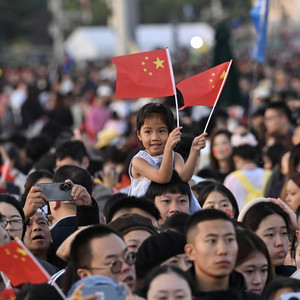
Wednesday marks the 76th anniversary of the founding of the People's Republic of China.
Crowds gathered in Tiananmen Square in Beijing for the flag-raising ceremony.
A 96-member honor guard escorted the national flag to the square.
The national anthem rang out as they raised the flag at sunrise.
Visitors to the square started gathering the night before to witness the ceremony.
The Hong Kong Special Administrative Region also held a flag-raising ceremony led by top officials.
Hong Kong's planned different activities to celebrate National Day.
Macau raised the national flag during a ceremony in Golden Lotus Square.
Chief Executive Sam Ho-Fai witnessed the ceremony with officials, residents and tourists.
China expects to see a travel boom during the eight-day National Day holiday, with passenger flows to peak on the first day of the vacation.
The rail network estimates 23 million passenger trips and has added over 2000 passenger trains, while expressway traffic is expected to witness twice the daily volume.
Nearly 20,000 flights are expected on Wednesday, an increase of around 4% on a yearly basis.
Scenic spots across the country are celebrating the holiday with various activities.
In Henan province, the Yuntai Mountain Cliff bears a nearly 300 square meter flag.
Thousands of flags flutter in the streets and public spaces in the city of Ordos, in the Inner Mongolia region, as well as in the districts and iconic spots of the Hong Kong and Macau Special Administrative Regions.
In Fujian province, national flags and red lanterns deck quaint buildings.
And for more on National Day, Huang Fei reports from Guangzhou on the festive atmosphere.
Food and shopping are, of course, at the top of the holiday agenda here in Guangzhou, at the Xiangxiangzhou pedestrian street.
And the holiday crowd is out at full force.
There's a massive crowd. food festival happening on that side where you could taste hundreds of local delicacies, not just from here in Guangdong, but also from all across China.
And it's quickly become one of China's most busy pedestrian streets, attracting 600000 people on its peak day.
30 years ago, almost to this day, Changsha Joe opened as China's first pedestrian shopping street.
And last year, it attracted 20 million people.
And just to keep things fresh, organizers are throwing things like fashion shows, culture shows and, of course, food festival, just to give people as much to explore.
But of course, the festivities are happening right across Guangdong.
Travel is booming.
On the eve of the holiday, in fact, we saw 10 million trips made. on the province's highways.
This was a new record.
And at the same time, at the Guangzhou South Railway Station.
Passenger numbers throughout this eight-day holiday are also expected to surpass 825 million, which is also going to be close to an all-time high.
Now, this time, we're also expecting a lot of travelers coming right across the border from Hong Kong and Macau, taking advantage of the ever more convenient cross-border travel on intercity expressways and high-speed rail networks.
Finally, true to Guangzhou's nickname, the Flower City, we can also expect a wide range of flower lantern shows happening throughout the week throughout the city to celebrate not just the nation's birthday but also the upcoming national games happening across the Greater Bay Area.
So lots to look forward to this holiday season.
That was Huang Fei in Guangzhou.
With China's eight-day Golden Week national holiday underway, many global destinations are seeing a surge in Chinese tourists, and Turkiye is among the top destinations.
Michal Bardavid reports from Istanbul as she spoke to tour guides there.
Turkiye, a bridge between east and west, offers a travel experience like no other.
It's no surprise that it continues to attract Chinese visitors everywhere.
Especially to Istanbul, where the Bosphorus Strait connects Europe and Asia.
First of all, it's a historical center.
We always say it, the capital of many ancient civilizations.
It holds both history and natural beauty.
Because Istanbul also brings together different human cultures within itself, it's usually a city that really satisfies them.
Istanbul is home to iconic landmarks like the Hagia Sophia Grand Mosque, once the largest Eastern Roman church and now a UNESCO World Heritage Site.
The Blue Mosque, Topkapi Palace and Basilica Cistern are also among the must-sees for many Chinese tourists.
What I've seen over the past 15 years is that they're really impressed by the warm hospitality of Turkish people here and our friendly attitude toward them.
They see us as if we're one of them.
In fact, they don't expect that kind of reception before they come.
Gülay Kalemköy Fırat is the owner of Flex Tourism and Travel Agency.
Fluent in Mandarin and a former tour guide herself, she says travel to Turkey is already smooth for Chinese visitors, but there's still room for improvement.
They get an electronic visa to come to Turkey.
The e-visa is issued either by themselves or through the agency from which they purchased the tour.
All done digitally.
I think it would be much better if the visa requirement were removed altogether.
Turkey and China enjoy strong bilateral ties.
Earlier this year, the country's presidents met at the Shanghai Cooperation Organization Summit, where Turkish President Recep Tayyip Erdogan emphasized a desire to deepen cooperation in tourism and cultural exchanges.
Fırat, who also practices Tai Chi in Istanbul, says incorporating sports and cultural performances into tourism can boost engagement and mutual understanding.
For example, if they were to come to Turkey and put on tai chi or kung fu shows to organize events, it would both promote Turkey and create a cultural exchange.
I believe cultural exchange is very important.
Tourism experts say October marks the peak season for Chinese arrivals to Turkey.
In Istanbul.
Many have already begun exploring, with popular next stops likely to include Cappadocia, Ankara and Pamukkale.
That was Mihal Bardavid in Istanbul.
Shenzhou, 20 crew members have sent warm holiday wishes to China and its citizens from aboard the Tiangong Space Station.
Taikunos Chen Dong and Wang Jie.
We are aboard China's space station, wishing our great motherland prosperity and strength, and happiness and well-being to people of all ethnic groups.
As the National Day holiday approaches, we are filled with excitement.
Moving forward.
We will continue with our scientific experiments and make all necessary preparations to welcome the crew of Shenzhou 21.
The Shenzhou 20 crew arrived at the space station in April and they've completed four spacewalks.
They're returning to Earth later this month.
Coming up, a government shutdown is underway in the United States.
Welcome to Climate Watch, the podcast that brings you the latest on climate change, energy and sustainability issues, all in under 30 minutes.
Each week, we speak with global experts, from energy policy pioneers to wildfire historians, uncovering the stories that matter most.
Climate Watch is your go-to source for insightful, inspiring conversations.
Tune in to Climate Watch on your podcast platform and let's navigate the path to a sustainable future together.
And nine minutes past the hour.
Partial government shutdowns taking effect in the United States.
The first since 2018.
It threatens the jobs and pay of hundreds of thousands of civil servants.
Deep divisions between Democrats and Republicans prevented the White House and Congress from reaching a funding deal.
Jim Spellman has more in Washington.
What this is going to mean in the short term is going to be about 750000 government employees will be furloughed.
They will not be going to work.
Some services will be cut.
Other things will keep operating.
Mail will keep being delivered.
Tariffs will keep being collected.
Social Security checks, Medicare checks, those will continue to go out.
The longer it goes on though, the more the impact will weigh on the larger economy, as well as many of these federal workers' personal economies.
Those are all things we've seen in past shutdowns.
What's different this time is President Donald Trump is also threatening to do major cuts in services and to have widespread permanent firings of some government employees.
So the last person that wants to shut down is us now.
With that being said, we can do things during the shutdown that are irreversible, that are bad for them and irreversible by them, like cutting vast numbers of people out, cutting things that they like, cutting programs that they like.
Essentially, this would be more of those Doge-style federal employee terminations that we saw earlier this year.
All of this coming from the White House designed to put more pressure on the Democrats.
And as this goes on, what's going to play out here in Washington is going to be seeing which side feels like they can sustain the political damage of a shutdown for the longest.
The Democrats here are trying to find some way to exert leverage.
They They don't control the White House.
They don't control the House of Representatives.
They don't control the Senate.
So they're trying to flex what little muscle they have by stopping this continuing resolution to keep the government funded.
But that's very risky.
It could turn out that the political damage done by this shutdown is greater than any potential political advantage the Democrats may see for themselves.
That was Jim Spellman on a partial government shutdown in the U.S.
The US president says drug maker Pfizer has agreed to lower drug costs and invest 70 billion US dollars in US manufacturing under a deal struck with the Trump administration.
Donald Trump made the announcement with Pfizer CEO Albert Borla at the White House.
And it came as the Republican president has for months sought to lower drug costs.
This is a critical step forward to our work and to improve healthcare and hardworking low-income Americans, especially low-income Americans, who will be helped so greatly.
In addition, Pfizer has agreed to provide some of their most popular current medications to all consumers at heavily discounted prices of anywhere between 50 and even 100 percent.
That's off the price.
And, in some cases, even more than that.
These drugs will be available for direct purchase online at a website operated by the federal government.
Under the agreement, New York-based Pfizer will charge most favored nation pricing to Medicaid and guarantee that pricing on newly launched drugs.
That involves matching the lowest price offered in other developed nations.
Pfizer, one of the largest US drug makers, produced the COVID-19 vaccine, Comirnaty and the treatment Paxlovid.
Trump has been talking for months about the need to lower drug prices.
He issued an executive order in May giving drug makers 30 days to electively lower prices or face new limits on what the government will pay.
U.S.
President Trump and his Secretary of War, Pete Hegseth, have told hundreds of generals, admirals and top US commanders from around the world that they are renewing the warrior ethos in the US military.
The Trump administration also called on ending what they called a generation of woke in favor of fighting wars.
Karina Mitchell reports.
Unprecedented in peacetime.
Military commanders summoned at short notice from US bases across the globe to hear from the man Washington now calls its Secretary of War, Pete Hegseth.
This was a combative speech vowing to restore a warrior culture to the US military and scrap what Hegseth called the woke policies of the past.
For too long, we've promoted too many uniformed leaders for the wrong reasons based on their race, based on gender quotas, based on historic so-called firsts.
We've pretended that combat arms and non-combat arms are the same thing.
We've weeded out so-called toxic leaders under the guise of double-blind psychology assessments, promoting risk-averse go-along-to-get-along conformists instead.
You name it, the department did it.
Foolish and reckless political leaders set the wrong compass heading, and we lost our way.
We became... the woke department, but not anymore.
But I look out at this group.
Hegseth called out some generals who have been dismissed by name and doubled down on his controversial views on women in the military.
When it comes to any job that requires physical power to perform in combat, those physical standards must be high and gender neutral.
If women can make it, excellent.
If not, it is what it is.
If that means no women qualify for some combat jobs, so be it.
Hegseth called for stricter physical standards and fitness tests for enlisted soldiers, whether they're in the field or work at a desk.
U.S.
President, Donald Trump Commander-in-Chief, in a long and mostly political speech, echoed his controversial Secretary of War, recalling the past and pledging to support the military in the future.
Together we're reawakening the warrior spirit and This is a spirit that won and built this nation.
And in this effort, we're a team.
And so my message to you is very simple.
I am with you.
I support you.
And as president, I have your backs 100%.
However, the US military has faced cuts in the senior ranks recently, with women and officers of color controversially sacked and staff positions at the Pentagon cut.
Trump's Department of War is also set to release its new national defense strategy, which will reportedly focus on an America-first agenda, concentrating more on hemispheric security rather than traditional areas of attention Europe, the Middle East and Asia.
The Trump administration is asking allies to pay more for their own defense, while the US focuses on shipbuilding, missile defense technology and overhauling its nuclear forces.
For a self-described president of peace and his Secretary of War, this unconventional gathering of top brass, perhaps a signal of the seriousness of the message being conveyed?
That was Karina Mitchell reporting.
US news outlet Axios reports that Qatar, Egypt and Turkey have urged Hamas to give a positive response to Trump's proposed peace deal.
The three countries met in Doha on Tuesday.
The Qatari foreign ministry, which has tried to mediate a ceasefire between Hamas and Israel, says the two sides need to reach a consensus before Israel's assault on Gaza can end.
Trump has given Hamas three or four days to accept his plan or face severe consequences.
Rami Almagari reports from central Gaza.
The people's reactions towards the plan announced yesterday by Donald Trump, Mr Donald Trump, President of the United States, and his administration are variable.
They are swinging between... hope and despair.
Some people.
They told us that they want the deal to come as near as possible because they are fed up with what's going on here on the ground.
The war that is continuing, the devastation, the lack of health, the lack of food, the lack of sanitation, all these problems that have been actually caused by the war.
They don't want to see them.
And on top of them is the displacement that is continuing that.
On social media, we have noticed that the people just write up cautiously about their reactions towards this plan because of the fact that this plan seems ambiguous.
Some of those we interviewed believe that Hamas is being squeezed now more than ever, and they might understand that Hamas might not respond positively to that plan because of the previous statements by Hamas that they want to go into a deal with Israel until Israel withdraws from the Gaza Strip.
And they also stated that they will deal with any force that comes over to Gaza to control Gaza as an occupying force or as an enemy force.
The people here are just swinging between hope and despair.
That was Rami Almagari reporting.
Eight Arab and Muslim-majority countries have released a joint statement welcoming the United States' ceasefire plan for Gaza.
Several of the proposal's points align with Egypt's foundational plan for peace from earlier this year.
The statement stresses that the nations will support Trump's plan as long as it leads to a lasting peace through a two-state solution.
Adele El-Marouki has more from Cairo.
The Trump vision announced on Monday calls for regional guarantors to ensure that Hamas and other armed Palestinian factions complied with the quote.
New Gaza vision.
It puts Egypt under the spotlight, as it is the only country other than Israel that shares a border with Gaza.
Egypt earlier had announced that, along with Jordan, it is training thousands of Palestinians to become a police task force, which Trump showed support for on Monday.
All trainees have been vetted to ensure their loyalty to the Palestinian Authority.
Like Trump's plan, Egypt earlier suggested that an independent Palestinian committee manage Gaza until the PA is empowered to lead.
Cairo also called for a path that would lead to a comprehensive peace.
Among the eight countries, however, some concerns remain.
Israeli Prime Minister, Benjamin Netanyahu, said Israel won't fully withdraw its troops from Gaza until the plan is fully implemented.
One article calls for the disarmament of resistance groups, dismantling their military infrastructure and not building it, which some considered vague wording that may allow Israeli troops to remain in Gaza indefinitely.
In addition, the occupied West Bank was not mentioned in the plan at all.
The joint statement signed by foreign ministers of Egypt Jordan, Saudi Arabia, the UAE Qatar Turkey, Indonesia and Pakistan insists that the West Bank must not be annexed by Israel and that it must be fully integrated with Gaza as part of a Palestinian state.
They also insist on full Israeli withdrawal from Gaza.
Egypt and Qatar say they handed over the proposal to Hamas leaders who are studying the document.
Turkey will be joining the two countries in all future mediation efforts as a major regional power.
On Tuesday, Egyptian President Abdel Fattah el-Sisi called all remaining countries of the world to recognize the state of Palestine in order to help build momentum for reaching lasting peace in the Middle East.
That was Adele Al-Marouki in Cairo.
Coming up, a strong earthquake in the Philippines has killed at least 69 people.
To buy or not to buy?
That's the question.
China is easing property restrictions and loosening cross-border financing rules to draw more foreign buyers.
Is this a last resort to boost its housing market?
How much appetite does foreign capital have for Chinese real estate?
Which cities are likely to stand out for overseas investors?
And what further reforms are needed to bring in capital without tipping the balance?
Tune in to The Chat Lounge this week, wherever you get your podcasts, and on CGTN Radio as we break down the changes that might reshape China's property market.
Rescuers continue to search for survivors after a magnitude 69 earthquake struck the central Philippines late on Tuesday, leaving at least 69 people dead and over 150 injured.
Authorities warn the number of casualties could climb.
Gretchen Malalet in Manila has the latest.
People are still on the edge in the Cebu province, as the Philippine Institute of Volcanology and Seismology has recorded more than 100 aftershocks overnight and some reaching as high as magnitude 51.
That constant shaking kept families awake the whole night.
So many were too afraid to return to their homes, and instead they spent the night outside, gathering in fields, parking lots and along the road sites.
The hardest hit areas, including Dahan Bantayan, Medellin, San Rimigo, and Bogos City.
So these are the towns that have been badly hit by the earthquake.
And these towns, concrete homes, and commercial buildings were damaged.
There were deep cracks, split open asphalt roads and power was cut off to entire communities, and also communication lines, leaving thousands without cell phone signals and in darkness.
And some of Cebu's centuries-old churches, while many dating back to the Spanish colonial period also suffered serious structural damages.
Their bell towers were fractured and their stone walls went crumbling down.
The national government has already mobilized multiple agencies to support rescue and relief operations.
The northern part of Cebu, and disaster management teams, together with police and the firefighters, have been deployed across the hardest hit towns.
Well, in San Remigio, crews are still clearing debris at the collapsed sports complex where a basketball game was underway last night and five people were killed and several others injured.
So rescuers are continuing to search in case anyone remains trapped.
That was Gretchen Malalad in Manila.
Indonesian rescue workers are still searching for survivors from a school collapse in the province of East Java.
At least 91 students are unaccounted for, along with three confirmed dead and around 100 injured.
The structure fell on top of hundreds of people in a prayer hall at the century-old Al-Hazni Islamic boarding school on Monday.
Authorities say the school was undergoing an unauthorized expansion to add two new stories.
Collapse sent slabs of concrete and other heavy debris crashing onto the students below.
More than 300 workers continue to work desperately at the scene, trying to reach survivors trapped below.
Of the approximately 100 injured, 26 are still hospitalized and many suffered head injuries and broken bones.
Authorities say the search is difficult due to unstable parts of the building.
Rescuers have been running oxygen, water and food from narrow gaps to those still trapped in the debris to keep them alive.
Some of them are pinned in place.
South Korean presidents vowed to sharply increase defense spending and introduce a variety of high-tech weapons as part of efforts to build a more self-reliant military.
And it comes as U.S.
President, Donald Trump's America First agenda raises questions about the US security commitment to its Asian ally.
In an Armed Forces Day ceremony, Lee Jae-myung repeatedly stressed the need to build a more independent military that can defend the country on its own.
With unwavering pride and confidence in our defense capabilities, we must now advance toward a strong and independent national defense.
In a rapidly changing security environment, self-reliant defense is not a choice, it is a necessity.
To ensure the peace and prosperity of the Republic of Korea, we must not rely on others.
We must strengthen our own power.
Lee says his government would increase next year's defense spending by 82 to introduce advanced weapons systems like AI, combat robots, autonomous drones and precision attack and defense missile systems.
He also says the government will improve soldier welfare by upgrading their service conditions and compensation.
Tariff war instigated by Trump's administration and his transactional approach to security threatens to erode South Korean trust in the US.
In sports, Yannick Sinner was back at his best in a 6-2 win over American teenager Lerner Thien in the ATP China Open Final, as the world number two picked up his third title of the season.
The four-time Grand Slam champion came into the title match at the National Tennis Center after a hard-fought semifinal win over Alex DiMennar, during which he struggled with physical problems caused by a stomach bug.
However, there were no signs of discomfort in his first meeting with 19-year-old Tien, as Sinner looked solid throughout that match.
The 2023 champion sealed the win to become the second man to claim multiple titles at the ATP 500 tournament after Novak Djokovic.
Carlos Alcaraz claimed the Japan Open crown in Tokyo on Tuesday with a 6-4 6-2 victory over world number five Taylor Fritz.
The Spaniard impressed throughout the week before sealing the title in straight sets.
The victory marks Alcaraz's eighth title of 2025.
Probably, unless the five minutes that I blamed my uncle and I was on the floor, but the rest of the tournament I just enjoy, every single second, which for me is just wonderful.
What I'm going to keep from these tournaments.
Really happy with the level that I played with everything.
Starting the week not really good with the ankle and the way that I came back from that.
Playing such a great tournament, such a great match I'm just really really happy about it.
After the match, he announced that he'll miss the upcoming Shanghai Masters due to injury concerns.
In the UEFA Champions League, Real Madrid beat Kazakh side Kairat 5-0 on the road for their second win.
Kylian Mbappe scored a hat-trick for his 13th goal in nine matches this season.
With two wins, Real is second on the table behind Bayern Munich.
Coach Xavi Alonso praised Mbappe's incredible performance after the victory.
He's at a point where practically every match is decisive.
He's effective, clinical in front of goal and we have to link up well with him.
We have to do a lot of things to create chances for him and today that was proven.
The other day, even in the derby, the first goal he scored was spectacular and we need to help him and let his quality flourish.
Elsewhere, Victor Osman scored an early penalty as Galatasaray stunned Liverpool 1-0 in Istanbul.
Liverpool also lost goalkeeper Alisson and striker Hugo Eketike to injury.
Jose Moreno enjoyed a warm welcome, but a disappointing return to Stamford Bridge.
A first-half own goal gifted Chelsea a 1-0 win over his new Benfica side.
Atletico Madrid smashed Frankfurt 5-1 at home for their first win in the league phase this season.
And monitoring body Glammos says Switzerland's glaciers have melted considerably over the past 12 months to log their fourth largest reduction in ice volume on record.
According to Glammos, a winter with little snow, especially in the northeastern part of the Swiss Alps, followed by heat waves in June, caused the glaciers to lose 3 of their total ice mass.
We're at 29 past the hour.
Beijing down to 17 degrees on Wednesday evening.
It's cloudy and 29 on Thursday.
Jinning, you'll see heavy rainfall overnight and 17 followed by a slight rain and 21.
Nanchang's down to 26 followed by sunny skies and 35 degrees.
Elsewhere in Asia, Islamabad's 21 overnight.
Thursday is sunny and 32.
Vientiane's 23 this evening, then a slight rainfall and 33 overnight.
Phnom Penh's at 24 overnight, then a slight rain in 32.
In Africa, Nairobi's getting some clouds and 28 degrees Celsius.
And that's it for this edition of the Beijing Hour.
In the second half of the program we have the story of a Chinese director who spent over a decade documenting China-Africa stories, using his camera to build bridges of understanding.
Making news.
Today, China's marked the 76th anniversary of the founding of the People's Republic with events across the country, including the flag-raising ceremony in Tiananmen Square.
And National Day also marks the start of the eight-day Golden Week holiday period that includes the Mid-Autumn Festival.
On behalf of the staff, Shane Biggum, in the Chinese capital, hoping you'll join us for the next edition of the Beijing Hour and open a window to the world together.
Listen up.
Can you hear the heartbeat of our world?
It's vibrant and pulsating with the essence of life itself.
From the stem of trees to the gurgle of rivers.
From the silent strength of mountains to the icy whispers of glaciers.
Even the solid ground beneath our feet, right there, in the midst of all beast, a heart of humanity.
What if those other heartbeats were to stop?
Would ours keep on ticking?
Ever wondered what's actually going on in Africa through the perspective of an African?
How are things really going between China and Africa?
What's the narrative of this relationship?
Well, get a perspective with China Africa Talk.
Hear from African diplomats, entrepreneurs, academics, Chinese natives and more.
Get on our wavelength every week to find out what's real with China Africa Talk.
Find us on your favorite podcast.
We'll see you there.
East to west, people in China are chasing their dreams and leaving their mark.
Want to know how they beat the odds and made a difference?
Footprints brings you the true life stories of their journeys.
You're listening to China Africa Talk.
Hello, I'm Bridget, and I'm here to tell you about China and Africa.
You are listening to the China-African Dialogue with Bridget.
Everything China, everything Africa.
Hello, you are listening to China-Africa Talk with Bridget.
Ladies and gentlemen, welcome to the Chinese-Arab dialogue with Bridget.
Hello and welcome to this special series of China-Africa Talk where we bring you a six-episode feature together forward to mark the 25th anniversary of FOCAC, the Forum on China-Africa Cooperation.
I'm Bridget Mutambirwa.
In this special feature, we meet the people at the heart of China-Africa ties, showing how FOCAC's vision is shaping lives and futures.
Where do your impressions of China and Africa come from?
A Chinese director has spent over a decade documenting China-Africa stories, using his camera to build bridges of understanding.
This is the story of his journey.
There's a popular saying among Chinese people who've spent time in Africa.
You fear Africa before you go.
You love it while you're there.
You miss it after you leave.
Zhang Yong is one of them.
His African journey began in 2012 during his PhD studies in film and media.
Back then, most academic research focused on Western cinema Hollywood Europe, even Asia and the Middle East.
But no one had done a comprehensive thesis on African film.
I thought, why not be a pioneer?
So I reached out to experts including a Nigerian professor in the US, and began field work.
Soon, I was meeting African directors attending film festivals, and in 2014, I went to South Africa to assist on a documentary about Chinese communities.
That lays the foundation for what became the first doctoral dissertation in China on African cinema.
It's still one of my proudest achievements.
That research opened the door for Zhang to make his own China-Africa documentaries.
For him, documentaries are more than art.
They are a tool for bridging mutual understanding.
My interest in China-Africa documentaries began with my research, but I realized academic writing alone wasn't enough.
Very few Chinese productions about Africa resonated with African audiences and even fewer were widely shared.
Since our field is practice-oriented, I thought, why not pick up the cinema myself?
That's how I started documenting the many details and faces of China-Africa exchanges.
In 2014, Zhang Yong took his first steps in Africa, assisting South African director Faik Dyer.
On Isolation to Integration a doc film about the history of the Chinese in South Africa.
A year later, he launched his own project, Africans in Yiwu.
He started with a one-person team with only one camera.
When I first started, it was tough.
I had no stable team. just one camera and a lot of passion.
Africans in Yiwu has many single-camera shots that I've filmed myself, including interviews with Somalia's ambassador to China, Ho Dan.
Things are more professional now, with multiple cameras, but back then it was pure determination.
For Africans in Yiwu Zhang, teamed up with Holden Osman Abdi, now Somalia's ambassador to China, then a PhD candidate.
Africans in Yiwu was truly my first deep collaboration with an African director.
At the time, Ho Dan was still a PhD candidate at Zhejiang University and neither of us had much practical filming experience.
Our background was more in film theory, so the project became a process of exploration and mutual learning.
From her I learned how to better understand Africans, their sense of time, their cultural aspirations and how they adapt to life in China.
She was constantly working with us to find common ground.
I came to realize that documentary filmmaking itself is a continuous process of learning.
Whenever you take on a subject, you need to become familiar with that field.
For example, when studying Africans in Yiwu, we also compared their experiences with those in Shanghai Wenzhou, Beijing or Guangzhou.
Even though many were engaged in business, the nature of their work and lives varied from city to city.
At that time, I had only been to South Africa and knew little about other African countries.
Even my co-director Hodan was from Somalia, but I had never been to her country.
We often joked about that, yet through the filming process following her lead, we met more Africans and gained a deeper understanding of the cultural diversity across African nations.
Looking back, I learned so much from that collaboration.
And I'm especially proud today that Ho Dun is now Somalia's ambassador to China.
It feels incredible to say that our little documentary team produced an ambassador, something that makes me very proud.
For Holden Abdi, that coal production, which started as a small project, grew into something larger.
I think we need to go back to actually late 2015, when we met at an academic conference, Zhang Yong and I.
We were both doing our PhDs and we were doing research on African film and TV.
So we found ourselves in the same circle and we just started talking.
And through our chats we started talking about how There's a lot of misrepresentation of the presence of the African community and the African people here in China, especially in a lot of documentary films that were out at the time that were mostly trying to portray a very negative image with regards to the experiences of the African community in China.
So we were just going back and forth and we had so many different ideas and then Zhang Yong came up with the idea saying oh, why don't we start with your story?
Can we start filming your story?
What's your experience in China like?
And then it was very close to the time of my graduation, I was graduating from my PhD at the time.
So John Young took a train and came all the way to Hangzhou and brought this camera.
It was just him and myself with no film crew.
And we just started talking.
We started filming while I was driving, filming while I was changing, filming while I was reciting and getting ready for my graduation speech.
So then, after a while, we found that the story came out pretty well, but it would stand out better if it was in the middle of a bigger context of different characters and different experiences and different views from different people.
We ended up working in the same institute, the Institute of African Studies at Georgia Illinois University.
So after graduation I joined the institute and so did Zhang Yong.
So during our work there, we were very fortunate enough to find support to film a longer series and we decided to follow the lives of 21 African individuals who were at the time living in Iwo, by following their lives and just filming different occasions, different contexts of their daily lives throughout a period of a year and a half.
We ended up with the Africans in Yiwu the way that you see it now, portraying these characters and sharing a deeper story about what it actually feels like to be an African coming to China for the first time different language, different culture, but still managing to find life love, work and deeper meaning.
Hou Dan Abdi is encouraging more people to join Zhang Yong to bring people's hearts together.
I think we need more people like him.
He's extremely passionate.
He's my former colleague.
I've worked very closely with him.
His passion is at times annoying, to be very honest.
But at the same time it is also very, very inspiring to see somebody who's very young, who has set a direction for his life, has never thought to look elsewhere or veer away.
He's been very dedicated, he's been very passionate and he really wants to bring the people of China and Africa closer together through the lens of camera.
And I hope that a lot of people will be inspired by him his passion, his work, his dedication, his work ethic and we will see more works that bring our hearts together.
Since Africans in Yiwu, John has produced another four China-Africa documentaries, including Chinese Meet Africa, Generation Z's China-Africa Stories, China-Africa Factory and Tazara A Journey Without an End.
The Tazara Railway is a landmark of China-Africa cooperation.
For many Chinese, even if they haven't been to Africa, they've heard of Tazara.
Built in the 1970s, Tazara is China's very first foreign aid project.
Stretching 1860 kilometers from Dar es Salaam in Tanzania to New Kapiri Mpochi in Zambia.
The railway has been playing a key role in the economic and social development of the two countries and beyond.
That's why it's affectionately known as the Uhulu Railway or Independent Railway.
But Western media often distort its story.
John was motivated to show what's really going on the ground.
I noticed that the BBC made a documentary about the Tazara railway.
After watching it, I was deeply struck.
It portrayed the very first foreign aid project of New China as being in such a dilapidated condition.
But when I actually travelled along the Tazara, I discovered the reality was not like that at all.
The trains were still running twice a week.
And for many commuters in Dar es Salaam suburbs, it remained an important means of transport.
So why did the BBC only show desolation and decay?
Why was the truth situation concealed?
To me, documentaries shouldn't be made that way.
From what I learned in film studies a documentary must be fair, objective and diverse in perspective.
Yet I felt the BBC had imposed a preset theme and completely smeared the railway.
That's why I decided to start again.
I wanted to present it from a more diverse point of view.
So besides myself, we invited a foreign co-director, a Danish scholar, to join the project.
Through his eyes.
We travelled the length of the Tazara, experiencing its present condition, the local scenery and interviewing people along the way about what the railway means to them.
I believe a film made this way, with a more international perspective, can truly resonate and spread globally.
We all wanted to see a better Africa.
We all wanted to see a free Africa.
We all wanted to see an end to colonialism.
The Chinese government, the Chinese people committed themselves in, you know, in words and in deed, and in action.
Zhang Yong's efforts paid off.
His documentary resonated with audiences.
Zhang Yong's efforts paid off.
His documentary resonated with audiences.
Zhang Yong's efforts paid off.
His documentary resonated with audiences.
Zhang Yong's efforts paid off.
His documentary resonated with audiences.
Our documentary was broadcast in 10 African countries and even in some Western nations.
I remember in Tanzania, it reached a peak rating of 5.93, which is remarkably high.
Usually, breaking past one is considered very good, so surpassing five was an unexpected surprise.
It showed that local audiences truly appreciated the film.
It also proved that African viewers want to see works that present history and current realities in a fair and diverse way, works that show the real picture of China-Africa cooperation.
As scholars, I believe in telling real stories, not stereotypes, not slogans, but authentic lives and events.
Beyond making documentaries, Zhang Yong is a PhD supervisor at Zhejiang University, one of China's top education institutions.
For Zhang, nurturing the next generation of China-Africa storytellers is very important.
As a teacher, I encourage my students to explore Africa through film and media.
Several have already graduated with PhDs and are now working in universities or related fields in society.
I believe a teacher's primary goal is to cultivate talent.
Relying solely on my own efforts is certainly not enough.
Currently there's still a limited pool of talent in China focused on China African film, media and communication.
That's why I hope more people will join this field.
After all, many hands make light work.
Given the richness of China-African stories, why not invest some time and energy to explore them?
You might just discover a treasure trove.
The younger generations to come are undoubtedly the hope for deeper China-African collaboration.
John's PhD candidate, Xia Yiwen, recalls how her very first assignment was to draw a proper map of Africa, a task that laid the groundwork for her later research.
The very first task Professor Zhang gave me was to learn how to draw a map of Africa.
It took me nearly a week to memorize it.
Eventually I could sketch it from memory and I knew which countries were in North Africa, East Africa and West Africa, along with their economic conditions, climates and geographical locations.
I even came to understand what the island of Madagascar actually looks like.
That exercise gave me a basic but essential foundation to start understanding Africa's geography, culture and economy.
It laid the groundwork for my research.
Now my main focus is on post-colonial African cinema, which involves a lot of historical study as well.
Professor Zhang, on the other hand, is particularly strong in China-Africa media and international communication.
So, under his broader framework and encouragement, I've been able to pursue my own branch of research.
Another of John's students, Abu Baker Hayati from Sudan, says he's discovering more about his own continent through the guidance of his Chinese professor.
I'm taking him as like also old brother because like they think that really I learned it from him.
I'm African.
I learned too many stuff really from him. he talk about the culture he talk about like too many sensitive stuff in for example in some countries i don't know about it i came from sudan i i just like i'm more focused about like north african countries but for me maybe this will be shocked for you also the first time i hear tinga tinga from him can you imagine and i like that that in tanzania and i'm from sudan i hear tinga tinga just like from him the first time and even like i immerse myself with the african group and like african friend after i know him through his documentaries so then i start know and like my mind start really raised and open about like really how is the african society and african culture Zhang Yong's vision is aligned with Zhejiang University's global talent initiatives.
Zhu Hui is the deputy party secretary of Zhejiang University.
Since 2018, our university has established 54 overseas practice projects across 21 Belt and Road countries, many in Africa.
Every year, nearly 100 graduate students participate, engaging in education technology, engineering and cultural exchanges.
We have exchange programs with African countries, such as South Africa and Morocco.
And we are expanding the exchanges to countries such as Ghana, Nigeria, Algeria, and Mauritius.
Zhang is now working on two more documentaries.
His goal, ten China-Africa documentaries by age 45.
I have a small dream.
Before turning 45, I want to make ten China-Africa documentaries.
I've been working on my sixth and seventh.
In the next six years, I will complete the last three with as much collaboration as possible.
China has established strategic partnerships with all African countries that maintain diplomatic ties, elevating their relations to an all-weather China-Africa community with a shared future for a new era.
Amid this growing momentum of cooperation, 38-year-old Zhang Yong is dedicated to doing his part, using his camera to document exchanges and tell the stories of ordinary people whose lives reflect this partnership.
Our Chinese-African cooperation is to implement specific people, specific stories.
Our cooperation between China and Africa is rooted in specific people, real stories and concrete events.
To me, history is essentially the collection of these individual stories.
As a documentary filmmaker and scholar, I want to use my skills and my lens to capture this part of history.
I believe these efforts will hold lasting value in the future.
And for many Chinese devoted to China-Africa friendship, Zhang Yong included, there comes a realization that their understanding of the continent remains limited.
That humility, deepening with time, brings with it a renewed urgency to keep learning and engaging for the years ahead.
Looking back, I have traveled to more than a dozen African countries, but my understanding of Africa is still limited.
Now I feel a greater urgency.
Can I visit all African nations before I retire?
Can I revisit the key ones more often?
When I was younger, I thought going once meant I understood.
Now I know what I don't know.
That makes me even more anxious.
With the limited time and energy I have, I want to spend more time walking the African continent, writing my research directly onto the land of China-Africa exchanges.
The key outcome of the 2024 Forum on China-Africa Cooperation Summit in Beijing is the implementation of the Partnership Initiative for People-to-People Exchanges spanning 2025 to 2027.
Under this initiative, China will launch 10 dedicated people-to-people exchange programs and collaborate with African nations to advance the China-Africa Cultural Silk Road project.
Specific measures include inviting 1000 African professionals from the culture and tourism sectors to China for training and executing a cooperation plan for innovation in radio, television and audiovisual media.
Furthermore, 2026 has been designated the year of China-Africa people-to-people exchanges.
As interactions between the two sides continue to grow, more individuals like Zhang Yong will undoubtedly emerge, dedicating themselves to fostering mutual understanding and strengthening the time-honored friendship between China and Africa.
On the 25th anniversary of FOCAC, the Forum on China-Africa Cooperation, CGTN Radio presents a special feature series Together Forward, showcasing the breadth and depth of the China-Africa Partnership.
Clean water projects in Zimbabwe.
New classrooms in Botswana.
Grand innovation in Kenya.
Agricultural training in Handan.
Vibrant trade in Yiwu.
And a documentary producer's journey in Hangzhou.
These are the stories that bring this partnership to life.
We have trained a group of high-quality talents in Africa who understand agriculture, love rural areas and care for farmers.
This small drilling program will go a long way in addressing this critical need.
All over the world, I never see one country like China, especially like you.
So this becomes more productive, cost-effective, and more free land.
I have a small ideal.
Before turning 45, I want to make 10 China-Africa documentaries.
This school is beautiful.
And like I'm saying, everybody wants their learners to be here.
Join us in celebrating 25 years of Folk Art.
Stay tuned with China-Africa Talk and discover the real impact of China-Africa cooperation and how we're moving forward together.
Find The Beijing Hour at precisely 6pm Beijing time.
We meet you on podcast and on air every weekday.
The Beijing Hour, your window on China and the rest of the world.
He can't live without the Yellow River in his eyes.
The Yellow River is so noble and elegant.
Both my grandpa and dad made a living from the river.
Would you like to move away from the Yellow River?
I don't think I will.
I love it so much.
The Yellow River, the second longest river in China, is regarded as a shaping force in the history, economy and culture of northern China.
Today, about 100 million people live within its water basin, making up nearly 9 of the country's population.
How is climate change felt at its headwaters?
And what are the locals doing to cope with it?
What are the descendants of the boatmen doing?
What has kept some people from leaving their home village by the river?
And what has drawn others back?
Could the fading fishing community revive in a time of digital transformation?
From 2021 to 2024.
Our reporters visited the upper, middle and lower reaches of the Yellow River, talked to the herders farmers boatmen, fishermen and eco-activists who share a close bond with the river, and present their stories in pictures, podcasts and videos, all in our 12-part series, The Yellow River Mosaic, available only on CGTN Radio.