Get the unmissable news stories of the day.
This is the Beijing Hour.
Examining the events that impact and shape China and the rest of the world.
This is the Beijing Hour.
One hour of news and information brought to you every weekday.
Now here's your host.
Du Hongyu with you on this Wednesday, December 10th, 2025.
You're listening to the Beijing Hour, coming to you live from the Chinese capital.
On today's program...
Chinese Premier Li Chang calls for openness and cooperation in global economic governance.
The China-proposed Group of Friends of Global Governance is established and the UN.
And China demands Japan reflect on and correct its mistakes and retract the Prime Minister's remarks on the Taiwan region.
In business, China's consumer price index in November.
In sports, Liverpool snatch crucial win at Inter amid escalating Salah's lot fallout.
In culture and entertainment, the theme and logo for China Media Group's 2026 Spring Festival Gala.
Now, today's top stories.
Chinese Premier Li Qiang has stressed that openness and cooperation remain the most effective way to spur economic growth, stabilize supply chains and drive technological upgrading.
He was speaking during the 1 plus 10 dialogue in Beijing with leaders of major international economic organizations, including the WTO, the World Bank and the IMF.
Premier Li called for greater market access, opposition to the politicization of trade issues and deeper collaboration in innovation to foster new growth drivers.
He added that China's newly adopted recommendations for the 15th five-year plan will support steady economic momentum and unlock greater market potential.
The attending leaders praised China's sustained growth and its commitment to multilateralism, saying they look forward to expanding cooperation with China in such areas as trade, green development, AI and financial stability.
For more.
Tianyu spoke with Zhou Mi from the Chinese Academy of International Trade and Economic Cooperation.
Professor, Premier Li Qiang talked about expanding mutual market opening, avoiding the politicization of trade issues and boosting international cooperation on innovation.
So, with global trade barriers on the rise, why does openness and cooperation matter so much right now?
Well, we know that for the different sizes economies and for different times, the openness and cooperation are both important.
So like for the smaller economies, they depend a lot on the cooperation with other countries.
They cannot produce everything.
So they have to import something from other countries and also export it to other markets to benefit from the international trade.
Well, for the larger economy like the China, EU or even United States, I think these major economies, they have super large abilities in the global supply chains.
So if they are not able to share these opportunities with their trading partners, I think that the other countries will definitely suffer from this closeness or some kind of a dis-cooperation.
Well, in the short term, I would say, the openings are making us possible for us to deal with a different situation by using the resources in a better way.
And for the longer term.
I think it's also important for us to think about what we can do to improve the status and trying to introduce more innovation abilities and cope with different areas to solve the problems, like climate change or other issues.
So for the longer term, I think it's also very important.
In such a kind of time, we should do more to improve the openness and cooperation which is very important and beneficiary for all of us.
Right.
So this dialogue focuses on working together on global governance and global development.
So how can China's cooperation with major international economic organizations help drive shared development around the world?
We know that China and also other major economies, they have promised a lot of commitments in the international organization.
Like in WTO, we committed to lower our tariff, to reduce the non-tariff barriers and also open our market.
So for us, I think it's a real important time to show our attitudes towards those kind of commitments.
Well, I think that China is one of the major economies in the world.
We are the number one in the trading regime.
So if we stick to this principle, I think that the world has more confidence that they can still stick to the globalization.
Well, I think there are still a lot of other issues, like when we talk with international organizations to discuss about the new issues, about the digital economy and how can we deal with these new changes.
When we are talking with them, I think that we are bringing that on the table.
What kind of things can we do to improve the role-based system?
And that is really important for us, for the enterprises, to deal with the uncertainties in the future.
And I believe that the cooperation between China and the international organization are also quite crucial for the world because our trading partners, other countries, they depend on the certainties of the expectation of the market.
If they are able to think that the world definitely will go on to improve its cooperation based on some of the rule system.
I think that is really important for them to deal with these uncertainties.
So we need to do more.
China has a very important role in this regard.
That was Zhou Mi of the Chinese Academy of International Trade and Economic Cooperation.
On the coast of Jiangsu province in East China.
The country's offshore wind ambitions are rising as fast as its turbines.
Liu Jiaxin visited Yanchang, known as China's city of offshore wind power, to see how the fast-growing industry has fueled green transition over the past five years.
Along the 582-kilometer coastline stretching into the Yellow Sea, rows of giant wind turbines turn steadily above the water.
This is Yancheng, one of the most valuable offshore wind resource zones in China.
Standing by the seaside, the wind keeps blowing and bringing an endless stream of energy.
Each rotation generates the electricity enough for a person to consume for a whole day, or even longer.
I'll let you do the math how many rotations it can do, as one wind turbine can work as long as 25 years.
The components of a wind turbine are easy to see.
A base, tower, blades, hub, and the cell.
The total weight of a unit amounts to hundreds of tons, yet the city is able to produce them at scale.
Our wind power base in Yenching currently has the capacity to produce 1200 wind turbine units annually, and these turbines are exported to dozens of countries and regions in Europe America, Africa and Southeast Asia.
Through collaborative innovation across the entire industry chain, Gold Wind Technology has achieved 100 domestic production of key core components its wind turbine units.
While i was marveling at the actual size of even a single part of a wind turbine, technicians mounted massive peach bearings onto turbine hubs, components that will eventually control the precise angle of each blade, whose scale is truly worth seeing in person.
From wind to powers that one is catching the wind, That's where this large guy comes in.
It's a wind turbine blade.
It is 131 meters long with a reach diameter of 5.2 meters.
Wow, and it weighs 60 tons.
Get this, it takes only 10 days for China to produce one of these blades.
To improve power generation efficiency and better adapt to the environment on the sea.
Offshore wind turbine blades are not only longer than those on land, but also need to be lighter, stronger and lightning resistant.
We use high-strength carbon fiber materials to increase the blade stiffness and reduce its weight.
And we covered the entire surface of the carbon beam with copper mesh, which can conduct lightning strikes to the ground, thus protecting the blade.
To ensure blades of this size can withstand real-world scenarios at sea, there's a crucial step before they can be mass-produced.
Well, you don't see this every day.
These blades are undergoing fatigue testing.
Each new blade before mass production must undergo rigorous testing in such a large lab like this for like six to ten months.
The blades that swing up and down are undergoing flapwise fatigue tests, while the blades that swing left and right are undergoing edgewise fatigue tests.
They are subjected to millions of vibrations in the laboratory to simulate what they would be like after 25 years of operation in a wind farm.
This is like verifying a person's workability.
Yes, the test is to see if blades can work from the start of their careers until retirement, whether they can withstand some high-pressure jobs and whether they can stick to their daily work.
What we're seeing in Yancheng is not just the construction of wind turbines, it's the construction of an entirely new energy ecosystem.
And it reflects the direction China has taken nationwide over the past five years.
Last year, China accounted for 47 of the world's wind and solar installations and 63 of global annual additions.
In the first half of 2025, wind and solar accounted for nearly one quarter of China's electricity consumption.
Of the total electricity consumed nationwide, one in every three kilowatt hours comes from renewable sources.
The share of non-fossil fuels and national energy consumption increases by one percentage point each year.
Back in Yancheng, the city is not slowing down.
As a city where green electricity accounts for more than two-thirds of its power generation, Yancheng is continuing to advance offshore photovoltaics, green hydrogen production, energy storage and smart energy systems.
China is working toward a goal that by 2030, about a quarter of its total energy use will come from non-fossil sources.
As these turbines turn above the sea.
The country's energy shift will contribute to drive down global carbon emissions.
That was Liu Jiaxin reporting.
Coming up in the show.
The China-proposed group of friends of global governance is established at the UN.
Washington has just reversed the course again.
It's now allowing NVIDIA to sell its advanced H200 AI chips to China, with a hefty 25 revenue cut flowing straight to the US government.
Is this a strategic concession, a commercial calculation or the start of a new conditional export model?
Will Chinese tech giants rush to buy the H200?
Can Washington achieve its intended goals with a policy shift?
And will this prompt other governments or exports to reconsider their own restrictions on tech exports to China?
Get all these and more on this week's Chat Lounge, wherever you get your podcasts and on CGTN Radio.
Twelve minutes into the hour.
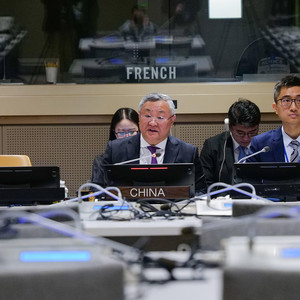
The Group of Friends of Global Governance has been officially established at the UN headquarters in New York.
The China-proposed group aims to enhance exchanges and cooperation in global governance.
Representatives from nearly 40 founding members attended the launching event.
China's Permanent Representative Fu Cong chaired the event.
The Group of Friends of Global Governance is an open and inclusive platform.
We believe more like-minded countries will join in.
We are willing to work with all nations to fully implement the Global Governance Initiative on the United Nations platform to promote the establishment of a more just and equitable global governance system, to jointly build a community with a shared future for mankind and create a brighter future for humanity together.
The group has also issued a joint statement saying its establishment is a significant step in implementing the global governance initiative.
The statement calls for joint efforts to uphold the outcomes of the victory in World War II, support the UN's role and coordinate actions on major global governance issues.
The ambassadors of Cuba, Burundi and Pakistan have praised the group's establishment.
Cuba warmly supports the global governance initiative presented by the President of the People's Republic of China, our good friend Xi Jinping.
We really believe that if we want to build a community of a shared future, we need an initiative like this.
A lot of problems we have now.
It is difficult to do it alone, but in rethinking the global governance by through global governance initiative proposed by the President, Xi Jinping, I am really confident that we could really change the world, create a new era and live in new international order.
You would have followed this meeting that launched the group of friends And it was very obvious from the statements that were made by the member states who have joined the group.
They see this as an initiative which is very timely because of the multiple crises that we face in the world today.
And there is an eroding confidence in the multilateralism and the role of the UN.
This initiative, which represents the global vision, the leadership of President Xi Jinping, and it builds on the earlier initiatives of the Chinese president.
We welcome it.
Former Egyptian Prime Minister, Assam Sharif, also praised the global governance initiative, saying it'll help promote equality and modernization.
I believe the most important global initiative is a global governance initiative which actually put the framework people, especially global South, that they can experience work with the world as equal.
That's the balance between, as I said, local modernization and global prosperity.
As an engineer, I came to my mind that China solved a very difficult equation the equation that balancing domestic modernization with the global responsibility
When I talk about domestic modernization, I'm talking about a systematic sustained, continuous process that starts with deep reform, high quality development and high standard opening up.
There are three items, but actually they shape how China is working inside and outside.
The point actually of the high standard.
Opening up means that China has a good intention to deal with the world with the best that they can do.
I want to say that China is not rising alone.
China is rising with the intention of lifting others.
The success of China is an opportunity for many.
Former Lebanese Prime Minister, Hassan Diab, shared his insights on the necessity of global governance in a multipolar world.
He said the world needs a framework that respects diversity.
For decades, we lived in a largely unipolar world.
But now we stand firmly in a multipolar global system where power, ideas and influence are widely distributed.
This shift is not a threat.
It is an opportunity, an opportunity to rethink how we cooperate, how we communicate and how we coexist.
In order to seize that opportunity, the world must do several things.
We must re-humanize humanity.
We must place dignity back at the center of international relations.
We need the humility to listen, truly listen to one another, not to respond or judge.
We must unleash the power of cultural diplomacy because, beyond political negotiations and strategic interests, we must learn to accept and respect the other view.
Furthermore, we must celebrate all facets of diversity, not only diversity of identity, but diversity of history, knowledge and pathways of progress.
Global governance today must also confront a rapidly changing technological landscape.
Artificial intelligence biotechnology, quantum computing and digital governance are transforming our world at a breathtaking speed.
These advances offer unprecedented opportunities but also profound risks.
This is why global governance must now extend to data ethics and the moral implications of technology.
In other words, we must place moral and ethical questions at the heart of global decision-making.
Chinese President Xi Jinping unveiled the Global Governance Initiative while addressing the Shanghai Corporation Organization Plus meeting in Tianjin in September.
Wednesday marks World Human Rights Day, commemorating the United Nations' adoption of the Universal Declaration of Human Rights in 1948.
Yet a stark reality remains, according to the UN's World Social Report 2025.
Over one-third of the global population lives on daily incomes of just $2 to $6.8.
For many, the right to development remains one of the most pressing human rights issues.
Jiang Tao reports.
A summit on deepening China-Africa cooperation on human rights, titled Practicing the Four Global Initiatives and Strengthening China-Africa Human Rights Cooperation, has just concluded in Jinhua, Zhejiang Province.
The forum focused on a crucial topic, raising awareness of the right to development.
Zhu Lishi, a law professor at Renmin University of China, was a key speaker at the event.
He explained why the right to development is particularly vital for developing countries.
For developing countries, rethinking the right to development is crucial.
Achieving consensus on it at the international level doesn't automatically translate into action.
In Africa, we have a special consensus.
Survival and development rights are fundamental human rights.
This stands in contrast to the West where, although the right to development is acknowledged, it lacks the universal agreement we see in Africa.
Xie Pengchen, director of the Human Rights Research Center at Shandong University, also weighed in.
First, China must share its development experiences with African countries.
We can tell them what has worked for us, and just as importantly, what pitfalls to avoid.
Secondly, we need to fully understand and even help articulate their developmental needs.
China's Global Development Initiative, guided by the principle of leaving no country and no person behind, seeks to create a fairer, more inclusive global development framework.
Talyn Rodriguez, a scholar from Cameroon and director of the Center for African Film and TV Studies at Zhejiang Normal University, praised this approach.
Putting development as core value of human rights is one of the concepts of what we call the global south China, in particular.
I do agree.
It is true that if you don't cover some basic needs, how will you stand in and talk of any right?
Zhejiang Normal University has long been a model of China-Africa cooperation, hosting over 200 training programs for African education leaders.
These programs have attracted more than 4000 participants, including senior officials, school leaders and experts from 49 African countries.
Through initiatives like the China-Africa University's 20 plus 20 Corporation Plan, China is helping African countries develop skilled professionals and supporting African students studying China, promoting knowledge exchange and laying the groundwork for sustainable development.
For the Beijing Hour, this is Jiang Tao.
You're listening to the Beijing Hour.
Coming up.
China demands Japan reflect on and correct its mistakes and retract the Prime Minister's remarks on the Taiwan region.
The Yellow River Mosaic is a 12-part series of multimedia stories featuring the people who live by the river and share a close bond with it.
Subscribe to Yellow River Mosaic on your favorite podcast platform or visit radiocgtncom for more in this program.
22 into the hour.
A Chinese foreign ministry spokesperson has urged Japan to reflect on and correct its mistakes and retract the prime minister's remarks on the Taiwan region.
Guo Jiakun called on Japan to face the root cause.
He also condemned Japan's moves to harass China's military exercises and training.
Sun Ye reports.
A fuller picture on the so-called radar illumination incident has come out in the last few days.
Japan had previously claimed that it had not received notification from China in advance, and now it has admitted that it has received notification from China in advance.
And Chinese foreign ministry spokesperson Guo Jiakun had said this afternoon that he's called out those Japanese behaviors as evasive and contradictory.
Tokyo previously asserted it had not received prior notice from Beijing, but has since acknowledged it was informed in advance.
This is an inconsistent and evasive position.
Tokyo has declined to explain why, despite receiving advance notifications, it nonetheless deployed fighter aircraft that entered China's exercise area without authorization to conduct close reconnaissance and harassment, thereby escalating tensions and continuing to sensationalize the issue.
Now Guo also goes on to urge Japan to face the root cause of the difficulties right now between China and Japan, and to reflect on and correct its mistakes and to retract Prime Minister Tai Kiyoshi's remarks on Taiwan.
Now on a relevant note.
Media outlets, including The Economist, have recently published commentaries that said the revival of militarism in Japan could only threaten regional and international stability.
Now, responding to those commentaries, Chinese foreign ministry spokesperson Guo had said that China has also noted a series of concerning moves or patterns in Japan.
Japan's defense spending has increased for 13 years straight.
And the five biggest defense companies in Japan had their revenue grow by 40 percent in 2024 alone.
And there are other concerning development stats, including amendments to the peace constitution, the lifting of bans of self-defense, collective self-defense, or rather
And there are also Japanese senior officials who are suggesting introduction of nuclear submarines.
Now Guo.
The spokesperson had said that Japan's military buildup and its arms expansion recently has already made neighboring countries and international communities, And that he also invoked the 1945 Posthumous Proclamation which required Japan to have full and complete disarmament and elimination of militarism.
And that is what Japan has accepted on reentering our international community.
Now Guo also goes on to say that if the revival of militarism in Japan goes on and goes in that direction, there could only be a new questioning on Japan's way in the future and new a renewed reckoning of its past crimes.
And China is also calling on all peace-loving countries to be vigilant and prevent the revival of militarism.
That was Sun Yeh reporting.
Residents who have lost nearly everything due to the deadly fire in Hong Kong two weeks ago are rebuilding their lives.
Tang Bo has more on how the locals have come together to support them in the weeks to come.
Another briefing held just before resettlement and photo-op support operations got underway.
Members of a local charity, the Taipo Community Care Team, and volunteers are now supporting residents displaced by the Wanford Court fire as they settle into temporary housing.
We received the affected residents from the fire at 930 pm after spending two hours working with the community care team to prepare supplies such as mattresses, hot meals and cleaning items.
We also mobilized Taipei residents through social media to help with transportation from the fire scene.
Residents at the site were reported to be exhausted, confused and under significant physical and emotional stress when they first arrived.
Nevertheless, as resettlement efforts move forward, many are beginning to adjust.
Some have even expressed interest in joining volunteer teams to support others in the same situation.
As the community care team responsible for local affairs, we are actively communicating with the district council to coordinate various follow-up efforts.
For example, this Sunday a traditional Chinese medicine clinic will be on-site to provide residents with follow-up health support services.
We aim to provide psychological and social work support, as people may experience emotional reactions of varying intensity as they begin to settle in.
For more severe cases, we will arrange for clinical psychologists to offer services and may even involve psychiatrists if needed.
A fire tests a city's emergency response while rebuilding assesses societal unity.
Here, we see the successful teamwork between the government and the community.
The wounds of Taipo are healing and the story of care continues to be written in the details of each day.
That was Tang Bo in Hong Kong.
It's 29 into the hour.
Let's check the weather.
Beijing will be cloudy with a low of minus 3 on Wednesday evening.
Thursday will be cloudy with a high of 3.
Tonghua will see sleet with a low of minus 9 tonight.
Thursday will be sunny with a high of minus 5.
Nanchang will be cloudy tonight and tomorrow with a low of 10 and a high of 23.
Elsewhere in Asia, Islamabad will be cloudy with a low of 9 this evening.
Thursday will be overcast with a high of 21.
Vientiane will see light rain tonight and tomorrow with a low of 16 and a high of 26.
Panopan will see moderate rain tonight and through tomorrow, with a low of 22 and a high of 31.
Now it's time for a short break.
So far this hour, Chinese Premier Li Chen has called for openness and cooperation in global economic governance.
The China-proposed group of friends of global governance has been established and the UN.
Dou Hongyu with you.
Stay with us here on the Beijing Hour.
Listen up.
Can you hear the heartbeat of our world?
It's vibrant and pulsating with the essence of life itself.
From the stem of trees to the gurgle of rivers.
From the silent strength of mountains to the icy whispers of glaciers.
Even the solid ground beneath our feet, And right there, in the midst of all, beats the heart of humanity.
What if those other heartbeats were to stop?
Would ours keep on ticking?
Ever wondered what's actually going on in Africa through the perspective of an African?
How are things really going between China and Africa?
What's the narrative of this relationship?
Well, get a perspective with China Africa talk.
Hear from African diplomats entrepreneurs academics, Chinese natives and more.
Get on our wavelength every week to find out what's real with China Africa talk.
Find us on your favorite podcast.
We'll see you there Examining the events that impact and shape China and the rest of the world.
This is the Beijing Hour, one hour of news and information brought to you every weekday.
Now here's your host.
Du Hongyu with you on this Wednesday.
Still to come, in business, China's consumer price index in November.
In sports, Liverpool snatch crucial win at Inter amid escalating Salah's lot fallout.
In culture and entertainment, the theme and logo for China Media Group's 2026 Spring Festival Gala.
To contact us, you can email radio at cgtn.com or follow our X account at cgtnradio.
Now first checking today's headlines, here's Tianyu.
Thank you, Hongyu.
The China Coast Guard says its fleet has patrolled the territorial waters of China's Diaoyu Dao, an island in the East China Sea.
An official statement said the patrol was carried out to safeguard China's rights in accordance with the law.
The Group of Friends of Global Governance has been officially established at the UN headquarters in New York.
The China-proposed group aims to enhance exchanges and cooperation in global governance.
Representatives from nearly 40 founding members attended the launching event.
China's permanent representative Fu Cong chaired the event.
The Group of Friends of Global Governance is an open and inclusive platform.
We believe more like-minded countries will join in.
We are willing to work with all nations to fully implement the Global Governance Initiative on the United Nations platform to promote the establishment of a more just and equitable global governance system, to jointly build a community with a shared future for mankind and create a brighter future for humanity together.
The group has also issued a joint statement saying its establishment is a significant step in implementing the Global Governance Initiative.
The statement calls for joint efforts to uphold the outcomes of the victory in World War II, support the UN's role and coordinate actions on major global governance issues.
UN Secretary-General, Antonio Guterres, is urging countries to step up funding for the UN's Central Emergency Response Fund.
The Global Humanitarian Overview for 2026 estimated that we will need 23 billion US dollars to reach 87 million people in most desperate need.
In many places, CERF has made the difference between life-saving help and no help at all.
This year, CERF has allocated US$110 million to neglected crises from Afghanistan to Somalia.
But Guterres warned the humanitarian system is under serious strain.
But even the most efficient engine cannot run without fuel.
In 2025, donor contributions fell sharply like never before.
This year's projected contributions are expected to be the lowest since 2015, a dangerous trend that weakens our ability to respond.
As a result, countless more people have died, Others have gone hungry or been left without health services, shelter and protection.
This is a moment when we are asked to do more and more with less and less.
And this is simply unsustainable.
Since 2006, CERV has provided nearly 10 billion in life-saving aid across more than 100 countries, reaching tens of millions of people every year.
The UN says the Secretary-General is deeply concerned about the continued detention of 59 UN staff members and dozens of NGO and diplomatic workers in Yemen.
UN spokesperson Stefan Dejarek says Houthi authorities have referred the cases of the detained personnel to a special criminal court, a move the UN strongly condemns.
Many of the staff have been held for years without contacts or due process, which the UN says violates international law.
The UN is calling on the Houthi authorities to withdraw the court referral and immediately release all detained workers.
And finally, the United Nations Children's Fund is calling for urgent action to protect the 5 million children displaced by the conflict in Sudan.
UNICEF says the civil war has forced about 10 million people from their homes and left more than 150000 dead.
The fighting has also pushed parts of the country into famine.
Children in Dafur and Kurdofan remain trapped with almost no access to food, clean water or medical care.
Women and girls face severe risks, including widespread violence.
UNICEF is urging all parties to stop the fighting and allow safe access for humanitarian aid.
Thank you.
And that was Tianyu with headlines.
Coming up in business, China's consumer price index in November.
The Beijing Hour, your window on China and the rest of the world.
36 into the hour turning to business.
Stock markets on the Chinese mainland closed mixed on Wednesday.
The Shanghai composite was down over 0.2%.
The Shenzhen component gained almost 0.3%.
Real estate services and educational shares were among the top gainers.
The Hong Kong stock ended higher.
The Hang Seng Index gained more than 0.4%.
In Japan, the Nikkei declined 0.1%.
Analysts say China's latest economic data reflects a steady growth in domestic demand and optimized industrial supply-demand structure.
The consumer price index rose 07 in November on a yearly basis from the previous reading of 02, marking the highest reading since March 2024.
The index edged down 0.1% on a monthly basis.
Core CPI, excluding food and energy, rose 1.2%, indicating sustained consumption recovery.
The producer price index rose 01 last month for the second consecutive month, driven by seasonal cold demand for winter heating.
For more.
Lily Liu spoke with Liu Zhicheng, a senior fellow at the Chongyang Institute for Financial Studies of Renmin University of China.
So what specific factors contributed to this 145 surge in fresh vegetable prices, which ended a nine straight months of decline?
As we know, this figure reflects the very incorrigible picture of China's consumption market.
In the past months, the government has tried its best to improve and upgrade the consumption power in China.
So in this way, we find that this CPI in November is really getting higher, a better result, because of the relevant policy issued by the government and also on the local market.
We see a big challenges and efforts together that to improve this consumption conditions and the atmosphere.
So In my opinion, I think there are two major factors that have driven this good recovery.
Firstly, it is food price.
As we know, the food price and the non-food price and the consumption index and also the service index, the three factors that are already increased from 02 to 06, 08 or 07.
That made a great contribution to the CPI.
That's a recovery in November.
And also we see that The energy price also has helped to increase this figure, because we know that November is already entering in China.
The half of the country entered into cold season in the winter time.
So that's why the consumption of coal for energy in this field made a great contribution for the CPI increase.
All right, let's move on to PPI numbers.
The number again recorded a decline year-on-year this month.
However, prices in some sectors like coal mining rose.
That is largely due to seasonal demand because of the winter season.
How do you think is China's internal competitive consolidation policy helping to narrow the price declines in industries like coal mining or photovoltaic equipment, as mentioned in those data?
Actually, the coal mining, the consumption in this field is quite special in China.
In wintertime, normally we see that we have to increase the price from the coal supply.
But in fact the coal supply or the coal miners, the price is getting lower than the expectation because i think that the other factors can have such a contribution for the gas supply and other energy products have already come into the market that have to to uh compensate the decline of the coal or supply.
But actually we still see that the seasonal reason for this ppi decline in this field.
In general picture we see that ppr will have other good reason that to get a recovery for the next year because we see the other products, especially including the production raw materials, beside coal and miners, but also the other products for the factory and also for other industrial digitalization equipment and mobile technology information exchangers.
So in this way, all this equipment will have a better position to support the PPI in a stable and sustainable field.
That was senior fellow Liu Zhicheng from Renmin University of China, offering his insights on China's latest economic data.
Chinese authorities have stressed that next year's economic work should adhere to the principles of pursuing progress while ensuring stability.
The emphasis is on the implementation of a more proactive fiscal policy alongside a moderately loose monetary policy, with better policy coordination.
Authorities also say it's important to maintain the leading role of domestic demand, pursue an innovation-driven approach and press ahead with critical reform tasks and opening up.
The International Monetary Fund projects that China's economic growth will reach 5 this year, an upward revision of 02 points from its World Economic Outlook report released in October.
The IMF says, despite facing multiple shocks, the Chinese economy has demonstrated remarkable resilience.
Meanwhile, the Asian Development Bank raised its 2025 growth forecast for China by 01 points, citing resilient exports and continued fiscal stimulus in the world's second-largest economy.
As for developing economies in the Asia-Pacific region, the ADB projects in its latest Asian Development Outlook that they will grow 51 this year, up from the 48 forecast in September.
ADB chief economist Albert Park says Asia and the Pacific's solid economic fundamentals are underpinning robust export performance and steady growth, despite a global trade environment clouded by historic levels of uncertainty over the past year.
China's top intellectual property regulator says the country holds more than 5 million valid domestic invention patents a world's first and its International Patent Corporation treaty applications have ranked top globally for six straight years.
By June, the number of high-value invention patents per 10000 people reached 153, surpassing the goal of 12 set out in the 14th five-year plan ahead of schedule.
The technology transfer rate among universities and research institutions has risen steadily.
The industrialization rate of enterprise invention patents increased from nearly 45 in 2020 to over 53 in 2024.
The Intellectual Property Administration says over the past five years, China's IP landscape has undergone a strategic shift from emphasizing quantity accumulation to pursuing quality enhancement.
This transition has accelerated the commercialization of high-value patents, illustrating the country's innovation-driven development.
It's laid a solid foundation to achieve greater self-reliance and strength in science and technology over the upcoming 15th five-year plan period.
The European Commission has launched a new antitrust probe into Google.
It's investigating whether Google used publishers' and creators' content to train its AI without fair compensation.
In its latest EU pressure on US tech giants after a fresh investigation into Meta, at a major fun on Elon Musk's eggs, Washington has criticized Brussels for targeting American firms.
William Denslow reports.
Looking at the details of this investigation, well, really, it's twofold.
First of all, the European Union has launched an investigation into Google's AI mode, essentially that feature on the search engine that summarizes content that it finds useful online for you if you type into its search engine.
Now the EU is looking into whether that essentially, as you rightly mentioned, doesn't provide appropriate compensation for those that have compiled that information that Google is pulling from.
The second part of this probe is looking at the generative AI features of Google, essentially its ability to strip content that's uploaded on YouTube.
Again looking to see whether those content producers are being adequately compensated for that information that's ending up in its AI material.
Important to note that the commission says that this probe is ongoing and it is not prejudging the outcome of its investigation.
You mentioned this is just the latest round in this growing spat between Silicon Valley and the EU.
We know that.
In the last few days, the EU has fined X to the tune of 140 million for alleging that it's not been transparent with its advertising, saying that the verification of its blue tick feature hasn't been properly vetted.
Elon Musk, the owner of X, says that the EU should be abolished.
The Trump administration.
Donald Trump himself has said that the EU is heading in the wrong direction.
That was William Denslow reporting.
You're listening to the Beijing Hour.
Coming up in sports, Liverpool snatch crucial win at Inter amid escalating Salah slot fallout.
Sidelined Story brings you all things sports related.
The hottest topics, latest events, juiciest stories, all with a very personal take.
Subscribe to Sidelined Story podcast for heated sports discussions covering events that are happening in China and around the world.
47 into the hour, turning to sports.
Here's Yang Guang.
Thank you, Hongyu.
We start with football.
Liverpool's Champions League hopes got a major lift as Dominic Zoboszlai buried an 88th-minute penalty to give them a 1-0 win away at Inter Milan.
But the victory came with a heavy cloud hanging over the squad, with a deepening clash between Mohamed Salah and head coach John Slott.
Salah was left out of the squad entirely just days after publicly accusing the club of quote throwing him under the bus for keeping him on the bench during the draw with Leeds United.
His comments didn't just target Slott and they were seen inside the team as unusually harsh, sparking questions about dressing room harmony and the forward's future role.
Slott addressed the tension after the match, insisting the group has stayed mentally strong through the turmoil.
We have showed so much mentality throughout this season with all the setbacks we've we faced, one of them this saturday and and much bigger ones before the season and during the season.
So um, i think i can only compliment my players about how much mentality and fight experience they've shown throughout this whole season.
That we've been multiple times very unlucky, That's also clear and that has led to the position we are in in the league.
Speaking about Salah, Liverpool captain Virgil van Dijk emphasised their long partnership and mutual respect, but admitted uncertainty about what comes next, as Salah prepares to leave for the Africa Cup of Nations.
I've been with Mo for such a long time and I've mentioned in another interview he's been a big part of my success out here at the club.
He's a big part of the club's success.
I've been a big part of his success and we've all been doing it together at Liverpool.
So the reality is as well that he's going away on the weekend and then hopefully he has an amazing African Cup of Nations, and in the meantime I have no idea what will happen.
Despite the drama, Liverpool's win lifts them to eighth in the group on 12 points, a level with Inter, but still chasing a guaranteed spot in the last 16.
Also in football, Barcelona return to winning ways, as Jules Koundé's quick-fire brace lifted them to a 2-1 comeback victory over Eintracht Frankfurt at Camp Nou.
After a disappointing draw with Club Rouge and a loss to Chelsea.
The result was a badly needed boost, pushing Barca up to 14th in the Champions League group, standings on 10 points, as they continue chasing a top-8 finish.
Frankfurt struck first through Ansgar Knauff, but Barcelona took control after the break, with Koundé heading in twice in three minutes.
After the match head coach Hansi Flick addressed Lamia Mel's visible frustration when being substituted.
Next time, next time he's sitting on the bench.
It's not a problem for me.
No, it's Lamin.
It's Lamin.
It's like this.
He get the yellow card.
I think also five minutes to go.
We have to make the change.
So it's why.
And I understand totally because everyone wants to stay on the pitch.
He thinks also he can play 90 minutes or 100 minutes.
He's young and it's okay.
I think it's also a good attitude.
For me, I have not a problem with that.
In other action, Bayern Munich rallied from Joshua Kimmich's own goal to beat Sporting CP 3-1 at home, and Chelsea conceded two second-half goals to throw away their lead and slump to a 2-1 Champions League defeat at Atalanta.
Lionel Messi has become the first back-to-back winner of the London Donovan MLS MVP award, adding another milestone to a remarkable season that also saw him named MLS Cup MVP.
The 38-year-old guided Inter Miami to its first league title, collecting two assists in Saturday's 3-1 win over the Vancouver Whitecaps.
Messi finished the postseason with a record 15 goal contributions and logged at least one goal or assist in every playoff match.
His 29 goals and 19 assists left him just one shy of the single-season record, while he also became the first MLS player with 10 multi-goal games.
Messi now joins pre-drag Rado Savelievic as a two-time MVP.
In basketball, the New York Knicks defeated host Toronto Raptors 117-101 in their NBA Cup quarterfinal.
Jalen Bronson scored 20 of his 35 points in the first quarter, while Kyle Anthony Towns added 14 points and 16 rebounds for the Knicks.
The Knicks, who have won four straight and eight of nine, will play the Orlando Magic in the semifinal game Saturday in Las Vegas.
The Magic beat visiting Miami Heat 117-108 to advance to the semi.
Magic guard Desmond Bayon made six three-pointers and matched his season high with 37 points.
Jalen Sucks had 20 points and Paulo Banqueiro added 18 for Orlando.
And finally, FIBA is working with the NBA to launch a new European club basketball competition in 2027, aiming to reshape the continent's professional scene.
The proposed league would feature 16 teams from major cities such as London Paris Rome, Berlin and Barcelona, and is intended as a joint FIBA-NBA venture rather than a purely NBA product.
The plan seeks to unify Europe's fragmented club structure, currently led by the EuroLeague and EuroCup, while offering sustainable pathways for teams from national leagues.
Officials say the initiative will coincide with the conclusion of the 2027 FIBA World Cup in Doha and will emphasize access, investment and long-term growth for clubs and fans alike.
Thank you very much.
And that was Yang Guang with sports.
Coming up in culture and entertainment, the theme and logo for China Media Group's 2026 Spring Festival Gala.
From north to south, east to west, people in China are chasing their dreams and leaving their mark.
Want to know how they beat the odds and made a difference?
Footprints brings you the true life stories of their journeys.
53 into the hour turning to culture and entertainment.
China Media Group has unveiled the theme and logo for the 2026 Spring Festival Gala.
Centered on the Year of the Horse.
The theme Steve's Galloping Forward embodies an unstoppable momentum.
The main logo features four horses advancing together, incorporating traditional patterns.
The gala promises to deliver an innovative and festive celebration for global audiences on Chinese New Year's Eve.
Budapest is now home to one of the world's most iconic archaeological treasures.
Ten original terracotta warriors buried alongside the first emperor of China have gone on display at the Museum of Fine Arts.
It's the largest exhibition of its kind in the region in decades.
Pablo Guterres spoke to the visitors and the curator of the museum.
Alex Kong arrived from China a few months ago to begin his studies in Hungary.
He is one of the first visitors to see the 10 terracotta warriors in their new temporary home.
A very good sign of the two countries having more ties and more relationships with each other.
Alex says he never imagined he'd see the terracotta army here, thousands of kilometers away from where they were buried to guard the founder of the Qin dynasty.
China has maybe a longer, more complex history than many people think.
And it would be very nice for Hungarian people to sort of discover the history and understand more about it.
Alongside the warriors, the exhibition holds more than 150 pieces weapons figures, objects of daily life, tracing the rise of the Queen and Han Dynasty.
The museum's director says it's one of the most ambitious cultural projects that Hungary has ever attempted.
In a museum, we don't only show items or works of art and artifacts, but Also we need to give knowledge to the visitors.
Bringing the original terracotta warriors to Budapest meant coordinating with eight museums across China and shipping fragile ancient figures across continents.
To understand the exhibition, visitors rely on the layout shape by curator Georgi Faisak, who wanted to recreate the feel of the archaeological site in China's city of Xi'an.
If the visitor follow the various parts of the exhibition, he or she can realize that we try to imitate the real circumstances, the real sites here in the museum.
She also wanted visitors to see the army as it once looked thousands of years ago.
For the museum's director, the goal is simple, to bring history to life.
I think the visitors will go out with a lot of information, a lot of experience, and they will be richer in knowledge.
And for Alex, these warriors offer more than a window to the past.
They offer connection, a moment where two cultures stand in the same room, looking at the same faces and finding a little more understanding between them.
That was Pablo Gutierrez in Budapest.
Now it's 56 into the hour.
Let's check the weather.
Beijing will be cloudy with a low of minus 3 on Wednesday evening.
Thursday will be cloudy with a high of 3.
Tonghua will see sleet with a low of minus 9 tonight.
Thursday will be sunny with a high of minus 5.
Nanchang will be cloudy tonight and tomorrow with a low of 10 and a high of 23.
Elsewhere in Asia, Islamabad will be cloudy with a low of 9 this evening.
Thursday will be overcast with a high of 21.
Vientiane will see light rain tonight and tomorrow with a low of 16 and a high of 26.
Penelope will see moderate rain tonight and through tomorrow, and with a low of 22 and a high of 31.
In Africa, Nairobi will see light rain with a high of 26 on Thursday.
Juba will be overcast with a low of 24 tonight, tomorrow cloudy with a high of 36.
And that's it for this edition of the Beijing Hour, making news today.
Chinese Premier Li Qiang has called for openness and cooperation in global economic governance.
And the China-proposed group of friends of global governance has been established and the UN.
Now, on behalf of the staff.
This is Zou Hongyu in the Chinese capital, hoping you'll join us for the next edition of the Beijing Hour and open a window to the world together.
Find The Beijing Hour at precisely 6 p.m.
Beijing time.
We meet you on podcast and on air every weekday.
The Beijing Hour, your window on China and the rest of the world.
He can't live without the Yellow River in his eyes.
The Yellow River is so noble and elegant.
Both my grandpa and dad made the living from the river.
Would you like to move away from the Yellow River?
I don't think I will.
I love it so much.
The Yellow River, the second longest river in China, is regarded as a shaping force in the history, economy and culture of northern China.
Today, about 100 million people live within its water basin, making up nearly 9 of the country's population.
How is climate change felt at its headwaters?
And what are the locals doing to cope with it?
What are the descendants of the boatmen doing?
What has kept some people from leaving their home village by the river?
And what has drawn others back?
Could the fading fishing community revive in a time of digital transformation?
From 2021 to 2024.
Our reporters visited the upper, middle and lower reaches of the Yellow River, talked to the herders farmers boatmen, fishermen and eco-activists who share a close bond with the river, and present their stories in pictures, podcasts and videos, all in our 12-part series, The Yellow River Mosaic, available only on CGTN Radio.