Only 50 % said they experienced revenue growth.
The sharp decline for the 94 % in the previous years.
Most of the victims are Chinese companies.
It's not only about the policies against the Chinese companies.
It may have some impact by the bilateral relations.
If the EU were to exercise more strategic autonomy and to do what's national interest, national being the whole EU, it may be slightly different path.
The Chat Lounge unpacks views and opinions on hot issues in a more casual way.
Welcome to the Chat Lounge.
I'm Tuyen. Joining me to discuss the Sino -EU economic relations are Ms.
Liang Lingling, Director of Communication and Research, China Chamber of Commerce to the European Union, Harvey Zodin, Senior Fellow, Center for China and Globalization, and Dr.
Zhou Mi, Senior Research Fellow, Chinese Academy of International Trade and Economic Cooperation.
A warm welcome to the Chat, everybody.
So let's first look at the annual report issued by Ms.
Liang's organization, the China Chamber of Commerce to the EU.
It says Chinese business confidence in the European Union has declined for the fifth year in a row.
So, Ms. Liang, does that mean it's reached a record low according to your chamber?
Alright. Thank you for having me.
And thank you for, you know, highlighting our reports.
And right, we have been publishing this annual flagship report on the developments of Chinese enterprises in the EU ever since 2019.
And unfortunately, this year, the reading of the EU's business environment reached a record low.
But actually, usually, our report covers basically two parts of the major issues.
For instance, one is to focus on the developments of the Chinese enterprises in the EU.
And this year, we observed that our reading showed that approximately 75 % of our survey businesses reported stable, improving conditions in 2023.
However, only 50 % said they experienced revenue growth.
And this is also the sharp decline for the 94 % in the previous year's surveyed.
As well as that, in contrast, that 23 reported revenue declined.
And this is also marked a very noticeable decrease in comparison with the previous surveys.
So on the revenue side, we observed that the Chinese companies, they are witnessing this kind of decline in the growth and so on.
And on the other hand, we also follow every year about the evaluation of the EU's business environment.
And for this year, that we observed that uncertainty has emerged as the primary challenge for basically the Chinese enterprises operating across the EU with 78 % of the respondents identifying as the key characteristic of this year's operation.
And rising compliance costs and growing anti -China sentiment are also significant factors affecting the Chinese enterprises in the EU.
So in total, that's this year, we've observed that the reading of the Chinese enterprises' overall devaluation of the EU's business environment now records the lowest in six years.
Right. It seems Ms.
Liang can't wait to tell us all.
So we now have a general impression of the situation.
Then Ms. Liang, can you briefly give us some examples of what the companies surveyed told you about the, I should say, deteriorating business environment there?
Right. Sure. So let me just give some context of our survey.
And we did the survey with the questionnaires and in -depth interviews with around 200 Chinese companies and organizations operating across the EU between August and November.
So about four months of surveyed.
And among them, we had interviews with 45 Chinese companies.
So basically this year, we have a very solid first -hand knowledge of their operations and performance and all the business sentiment and so on.
So for very concretely, we see that because it's quite, you see, there is a great disparity among different sectors.
And for instance, for this year, the ICT sector, also quite an issue for them over the years about the difficulties operating in the EU.
ICT stands for... ICT is a telecommunications sector.
So like in the digital economy sector, like very high -tech area, cables and electronics and so on.
And in this area, for instance, we serve that year, for them it's quite an issue about the political sizing of the business issues and economy issues.
But the context is that the telecommunication equipment basically is the biggest category for the China EU trade.
It is biggest category with regard to the EU's imports from China.
In 2023, it totaled 56 billion euros, but also witnessed like 11 % of decline year on year in trade and associated with this kind of trade downward training.
And we see that in sector, they were quite struggling.
On the other hand, there are, for instance, let me give you a quite small example that the commission publicly named the Chinese enterprises as the high risk vendors in the 5G developments, which really has brought a lot of negative impact on their business developments in the EU.
And if we could look at the cases this year, and we have seen the ongoing, the anti -subsidy investigation into Chinese electric vehicles.
And in the first half of this year, we've seen that the five consecutive cases under the foreign subsidy regulation, the FSR investigations into Chinese enterprises in the solar panel sector, in the clean tech sector, and so on.
So let's say that there's also one of the backgrounds that why this year Chinese enterprises are feeling much more pressure from the policymakers and policies and so on.
Right, you said you surveyed some 200 Chinese companies there.
But I think according to the statistics from the commerce ministry, there are about nearly 3000 Chinese firms in the EU.
Isn't a number, a small number or how accurate or how representative could they be?
I think represent the holistic picture of it, because as I said, the 200 are not only Chinese companies, but also the organizations, namely chambers of commerce operating across the EU.
So for instance, like chambers of commerce in Germany represent hundreds of the Chinese enterprises.
So we incorporate a lot of opinions from the chambers of commerce across the EU.
So they are not only that just one chamber of commerce, their reflection indicates the holistic picture of the Chinese enterprises evaluation of the Germany's business environment of France is a business environment.
So we are very confident you represent basically a more or less accurate picture of how it's ongoing there.
Great, thanks for the clarification.
And to Harvey, you are now living in Austria, do you have the dealings with Chinese invested companies?
And what's your general impression of how they've been fearing, especially over the past a few years?
My impression is that the report is accurate, that there's a lot more headwinds into relationship and for Chinese invested companies in Europe.
So what I'd like to do is Lin Lin talked on the macro level of the report and I want to put it in macro different terms.
So I think if the chambers report were a weather forecast, I'd say that yesterday's partly sunny weather, it's becoming rather unsettled.
And at best today and tomorrow, the weather is going to be partly cloudy with an increasing chance of severe storms.
And the report pointed out that China and EU remain each other's second largest trading partners with bilateral trade reaching 740 billion euros in 2023.
And the EU's trade deficit with China was even improved and actually narrowed by 27 % compared to 2022.
Part of that represents a post COVID bounce.
But it was good news nonetheless, but the declining expectations from the surveys respondents, you know, going forward, is very, very troubling, as Mr.
Yang has pointed out.
And I think one of the reasons is in Europe and in the EU, the chamber survey results, especially of expectations, were a confirmation of the really declining reality of bilateral relations, declining Sino EU bilateral relations in a more difficult and challenging period.
So in 2016, you had a situation where the EU viewed China as a strategic partner.
But by 2019, under increasing pressure from the Trump administration, the EU adopted a more hard line and I'd say schizophrenic view of China, a partner for cooperation, an economic competitor, and systematic rival.
And I personally expect that next year's chamber survey with Trump in the White House and Vanderland the head of the EU is going to be even more negative and stormy, unfortunately.
That's a general concern of many people here.
And Dr. Zhou, are you concerned and is the CCC EU's report in line with your knowledge of the situation of Chinese companies in the EU since your institute is affiliated with the Ministry of Commerce?
Yes, I can understand that report has some of the outcomes and I can find that the enterprises, especially from China to the University, EU are having some worries.
I think that's from my point of view that they really are feeling the pressures and not only by the government.
Actually, we see the EU's economy is under pressure and the cost of doing business is becoming harder.
So with some of the competition of the subsidies by the US government, some companies have moved from EU to the United States.
Well, on the other side, the supply of a lot of utilities like the gas and also the electricity are more expensive and that really giving a lot of pressure for the companies to do business.
So if you are looking at a situation, I can understand totally about their feelings.
It's not that good.
But compared with many other areas, EU is still a very important market for us to try to make a better use of the resources and also to address the challenges.
And also, I want to see that EU is a very good pioneer in a lot of concepts like the green development, like a digital economy.
They do have a lot of practices.
Well, we see the world is under change.
Well, for the digital economy, there are quite a lot of new tools or new practices are appearing.
So the EU is putting more restrictions like the so -called carbon tariffs on the different products.
Well, that is really giving a lot of worries to the Chinese companies.
So totally, I can understand their feelings, but I would think it's not only about the policies to fight against the Chinese companies.
It may have some impacts by the bilateral relations, but there are still some of other factors we need to concern.
Like what? Like I mentioned, the development of the technology, the competition of the United States, and also the unstable supply of the electricity and other costs, hikes, and the inflation pressures.
And to Ms. Liang, you talked about there are some differences between different sectors when they talk about their experiences there.
But are there any differences when it comes to different EU countries then?
Oh, right. Indeed. We also focus on the members states levels of their evaluation.
But of course, we didn't go so detailed, but this is overall of the EU sector and more precisely, the EU institutions, a lot of policies.
But of course, we went also a little bit further into different areas of EU, but they both they oppose different kind of characteristic.
For instance, now the hungry emerge India has a very big destination for Chinese investments in batteries and electric vehicles and so on.
So and in providing very favorable conditions.
And we also see that the trade between China and Germany, France, and the Netherlands are quite on the, it's quite still they are the very biggest trading partners of China.
And for instance, with regard to the investments that quite interestingly that in 2023, that Chinese investments in the EU are mainly flew to the last numbers, Sweden, so it changes all the time, and fluctuating because of some major, major investments.
But overall, it's that indeed, we also serve there are differences among the member states.
Another background is that sometimes they have different conditions for investors.
So this also reflects this intrigued and intrigued and, and so which destination that the Chinese enterprises wanted to settle down.
So, indeed, there are differences and disparities.
You mentioned Luxembourg, I'm curious, it's a really small country.
Why there? Well, Luxembourg, yeah, and surprisingly, it is one of the major destination for Chinese investments.
That is because that, of course, they can argue about it that Luxembourg, it is indeed very small, but it is kind of a US finance hub, in particular, with regard to the green economy, it wanted to build itself as the hub for the green, green finance.
And it is, it is has a very attractive, the policies for finance companies, finance institutions, and those are very, you know, they are not have it investments with regard to factories, it doesn't take years, but it's focusing on trade, and so on.
So in finance sector, Luxembourg is, is very good, it has been very good, and has also really retained a very large stop buying of Chinese investments.
I think when it may, a lot of them went to Luxembourg, because they want to set up the European headquarters in the, in the finance sector.
So that makes Luxembourg quite a very interesting destination for a new in the Chinese investment.
From the statistic, it is very, very nice.
It's more but mighted.
Right. You talk about the specific projects in that country, mainly related to green technologies, you were saying, or clean energy, finance?
In, well, I'm saying that Luxembourg is a finance hub.
So it is a form. So like the investments in finance sector, and for the financial institutions, and on the other hand, a lot of the banks, they are also issuing their bonds, the green bonds in Luxembourg as well.
And so it's also reflecting because previously a lot of the companies they went to UK before the Brexit.
Now the term Europe, for instance, the Frankfurt and Luxembourg as a as a destinations, so that's basically, and apart from the finance sector, Luxembourg is also very competitive regarding the technology innovations, and so on.
And what about Austria, you know, the country where Harvey is living?
Do we see any changes there?
Checking with them is the young, do you have any idea?
Right. As you know, the biggest destination for Chinese investment for years will be Luxembourg, Germany, France, and Spain, and Austria, of course, that represents a very important trading partner for China in the US, well, and particularly that Austria has its very unique foreign policy in the US
affairs. So also the very, very, very important partner for dealing with China's engagement with the EU.
This has been the chat lounge.
When we come back, find out what the companies can do to meet the challenges as I know EU economic relations are at a crossroad.
The strong wind was howling and whistling.
He was the first Chinese citizen to graduate from Yale University in the mid 19th century.
I was born on the 17th of November.
She had prominent features.
Three of us were old enough to lend a helping hand.
He navigated between two vastly different cultures and moved further to realize his dream and promote understanding between the people of China and the United States.
Was a native of Hanyang, I realized no danger.
China is really awakening.
Come and join us in discovering the incredible journey of Yong Wang in his autobiography, My Life in China and America.
Check out the audible stories on radio .cgtn .com and all major podcast platforms to search for the podcast books and beyond and find my life in China and America.
Welcome back to the chat lounge.
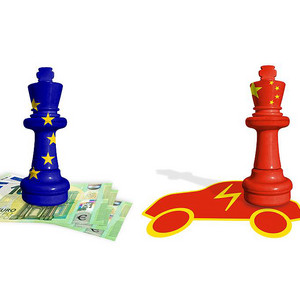
We continue our chat on China EU economic relations at a crossroad.
Right. Ms. Yang has mentioned two specific new regulations, namely the force of labor regulation and the corporate sustainability due diligence directive, and talked a little bit about how Chinese firms could be affected by them.
So Dr. Zhou, from your perspective, those two new regulations and the foreign subsidies regulation also specifically targeting Chinese firms because some analysts are saying so.
Actually, I don't think it's kind of very specific, country specific.
But the biggest victim could be Chinese firms.
Yeah. But how can you tell?
Because most of the victims are Chinese companies.
So I don't think that is from the appearance.
It's unfair. It's just the choice with discriminate, but the effect is discriminate.
So actually, that is the reason why we are saying that there are so many worries about that practices, because the world has so many changes.
When we are looking from just the clauses, the appearance, it seems to be OK.
But when we are talking about the real impacts, Chinese companies may suffer more because we are the number one in this regard.
So if you are trying to give you another example, it is about the gatekeeper in the digital economy.
When the EU is trying to require the gatekeepers of the big platforms of digital economy, they are really trying to perform like the fairness.
But they are the biggest airport in this basket.
So I would say that it is not very easy to identify whether a practice is good or not because we should try to combine the practices of these regulations with the situations of the competition in that industry.
Like for the green economy, we all know that the green economy is a very good thing.
But how can we try to make it fair and try not to discriminate the late comer?
It is really a problem that we have to do these things in the global level, instead of just looking from the EU side or from the European side.
And we've heard a lot about how, you know, the current situation are going probably worse for some Chinese companies there.
But obviously, there are some Chinese companies still saying they are not affected by the challenges.
And there were companies, I think Ms.
Yang just mentioned, 75 % of them reported improving conditions in terms of revenue growth and profitability.
So let's talk a little bit about them.
Who are they? And what have they done right to dissolve the challenges?
Well, that's a very good question.
I mean, yeah, of course, that because I was late in the end is integrated.
So we cannot go very detail in which companies submit that they register positive growth.
But we can have an overview office that basically we will say in the SME, the small and medium sectors, they're less affected by the policies and so on.
And because a lot of the major policies that are targeting the giant companies, giant multinationals, and those are companies under greater pressure, according to our observation.
And in the second sector, which last year, I mean, in our survey register, these growth are in from the financial sector.
And they reported their revenue and the profit growth in 2023.
So that's quite upbeat news in comparison with the other sectors that ICT and clean tech sector.
So finance sector and SME, I would say they are registered more positive readings in our survey.
So Dr. Zhou, are you surprised there?
Actually, I'm not so surprised about that situation.
As we know that EU is made of a lot of individual members and all these countries are different.
So they are also a very important country with a small and medium -sized enterprises like Italy.
And I would say that is also the reason why they want the integration so much in the past.
So when they are going to do something to support the companies, they are mainly they are judging the companies from their size, not from where they come from.
So as for the kind of common policies of the EU, they are trying to give some support to the weaker part of the EU members and also the companies.
So the SMEs are getting better treatment compared with other companies.
While on the other side, the SMEs are not so threatening.
So the people are trying to connecting them with more about the jobs creation and taxes and exports instead of just the national security or other issues of the threat.
So I think that is a kind of a very common practice, not only in you, but also in other countries.
Because when the companies has grown bigger enough, they are treated as very important stakeholders.
They have more taxes.
They have to do more about the CSR, the corporate social responsibilities.
And I think that is really our common practices.
So we can try to address this challenge and find better communications with different stakeholders and providing the companies with more certain environment and trying to teach them that we should look at these areas or these challenges in the different angles and trying to also think from the government
side, what they really want and what are their really targets on these practices.
Is there something to reduce the competition or trying to give better support to the development of the economy if it is anti -computation?
If it is trying to interfere with its commitments to WTO and also to the multilateral system, we should be trying to solve this problem.
But it is based on the innovation or trying to find better criteria or standards for the development of certain sectors.
Maybe we should think about how can we be better fit for their schools if they are not so good.
We can give some suggestions.
I don't think that we are only the criteria or policy takers.
We should try to do something to tell them what we really want, what we believe is not right for the practices and commitments to the multilateral systems.
I believe the CCCEU has done a lot, especially when it comes to having more communication or dialogue with local governments or officials.
It has called on the EU to respect the global division of labor in supply chains, use trade tools cautiously, and avoid over -emphasizing economic security in the report.
But Harvey, according to your understanding or knowledge of the EU or its Commission, what is the likelihood that the authority is taking such appeals?
Well, I have to say that having lived in Austria for a number of years now since Covid, I had a chance to look at the EU and the EU structure to visit the EU offices in Vienna many times.
And my impression about the EU is it's very much a work in progress.
It really doesn't have its act together.
It's a very young organization.
If you look at my country, the United States, we first had these articles of Confederation, which were kind of like what the EU has now.
You have member states who have most of the power with a central organization that doesn't have as much power in many respects.
We took decades to solve the problem.
We then went to a constitution.
We had to go through a civil war.
And I'm not saying that the EU is going to go through a civil war.
I certainly hope they don't.
EU and Europe have had enough wars already.
But I do believe the EU is a very positive development and it has prevented a lot of terrible situations in its short existence.
But when you look at the EU institutions, there's so many diverse countries with different national interests.
And people don't look at what's good for the EU.
They look at what's good for Germany or France or Austria or whatever member state they're talking about.
So I think it's going to take a long time.
I think until that happens, the EU is not going to be as effective an actor as it will be in the future if it has an opportunity to go into the future.
Of course, we've already had the case of Brexit where the United Kingdom left.
There are possible potential defections from the EU in the future.
It's a very volatile situation.
But the one thing I have to say about how the EU makes rules, it's quite a complicated process.
And I unfortunately have to characterize it as lowest common denominator because the countries with so many divergent interests looking to their own country, their own national interests still at this point, that it's going to be not easy to make rules that are very suitable other than lowest common denominator rules.
Also, you have a situation in the EU now where there's a rightward tilt of the EU and you have EU leadership with Vanderland that is decidedly anti -China.
And so that's why my weather forecast earlier, I talked about the stormy weather.
I don't see the EU being a force of cooperation with China yet.
But anything could happen.
But if we continue on the present course, I think that we're going to look at more decoupling rather than more cooperation.
That's not good. And Ms.
Liang, what's your chamber's experience there?
What have you gone through in terms of having dialogues or negotiations or communication with local authorities?
We really agree with what Havi just said.
And it is a challenging thought.
But what we have been doing is to make the Chinese business voice better heard and to make our concerns better addressed.
And so no matter how challenging it will be, we will try our very best.
Indeed, we have a lot of our communication channels.
We keep it very open.
For instance, the flagship reports and every year we communicate with the policymakers from both sides, not only the EU side, but also from the Chinese side.
And we communicate with the experts and enterprises.
So we try to expand its influence.
And the most important thing is that we have around hundreds of recommendations to improve the EU's business environment and to promote the China -EU cooperation and development.
And we do hope that those concrete recommendations create the policymakers and to change the business environment.
It is the goal, our ultimate goal.
And we know it's not easy and due to the complex situation in the EU decision -making and so on.
But as I said, we will try our very best to make out the business voice to be heard.
Yeah. One thing I don't understand is that the global economy or, you know, the European economy are already very admired.
And why those politicians, like you said, are still politicizing some economic issues.
Why don't they just help facilitate or smooth this process of economic growth?
You know, we've already seen some Chinese companies, especially automakers, suspending the construction of their auto plants in Europe, which means less investment from China to Europe.
And that will do no good to the European economy.
So, Harvey, under what circumstances do you think those EU decision -makers may, you know, make a shift or a U -turn probably and then realize such a path will only lead to catastrophic consequences to the continent?
I think, hopefully, in the best circumstance, that they'll only make the shift when they realize it's in their national interest.
And talking about the EU, I mean, the national interest of the member states and the EU bureaucracy writ large, that it's to their benefit and that we can get beyond the politics, the demonization of China and so on, and work together on a lot of these issues.
And I think that's why the report of the chamber is to be commended, because the chamber is very well organized to give voice to the Chinese industry's concerns.
And one thing I have to say about the EU is one thing they do very well, although they may not listen all the time, is they're very good at soliciting input from stakeholders.
And clearly, Chinese companies that do business in EU, and actually for EU companies that do business in China, they're also stakeholders in this situation.
So the chamber, by making these annual reports and the other reports that they do, provide a tremendously positive amount of useful information to the EU, because the EU depends on information.
And really, sometimes the information becomes a war in itself.
So who has the better information, who could make it more understandable, and so on.
So I believe, as the chamber and other Chinese organizations, for example, go forward in interacting with the EU and making the economic arguments and showing that certain situations can be win -win as opposed to zero sum, that we'll all be better off.
But in the zero sum game, and not in the win -win game, because the politics of Europe and of the EU member states are such that we're in a kind of a trade war.
And it would be better if market forces could work, and the different countries could do the things that they do best, and that the market could be more efficient, as opposed to imposing all these tariffs and all these things that don't bode well for our future.
I mean, you only have to look back at history, and look at the century ago in America, with our tariffs, with Smoot Holly tariff, and so on.
It ruined the globe, it ruined the country, it caused a world war.
And I think we're in danger of going in that direction if we have more decoupling, because decoupling and de -risking are basically two close points on the same continuum.
So I worry. Indeed.
And Dr. Zhou, do you think on the Chinese side, what we can do there to help probably unlock this deadlock?
Yeah, I think that is a kind of practice that Chinese government is always trying to do.
We are trying to do some negotiation based on some of our disagreements.
Well, as for the NEVs, the new electrical vehicles' problems, we want to do some negotiations with the EU to talk about the targets, their targets.
What they really want to do is trying to not destroy the EU industries, so we are trying to set some kind of a ghost, not to steal the car with very low prices.
But we do not have to use the anti -subsidies or this kind of measurements to deal with the situation.
We want to talk with them.
Well, I have to see that the EU mechanism is not that effective.
They have to use the voting rights by the different members to decide the practices of certain kind of decisions like for the anti -subcity.
They have to be ratified or permitted by the member states.
So that is also one of the reasons why the UK left the EU.
It's a kind of ineffective way of dealing with the situation.
But we still have the patience.
So we're still very open not only to the EU as a whole, but also to the certain states of EU to discuss about the details of the cooperation, like for the Hungarian or Poland or other countries.
Can we do something to support the recovery of the economy or strengthening the supply chain and industrial chains?
So we are open to different kinds of practices.
And I think that is also one very important issue about the possible agreements by the two sides that we have finished several years ago before Trump came into the White House the first time.
So we have talked about the electoral investment treaties, and that is very important and very advanced in that era.
But now I still feel that it is possible for us to try and to do more, because if you are looking at China for the opening policies, we kept on this way to open wider and wider.
We want to welcome the companies from the EU to come here to invest here.
And on the contrary, I think that is natural for us to think about what we can do to support the EU by the investment.
Actually, there are so many wide areas of cooperation, like the infrastructures, like even for the rules of the digital economies.
We do have so many platforms and opportunities.
The Chat Lounge. The Chat Lounge unpacks views and opinions on hot issues in a more casual way.
You said China has committed that it's going to be more open to outside investors, but it seems that it's not something some of the European Chamber of Commerce member companies would agree.
You know, in September, the EU Chamber of Commerce in China issued an annual European business in China position paper warning European business confidence in China is at an all time low.
So it seems companies from both sides are struggling in each other's market.
So people are saying, why not just withdraw from each other's market?
Do you think that's a possible scenario, Dr.
Zhang? Yeah, I would say that is, like I just mentioned at the beginning that when we're talking about the practices, we need to understand that the reason why the governments are trying to do more policies or regulation.
First of all, it is an end of change where involving very quickly, I mean, for the technology, for the mode of doing businesses, they are growing very fast.
And we have to adapt to these new scenarios, like for the digital economy, we didn't have that before.
But now we're having some of them and it is impacting our practices a lot.
So we need to practice more regulations.
And that is one way, why we can understand the governments are trying to be more cautious about the possible negative impacts for the economy.
They are publishing some more policies.
And the second, I want to see, it is also for the safeguard by themselves, because we know the world is under so many uncertainties and the fight between different countries are becoming more and more attention.
And I think that is also the reason why the governments are trying to do more regulations to protect the benefits of the economy.
But I have to say, for the direction of openness, Chinese companies are facing more practices by the EU, one are trying to limit the abilities of the Chinese companies.
But when we're talking about the Chinese government practices, they are trying to have a better openness.
And that is the direction.
Maybe I can also understand that feeling of EU from another aspect, because we are saying that the Chinese companies are competing very hard in Chinese market.
So the EU companies are feeling not so competitive here.
So that is also the reason why they want to do more to comply for that.
And I believe that is also something that we should try to address in the future practices and also some of the rules making for the decision makers.
And talking about the future outlook of Sino -EU economic and trade relations, the whole bilateral economic relations, given the low confidence on both sides in each other's market, Dr.
Zhou, are we going to see the beginning of companies quitting each other's market in large numbers?
I hope not, because for both sides, the multinational companies are really important part of the economy for both sides.
So we hope that we can strengthen the cooperation.
But I have to say that in such an uncertain world, it is very important for the practices of the enterprises.
The good examples are very important, but the bad examples are not so good.
So we should try to create a better atmosphere while also set up certain good examples to let other companies to believe that we will have a better environment for the businesses and for the investment.
Yeah, right. It's hopeful that the economic relations of both sides wouldn't deteriorate that fast, at least.
But what's the situation on the ground in the EU market, Ms.
Liang? I mean, we do have this kind of concern in previous years that they worry that if the evaluation of the US business environment is very gloomy, what would they have done?
But in reality, I mean, even though that business confidence may reach the record low, but in reality, that it is very costly to fully withdraw from the specific market, in particular, if you already have the blueprint in it.
So it's very costly to withdraw from the market.
And so this is one thing.
And secondly, of course, we also asked the long -term outlook, expect of the outlook of the EU markets in our survey.
And now we have very kind of a rose rating, for instance, like about 21 % of our respondents consider the EU as their most important market outside of China.
And with 66 % expecting the EU market's strategic importance to grow in the next one to three years.
So let's say that actually the importance of the EU market for the Chinese companies, in particular, their overseas expansion has been on the rise.
So we are not very worried that they will be quitting the European market in a very large number.
Right. But we've seen Jens Escalante, I think, ahead of the EU Chamber of Commerce in China, wanting a China -Europe trade war is unavoidable on current trends, because, you know, there are a lot of negotiations underway.
But it seems it's quite lengthy.
And there is no foreseeable future.
People can see your little hope that the whole thing or the whole situation can be settled.
So Harvey, how likely is that to happen?
You know, a trade war between the two sides?
Well, unfortunately, anything is possible.
And with Donald Trump being inaugurated for his second term in a very short time, anything can go because the one thing we know about Trump is that he is unpredictable.
And so all we can predict is more unpredictability.
And it could go either way.
And it will impact what happens with the EU, because the EU itself is basically more or less a lap dog of the United States.
And the question for the future is it's a political question, not an economic question.
When and if the EU will exercise more strategic autonomy in doing what's good for the EU as opposed to what is good for only the US or for what the US says.
So I think the EU will have to come to a fork in the road and make a decision.
It's not the case of one of our great manglers of the English language, Yogi Berra, who talked a lot in Malaprops, said things that made no sense.
And he said, if you come to the fork in the road, take it.
Well, that's an impossibility because you have to take one path or another.
And so I believe if the EU were to exercise more strategic autonomy, and to do what's its national interest, national being the whole EU, and that it may reach slightly different paths.
And couple that with more and more dialogue between China and the EU, I think that we can reach solutions that are win -win.
For example, if you take this situation with automobiles, so there's a lot of negotiations going on on NEVs, and there should be.
And maybe a decent agreement could be reached where there's a floor on the pricing of Chinese vehicles, maybe on the number of vehicles that are coming into EU, that there could be some kind of an accommodation.
And by the same token, if you look at solar energy, where China is the leader, agreements could be done there as well.
Because right now, we're in a win -lose, zero -sum situation.
But it's also possible to see win -win situations.
And because we have so many existential problems that we share in common, like the environment and global warming, and others, if we don't work together, we're not going to meet those challenges.
So sooner or later, I think the people, especially in the EU, are going to realize that they have to get with the program and negotiate hard, but reach agreements.
Sometimes I'm thinking that some exodus of Chinese companies could be a solution, because the EU decision makers, they haven't felt any pain because the Chinese companies are not leaving.
They still have a lot of hope on that market.
But like Ms. Liang just said, Chinese companies basically are not considering leaving the EU market.
So Ms. Liang, what kind of suggestions would you have for those Chinese companies that are experiencing this kind of pain themselves?
How are they going to meet these kind of challenges, which could be increasing in the future, like Hari just mentioned?
Right. I mean, we are currently at a year of uncertainty, so we observe that a lot of Chinese companies, and they are now on the wait and see mode, and in particular, for instance, in the EV sector, considering that there is ongoing negotiation between the two sides about the tariffs.
What we can say is that at this stage is that we talk with the Chinese and European companies, and we found the perspective of the business, the tariffs, and the trade war.
The last things that the business want to witness or have, and actually this is also the last thing that the consumers should have and so on, because they are not only costly, and all the costs of the tariffs will be just passed on the consumers, and you will limit the choices of the market and so on.
So reaching a deal and avoiding trade war will be beneficial for all sides.
We are very sure about that.
And for the suggestions for the companies who are in a difficult, challenging situation, our recommendations, the first one, hand on there.
I mean, a lot of the things we can account, we can pin our hope on, for instance, like next year, China and EU will celebrate this 50th anniversary of the diplomatic ties.
And we are expecting that this historic moment will inject some positive energy into our relations.
And both China and EU now are faced with the reelection of Trump.
So it is some, well, now probably a larger trade war between global power is looming as well.
So facing all those challenges, the trade, economic size, and of course, don't forget the global warming.
So climate change and so on.
All those challenges, they all require a lot of inputs and cooperation on multilateral level.
So our, in line with our survey results, and we do think that the Chinese companies are not, at the moment, not quitting, or they are not preparing for quitting, given that the importance of the European market.
And our suggestion will be also, as I said, economically, it's not very sustainable for the companies to make extremely quick or harsh decisions about going in or out the market.
So we should have our belief and then cooperate, create more, this kind of exchanges and opportunities for cooperation.
But how long can they wait?
Well, I mean, that's very interesting, because for business, for companies, we are, we observe that in particular for those companies operating in EU, we are not very sure.
It's not about very short -term mission, most often are having the very long -term mindset of developing in a specific market, because practically, it's very costly again to, you know, to invest in the market, and then quickly withdraw from the market, because that's very costly economically, you have to
put in top of investment, and then we withdraw.
So basically, all your previous investment would be lost.
So in practical terms, we also didn't have an observe this kind of very harsh decision of the business operations on the ground.
So again, we are again, still remained optimistic, cautiously optimistic, about the long -term or medium -term relations, trade or economic trade between China and the EU.
And this is also well reflected in the result of Chinese companies.
Right. And lastly, Dr.
Zhou, what would be your suggestions?
Well, my suggestion would be that we should also think about, like Ms.
Liang have mentioned, the possibilities of cooperation.
Well, for China and the EU, as I suggested, we should not just try to look at some of the rules or practices from its own.
We should look at as a broader, much broader, you know, environment or the background.
So we should try to think about what we can do to improve the cooperation for both sides, because China and the EU are really important economies in the world.
If we are not so important, how can we establish strong relations, I mean, for the trade and investment in the past?
So it's based on the market.
We should respect the market and try to follow our commitment in the multilateral system and try to find better ways to address the challenges by both sides and also to have a better spillover in effect to other partners of us.
Actually, like former WTO head, Pascal Lami just said, China and the European Union should address their disagreements from a united front against the challenges that may emerge beginning next year instead of us standing hostile to each other.
And with that, we wrap up our chat for this session.
Many thanks to Dr. Zhou Mi, Senior Research Fellow Chinese Academy of International Trade and Economic Cooperation, Ms.
Liang Ling -Ling, Director of Communication and Research, China Chamber of Commerce to the European Union, and Harvey Zodin, Senior Fellow with the Center for China and Globalization.
For your insights, the show is available on all major podcast platforms.
Please email us your comments at radio at cgtn .com.
I'm Tuyen. Thank you for listening.
We'll have more chat at the chat lounge next week.
The best military commander is not he who fights a hundred battles and wins every one of them.
The best military strategy does not lead to the desiccation of the enemy's capital city.
Decoding the Art of War will help you understand why there's no art in war and how Xinzi stayed undefeatable using the science of war with fun stories and insightful breakdown of famous battles.
Find Decoding the Art of War wherever you listen.
2500 years ago, an old man rode on his buffalo and headed west of China.
Before he vanished into the wild, he left behind a book of 5 ,000 words, which for the next two and a half millennia would have shaped the Chinese way of thinking.
Subscribe to the sayings of Laozi and find out why generals with wisdom yield after winning the ultimate battle and how staying behind just might help you get ahead of others.
The sayings of Laozi is available on all major podcast platforms.