Get the unmissable news stories of the day.
This is the Beijing Hour.
Examining the events that impact and shape China and the rest of the world.
This is the Beijing Hour.
One hour of news and information brought to you every weekday.
Now here's your host.
Dou Hongyu with you on this Thursday, December 11th, 2025.
You're listening to the Beijing Hour, coming to you live from the Chinese capital.
On today's program.
Chinese leaders have decided priorities for the economic work next year at the Central Economic Work Conference.
China says its recent strategic patrol with Russia should not be a concern for Japan.
And Venezuela accuses the US of international piracy after American forces seized an oil tanker off the Venezuelan coast.
In business, the US Federal Reserve cuts its key interest rate to spur hiring as job growth slows.
In sports, Manchester City rallied to beat Real Madrid in a tight Champions League showdown.
In culture and entertainment, a Chinese storytelling tradition recognized as UNESCO Intangible Cultural Heritage.
Now, today's top stories.
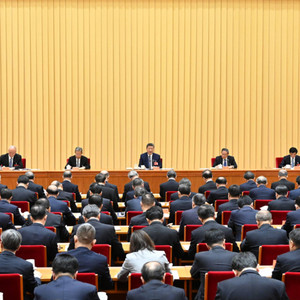
China's annual Central Economic Work Conference has called for maintaining steady and progressive economic policies, as the country's leadership decided priorities for next year's economic work.
General Secretary Xi Jinping of the Communist Party of China's Central Committee attended the meeting on Wednesday and Thursday and delivered a speech.
The meeting called for strengthening macro policy coordination, expanding domestic demand, fostering new growth drivers and advancing high-quality development.
Priorities for 2026 include boosting consumption, supporting innovation, promoting coordinated regional development, deepening institutional opening up and improving social services.
The meeting urged strong confidence in China's long-term economic prospects and called on all sectors to unite in achieving a solid start to the 15th Five-Year Plan.
The World Bank has revised up its forecast for China's economic growth by 04 percentage points, raising the forecast to 49.
The bank said accommodative fiscal and monetary policies supported domestic consumption and investment, while more diverse export markets helped maintain resilience.
The World Bank's projection followed the International Monetary Fund's revised forecast for China's GDP to 5, up 02 percentage points from its estimate in October.
The IMF said the Chinese economy has shown notable resilience amid multiple shocks.
China has set a growth target of around 5% for this year.
Walter Morris reports from Washington, D.C.
Well, a team of experts from the International Monetary Fund spent 10 days in Beijing and Shanghai.
And in addition to this improved economic forecast, experts say that China has shown incredible resilience.
So Wednesday, the IMF releasing the economic forecast saying China is on track to hit a growth target of 5 this year and 45 for 2026.
That improved outlook is 0.2% higher than a previous forecast in October.
The International Monetary Fund presented those findings in Beijing Wednesday, saying China's moving in the right direction.
The experts say the recent forecast comes in response to lower than expected tariffs and the October trade truce with Washington that de-escalated tensions along with welcomed macroeconomic policies.
The team also recognized China's efforts to boost consumption-led growth.
China has the opportunity to reach a new stage of development in which its growth engine switches from investment and exports to domestic consumption and its economy reorients from goods to services.
It's a great opportunity.
Seizing it requires brave choices.
And in a statement the IMF mission chief for China said China's economy has shown notable resilience, despite facing multiple shocks in recent years.
China's large economic size and heightened global trade tensions make reliance on exports less viable for sustaining robust growth.
The authorities recognize the imperative of increasing consumption as a driver of growth.
To this end, they've implemented welcome policy measures.
And the IMF team says it looks forward to continued engagement with Chinese authorities.
That was Walter Morris reporting.
For more.
Zhou Fang spoke with John Gong, professor of economics at the University of International Business and Economics.
Professor Gong, in the current economic climate, marked by rising trade barriers, what does 04 increase signify?
Well, I think the World Bank should have done this some time ago.
It's just catching up with what's happening with respect to China's economy so far.
Now it's predicting a 5 growth for the whole year in China, which is also the China's government's growth target.
And I think we only have one more month left.
And the economic performance statistics so far have demonstrated that it's highly highly likely that China is able to reach its 5 growth target.
So the World Bank is just catching up with that.
Its previous estimate has been lower than this.
Now it's increased by 0.4%.
So I think basically the World Bank is saying that we're going to agree with Chinese government that it's going to be 5 this year.
Big deal.
So I don't think there's too much of a significance here.
I think it's just that the bank's previous estimate estimate as being a little bit more optimistic.
Now it's just catching up with what's really happened with China's economy.
I think 5% growth is very reasonable.
Definitely we're going to reach that, given the growth performance up until October.
So we only have a month or two left, but We're going to reach this, no doubt about it.
And also the World Bank's report notes that China's export diversification has demonstrated resilience.
Could you analyze the reasons behind this?
This goes to say that China's exports have been very much welcome in many parts of the world.
We had a quite good performance so far, even against the backdrop of the most severe tariff schedules introduced by Washington so far.
And China's exports to the United States market has a significant drop over the last few months.
Even against that backdrop, we're still seeing overall aggregate exports increasing a little bit.
That means that China is diversifying into many other countries.
At the end of the day, this shows that Chinese products Especially, I think, high-end products are very much in demand, are very much welcome in many parts of the world.
I'll just give you one example, electric cars.
I think electric cars are selling very well in Europe, even amidst the politicians talking about taking actions to sort of fend off the inroads of Chinese cars.
But nevertheless, European consumers are voting with their pocketbook, voting with their feet.
They're buying Chinese cars.
So I think you know this shows that the product portfolio of Chinese sports has been very competitive on international markets.
That was Professor John Gon from the University of International Business and Economics.
The APEC China Year has begun with a symposium on next year's theme and priorities for the Asia-Pacific Economic Cooperation.
It serves as the opening session of the APEC informal senior officials' meeting in Shenzhen.
The event is the first APEC gathering under China's chairmanship for 2026.
China has chosen the southern city to host next year's APEC economic leaders' meeting.
The country has stressed the need for high-standard opening up in its 15th five-year plan, which begins next year.
Wang Mengjie has more on China's priorities in the next five years.
Opening up is a cornerstone of China's modernization.
When we talk about high-standard opening up, four key words come to mind.
The first is wider, meaning China is opening further to the world.
This includes aligning with high-standard international trade routes, speeding up regional and bilateral trade agreements and advancing the upgrade of pilot freight zones.
So far, China has set up 22 pilot zones, with the Hainan Freight Report set to launch island-wide independent customs operations on December 18th.
Opening China wider also means advancing RMB internationalization, promoting reform in global economic and financial governance and walking toward an international economic order that is fair open, inclusive and mutually beneficial.
The second keyword is innovative.
Promoting innovation in trade means improving quality and performance, strengthening China as a trading nation, optimizing goods trade, expanding grain trade and balancing imports and exports.
Keyword number three is two-way investment.
Expanding two-way investment means boosting China's ability to attract foreign investments, providing easier market access, creating a business-friendly environment, improving overseas services and promoting the integration of trade and investment.
How is China achieving this?
According to the Ministry of Commerce, in the first nine months of 2025, new foreign-invested firms rose 162.
Investment from Japan jumped over 55, the UK over 20 and Switzerland over 19 compared with last year.
The fourth keyword is high-quality belt and road cooperation.
This means strengthening strategic alignment with partner countries, enhancing connectivity in infrastructure and standards, and building closer bonds with people along the belt and road.
Together with opening wider innovative trade and two-way investment.
This is China's hand-standard.
Opening up in the next five years represents driving its own development while sharing opportunities with the rest of the world.
That was Wang Mengjie reporting.
Coming up, China says its recent strategic patrol with Russia should not be a concern for Japan.
Is this a strategic concession, a commercial calculation or the start of a new conditional export model?
Will Chinese tech giants rush to buy the H200?
Can Washington achieve its intended goals with a policy shift?
And will this prompt other governments or exports to reconsider their own restrictions on tech exports to China?
Get all these and more on this week's Chat Lounge, wherever you get your podcasts.
11 minutes into the hour.
China says its recent strategic patrol conducted with Russia should not be a concern for Japan.
The two countries' militaries conducted a strategic air patrol over the East China Sea and the Western Pacific on Tuesday, the 10th such mission between the two sides.
Zheng Yibing has more on the Chinese Foreign Ministry's response.
Regarding the China-Russia joint strategic air patrol the question raised during the regular press conference, saying the Japanese defense minister had held talks with the head of NATO and expressed serious concerns
For this.
Kozakun, a spokesperson of the ministry, said there's no need for the Japanese side to make a fuss.
He stressed once again, the patrol is an operation carried out under the annual cooperation plan of China and Russia.
He said it showcases two sides determination and capability in jointly responding to regional security challenges and keeping the region peaceful and stable.
That was Zheng Yibing reporting.
Diplomats and experts around the world continue to criticize Japanese Prime Minister Sanae Takeuchi's remarks on China's Taiwan region.
Former Serbian Foreign Minister Ivan Markic is one of them.
The Japanese Prime Minister's provocative action is unwise.
Her remarks serve no one's interests.
China is fully entitled to voice its indignation and large protests.
As Serbian President Vukic has said, Taiwan belongs to China.
It is an indisputable fact.
The Japanese Prime Minister's erroneous remarks undermine regional stability.
Colombian economist Maximiliano Londono says Japan must never engage in military expansion, under any circumstances.
Japan must retract its aggressive policies, as the one China principle has been recognized by over 180 countries worldwide.
Japan must acknowledge all its wrongdoings and crimes committed against China and other Asian nations.
Under no circumstances should Japan engage in military expansion, or it will once again threaten peace in Asia and the world.
Japan has been escalating regional tensions, from close reconnaissance of China's Liaoning aircraft carrier formation to exporting offensive weapons.
China says the moves violate the post-World War II international order.
Zhao Yunfei explains why Tokyo's accelerating militarization is raising historical concerns.
China's defense ministry and foreign ministry have both voiced firm opposition to Japan's recent maritime military actions.
Before the PLA Navy's Liaoning aircraft carrier formation conducted flight training east of the Miyako Strait, China had notified Japan in advance, according to an audio recording.
This is China Navy warship 101.
Our formation organizes shipboard aircraft flight training as planned over.
Chinese warship 101, this is Japan warship 116.
I copied your message.
Communication of this kind occurred twice on the afternoon of December 6th.
China says the notification is in accordance with the international convention.
Despite being aware of the Chinese Navy's activities, two Japanese F-15 fighter jets entered China's training zone at one point, approaching within 50 kilometers.
Japan later shifted blame by accusing China of radar illumination.
However, activating search radar during flight training is standard practice for carrier-based aircraft worldwide, especially when a foreign jet has come this close.
China says these close-in reconnaissance activities pose serious security risks and are part of a larger pattern of military provocation.
Previously, Japan even vowed to target China's newest aircraft carrier, the Fujian.
Why is Japan escalating its provocations?
Chinese Defense Ministry spokesperson Zhang Xiaogang warned that if Japan returns to a path of militarism, it risks plunging into an irretrievable crisis.
Yet Japan continues to accelerate its military capabilities.
Recently, Tokyo delivered the first batch of Patriot Vance Capability III interceptors to the US, marking its first export of offensive weapons under eased US restrictions, a move China says violates Japan's post-World War II obligations.
The 1943 Cairo Declaration and 1945 Potsdam Declaration required Japan to complete disarmament and barred it from maintaining industries that could support rearmament.
China says these series of military actions was triggered by Japanese Prime Minister Sonny Takahashi's remarks on Taiwan, which ignore the post-war consensus that Taiwan is part of China.
Taiwan is Chinese territory.
How to resolve the Taiwan question is a matter for China alone and allows no external interference.
Yet Takeichi linked Japan's survival-threatening situation to a Taiwan contingency, implying the potential use of force against China.
Is this what the Japanese side means by a passive defense strategy that is supposedly exclusively defensive?
Japan's so-called passive defense strategy doesn't add up when we look at the numbers.
The government has approved a supplementary budget for fiscal year 2025, pushing defense spending to 2 of GDP, the 13th consecutive annual increase.
Japan's military buildup continues, including revising its three non-nuclear principles and deploying mid-range surface-to-air missiles near Taiwan.
But does he have the strength to provoke China?
The answer is no, because China says it has the legal right to respond to any aggression.
The Chinese embassy in Japan has warned that, under the UN Charter's Enemy States Clause, if any fascist or militaristic nation, including Japan, takes steps toward aggression, founding UN members, including China, have the right to take direct military action.
This is not the same as in 1931.
China suffered enormous losses during the Chinese people's war of resistance against Japanese aggression, with 35 million military and civilian casualties.
Alongside the international community, China hopes such a tragedy is never repeated.
We urge the Japanese side to repent its war crimes and to immediately abandon efforts toward constitutional revision and military expansion.
Any attempt to repeat the path of aggression and undermine the post-World War II international order will not succeed.
China has always sought to resolve disputes through diplomatic means, but does not tolerate actions that cross its red line.
Japan's military provocation is a threat to regional security and global order and must face the consequences.
Local authorities in Hong Kong have rolled out coordinated support for the residents affected by the devastating residential fire in Taipo District two weeks ago.
Chen Yuan has more on the recovery efforts so far.
In the past two weeks, since the tragic Wangfu Court fire, the Hong Kong Special Administrative Region government has moved with impressive speed, scale and transparency.
Within 24 hours, three task force were formed to set up emergency housing, to distribute aid and to conduct inspection and regulation.
Here's what they have achieved so far.
Nearly 4000 evacuees who were once sleeping in community halls have now found temporary relief in rent-free hotels and transitional housing.
A collection set up by the government has reached a total of HK34 billion and is being used to support all those affected, including bereaved families, displaced residents, construction workers and foreign domestic helpers.
To help them access support, the government set up a one-stop website with hotlines and departmental contacts offering free medical care, mental health services, legal aid and transport assistance, among others.
Another platform has already helped distribute more than 16,000 donated items to those in need.
Most households have been paired with a social worker, so that no one faces the flood of information alone.
Meanwhile, authorities have inspected over 350 construction sites, removed scaffold nets from over 200 buildings and will soon spot-check new scaffold nets on-site before they're used.
It's worth noting that, as departments work together to handle this crisis, communication with the public has been swift and transparent.
Officials are delivering results while answering urgent questions, with nightly updates, keeping the communities informed.
As Hong Kong rallies behind the fire victims, the government's coordinated efforts are providing a crucial backbone of support, helping the community to begin the path to recovery and rebuilding.
That was Chen Yuan reporting.
You're listening to The Beijing Hour.
Coming up.
Venezuela accuses the US of international piracy after American forces seized an oil tanker off the Venezuelan coast.
Radio.CGTN.com for more in this program.
21 into the hour.
Venezuela has accused the US of international piracy after American forces seized an oil tanker off the Venezuelan coast.
Washington claims the vessel is under sanctions.
Caracas has vowed to defend its sovereignty, natural resources, and national dignity.
It says it'll denounce the move before international bodies.
U.S.
President Donald Trump has confirmed the ship's seizure, but did not offer any details.
The US has been moving troops and warships into the Caribbean and launching strikes on suspected drug boats to pressure Venezuela.
Stephen Gibbs reports from Caracas.
Yes well, after several weeks of this standoff between the United States and Venezuela, a major escalation.
An oil tanker which had docked at a Venezuelan port was seized by US forces off the coast of this country.
This was confirmed by President Trump.
As you probably know, we've just seized a tanker on the coast of Venezuela, a large tanker, very large, largest one ever seized, actually.
And other things are happening, so you'll be seeing that later and you'll be talking about that later with some other people.
Well, Trump was asked what might happen to the oil that was on that tanker.
He said, I guess we will keep it.
Apart from that, we have few details.
We understand from one source that the tanker might have been heading for Cuba.
Other sources say that it might have been sanctioned under U.S. sanctions on Iran.
But, of course, this all takes place amid this massive US naval and air buildup in the Caribbean region, the biggest in several decades, amid a standoff between the Trump administration and President Maduro, who Trump has said should stand down.
Now.
So far, the action has mainly focused on attacks on speedboats which the US alleges have been carrying drugs.
Those attacks, the US says, have all taken place in international waters.
It's not clear precisely where this seizure happened but, moving to oil, tanker seizures could have serious consequences for the Venezuelan economy, which has the world's largest proven oil reserves and depends on oil for most of its foreign currency earnings.
Already, much of the oil industry is sanctioned by the United States, although the US company Chevron still operates here.
So we do await more details, but this does appear a major escalation in this deteriorating situation.
Thailand and Cambodia have accused each other of targeting civilians in their ongoing border clashes.
Cambodia said nine of its civilians were killed and 64 others were injured.
The Thai Defense Ministry said over 400000 residents across seven provinces have been forced to evacuate.
The Malaysian prime minister said the leaders of both countries are open to negotiations.
Martin Low reports from the Thai-Cambodian border.
There is growing concern that what began as a border skirmish may now be escalating towards full-scale conflict.
With conflicting claims from both sides.
Casualty figures remain unclear, but both military personnel and civilians are losing their lives.
Many areas along this border have been designated as red zones, where the Thai military says fighting can be expected at any time, with the risk of tank artillery and rocket fire.
Civilians have been evacuated and access to the battlefield has been blocked.
This small community of roughly a dozen residents sits just outside the exclusion zone and has been provided with a bomb shelter.
Smoke drifting across the hills is from heavy weapons fire.
We hope we don't have to leave because we have children and the elderly to look after.
But if we must go, we hope the authorities will help us.
Militarily, Thailand is significantly stronger than Cambodia.
And analysts believe Cambodia would struggle to withstand a sustained Thai offensive.
Thailand also has fighter jets capable of conducting airstrikes, a capability Cambodia does not possess.
That was Martin Low reporting.
Kiev is facing growing pressure to accept the terms of a US proposed deal to end the conflict with Russia, as Moscow claims significant gains on the Ukrainian battlefield.
Media reports say the US has given Ukrainian President Volodymyr Zelensky until December 25 to respond to the peace proposal.
This comes as the Russian Defense Ministry said it targeted Ukrainian facilities in over 140 areas over 24 hours.
Ukraine said it repelled multiple Russian attacks, but its forces are facing the hardest challenges since the conflict broke out in 2022.
Leaders of the UK, France and Germany have held a call with U.S.
President Donald Trump to discuss the U.S. peace efforts.
Russia says the country and the US have realized that the conflict cannot be solved without eradicating the causes of the Ukraine crisis.
Audrey McAlpine reports from Kiev.
We know that overall there's been a lot of iterations of this peace plan moving between Ukraine and Russia.
At first it started as a 28-point plan, then it was reduced to a 19-point plan after Geneva.
We now believe it's somewhere around a 20-point peace plan, but some of the major issues involving the seeding of Ukrainian territory, Ukraine's ascension into NATO and the big question mark is security guarantees.
Zelensky has also said that he would be willing to have elections as soon as 90 days, but that he would need the support of the US in order to carry out those elections safely.
Here on the ground, people that I speak with ukrainians, say that while at first this peace plan gave them a lot of anxiety, they felt that they might have to agree to something that would be against their interests and agree to it very quickly.
Now many of them have taken a sort of back seat, they've disengaged from the movements of this, of this peace plan, because they feel that and fear that it might be yet another failed attempt at peace, as we've seen several times uh, throughout the trump presidency, much like we saw over the summer, for example.
That was Audrey McAlpine reporting.
Now it's about 29 into the hour.
Let's check the weather.
A major cold wave is sweeping across most of China from west to east between Wednesday and Saturday, bringing strong winds, significant temperature drops and widespread rain and snow.
The daily average or minimum temperatures will drop by 6 to 10 degrees Celsius.
Weather authorities have issued a cold wave and strong wind warning, and a level 4 emergency response for the severe weather is in effect.
Beijing will be cloudy with a low of minus 4 Thursday night.
Friday will see moderate snow with a high of minus 2.
Nanchang will be cloudy with a low of 11, then light rain with a high of 19.
Elsewhere in Asia, Islamabad will be cloudy with a low of 10 this evening.
Friday will be overcast and 21.
And Vientiane will be overcast tonight and tomorrow with a low of 20 and a high of 28.
In Africa, Nairobi will be cloudy with a high of 26 on Friday.
Kampala will see light rain with a low of 18 Thursday night, followed by overcast with a high of 27.
Now it's time for a short break.
So far this hour, Chinese leaders have decided priorities for the economic work next year at the Central Economic Work Conference.
China says its recent strategic patrol with Russia should not be a concern for Japan.
Dou Hongyu with you.
Stay with us here on the Beijing Hour.
Listen up.
Can you hear the heartbeat of our world?
It's vibrant and pulsating with the essence of life itself.
From the stem of trees to the gurgle of rivers.
From the silent strength of mountains to the icy whispers of glaciers.
Even the solid ground beneath our feet.
And right there, in the midst of all beats the heart of humanity.
What if those other heartbeats were to stop?
Would ours keep on ticking? ever wondered what's actually going on in africa through the perspective of an african how are things really going between china and africa what's the narrative of this relationship well get a perspective with china africa talk hear from african diplomats entrepreneurs academics chinese natives and more get on our wavelength every week to find out what's real with china africa talk find us on your favorite podcast we'll see you there Examining the events that impact and shape China and the rest of the world.
This is the Beijing Hour, one hour of news and information brought to you every weekday.
Now here's your host.
Dou Hongyu with you on this Thursday.
Still to come, in business, the U.S.
Federal Reserve cuts its key interest rate to spur hiring as job growth slows.
In sports, Manchester City rallied to beat Real Madrid in a tight Champions League showdown.
In culture and entertainment, a Chinese storytelling tradition recognized as UNESCO Intangible Cultural Heritage.
To contact us, you can email radio at cgtn.com or follow our X account at cgtnradio.
Now first checking today's headlines, here's Tianyu.
Thank you, Hongyu.
China's annual Central Economic Work Conference has called for maintaining steady and progressive economic policies, as the country's leadership decided priorities for next year's economic work.
General Secretary Xi Jinping of the Communist Party of China Central Committee attended the meeting on Wednesday and Thursday and delivered a speech.
The meeting called for a strengthening macro policy coordination, expanding domestic demand, fostering new growth drivers and advancing high-quality development.
Priorities for 2026 include boosting consumption, supporting innovation, promoting coordinated regional development, deepening institutional opening up and improving social services.
The meeting urged strong confidence in China's long-term economic prospects and called on all sectors to unite in achieving a solid start to the 15th Five-Year Plan.
The World Bank has revised up its forecast for China's economic growth by 04 percentage points, raising the forecast to 49.
The bank said accommodative fiscal and monetary policies supported domestic consumption and investment, while more diverse export markets helped maintain resilience.
The World Bank's projection followed the IMF's revised forecast for China's GDP to 5, up 02 percentage points from its estimate in October.
The IMF said the Chinese economy has shown notable resilience amid multiple shocks.
China has set a growth target of around 5% for this year.
Chinese Vice Premier He Lifeng has said he hopes the IMF will continue to deepen cooperation with China and inject new vitality into the economic development of the country and the world.
He was speaking while meeting IMF Managing Director Kristalina Georgieva in Beijing.
The Vice Premier said the Chinese economy has maintained a steady momentum of growth since the start of this year and the country has the confidence and capability of maintaining sustained and healthy economic development.
Georgieva said the IMF appreciates China's contributions to the global economy and the strong support the country has provided in establishing the IMF Shanghai Centre, which officially launched its operation on Monday.
Georgieva said the IMF is willing to continue strengthening its cooperation with China.
Chinese Foreign Minister Wang Yi will visit the United Arab Emirates, Saudi Arabia and Jordan from Friday to Tuesday.
The Chinese foreign minister will hold talks with his counterparts of the three countries and they will discuss bilateral ties and the situation in the Middle East.
Chinese authorities have urged Mexico to correct its practices of unilateralism and protectionism at an early date.
A Chinese Commerce Ministry spokesperson said the country opposes unilateral tariff hikes in all forms.
The spokesperson was commenting on the Mexican Congress' approval of a proposal to raise tariffs on non-free trade agreement partners.
The new tariffs will reportedly take effect on January 1, 2026.
The spokesperson said China welcomes related countries to resolve economic and trade disputes through trade agreements, but such agreement should not undermine global trade development or China's legitimate interests.
And finally, Venezuelan President Nicolas Maduro is urging the US to stop what he calls interference in his country and across the region.
His comments follow U.S.
President Donald Trump's announcement that American forces seized an oil tanker off Venezuela's coast, further raising tensions.
The move is the latest in Washington's efforts to pressure Maduro, who is facing narco-terrorism charges in the US.
Venezuela, Interior Minister Diosdado Cabello accused the US of trying to seize the country's natural resources.
What they want is to steal our oil, to steal it, to steal our gold.
They want to steal our gas.
They want to steal our water because they don't want to pay.
And why don't they pay for it?
Because they are thieves.
They are accustomed to that.
So that's why I ask.
We are ready to carry on and take on everything, prolonged and active resistance.
For nearly four months, the US has kept a substantial military presence in the Caribbean, much of it near Venezuelan waters, officially to combat drug trafficking.
Thank you very much.
That was Tianyu with Headlines.
Coming up in business, the U.S.
Federal Reserve cuts its key interest rate to spur hiring as job growth slows.
36 into the hour turning to business.
Stock markets on the Chinese mainland closed lower on Thursday.
The Shanghai composite was down 0.7%.
The Shenzhen component lost almost 1.3%.
Wind power and aerospace equipment shares were among the top gainers.
The Hong Kong stock remained almost flat.
In Japan, the Nikkei declined 0.9%.
The Chinese Commerce Ministry says it plans to help the retail industry modernize and grow in better ways during the next national five-year plan period.
Ministry officials say they will offer more policy, help release guidelines sooner and make better use of resources.
A main goal is to create fairer competition between online and physical stores.
This is meant to connect new kinds of products and services with new consumer demand, helping each drive the other.
U.S.
Federal Reserve Chair, Jerome Powell, says the 43-day government shutdown impacted US economic growth in the fourth quarter.
He made the remarks as the Fed cut its key interest rate by a quarter point to around 35 percent to spur hiring as job growth slows.
Owen Fairclough has more details.
A final rate cut at its final meeting of the year.
The US central bank, the Federal Reserve, lowering its benchmark interest rate to around 3.5%.
That's the lowest in around three years, all in an attempt to lower the cost of borrowing for businesses and consumers.
It's always a difficult balancing act for the Fed, but it has something of a Sophie's choice to make at this meeting.
Inflation is lingering in some parts of the economy, with the cost of living for some things still elevated.
But the Fed is more concerned about the US labor market.
Yes, unemployment remains at historic lows, but there's concern that employers aren't adding jobs fast enough, and lowering that benchmark interest rate should incentivize employers to hire.
Here's the chair of the Federal Reserve, Jerome Powell.
The temporary shutdown of the federal government has likely weighed on economic activity in the current quarter, but these effects should be mostly offset by higher growth next quarter, reflecting the reopening.
A reasonable base case is that the effects of tariffs on inflation will be relatively short-lived, effectively a one-time shift in the price level.
Our obligation is to make sure that a one-time increase in the price level does not become an ongoing inflation problem.
So the Fed is essentially making a bet that any inflation has largely been driven by the impact of the Trump administration's tariffs on goods coming in from overseas and thinks that broadly next year that inflation will drift down to its 2 target.
That's considered the ideal rate. for this central bank.
But it is significant that there were three dissents among those Board of Governors and two of those governors essentially objected to cutting that rate.
They're concerned that cutting that rate will drive inflation up again, with memories somewhat fresh of the worst inflation crisis for decades that was largely driven by slashing borrowing costs to save the US economy from the COVID-19 pandemic.
If the economics seem complicated, then consider the politics.
Jerome Powell has weathered constant attacks over the past year, since Donald Trump took his second term, about not cutting that rate quickly or fast enough.
And the somewhat deja vu there from Trump's first term.
It was Trump who picked Powell as his Fed governor and attacked him then for not cutting that interest rate.
Powell's term ends in May and the successor is due to be named within the coming weeks.
That was Owen Fairclough reporting.
For more.
Lincoln Humphrey spoke with Wang Yaojing, associate professor of economics at Peking University.
The Fed's latest rate cut was broadly anticipated, although opposed by two votes in the meeting there.
We just heard
Against this backdrop, what are the most critical indicators to watch now for US inflation, the labor market and the global economy's response?
So yes, I think it's broadly matched with the market expectations, as the futures market has priced in a high probability about, I think, 89 of this quarter point cut.
But the Fed forward guidance was more cautious than some market expectations, implying fewer cuts than the market had hoped.
And you mentioned what to be watching, and the Fed statement and projections indicate that inflation remains elevated above the long-term 2 target.
And the Fed Chair Powell, attributed some of the inflation overshoot to be import tariffs rather than domestic demand pressure.
So framing it as to be less persistent, and we'll be keeping an eye on that.
And the FOMC noted downside risk to employment have risen, which is a key reason for this easing policy.
So we should also be looking at job gains, which has slowed over the course of the year.
But non-farm payrolls and unemployment rates and wage bill growth are something to be going to be looking at.
And also the Fed T-bill buying program is a technical measure to ensure global market liquidity.
So we're seeing the dollar is weakening.
But going forward, it's an overall decision which the Fed has emphasized, a data-dependent approach.
But we also heard that the...
Jerome Powell's time is probably up, so we don't expect much actions to be really done by the Fed in the first quarter of 2026.
Now we've seen the response on Wall Street and the reactions to the US dollar.
How quickly and how effectively will this rate cut translate into lower funding costs for corporations?
Specifically, will it meaningfully alleviate global dollar funding strains in the coming quarter?
Well, the short answer is yes, but only partially and temporarily.
So the fed's 25 bp cut plus the announced short-term t-bill purchase should ease short-term money market stresses and shave a little off corporate short and funding cost over the next quarter.
However, passing through the broader bank lending rates or long-term corporate yields or global dollar funding condition will likely to be very modest.
First of all, the market still expects lingering inflation, so medium and long-term yields are still elevated because of that.
And secondly, corporate loan pricing and mortgages will only gradually reflect the cut.
So the Fed cut plus the short-term T-bill purchase should meaningfully calm immediate money market strains and lower very short-term dollar funding costs over the coming quarter.
But the more fundamental improvements should require more sustained easing cycle.
That was Associate Professor Wang Yaojing at Peking University talking about the latest U.S.
Federal Reserve interest rate cuts.
Industry data shows China's light industrial enterprises above a designated size recorded 19 trillion yuan, or about 27 trillion US dollars, in operating revenue in the first 10 months of this year.
That's up 1.9 percent from the same period in 2024.
According to the China National Light Industry Council, the combined profits of these businesses surpassed 11 trillion yuan, representing a 16 increase.
Backed by policies aimed at stabilizing growth and expanding domestic demand, the sector continued to demonstrate steady momentum and strong resilience.
From January to October, the added value of light industrial enterprises above a designated size rose 58.
Battery manufacturing and plastic furniture production both posted double-digit gains.
Domestic consumption has further supported the industry's expansion.
Retail sales of 11 major categories of light industrial goods topped 7.1 trillion yuan, up 9.8%.
Sales of home appliances and audiovisual equipment surged 20, sustaining double-digit growth since last September.
High-efficiency home appliances remained in strong demand under the ongoing trading subsidy programs.
And finally, China's automobile production and sales continued their strong performance in November, with production and supply maintaining a relatively fast pace.
According to the China Association of Automobile Manufacturers, the monthly automobile production exceeded 35 million units for the first time, setting a new record.
From January to November, production and sales both surpassed 31 million, with yearly growth each exceeding 10.
During the first 11 months, China's new energy vehicle production and sales both approached 15 million each, registering an increase of over 30.
Meanwhile, new energy vehicle exports exceeded 2.3 million, representing a 100% increase.
You're listening to the Beijing Hour.
Coming up in sports.
Manchester City rallied to beat Real Madrid in a tight Champions League showdown.
Sideline Story brings you all things sports related.
The hottest topics, latest events, juiciest stories, all with a very personal take.
Subscribe to Sideline Story podcast for heated sports discussions covering events that are happening in China and around the world.
46 minutes into the hour, turning to sports, here's Yang Guang.
Thank you, Hongyu.
We start with football.
Manchester City dug deep at the Vanderbilt rallying from a goal down to beat Real Madrid 2-1 in a tight Champions League showdown.
Rodrigo opened scoring, but Madrid's own mistakes flipped the script with a Thibaut Courtois spill finished by Nico O'Reilly, and then Antonio Rudiger's foul that handed Erling Haaland winning penalty.
City manager Pep Guardiola said the result was big, but the performance still wasn't enough.
Don't misunderstand me.
Winning Bernabeu is a big, big task.
Really, really, really big task, especially in this competition, the Champions League.
Don't misunderstand me.
But at the same time I don't know in February, March we were able to go through the level to arrive really, really semi-finals.
Finals require better performance than today.
That's for sure.
And we will work on it.
So it's not enough.
It's not enough to be...
City's win lifts them to fourth in the standings while pressure continues to mount on Madrid.
Also in football.
Arsenal stayed perfect in the Champions League, cruising past Club Rouge 3-0 in Belgium to make it six straight wins and tighten their grip on top spots.
Nani Maduaki lead it up with a stunning opener and a simple header after the break, before Gabriel Martinelli capped the night with his fifth goal of the competition.
Manager Mikel Arteta said the performance was especially meaningful given Arsenal's injury troubles.
Yes, a really positive evening.
I think it's very difficult to win away from home in the Champions League.
We've done it with a lot of absences, especially in the back line.
And even this morning, we lost two players.
And I love the way the team reacted to that collectively, individually.
For example, what Christian Norgat has done just talks about how much better he makes all of us with his attitude, with his commitment, in the manner that he prepares and then he's able to perform.
So yeah, overall a really positive night.
The rain sends Arsenal straight into the round of 16.
Elsewhere, Bayer Leverkusen needed late heroics, as Alex Gramado struck in the 88th minute to salvage a 2-0 draw at home against Newcastle.
And in Spain, Paris Saint-Germain was held to their first schoolies match of the season, grinding out a 0-0 draw at Athletic Bilbao.
Turning to table tennis, Wang Chuqing survived a major scare in his WTT finals opener in Hong Kong, rallying from a 3-1 deficit to edge Japan's Sora Matsushima in a seven-game thriller.
The top seed, steadied himself in the late stages and squeezed through to the last eight, where he will meet French paddler Alexis Lepoin.
On the women's side, Wang Manyu also advanced, beating Miwa Harimoto 4-2, after a fast start and a brief mid-match wobble.
Wang says the quick rematch made this meeting especially tough.
We faced each other for the second time in a very short period, which is not a good thing for the winner of our last match, because the player who lost would try to fight back this time and her mindset would be better.
I think I started well here, but in the third game, I felt short after taking an 8-0 lead.
But I also think my opponent performed far better this time than in her previous outings.
In mixed doubles, Lin Shidong and the Quiet Man cruised to a straight game swing to open Group 1.
In snowboarding.
China's top riders made a strong start to the new halfpipe season at the Snowboard World Cup in Secret Garden.
In women's qualifying veterans Cai Xuetong, Wu Xiaotong and Liu Jiayu all booked spots in the final.
Cai, aiming for fifth Olympic Games, shook off a heavy first-round fall and stormed back with 7275 to secure seventh place.
Wu followed in eighth while four-time Olympian Liu claimed last qualifying spot in tenth.
South Korea's Chun Ga-on led the field with a dominant 93.
On the men's side, Wang Ziyang was the lone Chinese rider to advance, finishing 7th to reach Friday's final.
In basketball, Stephen Castle exploded for 30 points and 10 boards, leading the San Antonio Spurs past the Los Angeles Lakers 132-119 to reach the NBA Cup semifinals.
The Aaron Fox added 20 as the Spurs, still without Victor Wimbanyama, won for the 9th time in 12 games and set up a West final showdown with Oklahoma City Thunder in Las Vegas.
Luka Doncic pulled in 35 for LA, while LeBron James added 19 and 15, but Lakers couldn't recover after San Antonio broke the game open with a big second-quarter surge.
A late Lakers push cut the deficit to eight before Castle buried a dagger three to ice it.
In other action, Shea Guges Alexander scored 28 points as the OKC set a franchise record of, with their 16th consecutive victory, a 138-89 home win over the Phoenix Suns.
And finally, in cycling, Slovenian star Primoz Roglic says he's stepping away from the Tour de France next year, admitting he needs to be realistic about his chances of winning cycling's biggest prize.
Instead, the Red Bull borrower Hansgrohe rider will pour his energy into chasing a record fifth Vuelta a España title, after claiming his fourth in 2024.
Roglic, who finished eighth at this year's Tour and was run up in 2020, said his priority is racing, where he can truly contend for victories with the team confirming, Remco Evenepoel and Florian Lipovic will lead their 2026 tour campaign.
Rutledge says choosing the Vojta over a potential tour podium is simple.
Thank you very much.
That was Yang Guang with sports.
Coming up in culture and entertainment a Chinese storytelling tradition recognized as UNESCO Intangible Cultural Heritage.
From north to south, east to west, people in China are chasing their dreams and leaving their mark.
Want to know how they beat the odds and made a difference?
Footprints brings you the true life stories of their journeys.
53 into the hour turning to culture and entertainment.
UNESCO has upgraded China's Hezhe Imakan storytelling from its urgent safeguarding list to the representative list of the Intangible Cultural Heritage of Humanity.
The UN agency also added the art preservation program to the Register of Best Safeguarding Practices, marking the first time China has received both honors together.
Hezheyi Makan is an oral storytelling tradition of the Hezhe people, an ethnic minority in northeast China.
Performed in the Hezhe language, it preserves local history legends, fishing and hunting, life rituals and moral lessons.
It was inscribed on the List of Intangible Cultural Heritage in Need of Urgent Safeguarding in 2011.
Since then, coordinated efforts by communities, scholars and authorities have revitalized the tradition, ensuring it continues to be passed to future generations.
Shanghai's Bond Finance Center has turned into a complete winter wonderland, featuring ice skating circus, performances under the lights and a buzzing night market drawing crowds from across the city.
Tang Xiaofan was on the scene, soaking in the carnival vibes.
Winter is here and Bon sparkles with a new romantic journey.
A winter carnival is now sweetly unveiled at Bon Finance Center.
The perfect timing to come to Shanghai.
We were very surprised, so beautiful.
I feel the people, the good energy with the people.
I like it, really happy here.
You can glide into Bon at this skating rink.
Whether you are a pro or a first-timer, it's definitely the coolest way to enjoy a winter day.
This 300 sqm skating rink features a professional tournament-level ice surface, enhanced by an immersive light show and artificial snowfall, creating a truly magical experience.
Be sure to catch Circus Players, which has made a stunning debut.
It masterfully blends acrobatics, singing, mime and live DJ music.
I do aerial straps, aerial acrobatics.
It's a little bit cold but good audience with their smile make us warm.
Today I'm a clown, musician and a balancer.
I feel the beautiful energy with the people.
Yes, a lot of connection with people.
After all the excitement, warm up at this night market.
Grab a drink, try some tasty food and chill with your friends in this cozy outdoor vibe.
Cheers to the perfect winter gathering.
It's incredible.
It's such a good place.
So I'm first time here and we just came here maybe it's 10 minutes and this is my first glass.
So I just started.
First time we do this event.
But it's very well organized, beautiful people, beautiful shops and really having fun.
I've actually been here since the afternoon so I saw it transition from day to night.
The atmosphere becomes even better when the lights come on.
The place feels incredibly warm and lively with lots of international visitors around.
I'm just having a really great time.
From IP collaborations to night markets and live performances, commercial hubs like BFC in Shanghai are trying to attract customers after dark with extended operating hours and shopping discounts.
That was Tang Xiaofan reporting from Shanghai.
It's 56 minutes into the hour.
Let's check the weather.
A major cold wave is sweeping across most of China from west to east between Wednesday and Saturday, bringing strong winds, significant temperature drops and widespread rain and snow.
The daily average or minimum temperatures will drop by 6 to 10 degrees Celsius.
Weather authorities have issued a cold wave and strong wind warning, and a level 4 emergency response for the severe weather is in effect.
Beijing will be cloudy, with a low of minus 4 Thursday night and Friday will see moderate snow with a high of minus 2.
Nanchang will be cloudy with a low of 11, then light rain with a high of 19.
Elsewhere in Asia.
Islamabad will be cloudy, with a low of 10 this evening.
Friday will be overcast and 21.
Vientiane will be overcast tonight and tomorrow with a low of 20 and a high of 28.
In Africa, Nairobi will be cloudy with a high of 26 on Friday.
Juba will see light rain with a low of 23 tonight, tomorrow cloudy with a high of 33.
And that's it for this edition of the Beijing Hour.
Making news today.
Chinese leaders have decided priorities for the economic work next year at the Central Economic Work Conference.
And China says its recent strategic patrol with Russia should not be a concern for Japan.
On behalf of the staff.
This is Dou Hongyu in the Chinese capital, hoping you'll join us for the next edition of the Beijing Hour and open a window to the world together.
Find The Beijing Hour at precisely 6 p.m.
Beijing time.
We meet you on podcast and on air every weekday.
The Beijing Hour, your window on China and the rest of the world.
He can't live without the Yellow River in his eyes.
The Yellow River is so noble and elegant.
Both my grandpa and dad made the living from the river.
Would you like to move away from the Yellow River?
I don't think I will.
I love it so much.
The Yellow River, the second longest river in China, is regarded as a shaping force in the history, economy and culture of northern China.
Today, about 100 million people live within its water basin, making up nearly 9 of the country's population.
How is climate change felt at its headwaters?
And what are the locals doing to cope with it?
What are the descendants of the boatmen doing?
What has kept some people from leaving their home village by the river?
And what has drawn others back?
Could the fading fishing community revive in a time of digital transformation?
From 2021 to 2024.
Our reporters visited the upper, middle and lower reaches of the Yellow River, talked to the herders farmers boatmen, fishermen and eco-activists who share a close bond with the river, and present their stories in pictures, podcasts and videos, all in our 12-part series, The Yellow River Mosaic, available only on CGTN Radio.