Get the unmissable news stories of the day.
This is the Beijing Hour.
Examining the events that impact and shape China and the rest of the world.
This is the Beijing Hour.
One hour of news and information brought to you every weekday.
Now, who's your host?
Shane Biga with you on this Thursday, March 6th, 2025.
You're listening to the Beijing Hour coming to you live from the Chinese capital.
On today's program, the Chinese President's been visiting with provincial and regional delegates and joining discussions at the annual session of the country's top political advisors.
Trade tensions are a major topic at the two sessions meetings in Beijing, with experts saying that China is resilient and can navigate these challenges.
The World Trade Organization says Canada's formally requested a hearing regarding U .S.
tariffs enacted this week.
In business, China says it has plenty of policy options for facing financial uncertainties.
And today we have Part 4 of the Yellow River Mosaic series, telling stories of people whose lives are intertwined with the famous Chinese Waterway.
Today we visit one of the four sacred mountains of Tibetan Buddhism in China.
Now checking the day's top stories.
Chinese President Xi Jinping has visited representatives attending a joint group meeting at the annual session of the country's top political advisory body.
He joined the discussion of national political advisors from the China democratic league, the China Association for Promoting Democracy, and the education sector.
President Xi heard their comments and suggestions.
Chinese presidents urged Jiangsu Province in eastern China to play a major role in the country's overall development.
Xi Jinping made the remarks during a discussion with deputies from the province attending the national legislature's annual session in Beijing.
Jiang Su is a leading economic powerhouse in the country.
President Xi called on the province to take the lead in promoting the integration of technological and industrial innovation, and setting an example, and bringing prosperity to all.
Jiayun Fei has details.
Setting an example to promote prosperity.
The hope of Chinese president Xi Jinping for Jiangsu province.
The Chinese president participated in deliberations by the Jiangsu delegation on the first day of the annual National People's Congress gathering.
After listening to reports from six deputies, presidency stressed the need to build a modern industrial system by integrating education, science and technology and talent development.
He said industrial innovation must be rooted in a strong, real economy that balances the upgrade of traditional industries with the development of emerging and strategic sectors.
He urged Jiangsu to deepen reforms, eliminate barriers and enhance growth potential.
"...China is at a critical stage in transforming its economic development model.
This year's government work report sets the new growth target at around 5 percent, a new goal that requires new growth momentum through innovation and reform." President Xi called on Jiang Su to play an active role in advancing the integration of the Yangtze River Delta with the development of the Yangtze River Economic Belt, as well as efforts to advance rural revitalization, urban integration, and the consolidation of poverty alleviation achievements.
Eastern China's Jiangsu Province has enjoyed strong economic growth.
The province has vowed to build modern industrial systems and promote high -level opening up in the year ahead.
That was Zhao Yunfei on President Xi's hopes for Jiangsu Province.
Jiangsu's GDP growth rate of 5 .8 percent in 2024 outpaced all other Chinese provinces and regions.
The size of its economy was second only to Guangdong.
Phillip Hampshire spoke with Associate Professor Shi Zhao at Peking University HSBC Business School to learn how the province managed it.
I think Jiangsu even before 2024, it was a star in Chinese economic growth.
Jiangsu was a traditional manufacturing base.
It's one of the regions that was open to the world among Chinese provinces in the early time, so right now it accounts for 10 % of Chinese GDP.
Whereas, what's Jiangsu exemplified I think is a robust economic development model that's both rooted in a traditional strength in manufacturing that's been renewed and upgraded continuously, and also innovation, the power of talent creation and retention, as well as entrepreneurship, and openness.
I think the most important point is that Jiangsu exemplifies all these great characteristics of the Chinese economy, but it's not the unique one.
China has as many other regions, that's helped equal potential.
And that's why it's very important for this Jiangsu model to be applied, to be copied, you know, in other places in China.
Professor, President Xi has urged Jiangsu to play a major role in national development, so what strengths or sectors can the area make use of in order to fulfill that role?
First of all, it's very important that Jiangsu, as a manufacturing -based, uh, continual upgrade is manufacturing.
So the world is changing fast.
The type of products that Jiangsu used to produce is vastly different from what it's producing right now.
And all these are driven by relentless, uh, innovation and new technology.
And also I think what's made Jiangsu very powerful is also, uh, that it has its own higher education system that has been critical to creating the type of talent that is need.
Finally, I think Jiangsu is very different in the sense that it has an integrated and balanced growth within the province as well as with the Yangsu River Zilta in general.
Jiangsu has several very powerful cities that are complementary to each other.
So I think in all these aspects, Jiang sook can be said as an example for the rest of the country.
That was Shi Zhao at Peking University, HSBC Business School.
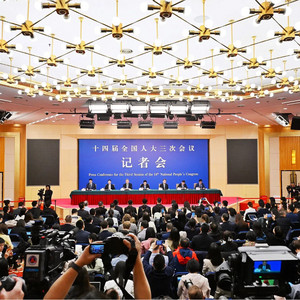
China says it's fully confident in achieving the economic growth target of around 5 percent as their solid foundation, support and guarantee.
Jiang Shanjie, head of the National Development and Reform Commission, made the comment following a meeting of the annual session of China's top legislature.
In the meantime, Beijing also pledged to establish a national venture capital guidance fund in the near future, with the aim of strengthening the development of innovative enterprises.
Chinese commerce minister Wang Wintao says the momentum of the country's foreign trade will stay strong.
He pledged to facilitate domestic enterprises accessing overseas markets.
One also said US tariffs against China are harmful to both countries, and that cooperation is the only way forward.
China says it welcomes international investors to join Chinese tech companies and opposes the politicization of market -based investment activities as well as the imposition of unfair investment barriers.
Governor Pan Gongsheng of the People's Bank of China also said the country will maintain exchange rate flexibility while strengthening guidance and guarding against exchange rate risk.
He also revealed that China will cut reserve requirement ratios and interest rates later this year.
The cuts will be in line with domestic and international economic and financial conditions, as well as the performance of financial markets.
Beijing is also poised to accelerate a new round of capital market reform and opening up, while enhancing the foundation for the healthy development of the stock market.
Wu Qing, with the China Securities Regulatory Commission, said the country will further enhance market inclusiveness, improve the coordination between investment and financing development, and deepen the effectiveness of supervision and law enforcement.
Diplomats and representatives from international organizations are attending the two sessions in Beijing.
They share their expectations for more cooperation.
Among them is Dutch Ambassador to Well, I think the areas where we can work together is clearly a green technology as one and energy transition.
I think we both face the same challenges in making the world more sustainable.
From the Dutch perspective, agriculture and horticulture are very important.
We have challenges when it comes to world food supply and, of course, the broader areas of technology.
AI, of course, is a very important one.
not only on the production but also on the code of conduct.
Where can we work together when it comes to not only the promotion of artificial intelligence but also on the regulation.
Uruguay ambassador Fernando Lugres said there are a lot of expectations on how the two sides can elevate their comprehensive strategic partnership to a new level.
In the last days a very important high level delegation of China visited us.
We have a new government in Uruguay that is committed to continue to foster the bilateral relations with China, in all the different areas and especially in trade, economical cooperation, trying to bring more investments, having more cooperation in science and technology, and of course to continue the political understanding of the two countries that has been so important in the last four decades of bilateral relations.
WHO representative Martin Taylor said he's looking forward to China continuing to play and deepen its role as a global health leader.
So, in recent years China has made good progress in terms of health care development, both in terms of expanding the health care system so that more people can access health care.
We've seen China both investing in terms of strengthening the health care system, but also in particular in terms of strengthening the epidemiological surveillance.
And also China makes some strong financial contributions as well in terms of support in global health and other countries.
The annual 2 sessions refers to the meetings of China's top political advisory body and the top legislature of the National People's Congress.
The sessions hold profound significance as they offer a critical window into China's development roadmap for the year ahead.
Coming up, a discussion on trade tension at China's annual political meetings.
transformation, innovation, sustainable development, consumption, investment, and foreign policy.
People's livelihoods topped the agenda.
As lawmakers and political advisers, gather in Beijing, the two sessions bring together China's top legislative body and top political advisory body.
As delegates and members discussed the country's biggest priorities and plans.
What's China's growth target?
In our motions and proposals are addressed.
Follow CDTN's coverage of the annual political season.
A key moment that shapes China's political future.
11 minutes past the hour.
Trade tensions are a major topic of discussion among deputies at the ongoing session of China's top legislature.
Some suggest that the experience gained from managing economic pressures has better equipped domestic enterprises to navigate new challenges.
Do Hong -Yi has more.
Global economic uncertainty is intensifying especially in the wake of new US tariffs on imports from China and other countries.
Despite the pressure, some Chinese industries continue to thrive, boosting confidence across the business sector.
A prime example is the photovoltaic industry.
Tongwe Group Chairman Liu Hanyouan says two decades of sustained development has made the industry strong enough to withstand U .S.
tariffs. We seldom talk about U .S.
tariffs, because they don't impact us enough to matter.
Consider this. Last year, China installed 278 gigawatts of solar capacity, while the U .S.
installed just over 30, only a fraction of ours.
We respect the US's global position, but their competition no longer affects us." Despite over a decade of US tariffs on Chinese solar imports, China's share in global shipments has surged from less than 1 percent to over 85 percent.
Liu argues that while the US is using tariffs to support its domestic industry, it cannot impede the broader global energy transition.
We understand that the U .S.
is trying to get their photovoltaic industry some space to breathe and grow by raising tariffs.
But the global shift towards clean energy is unstoppable.
And we are already ahead.
So there's nothing to fear.
Beyond solar products, the U .S.
has expanded tariffs to all Chinese imports, ending another 10 % this week on top of the increase implemented in February.
… economist Heung Hui -yor Jieh warns that these tariffs will ultimately bankfire on the U .S.
economy… Since China buys upstream products from the U .S., which are then processed and exported, these tariffs will inevitably disrupt the U .S.
on exports as well.
The US industrial chain is incomplete, and it is impossible to establish a fully self -sufficient supply chain in the short term.
He also emphasized that China's countermeasures, including retaliatory tariffs, will be effective in pushing for an end to the trade war.
Beyond direct counteractions, Yu urged businesses to actively diversify their markets.
It is crucial to expand export destinations beyond mature economies like the U .S.
and Europe. Companies should proactively explore opportunities in the global south, BRICS nations, and other emerging markets.
While seeking new trade partners, he stressed the importance of strengthening internal capabilities.
The business must focus on boosting productivity, further reducing costs, and enhancing product quality to improve their international competitiveness.
Experts agree that challenges persist not only from the U .S.
but also from economies promoting de -globalization.
These challenges come not just in the form of tariffs, but also through regional conflicts standards, and the weaponization of trade standards.
As China navigates these hurdles, it's defining its own trajectory toward continued growth and leadership, shifting to high end manufacturing and expanding international collaboration.
For the Beijing Hour, this is Dao Hongyu.
From a little known town in the 1980s to an industrial powerhouse churning out 800 million pieces of luggage each year.
Bugeo's remarkable transformation has been driven by the ambitions of countless entrepreneurs.
Zhang Tao sat down with a second -generation entrepreneur to explore how the spirit of entrepreneurship turned the small town into a global leader in luggage manufacturing.
At the Bugeo New City International Trade Service Center, entrepreneur Yang Ming is seeking advice on foreign trade policies.
He plans to stock his products in North America.
up, facilitating direct sales to local customers.
If successful, this strategy would give his business a pricing edge and improve efficiency.
Every day we have to fight.
We don't settle for the status quo.
We keep pushing, keep innovating.
Today, businesses are no longer relying on just one platform or one form of trade.
I may be doing well as an agent here in Baikou, but I also want to expand into overseas markets and build my own brand.
Yang Min is part of Baikou's new generation of entrepreneurs.
When his parents started in the 1980s, they were no local factories.
They sourced goods from the southern trade hub of Guangzhou and resold them, laying the foundation of Baikou's luggage market.
By 2000, as demand for high quality products increased, the business shifted toward brand partnerships, acting as agents for multiple brands.
When we took over in 2013, we were already representing six or seven brands.
But being an agent for someone else's brands is like raising another person's child.
I've seen brands rise and fall.
Some succeed, others disappear.
In the end, I was left with nothing of my own.
Determined to create something lasting, Yang Ming decided to launch his own brand.
In 2018, he became working with professional agencies for market positioning, analysis, and branding.
Two years later, his brand made its debut.
By go, he believes it's the ideal place to build a business.
It can produce all types of luggage, but finding the right factories is key to fulfilling orders efficiently.
We must constantly refine our processes, eliminate inefficiencies and use speed and precision to solve problems.
After 40 years of development, Baigou now boasts a complete industrial chain, from raw materials production and design to manufacturing and sales.
Through an intensive wholesale and retail network, the town exports its products worldwide.
Earning the nickname was luggage capital among traders from Eastern Europe, the Middle East and beyond.
While many businesses remain focused on traditional models, younger entrepreneurs like Yang Min are looking ahead.
I believe buy -go shouldn't just focus on the domestic markets.
It has the potential to become a global force in the baggage industry.
It may become an international hub and a major distribution center.
Yang is planning to build a digitalized industrial parking by Go, one that, in his view, will define the future of the town's manufacturing landscape.
For the Beijing R, this is Zhang Tao.
Coming up, Canada is requesting a hearing at the WTO regarding US tariffs.
Artificial intelligence is racially shaping many industries, and sports is no exception.
From robot athletes to AI referees, technologies transforming how athletes train and compete, listen to the latest episode of Sightline Story to join our discussion on the impacts of artificial intelligence on sports.
Should we let AI change the game, or guard our sporting traditions?
Subscribe to Sightline Story and debate us wherever you get your podcasts.
Now, 20 minutes past the hour, the World Trade Organization says Canada submitted a request for dispute consultations to address new U .S.
tariffs. The Mexican government says it could shift trade alliances, if necessary.
The White House says Trump is granting a one -month exemption to three major automakers, from the newly -imposed 25 percent tariffs on Mexico and Canada.
Dan Williams has more.
Once it emerged that there would be a phone call between the U .S.
President Donald Trump Canada's Prime Minister Justin Trudeau, hopes were raised perhaps of a breakthrough, perhaps of yet another pause, as was the case a month ago when these tariffs were first due to be implemented, but that largely doesn't seem to be the case, certainly there will be we understand a carve -out for the auto industry, a one -month pause for tariffs around the auto industry of course the auto industry very much intertwined in North America with very complicated supply chains.
And there would have been, certainly, there were fears that if these tariffs were implemented and as time had gone on, that there would have been perhaps a breakdown in factories across both sides of the border.
But as it stands, the rest of the tariffs, well, they remain in place.
And they were confirmed by Caroline Levitt, the White House press secretary.
The call ended in a somewhat friendly manner, as the president said.
but he's not going to stop standing up for the American people and to answer your question directly when it comes to fentanyl for the last four years unfortunately our neighbors to the north and the south Canada and Mexico respectively have allowed America to be a dumping ground not just for illegal aliens but for illegal poisonous deadly fentanyl which is now the number one killer of young people in this country aged 18 to 34.
So border security concerns remain the key issue according to the White House and of course this is these are all claims that Canada denies, they say that less than 1 % of illegal migrants and illegal drugs cross the US -Canada border into the United States and say that they believe that there are other elements for the reasons for these tariffs being implemented.
Canada's also it has to be said they say that they've spent some $1 .3 billion and strengthening the border as well so as it stands these tariffs well they remain in place 25 % on most Canadian goods coming into the US as well as 10 % tariffs on energy products and of course there's also now these retaliatory tariffs from Canada as well and most economists seemingly believe that these tariffs especially for Canada will be devastating for the economy here." That was Dan Williams reporting.
Cole Jung's General Manager of TC International Logistics based in Vancouver, Canada, shared how the company is responding to the U .S.
tariffs. For us, we are a logistic company focused on the freight -rolling businesses.
The hike off the heritage from U .S.
to Canada, it actually may not affect us right away.
it will have a delay effect.
And you will affect the manufacturing companies first, in Canada.
And from what we are going to predict, they are going to be, if I own a logistic business, for in many three areas.
The first area is the ground transportation of trucking companies within USA and Canada, which they focus on moving the cargo between USA and Canada, Canada and they rely on the higher volume of trade of the exchange of goods between US and Canada every day.
So this sector is going to be affected the most in the first.
And the second one is, maybe you have noticed, there's also an executive order signed by Donald Trump about suspending the de minimis exemption for packages and cargo that's less than $800 in value.
This actually has also a very significant effect on shipments that are being shipped in small packages across the borders between USA and Canada.
And actually a lot of the small businesses in Canada rely on, and the US as well, rely on this method to enjoy the tax -free small package shipping.
And this is also actually made out a big part of logistics right now in this area.
And the third one is because of the travel between USA and Canada expected to reduce because more and more Canadians realize that they need to focus on their own services, their own businesses, so the reduce of the travelers to the U .S.
will reduce the number of flights between U .S.
and Canada, and thus will reduce the capacity for air freight businesses in our business, in logistic business.
So we expect our customers in Canada to choose to import goods from other countries to replace their suppliers from USA, and for example, for the auto industry and other industry, we expect, you know, Canada companies to import more from Japan, Korea, Southeast Asian countries, and for us we need to develop more trail lanes and reduce our reliance on the businesses within North America.
The second thing is that we also need to increase our cooperation with our customers in Mexico because this is also a country we work with.
They also import a lot from other Asian countries So we need to try to reduce our realizes, as I said, with USA, but focus more with Canada and Mexico.
That was a logistics manager in Vancouver, Canada.
South Korea has defended itself after U .S.
President Donald Trump accused it of unfair trade practices and threatened new tariffs.
Jack Barton, has more.
I think there's a lot of consternation here at the moment, and not so much because of the various policies that Donald Trump has been announcing, but the fact that they seem so fickle or changeable or you never know what would be implemented one day, retracted the next or where you're going to stand.
And everybody wondering, is it going to be like this for the entirety of the next four years?
Trump, of course, talking about imbalances during that address to Congress.
And it is true that last year South Korea had a surplus of more than $55 billion when it comes to trade with the US.
And that was up by more than 25 % from the prior year.
But when Trump talks about South Korean tariffs being four times higher than US tariffs, according to the Ministry of Trade and Industry here, that is just not true.
That's their words in a statement they put out, not true.
They say while it is true that the most favorable nation trading status for the US, for the US, the tariffs are 3 .3%, it is technically around four times higher for South Korea.
But they have a free trade agreement that overrides all of that so that tariffs are actually under 1%.
Last year, they were around, on average, 0 .79 % for US goods, and that comes down each year.
So according to the Ministry, that's around zero this year.
So let's say that it's just absolutely not true and the feeling is here, it's probably a negotiating tactic by Trump to put more pressure on South Korea ahead of what is expected to be negotiations over the cost of hosting U .S.
troops, roughly 28 ,500 U .S.
troops in South Korea, shipbuilding deals that the U .S.
wants to implement, and other trade deals, but yeah a lot of consternation here and of course you know Trump talking about that.
That was Jack Barton reporting on South Korea's response to Trump's tariff threat.
We're at 28 pass the hour, Beijing down to 1 degree Thursday evening.
It's sunny and 13 tomorrow.
Nansheng is down to 5, Cloudy and 12 on Friday.
Elsewhere in Asia, Islamabad is 9 overnight, then overcast to 24.
Vientiane is down to 19, then Cloudy 28 on Friday.
Phan is at 24 this evening, then a slight rainfall in 32.
In Africa, Nairobi is getting a slight rainfall in 30 degrees Celsius on Friday.
It's time for a short break!
So far this hour, the Chinese President's been visiting with provincial and regional delegates and joining discussions at the annual sessions of the country's top political advisors.
Trade tensions are a major topic at the two -sessions meetings in Beijing with experts saying that China's resilient and can't navigate these challenges.
World trade organizations, as Canada has formally requested a hearing regarding U .S.
tariffs. Shane Beggam with you.
Stay with us here on the Beijing Hour.
The best military commander is not he who fights a hundred battles and wings every one of them.
The best military strategy does not lead to the desiccation of the enemy's capital city.
Decoding the art of war will help you understand why there is no art in war and how citizens stayed undefeatable using the science of war with fun stories and insightful breakdown of famous battles.
Find Decoding the Art of War wherever you listen.
A gripping audio drama series inspired by real -life tales.
From unexpected encounters to heartfelt reunions, immerse yourself in a narrative of love, peace, and enduring friendship.
a piece of my lost childhood.
Listen to Echoes of Coolia on radio .cgtn .com and all major podcast platforms.
Bing An. Bing an. Bing an.
Examining the events that impact and shake China and the rest of the world.
This is the Beijing Hour, one hour of news and information brought to you every weekday.
Now, here's your host Shane Bingham with you on this Thursday, still to come.
In business, China says it has plenty of policy options for facing financial uncertainties.
And today we have part 4 of the Yellow River mosaic series telling stories of people whose lives are intertwined with that famous Chinese waterway.
To contact us you can email radio at cgtn .com or follow our x -account at cgtnradio.
First of all, a check of the days headline news.
Chinese president Xi Jinping has visited representatives attending a joint group meeting at the annual session of the country's top political advisory body.
He joined the discussion of national political advisers from the China Democratic League, the China Association for Promoting Democracy, and the education sector.
President Xi heard their comments and suggestions.
The White House has confirmed that Washington's been secretly engaging with Hamas in unprecedented direct talks.
Led by US envoy Adam Bowler, the meetings mark a clear breakaway from a decades -long US policy against negotiating with groups it views as terrorist organizations.
President Donald Trump warned Hamas there will be, quote, hell to pay if the militant group does not release all hostages immediately.
Hamas has warned that Trump's comments could undermine the Gaza ceasefire and hostage deal.
It's not the first time Trump has threatened the Palestinian group.
In December, he said there would be all hell to pay if hostages were not released by the time he took office.
The United States has paused intelligence sharing with Ukraine, following a halt of military aid to Kiev.
US National Security Advisor Mike Walts says America has taken a step back and is reviewing all aspects of the relationship with Ukraine.
CIA Director John Ratcliffe says President Trump has a real question about whether Ukrainian President Vladimir Zelensky is committed to the peace process.
The pause in intelligence sharing is a chance for the Ukrainian leader to think about that.
Earlier, Zelensky said the oval office clash with Trump over the weekend was regrettable, adding that he is ready to sign a mineral deal at any time and in any convenient format.
Kremlin spokesman Dmitry Peschkov says Russia views Zelensky voicing readiness for the resumption of peace talks positively.
Belo -Russian President Alexander Lukashenko says Minsk is ready to host trilateral talks between the US, Ukraine and Russia.
Meanwhile, European Union leaders are holding emergency talks in Brussels on Thursday to find ways to increase military budgets and set new defense spending priorities.
Protesters have clashed with riot police outside of Greece's parliament in renewed nationwide protests calling for politicians to be accountable for a 2023 rail disaster that claimed 57 lives.
Scores of youths set fire to trash bins in a square in central Athens and police in Riot Gear responded with tear gas and baton charges.
There were no immediate reports of injuries or arrests and Jaliki is among the protesters.
I came here from the first moment for these children and for these mothers.
I wish that no other mother should cry.
Greece is eating its children, and they shall not eat other children." The fierce clashes erupted hours after opposition parties challenged Greece's government with a no -confidence motion in Parliament.
A days earlier, a general strike and much larger protests marked the second anniversary of the tragedy.
It happened in northern Greece on February 28, 2023, when a passenger train collided head -on with the freight train.
Many of the victims were university students returning from a long weekend holiday.
Authorities in Indonesia have begun seeding clouds to stem heavy rains that have led to deadly flooding around Jakarta.
This comes after overflowing rivers killed a three -year -old girl and displaced over 2 ,000 residents.
Weather forecasters say the rains could extend into next week.
Officials hope the cloud seeding would draw rain away from flooded areas or release rainfall in manageable doses.
Rescuers are still helping to evacuate residents.
Home to around 11 million people, the low buying Indonesian capital is often hit by floods during the wet season.
In 2020, flooding and landslides from downpours killed nearly 70 people in and around Jakarta.
A 24 -member Chinese medical assistance team is heading to the Republic of Guinea to introduce technologies and assist local health care professionals over the next 18 months.
China's 31st team to go to the African country.
The members will collaborate with local institutions and professionals to conduct field visits and prepare samples, promote the culture of traditional Chinese medicine, and help improve local medical and health conditions and standards.
The body acrobatic team of the Chinese people's Liberation Army Air Force is putting on an air show in Thailand.
Pilots completed their first exercise before the show, later in the week.
They are participating in celebrations marking the 50th anniversary of the establishment of China -Thailand diplomatic ties.
Shane think I'm in the Chinese capital coming up in business.
China says it has plenty of policy options for facing financial uncertainties.
The Beijing hour, your window on China and the rest of the world.
36 past the hour turning to business now and here's Wang Zihang.
Thank you Shane. Stock market is on the Chinese mainland closed higher on Thursday.
The Shanghai composite was up nearly 1 .2%, while the Shenzhen component gained more than 1 .7%.
The software development and the digital media sectors were among the top gainers.
Elsewhere in China, the Hong Kong stock market also saw significant gains, with the Hang Seng index up nearly 3 .3%.
Meantime, stocks in Japan also increased, the Nikkei added almost 0 .8%.
The Chinese finance minister says the central government has sufficient reserve tools and policy space to address potential internal and external uncertainties.
Lanfue An says a more proactive fiscal policy reflects the targeted and forward -looking nature of the country's regulations.
According to Lan, the deficit rate for this year is set around 4%, with a deficit scale of over 5 .6 trillion yuan, or around US $773 billion.
The scale is about 1 .6 trillion yuan larger than last year.
The deficit level and scale are the highest in recent years.
The minister says authorities will make efforts to ensure the effective implementation of the package of policies introduced last year.
He adds that authorities will also plan and develop incremental policies to benefit people, promote consumption and enhance future growth potential.
Official data shows that global manufacturing purchasing manager's index came in at 50 in February, unchanged from the previous month.
Asia's manufacturing PMI went up 0 .6 point to reach 51 .3, staying above 50 and in expansion for 14 months in a row.
The manufacturing Entering PMI for the Americas was 50 .2, 0 .7 points down from January ending a three -month streak of monthly growth.
The readings for Europe and Africa remain in contraction territory remaining below 50 despite a slight increase.
Fujian has one of the longest coastlines in China.
Fisheries are an important pillar of the eastern provinces' economy.
Wubin traveled there to find out how one's endangered species of fish have become popular on dining tables after decades of farming.
It's eight o 'clock in the evening.
For fish farmers in East China's Fujian Province, the night is young.
They are hunting large yellow croakers.
The fish is silver during daytime.
It only turns yellow at nighttime.
That is why we hunt them at night." The fish is a favorite on Chinese dinner tables, but back in the 1970s, it was almost extinct due to overfishing.
Inside one of the city's breeding centers, researchers feed and check up on baby fish.
After generations of selection and farming, the fish now grow faster and are more adaptive to different environments.
We've developed a gene chip which can help the team to quickly and accurately identify a large number of genotypes of large halo -broker greatly improving the precision and efficiency of the selection and breeding of the fish.
This is just one example of the huge efforts that have saved the species.
Fish farming has also been transformed by adopting more scientific methods.
Yao Weidu was one of the earliest people to explore the deep water farming of the fish.
He now owns one of the largest sea farms in Ningdu.
The quality of the fish is getting better and better after the transformation.
The net cage was 3 .3 meters long and 3 .3 meters wide.
And now it's 24 meters long and 24 meters wide.
It's 12 meters in depth.
The host base is different.
A set of equipment is also used to monitor the water quality and make sure it's the best possible condition for the fish to flourish.
The equipment can provide temperature, dissolved oxygen, salinity and pH every day, and these numbers are all relevant to the farming of large yellow proker.
Ninde now produces more than 80 percent of the country's large yellow croaker.
In 2023, the city's total output of large yellow croakers reached 213 ,000 tonnes, making it an important contributor to the local economy.
The output value of the entire large yellow croaker industry has exceeded 20 billion yuan, more than 2 .7 billion US dollars.
A recent report by a US think -tank shows Chinese researchers have produced far more research papers on chip design and fabrication than any other country.
According to the Emerging Technology Observatory at Georgetown University, among the 475 ,000 English -language chip design and manufacturing -related articles published from 2018 -23, China accounted for 34 % of all semiconductor research publications.
European nations fell followed collectively at 18 % and the United States at 15%.
The report also shows half of the most influential studies, those ranking in the top 10 % of citations, are by authors from Chinese institutions compared to 22 % from the US and 17 % from European collaborators.
The US Federal Reserve Facebook says the country has seen a slight uptick in overall economic activity since mid -January.
Most regions have experienced modest to moderate growth in manufacturing, while consumer spending has dropped in general.
Automotive sales have seen a slight decline and agricultural conditions have worsened.
Meantime, insiders across industries such as petrol chemicals, office equipment, and real estate have expressed concerns over the impact of trade policy changes, noting that tariffs will clearly drive up costs for these sectors.
Published eight times per year, the Beigeberg is a survey on economic conditions based on information collected from 12 regional reserve banks.
Alright. Thank you very much.
That was Wang Zhehang with Business.
You're listening to The Beijing Hour, just ahead, we have part four of the Yellow River Mosaic series, telling stories of people whose lives are intertwined with that famous Chinese waterway.
Located in Qinghai in northwest China, Aunir Macin, one of the four sacred Tibetan Buddhist Mountains in China, is part of the Kunlun Mountain Range and a crucial water source for the Yellow River.
It contains the largest glaciers and headwaters of the Yellow River.
It's also home to a variety of plants and animals.
This is my first time seeing a snow leopard up close.
But the mountain is getting increasingly vulnerable to the impact of climate change and human activities.
A snow line we examined retreated 300 metres in 15 years.
In this program we travelled to Anyem Maching to find out how the local people strive to protect it in the face of global warming.
Stay tuned for the third episode of our 12 -part series, the Yellow River mosaic, Anyem Maching tracking the snow line.
44 minutes past the hour, you're listening to the Beijing Hour.
Let's continue our 12 -part special series, the Yellow River Mosaic.
Amni Machen. One of the four sacred mountains in Tibetan Buddhism in China, is a vital water source for the Yellow River.
Yet its glaciers are retreating due to global warming.
Local herders are trying their utmost to protect the revered mountain peak.
Here is Uzhia with part four, Amni Machen, tracking the snowline.
April the first, 2024 at the foot of Anya Maching, Maching County, Qinghai Province.
400 kilometers away from its headwater stream ,ARKutung Le Psychology.
The Yellow River makes a u -turn at the Anya Machin range before heading northwest.
This region is home to many glaciers and an myriad of flora and fauna species.
Tottering up the mountain over snow -covered rocks in freezing rain, we followed Hua Chingjir, a local Tibetan herder, as he patrolled Anya Machin.
This is the mark we made in 2021.
He stopped in front of a large rock with 2021 painted on it in blue.
The snow -line retreated 28 meters from a year earlier.
At an altitude of 4 ,500 meters above sea level, we were surrounded by snow -capped mountains on three sides.
Wearing a dark, red, ship -skin coat, the 53 -year -old man was out of breath due to the thin air.
He bent down to pick up something as we were moving forward.
I pick up litter and take them away when I see them on the mountain.
Stretching from north -west to south -east, Ania matching is part of the east extension of Khunle Mountains.
Its highest peak is one of the most renowned sacred mountains in Tibetan culture.
I come to visit now and then.
In Tibetan language, amni means ancestor.
Maching means the largest mountain at the source of the Yellow River.
A township nestled in the south -eastern part of the Anim McChen range, Huaxing Jie started patrolling the mountain regularly, after making a pilgrimage circuit around it in 2014.
I was stunned to see how much the glaciers had shrunk.
And waste could be seen almost everywhere.
The water sources were polluted and drying up.
The highest peak of Anya Mächink has been a pilgrimage site of Tibetans for centuries.
Going around it once is 140 kilometers and usually takes a week to complete.
2014 was a big year of pilgrimage for Tibetans, which comes around every 12 years.
A greater number of visitors came in 2014 compared to previous years.
Standing at nearly 6 ,300 meters above sea level, Anya Machin's varied altitudes and climate conditions support a diverse range of wild plants and animals.
Its landscape changes from grasslands and shoplands, to coniferous forests and ultimately The alpine meadows as you ascend higher, making it a paradise for wildlife species including some endangered ones.
Melt water from glaciers feeds into the Yellow River, offering a stable water source for China's second longest river.
However, that landscape is changing.
There are far more shrubs growing by the water since 2000s, but the cattle don't eat that.
Some types of plants the cattle do eat have been disappearing When I circled the mountain back in the 1990s, the snow was so heavy that the cattle sometimes sunk into it, but it's rare to see such heavy snowfall nowadays.
In those days, you barely saw a car on the road.
and we relied on a kettle to carry supplies.
Anja Machin was one of the first mountain peaks in the country to open to foreign climbers in the 1980s.
It has since attracted hikers, mountain climbers, scientists and tourists from around the world.
A lot more people have come here as road conditions improved.
Some of them little casually.
Hwang Bujue. Hwang Ching Jue's friend comes from Gang Er, a township to the north of Hwang Ching's hometown.
He said they could hardly spot snow leopard or brown bear, in the early 2000.
Back then, I didn't understand why the glaciers were melting and the water sources were drying up.
I was really upset.
If there is no water on Animaching, the plants and animals would not survive, neither would we or the Yellow River.
The local people consider any stable supply of water as a water source, whether it originates from glaciers or underground.
Whanching has conducted fieldwork on regular basis to locate water sources and has discovered that 43 out of some 100 sources had dried up.
Some people don't understand, they'd say, he tracks the mountains everyday.
What is he really up to?
It's okay if they don't understand me as long as they know how important Amni Macin is." Hua Ching has been litter picking at Ani Macin since 2014.
Since then, the number of local herders from the four townships who have joined him around Anima Ji has increased from a few dozen to over 2 ,000.
This is one of the spots where we monitor the water sources.
Here you can see six of them.
We followed Druma Ji, a local villager, until Lucid Motors sprints out from piles of blue rocks.
We monitor and record not only the number of water sources, but also the water quality.
It's pure mineral water, but spring water never freezes, not even your winter, and temperatures drop to minus 40 degrees Celsius.
The area has become cleaner in recent years.
Water flow has increased.
Depleted sources are filled with water again.
And new water sources have emerged.
We've also found some wild animals coming back to this area.
The herders report to me if they spot wild animals.
Some animals are appearing more frequently nowadays, including snow lepers, musk deer, blue sheep and white live deer.
Unfortunately, they cannot stop the glaciers from melting.
The snow lion continues to retreat.
We have been monitoring three snow lions from different directions of Amnimachan since 2008.
They have retreated from 40 to 300 meters in 15 years.
The one next to the highway reduced the most.
They have contributed to preserving a better ecological environment.
But what they can do is limited against the magnitude and the rate of the global warming.
Guo Wan -Qin, a glaciologist at Northwest Institute of Eco -environment and Resources under the Chinese Academy of Sciences, has been monitoring Aanyama -Qin glaciers with his team for over a decade.
The glaciers are melting at a faster pace in the last 10 years.
The surface is of two of the biggest glaciers we have been observing are mounting and receding 3 meters every year.
Data from the National Climate Center shows that the average temperature on the Qinghai Xizang plateau, where anime ching is located, rose by 0 .35°C every 10 years from 1961 to 2020.
That's twice the global warming rate.
Guo Wan -jin says his team collaborates closely with the local herders.
They've been helping maintain our monitoring stations at Amni Malchian for years.
Sometimes they come along with us when we conduct field work and we show them the professional way to measure the glaciers.
these villages. Hua Qingjia and his fellow herders are determined to carry on with their work against Orlots.
It is like when your mother is ill the son should know what is wrong with her and take care of her.
I will continue to take care of Omni Machin until I leave this life.
If we, our born -here, do not care about the mountains, we are food.
It's ourrade M. Nimachi.
It hurts to see the glaciers melting.
We keep recording its conditions so future generations would know that the sacred Mountain was once covered in snow.
How I wish we could slow down the pace of glacier retreat with the help of advanced technology.
According to official data, Anya matching glaciers have been shrinking by an average 67 hectares in total each year since 2000, about the size of 94 football courts.
And that was part 4 of our special series, The Yellow River Mosaic.
You can also access more photos and videos of the series by logging in at radio .cgtn .com We're at 58 past the hour.
Check in the forecast before we go for the day.
In Beijing's down to plus 1 Thursday evening.
It'll be sunny in 13 tomorrow.
Nansheng is at 5 overnight, then cloudy in 12 degrees.
Elsewhere in Asia, Islamabad is down to 9, then overcast conditions in 24 on Friday.
Vientiane is 19 this evening, then cloudy in 28.
Phnom Penh is down to 24.
a slight rainfall in 32 tomorrow.
In Africa, Nairobi is getting a slight rainfall in 30 degrees on Friday.
Compile us down to 20, then a slight rainfall and 27 Celsius.
And that's it for this edition of the Beijing Hour.
Making news today, the Chinese president has been visiting with provincial and regional delegates and joining discussions at the annual sessions of the country's top political advisors.
On behalf of the staff, this is Shane Begum and the Chinese capital.
Helping you join us for the next edition of the Beijing hour and open a window to the world together Takeaway, Chinese where you can take some Chinese away and experience progress day by day Takeaway, Chinese.
We will promise you a difference Hello, everybody.
Welcome to Roundtable coming to you live from Beijing.
Roundtable. Roundtable.
Connecting China and the world.
We bring you fun and timely discussions about what's affecting our lives everywhere, every day.
Tune in to Roundtable where the East meets the West and understanding is the goal.
From north to south, east to west, people in China are chasing their dreams and leaving their mark.
Want to know how they beat their odds and made a difference?
Footprints brings you the true life stories of their journeys.