NPR. This is The Indicator from Planet Money.
I'm Dariam Woods. And you're listening to Indicators of the Week.
Today we're joined by two of our colleagues from Planet Money, Erica Barris.
So happy to be here.
And Mary Childs. What's up, what's up?
Today on the show, we're going to recap this week's top indicators from hypothetical lawsuits over the Gulf of Mexico slash America, to why the price of chicken hasn't gone up, to whether tens of millions of dead people are indeed collecting social security checks.
We'll have all that after the break.
this message comes from intuit turbo tax now taxes is matching with an expert backed by tech to get you the most money back at turbo tax .com experts only available with turbo tax live see guarantee details at turbo tax .com slash guarantees this message comes from charles schwab when it comes to managing
your wealth schwab gives you more choices like full service wealth management and advice when you need it.
You can also invest on your own and trade on Think or Swim.
Visit Schwab .com to learn more.
Support for NPR and the following message come from Edward Jones.
What does it mean to be rich?
Is it having a million stories to share?
Is it having more time to give?
Edward Jones's financial advisors will support what matters to you.
Edward Jones, member SIPC.
This message comes from Charles Schwab.
When it comes to managing your wealth, Schwab gives you more choices, like full -service wealth management and advice when you need it.
You can also invest on your own and trade on thinkorswim.
Visit schwab .com to learn more.
So for Indicators of the Week, my indicator is 1%, which is how much the price of chicken meat has risen over the last year.
That is in large contrast to egg prices that have nearly doubled in the US.
Huh. So chicken is basically flat in price.
Yeah. And this had some listeners to the show asking some questions after we published our story this week on egg prices.
So you might recall that the big villain driving up egg prices is bird flu.
So it's kind of this puzzle why bird flu hasn't also affected the price of chicken.
Yeah, those things kind of go together as I understand it.
Or do they? So first some farming basics.
The chicken people buy in the supermarket is not from the same breeds that lay eggs.
Okay, so chickens that we eat are broiler chickens And chickens that lay eggs are called layers.
Yes. Also, the farming is completely different, which is reason number one that bird flu so far has not affected the price of chicken.
Namely, that commercial broiler chickens are typically slaughtered between four to six weeks old.
Egg layers, on the other hand, need more than four months before they can even lay their first egg.
So when bird flu hits the country, it takes much longer for the national egg -laying stock of hens to be replenished.
Wow, I hate this. The chicken that we eat, they don't even have a chance to get sick.
Yes. And reason number two is that egg farms tend to be a lot bigger than chicken farms.
So we're talking about one and a half million hens in the average egg farm that had bird flu, as opposed to a tenth of that for the average chicken farm.
So when bird flu hits an egg farm, it's a lot more chickens that need to be culled.
I think I'm becoming a vegetarian again.
I don't think I can handle this.
Yeah, seriously, this is propaganda, Erica, and we're very susceptible.
I know. So the propaganda is the truth.
I'm sorry to say that.
I'm literally saying nothing but how the farming works.
I hate it. And reason number three why chicken prices have remained stable is their locations.
There are four big flyways for wild birds in the US.
Oh, this is basically the highways in the sky for bird migration?
Absolutely. These flyways put farms along them at greater risk of disease from wild birds.
And the broiler farms happen to be less concentrated on the two flyways where bird flu is most prevalent.
So at the moment, that's meaning less bird flu, plentiful chicken supply and pretty stable chicken prices.
Wait, so are you saying that the broiler farms are in not flyover country?
They are in flyover country.
We are redefining flyover country on this very podcast.
So broiler chickens get to just keep living their short lives, keep getting murdered in flyover country.
The coastal chickens are now all being killed in mass by either bird flu or by their owners.
And Darian has added two more to the count of vegetarians in this world.
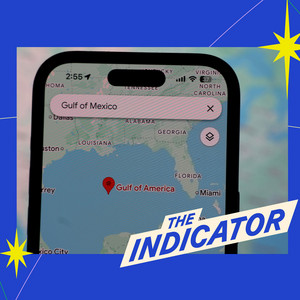
So anyway, speaking of coasts, my indicator of the week is 12, as in nautical miles, because that is the area that Mexico's president says is perfectly fine being renamed the Gulf of America per U .S.
President Donald Trump's wishes.
So if I'm getting this right, Mexico's president says you can rename 12 nautical miles the Gulf of America, but not the entire kind of thing we think about.
That's right. And so that's only 13 .8 regular miles.
And they are different miles and nautical miles because the Earth's arc becomes a factor in accurate measurement.
Now, this is the indicator we needed.
Yeah. I know, right?
Isn't it so fun? We actually just learned a whole lot about nautical miles and other oceanic conventions because Eric and I just did a whole episode of Planet Money about a dispute over sunken treasure.
Yes. Which is a whole different world down there.
And there has been a sort of interesting corporate response to this name change, which is that they've been pretty cooperative.
Oil companies, including Chevron, Shell, and BP, adjusted pretty quickly to follow the administration's guidelines.
They have to coordinate with a whole bunch of different federal agencies on a very regular basis, like the Bureau of Safety and Environmental Enforcement and the EPA and the Coast Guard.
So it makes sense to all be using the same language just for consistency and ease of doing business.
So they all switched.
And so have U .S. companies that provide maps like Google.
And also, you may have forgotten, Apple and Microsoft.
They too have map products.
I never knew that Microsoft did.
I know. It's Bing. It's Bing Maps.
You ever heard of it?
Oh, never heard of it.
I know. So that is the context.
Google updated Google Maps so that U .S.
users see Gulf of America and users in Mexico still see Gulf of Mexico and international users get to see both.
That is so, so chaotic.
Isn't that confusing?
So according to reporting by our colleague at NPR, Manuela López -Restripo, this week Mexico's President Claudia Sheinbaum wrote a letter to Google taking issue with renaming.
She pointed to a UN convention.
These are written agreements between countries and the UN, which says that a country's territorial sovereignty only extends 12 nautical miles from its coastline.
So, she said, any name change only applies to up to 12 nautical miles, not the rest.
Take that. I know, I just find that so charming.
It's like, yeah, you can have your 12 nautical miles.
For some reason, I don't know if the U .S.
president is reading up on nautical law at this stage, but I'm willing to be corrected.
So Scheinbaum says that Google wrote back saying they were going to comply with the change, but that they could come meet with Mexico's government to talk about it.
And then in a press conference this past Monday, Scheinbaum said she was waiting for a new response from Google.
But if not, she said, quote, we will proceed to court.
To do what? I know, right?
It's a really good question because it's all very vague.
Like, would this be a civil suit in what court?
Like, who knows? But I guess if the name change itself is just semantics or rhetoric, she's meeting it in kind.
So from squabbles over naming maps to Social Security.
Take us away, Erica.
That's right. OK, so my indicator is the number tens of millions.
And that ballpark number is how many dead people over the age of 100 the Trump administration claimed were receiving Social Security checks.
I saw 200 there and 300 as well.
Let's just say that those numbers sound a little off.
Social Security didn't even exist that long ago.
So even if you were 100 years old in the 1930s when Social Security started, this still does not actually make sense.
Yeah, they weren't contributing.
They were not contributing.
That's right. They haven't earned their credits yet.
So how did they come to this tens of millions number?
How did this start?
So this week, President Trump made this claim.
He was at a press briefing and his advisor, Elon Musk, he posted on X, maybe Twilight is real and there are a lot of vampires collecting Social Security, followed by a couple emojis.
So, OK, but what is actually going on?
The confusion stems from this like very old school software that the Social Security Administration uses.
And the thing that's most important is that the agency has not set up a system to properly mark death information in its database.
And that includes for nearly 19 million Social Security numbers of the people that were born in or before 1920.
So this doesn't mean that those people are actually getting benefits.
And even if they somehow had been, once you actually hit the age of 115, the agency automatically stops payments.
So why haven't they just updated the software or the database?
Yeah, so that would seem like the easiest fix, but apparently that would cost up to nearly $10 million.
So the administration made this choice to not actually do that.
And I should mention this all started because they are trying to, like, root out, like, unnecessary waste.
And the Social Security Administration did send out a press release last year.
And they said that over seven years, it had overpaid recipients $72 billion.
Now, it did get most of that back, but it's still a few billion short.
OK, from maps to chicken to Social Security, not from beyond the grave.
Thanks so much for joining Indicators of the Week.
Thank you for having us.
Yeah, this was a blast.
This episode of The Indicator was produced by Corey Bridges with engineering by Neil Raj.
It was fact -checked by Julia Ritchie.
Cake & Cannon edits the show and the indicators of production of NPR.
to achieve your language learning goals no matter how busy your schedule gets.
It's designed to maximize study time with immersive 10 -minute lessons and audio practice for your commute.
Plus, tailor your learning plan for specific objectives like travel.
Get Rosetta Stone's lifetime membership for 50 % off and unlimited access to 25 language courses.
Learn more at rosettastone .com slash NPR.
Support for NPR and the following message come from Bolin Branch.
Change your sleep with the softness of Bowlin Branch's 100 % organic cotton sheets.
Feel the difference with 15 % off your first set of sheets at bowlinbranch .com with code NPR.
Exclusions apply. See site for details.