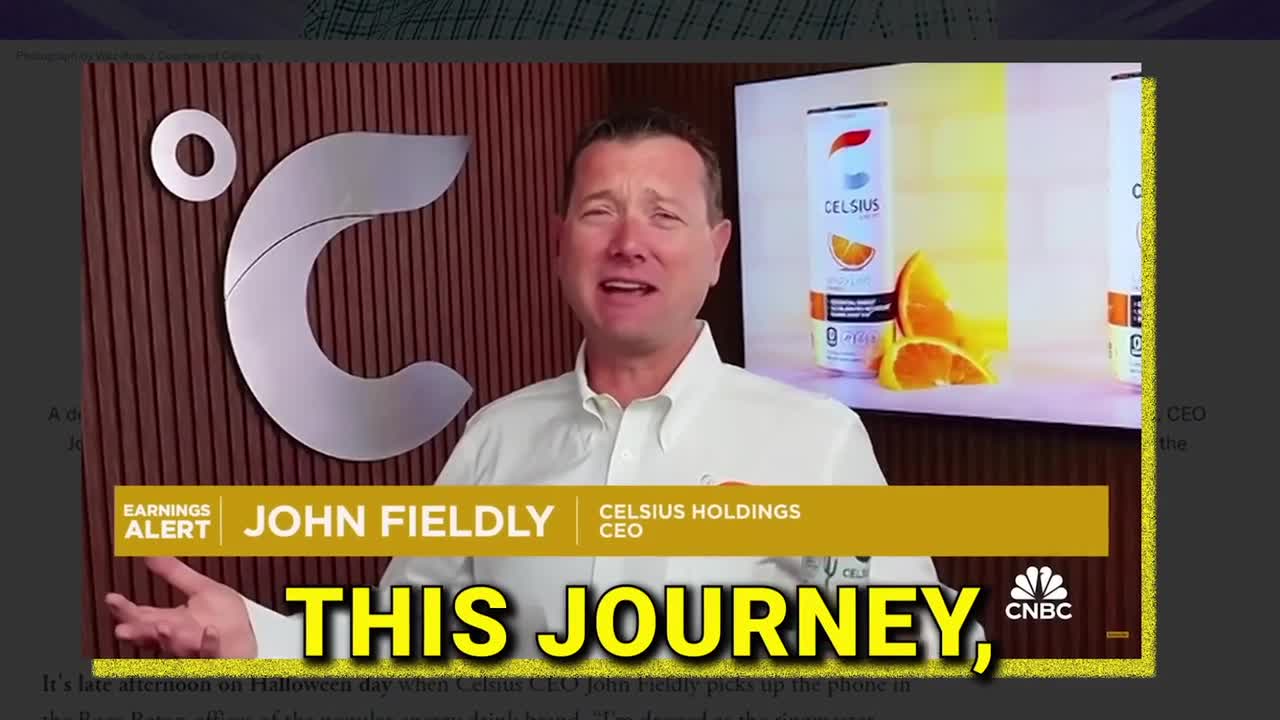
We got our like a pink slip from Costco, got delisted from Costco, which represented over half of our revenue at the time.
And then we got delisted out of Walgreens and CVS within the next 30 days.
Welcome to The Logan Bartlett Show.
On this episode.
What you're going to hear is a conversation I had with John Fieldley, CEO of Celsius.
Now, many people probably know Celsius as an energy drink maker due to its near ubiquity.
But what people probably don't know is that the company nearly went bankrupt a number of different times, including being delisted from the NASDAQ stock exchange.
John and I talk about this journey, which also included losing 50% of its revenue overnight.
We talk about how John was able to build the company back up, transition it from a niche in weight loss to a broad leader in the energy drake space, as well as a number of the different marketing strategies that they've used to rebrand the business into the nearly 10 billion business in the public markets today.
You'll hear that conversation with John now.
Well, John, thanks for doing this.
Glad to be here.
I appreciate you coming over, hanging on the couch here.
Yeah, nice couch.
Yeah, yeah, yeah.
Coffee here, nice place.
Yeah, yeah.
We're working on a studio as we speak for New York.
And in the interim, my home apartments is as good as we got.
Thankfully, it works.
Absolutely.
Well, so for people that don't know, I'm sure everyone knows Celsius, but it's been an incredible journey.
When I started unpacking the levels or the story over the course of the last 10 years since you've been here, It's unlike any other journey that I've kind of seen.
So maybe just a level set for people that don't know.
Business was founded?
Originally founded in 2004.
2004.
And the original premise was what?
The original premise was founded by Steve Haley and Janice Haley.
They were entrepreneurs in South Florida.
And I don't know if a lot of people know about South Florida.
I didn't realize this until I started working at Celsius, but it's like an incubation area.
Not only was in Boca Raton, not only did IBM have a research center where the first home laptops Yeah, I remember.
I think that was like the project that actually built Microsoft, because the operating system for Microsoft was put on those laptops right.
So Boca Raton is like the home kind of of Microsoft's origin.
Yeah, it's right by our office, the Innovation Center today.
And the city has a good office in there.
And then outside of that, there's a lot of sports nutrition.
So it's the mecca of sports nutrition.
I mean, Miami was just ranked one of the most fit cities in the US most recently.
So it all makes sense.
And everyone wants to look good at the beach.
And there's a lot of sun and a lot of beaches around.
But if you look at gardener life's down there, herbal life's down there.
GNC had their innovation down there.
Rexall Sundown, and one of the main investors is Carl DeSantis, who actually built Rexall Sundown, which is the top multivitamin company in the US for some time.
Um, but when you go back, the original thesis was to create a negative calorie drink.
Um that actually will burn calories of 100 140 calories and help burn body fat.
And at the time there was only kind of weight loss pills that were out there.
Uh, those type of, um, of products.
And they really wanted to create something that can promote health and wellness, also be used as a pre-workout and create the first negative calorie soda that didn't really exist.
So that was kind of the initial vision and concept.
And so when did the business go public?
It was right around 2009, they uplisted into what they call a kind of reverse merger into a prior public company.
So if you read any of our SEC filings, we used to be a mining exploration mineral company out of Nevada.
And unfortunately we're not successful back then and acquired a beverage company called Celsius in Florida.
So original name of the company was Vector, a mining exploration mineral company who now bought a beverage company and today we're Uplisting is, I guess I mean, I'm sure people that are more financially specific about this stuff not totally dissimilar to a SPAC concept in some ways, which has been more in vogue of late.
So that's how it went public.
And what was the?
I realize this predates you a little bit, but at that point in time the market cap was
Yeah, the market cap, it did extremely well.
They raised, they did an initial IPO, post the reverse merger, they call it.
They raised about 175 million approximately.
They were listed on nasdaq.
The stock did extremely well, i believe.
I'm not sure the the peak market cap it did, but you know it was uh well into you know, the 30 to 50 million dollar range at a point and, um you, It was a success.
Everyone was excited.
When you think about it.
At the time you had low-cal, no-cal and Celsius was going after the negative calorie category within the beverage category.
It's never been seen before.
That was like the initial message.
And negative calorie, I guess, having listened and prepped for this, I understand what it means.
But for people that don't know what that is, it's actually, can you explain that concept?
Yeah.
So when you look at, you know, there's Basically, the product increases your metabolic rate.
So it allows your body to burn extra calories.
Your body constantly works harder within.
The product is actually clinically proven to burn about 100 140 calories over a four-hour period just by consuming the product.
They had over six clinical studies with that.
Also the science is also based on within the research.
You'll burn twice the body fat during a workout drinking a Celsius 15 minutes before, versus the placebo that they use was a Diet Coke.
Within the science,
So product truly functional and really revolutionary within the category.
So you came in in 2012?
Yep, I started January of 2012 and I unfortunately, you know, leading up once the company did the IPO, they got a lot of excitement.
They actually I mean, they were on The Today Show.
The amount of news and buzz around this.
You know really negative calorie beverage that was coming to market.
It created so much excitement that Coke and Nestle actually partnered and created a negative calorie soda competitor called Inviga that they launched.
And unfortunately well fortunately, I guess is that they didn't do the proper research, they didn't have the proper science to justify the structure function claims, because in beverage, especially in diet nutrition and sports nutrition, you need to back up your claims right.
So if you're gonna make structure function claims, you need to be able to substantiate them with science, And they weren't.
I guess they lost in a class action lawsuit.
They didn't have substantiation to justify the negative calorie effect of Envega.
And so they wound up shutting, closing their doors.
And during that same time, Celsius actually had a class action lawsuit as well.
And the company.
Because of the research, because it was done in South Florida And it was formulated by individuals in the sports nutrition space, they did the product right.
They did the science, they did the research.
So the product was actually prevailed in the California class action lawsuit.
We know all the lawsuits that come out of California.
So product's backed by science and it prevailed in the California court system.
So it truly does what it says and having a true functional beverage, there's nothing better than Celsius, great flavors and the functionality is there and it's great for a pre-workout and that's uh, alluded to, kind of allowed us to move forward to where we are today.
Yes so, so maybe go through that that, that journey, so so you come in.
This class action lawsuit's going on, like i just finished right before it was like 2011 uh 10, 11.
I'm sure that wasn't great great for the stock price.
Yeah, definitely not too good.
It's been a roller coaster.
And then the Aviga competitive launch, I assume, also weighed down the stock as well.
So there's all these pressures of being a small cap, publicly traded but small cap company going on.
And ultimately, you all were faced with a delisting.
Yeah, so they had a.
The team had great execution plans.
They got listings all across the US, every major retailer, from Costco to Kroger to 7-Elevens great distribution in the amount of stores.
They took the 17 million, did a variety of marketing strategies and it just they couldn't get the rotation.
You know, it's one piece of the business in retail is getting the distribution.
The other piece is getting consumer acceptance and building a loyal consumer base.
And it just the mix just didn't happen.
So The company ran out of cash.
They tried to sell the business.
There was no buyers due to the failed, kind of a failed start.
They tried to raise additional capital and unfortunately just wound up having to get.
They got delisted.
And the majority shareholder came in, which was Carl DeSantis.
And he kind of bought out the founders and several other people that were initially in the company.
And they got delisted all the way down to the penny stocks which, if you know the different tiers, you get everything from NASDAQ to OTS.
The pink sheets and then the penny stocks.
And within penny stocks, there's a stop sign version, which is like really, really low.
And that's where Celsius was.
They're non-reporting, non-disclosed and just kind of just the shell was just out there publicly trading on the pink sheets.
How many people were at the business at that point?
When I showed up in January 2012, I was going through interview processes with the major shareholder, as well as Jerry David, who brought me on.
There was about 12 people.
Wow.
10 or 12 people that were there.
What was really neat was hearing majority shareholders say, you know, he was honest.
It's just, you know, there was a lot of challenges.
It didn't work.
We tried to sell the business.
I got a lot of investors here that lost a lot of money and we need to make them whole.
I'm looking for a leadership team that can make the shareholders whole.
So that was the main kind of thesis he had when he was looking for a management team.
How do we drive profitability, and how do we make all these investors whole?
Because he felt really bad what happened.
And so so you join at that point.
And what is the product vision?
Uh that, you're that, that that they're kind of galvanizing behind uh, and going to tackle.
Yeah, so you had, you know, Carl DeSantis, I mentioned he built Rexall Sundown.
So just think of his mindset within, you know, multivitamins, truly functionality from the vitamins.
I joined with Jerry David.
So he was the prior CEO of Celsius.
I worked with him in a biotech consumer products company called Orogenics out of Tampa.
A lot of the research is all based on oral bacteria, which was really great to learn about.
And so I joined him as the CFO to help Jerry turn this business around.
And the main thesis was really to take the true functionality of the product, really that negative calorie, the fat burning capability functionality and bring that to more consumers target consumers within the weight loss community.
So Jerry's experience, he came from, the home shopping network.
So he dealt a lot with the supplement industry as well.
And so he was, had a lot of experience in that space.
So that was the main kind of thesis.
Let's go after the weight loss crowd.
We got this, we did a bunch of before and afters.
We were in People's Magazine every year.
They do a big, Big issue about individuals that lose over a hundred pounds.
I personally know that, like six people that have lost anywhere between 80 to over a hundred pounds on Celsius.
And it's, but it's not because of the product.
It's because they got, it gets you thinking about health and wellness.
And that kind of goes to where we are today.
Yeah.
Yeah.
And it's very rare.
You see meat products that or have a product that changed people's lives and goes to my first demo I did.
I remember when I started, you know, we've done tons of demos and I was out of 5K.
I had my wife, my daughter, my son was still in a stroller.
We got some friends coming in.
I got family.
I got my parents.
We're all wearing our Celsius gear, handing product out, trying to hand product out which, trying to hand out a negative calorie drink was a little difficult.
Everyone's kind of what's in it and there's a lot of questions.
But uh, this individual comes popping his.
You could see him coming through the crowd.
He's like celsius and um, i knew we had something at that point.
I wasn't sure up until that point.
But when you see Someone like the passion and he explained the product to all of us and how it's changed his life.
It got him in the 5Ks and he's going to run his first marathon this year.
I mean, and he kind of attributed it all to Celsius and it's pretty amazing.
And so from a distribution point though.
So now you have this vision of where, with DeSantis as the majority owner, and you have this vision of where it can go, or at least what the positioning is.
How do you actually start selling the product?
Or what are the distribution choke points that you're sort of thinking about to actually reach customers?
Well, especially in the beverage industry, it's really difficult.
You're shipping basically liquid around the country.
So it's a really difficult challenge.
And it's like the chicken and the egg in retail.
We did have some distribution when I started.
They started to get delisted from a variety of retailers.
Within my first it was like the first three months we got our like a pink slip from Costco, got delisted from Costco, which represented over half of our revenue at the time.
So that was A really scary time.
I wasn't too sure about how long the investor was going to continue to invest in the company when you lose half your revenue.
And then we got delisted out of Walgreens and CVS within the next 30 days.
And it's difficult.
And the distribution.
There's wholesalers, there's distributors, and then there's a direct.
So you can sell direct to retail.
You really almost have to start selling direct to retail first before you can get a wholesaler to take you.
Otherwise, a lot of times you have to pay a lot of upfront fees and costs to try to get a distributor to take your product.
If you don't have consumer pull, it's a really expensive proposition.
So we stuck with our, what we call direct store, you know, direct to retail focus.
And we built the brand within the food industry, mainly in the grocers and the HPC set.
So next to the Atkins and the protein bars and that type of space.
And so at that point, to go direct on that, are you calling up individual stores?
Or how are you actually reaching people?
Well, what we were doing, we had a few good accounts.
So Publix always believed in us in South Florida or in the Southeast.
We had HEB out in Texas that really held onto us.
Focusing in this HBC set, which is health and beauty, what we call them like.
The hurdle rates, or your items sold per day or per week, are a lot lower than the beverage industry.
So we were able to get somewhat of a footprint in these retailers, because they weren't expecting high volume sales.
So we're able to stay in retail.
Which is an interesting distinction.
And so if you're sitting alongside, I don't know, a traditional energy drink or a soda, then the volume that they're expecting or the turnover they're expecting is far higher.
But if you're sitting next to some weight loss thing, the expectations that the HEBs or the Publix would have is just different.
Right, it is, it is.
You gotta look at your set that you're going into.
What are the velocity rates?
What are the minimum hurdles?
If your brand, if your product cannot meet those expectations, retailers are cutthroat.
You got, you know, some have got 60 days could be three months or six months to perform.
Otherwise, you're out.
Otherwise, you're going to start writing checks to stay in.
And that can be a really bad spiral, especially when back in 2012 and 15, things were really really tight.
Yeah, I can imagine.
And so was that a positioning change, or was that the way that it had always been positioned?
It was just fortuitous.
That's the way it was always positioned.
The company spent, I mean, you look at the history.
The company spent a lot of money on the science, a lot of money fighting in California courts to prevail with the science and truly believing in this disruptive technology that Celsius has that can disrupt the beverage industry.
And it's a great story for investors, especially when you can start to show traction.
The challenge is when you think about your consumer.
We learned through the journey that you really have to have different messaging.
Just as you're going to sell to a retailer, you need to have different messaging to a retailer than an investor, than a consumer.
It's like going back to you think Maybe easy, you know a 101 when you're going to prepare for a sales meeting.
Like, who's your audience?
Who's your customer?
What are their need states?
And what are our differentiators and how we're going to win them over and what value can we add?
So I think that was we were selling one story to every single person or every segment that were along the value chain.
And we changed that.
When did when did it shift or the positioning evolve from for more weight loss centric to more wellness centric?
We back.
Probably around 2016, we started to really slowly move away from the true functionality of the product and leading as a differentiator and talking more about the great product as an energy drink, as a pre-workout.
It'll provide you better for you energy.
The product has over seven essential vitamins which are differentiated.
Versus a lot of the competition you don't get crash or jitters.
Versus a lot of pre-workouts give you crash and jitters and you get like anxiety type of feeling.
So there was a lot of differentiation within features and we focused on fitness with those attributes leading with that.
And then, by the way, it also is clinically proven to burn calories and body fat and not leading with that on the front end.
We got more ingrained into that strategy through 2017 when we did a packaging change.
We've changed the packaging probably since 2012, almost every year.
There was like add this word, that word's not right.
The marketing team and even our investors were providing us insights on what the packaging should say, that it needs to say this word and that word, and it's not working because of this.
And so eventually we kind of moved, and I think it was 2016.
If you saw one of our cans, I think it had as many words as you could fit on a can during that time.
And in 2017 we kind of rebranded it.
We cleaned up the packaging, we made it more simpler, we embraced who we really wanted to be as an aspirational brand and kind of.
We did an exercise like we What are aspirational brands that we can turn Celsius into?
We always talked about we change people's lives.
What is that meaning?
How do we really create an iconic brand that is tied to changing someone's life, living better, living fit, pushing people to accomplish their goals?
How do we get the brand to be more emotionally driven versus functionally driven in the decision making or the consideration phase?
Those were a lot of exercises because if you go back to past 2017, it was really going on the functionality as the consideration, not the emotional connection.
And if you think of any iconic brands that are out there In the world, it's that emotional connection that wins, because you're always going to lose potentially.
You know, if you say you have X amount of vitamins, someone's going to put a different vitamin in.
Or if it has, you know, X percentage of this, then someone's going to say that I have this.
So you have to make more of an emotional connection.
And we learned that during the journey.
And if you look at Nike, I was watching CNBC.
And they had an executive from Nike on.
And they were talking about how Nike is an iconic brand.
And it's all about the brand as the differentiator.
Even though they have multiple lines that offer different attributes, it's really the Nike that is this iconic brand and differentiator.
So those are things that we think about.
You look at Monsters, an amazing brand.
You know, Red Bull.
Look at Apple.
We always said we want to be like Apple and Starbucks.
You know, we was in the office.
We always say that green straw means something.
You know people wake up an hour early to wait in line to get that.
You know stand that, stand in line, get that Starbucks and you show up to work.
It says something about who you are.
We want Celsius to be more than an energy drink.
It says something about who you are.
We've been working on that.
Yeah, you've done a great job executing on that.
Was the low point, I assume, after the Tosco and the pullout from the retailers, and then was it a series.
Was there any moment along the journey after that that it was clear you were out of the woods?
That stands out.
Or was it just a bunch of small moments along the way?
It's a variety of kind of small moments along the way.
I think, you know, the plane's always crashing and you're always trying to pull up.
You know, it's...
Even today.
I mean where we are today.
You kind of have to take a step back and look at the accomplishments of the team and where Celsius is.
Now we're over a 10 share in the energy drink category, which it's amazing that one out of every 10 cans is a can of Celsius and seeing the consumer acceptance and the love for the brand.
You know.
But when you get into the bunker and you're in the huddles, it's you know you're trying to run the next play.
You need to get that extra yard.
You know, the clock's running out.
You know, there's... uh just a lot of um you don't get that feeling i guess you really need to step back yeah along the way did you um when so when did the relisting occur so in 2000 i think it was mid 2017 we uplisted we got we backed got back to uplisting the nasdaq once we started we met the requirements so It's actually, I spoke to a lot of different analysts and we might be, seem to be one of the only companies that have actually graduated from every single class of public company status.
Like a minor league baseball player or something.
Yeah, like back to, And we didn't skip one.
So we went from OTC, petty stock, non-reporting with a stop sign, stay away, to OTC fully disclosed.
And that means you start filing, you comply with the OTC markets.
It's not SEC filings, but you're releasing financial information quarterly and there's a variety of things you need to do.
And then there's an OTCQX, which is like another league up where you start being more compliant.
Then you become SEC registered, which is another step up.
And then we uplisted to NASDAQ.
So we kind of like went through all the different phases of a public company and That was a major milestone when you look at it.
It was going back to the initial thesis from Carl that wanted to make investors whole.
Had 5 million in the line of credit.
He was there.
He's passed away now, but he was there on that day, and that was really special for him.
That was really an awesome time to get it back listed.
You know, it brought this thing back from really the dead.
And what's fascinating is you hear some of the Koch executives talk.
I was at a conference and they were talking about all the new beverage companies that come to market every year.
And there's over like a thousand new beverages come to market every year.
About 10 will make it to a million dollars or 10 million in sales.
Of that 10%, make it to 100 million.
And of that 10%, you know, 1% makes it to a billion.
So it's just really, really rare.
Yeah, the survivorship rate is really, really low.
And I'm sure...
It's an even smaller number of those that do it on the public market, coming all the way down and back up.
I think you're a one of one.
I think you're a one of one on that.
And so along the way in the repositioning, was there, Was there any major unlock that really felt like OK, now the tides are turning and there's wind at our back now.
Was it the repositioning into more of an energy drink that that really enabled the success, or what was it along the way?
Yeah, I think it was a couple of things there.
So the rebranding of the product, I think, was monumental.
And changing the position to more.
This live fit aspirational mantra, where Celsius provides this essential energy for life, that allowed us really, at the time, within the category everyone was talking about, better for you energy.
So there was a variety of new brands coming out with better for you ingredients and functionality.
And there was some space within retail sets because Remember, keep in mind when you're talking to retailers, getting that shelf space is super critical because you can't build a brand without retailer or shelf space.
But you can't be too far off the category or too far off into that white space, because you will not have a home at retail.
So you really need to adapt. and grow with the category and how retailers perceive the category.
So with this better for you kind of category starting to evolve, Celsius was able to gain some distribution in the beverage category and start to get off some of the shelves in the HPC sets and leverage this better for you, although it was a small space.
We got more trial, more awareness, more availability.
And while we were doing that, we also were building it up on Amazon.
So Amazon, we're almost a 20 share on Amazon.
We're actually, the latest data had us at number one energy drink.
So we tattle back and forth between historically with Celsius and Monster, kind of go back and forth.
And that was a really loyal consumer base.
And if you really think about building a beverage which is an energy drink is normally an impulse purchase.
We've built this brand through a platform that you had to spend 20 to 25 to buy a case.
Take it home, chill it and drink it as part of a daily lifestyle and a daily routine.
So that's really difficult to do.
So we knew we had something special because of the consumer base, the loyalty we've had on Amazon.
And Vitamin Shop has been a major retailer for us over the years.
So between those two retailers, we knew we had something.
We knew the consumer health and wellness trends were getting stronger.
We knew this fitness lifestyle position we were embracing was differentiated in the category.
It played within traditional energy and it played with this better for you energy that the retailers were building out.
But it was this white space kind of in between that we could throttle.
And we could bring in more consumers and play in both spaces.
So that allowed us to continue to scale the fitness during that time. continues to get bigger.
A lot of these specialty gyms that we've embraced along the way, I think allowed us to connect with more consumers in an emotional way.
If you go back to like Barry's Boot Camp, Dog Pound up here, you go to Equinox, you go to SoulCycle.
A lot of these great gyms are more than a gym.
They're an experience.
And we've been a part of that journey along the way.
And that's been really exciting to get trial and awareness and to start becoming more of a lifestyle.
And so the energy drink category, the big three as I think about it, the Red Bull monster in you all, and all kind of appealing to slightly different constituents.
I'm sure there's some overlapping Venn diagram that exists, but who is your core customer?
Wellness is obviously an important factor into it, but do you think of it as a 20s 30s, 40 something?
Yeah, so historically, if you go back to the original, when I started it was 24 to 34.
It was an older demographic, because someone at that point, when you go back to 2012, almost to 2000, kind of 16 it was really focused on someone looking for weight loss.
It was that it was an older consumer.
We were still focusing on the gyms, but really mark marketed as a pre-workout.
And then today, with the fitness lifestyle in 2017, we changed that positioning.
We're going and and gyms become gym.
I mean just the excitement around gyms.
It's becoming culture, right.
Sure.
I mean, prior to that, it wasn't part of culture.
Now everyone goes to the gym, gym memberships.
Look at the athleisure apparel industry.
That didn't really even exist.
Now it's a multi-billion dollar category.
Yeah.
So, I mean, uh, so, so we've embraced that through the journey.
And I think that when you look back um, those are some some really key milestones along the way um that allow us to be kind of change that positioning and embrace that and, um where we are.
So who is the user or who's the, the ICP?
So today is the 18 to 24 is our main target.
Um, do really great with, with Gen Z. Actually, we just, uh, last week we graduated.
We have a cell city university program.
We uh have 210 college students in over 90 universities come down to South Florida.
We educate them on consumer products, everything from budgeting planning, production procurement, marketing strategies.
And they're really the CEOs of their campus.
And then they go back and activate.
And we work alongside them with a variety of our team members.
So it's about 18 to 24 is the target consumer.
Someone that's looking, you know, believes in fitness, has a fitness lifestyle mindset and looks forward to living life to its fullest.
That's what we're about.
And so, as you think about reaching or appealing to those constituents or that ideal customer profile we talked about gyms as a distribution point and brands and all that
You guys have also leaned in and done a successful job within, like influencers as well, and signing kind of athletes as sponsors or endorsers of your business.
How have you guys thought about that as a distribution point?
Yeah, I mean, that's that's been really critical.
You know owning the phone, influencer leveraging.
You know it was Facebook and Instagram and TikTok and Snapchat.
We need to be where consumers are.
What's great about social media is, you know, people can find anything out on social media.
And with the fitness lifestyle, There's so many trainers we initially were embracing.
We still do personal trainers.
We're actually, during COVID, we leveraged them on our platform.
We helped a lot of them become and help them get subscription models on how to use you know better use Instagram, as you can build a platform, a personal training business, on these platforms.
And then he had zoom pop up and that was the video programs and video workouts and we really embraced it.
The key is to embrace the technology around you and And it's an omni-channel world
Consumers want it when they want it.
And it's an impulse purchase a lot now.
And everything's at your fingertips on these phones.
So that's something we've always embraced.
We're the number one on Instacart as well, selling energy drink.
And Influr is a key strategy.
Yeah, and so your personal rise within the company.
So you joined as CFO, but it was only 12 people at the time.
And then you took over as CEO when?
I took over right around 2017.
I did a dual role.
I was CEO, interim CEO, CFO.
Jerry wound up retiring during that time.
He was getting up there in age and The company was out looking for the pursuit of a new CEO that could take this company to the next level.
So that lasted for, I guess, about a year and a half while they were going through looking for someone with pedigree that could lead the company to disrupt the beverage category.
And so we uplifted the NASDAQ as I uplifted it, the whole company as the interim CEO, CFO.
And I don't think there's too many public companies that have done that, which was quite interesting.
So that was one of my justifications towards the end of the whole thing.
I want in on the next interview process as we're going through these candidates.
And I was running the company for over a year and a half, driving good revenue.
We uplisted at NASDAQ.
We're making great progress with our retailers and customers and things like that.
So I said, give me two years to get rid of me.
Give me a shot.
So I finally convinced them.
And how many employees was the business?
Around that time?
We were probably around 40.
OK.
And do you remember what the market cap was when you uplisted?
I think around 30, maybe 36 million.
Wow.
Somewhere around there.
Yeah.
And you've been- I'll have to look back.
I don't know.
So it was something like 36, 40 million.
Yeah, quite a-
It's smaller than it is today.
Yeah, quite a journey from there.
It's been crazy.
And so I guess, from that point in time, taking over as public company CEO and leading the charge?
I'm curious.
That experience of writing the stock price up in all the different considerations around that.
Can you speak to what that journey has been like, now that the stock price has accelerated to the point that it has?
Yeah, I know when I started, the stock was 20 cents.
We did a three for one split recently this year.
So you know it's been.
As you're Running a public company, you can't focus on the stock price, which is very difficult to do, especially when everyone's incentivized with stock.
But you got to look beyond that.
Otherwise you become what we say internally you're going to make an outer orbit adjustment that you don't want to make.
Because you can be perception.
The stock market is so emotional.
At the end of the day, you need to run.
You've got to run the business.
You've got to run the strategy.
It is a marathon.
It is not a sprint.
That's part of like an emotional piece that, as running a public company, you need to overcome because it can make you pretty crazy.
We've had team members that go a little crazy and you gotta like calm them down.
Like, listen, it is, you know, things get better.
You know, it's all over the place.
But at the end of the day, we do the right things for the business.
We drive revenue.
We're driving profits.
We're driving long-term growth for shareholders.
And I believe at the end of the day, that's what's going to prevail, and that's what plays out.
And so from 22 to 23 revenue, I think doubled or roughly doubled in that period of time.
And you signed a distribution deal or Pepsi invested as well at that point?
Yeah, 23 Pepsi invested.
So when you look at that distribution journey so, as I mentioned, we started off going direct to retail
We were basically seen as a fitness gym rat brand.
And everyone knew about us in the beverage industry, which was really a challenge as well, because we had this kind of skeleton in the closet everywhere we went, because we were delisted at every retailer.
And everyone.
A lot of people knew, Everyone knew in the beverage industry that this brand was kind of like a dead brand that was trying to be revived.
And it's not going to be successful, especially for people that were not in the beverage industry.
So I was never in the beverage industry prior to this.
And either was Jerry.
And so that was a lot of stigma.
And people remember first impressions, right?
I think that's a major thing in life.
First impressions mean everything.
So don't mess it up.
So we messed it up.
So we had to come through as a company and prove everyone.
So we were able to get back into the distributors.
We couldn't get into any distributors because they saw us as this fitness gym rat brand they called it.
Doesn't belong in the beverage category.
Belongs in HBC and in the gyms.
If you remember, there is a brand still on the shelves today, Bang Energy.
They came from the sports nutrition space as well.
They didn't have that prior stigma of getting delisted in the attempt to be a beverage company.
So they were able to have the opportunity during that time of a little bit after this better for you category.
They're the buyers.
I was talking about those retailers were looking to expand their shelf space.
Bang was able to show the demand in the fitness channel and start to really get open the eyes to these retailers about this performance energy.
So you had better for you energy, but then performance energy is the future of the energy category.
And they were able to convince the retailers and the distributors gave them that opportunity to go into a lot of the ABI independent distributor network.
And they did amazing.
They got up to about seven or eight share.
They did really good.
A lot of you have probably seen their ads and tried some of their flavors.
Great innovation, great flavor innovation.
They had a really successful business and moved over to Pepsi.
So Pepsi wound up taking them on their trucks due to the success.
So that opened a big hole within the Anheuser-Busch network for volume and that allowed Celsius the opportunity to go to DSD, which is direct store delivery.
So it's more of like a white glove service that keeps product on shelf.
So instead of going in the back door per se, you're going in the front door and someone's keeping product on shelf.
And that also allows you to get cold placement.
Because when you go into a retailer, all those cold placements is really that supplier or that distributor putting that product there and keeping it cold and to be sold.
So that allowed our sales to almost double.
We did really well because we had awareness on Amazon.
We had awareness in fitness and the gyms.
And then we started to hit retail.
We were starting to get that consumer pull because people were seeing it and trying it.
We had great flavors and the proposition we have.
So we were with ABI for a little over a year and Bang Energy had some differences with Pepsi.
They wound up ending the relationship.
So PepsiCo had a void within their energy drink portfolio and they knocked on our door in 2023, took an interest in us.
An 85 investment into Celsius, put us on their trucks and we're in pretty much every single major retailer in the country right now.
And revenues doubled overnight again and continue to grow.
And it's been an awesome partnership with Pepsi.
That dance card situation is a fascinating one.
Bang Energy, you must be number one fans of them, given both of their moves.
We are.
I mean, without Bang, you know, who knows what could have happened.
I mean, they really changed the way, they opened the eyes to buyers about this performance energy.
And prior to that, it didn't even exist.
Then this whole new category and retailers were all talking, oh, we need a performance energy set.
So then, that opened up the opportunity for Bang and C4 and Celsius to have it be in this new performance energy set, as these performance brands coming out of the gym network, the gym channels, are going more mainstream, same time that, you know, if you look back, these brands continue to um, you know, the gym, the gym brands the, the specialty chains and everything really were gaining massive amounts of traction.
I look at planet fitness was exploding at the time and a variety of these other national chains.
I'm just kind of doing the math.
You mentioned the $5 million note or line of credit.
That was the original investment that went into the company.
Since I started.
Since you started.
Yeah.
OK.
So that went in.
That was the initial.
That was the initial.
The initial line of credit, so the $5 million of which you only used for.
And then you took the $550 million from Pepsi, but that's still on the balance sheet.
That's on the balance sheet.
And so is that all the money you guys have ever consumed?
Along the way, I mean- For the U.S. business.
For the U.S. business.
Yeah, I mean, like in the early, like I think 2015, we used about $4 million from 2012 to 2015.
Then we got an investment of seven, I think it was around $17 million from Horizon Ventures.
Many of you might know them.
Yeah, sure.
Great group.
They saw us as a disruptive technology in the food space.
That was really exciting, especially getting Ali Ka Shing, one of the wealthiest men in Asia, to invest in this beverage.
So that was really a game changer for us. run up investing those funds and expansion into China.
But if you extrapolate that out, we've been profitable ever since.
And that 17 was only used in Asia, right?
And so it was really the Ford to build the company that is now doing.
We did 400 million last quarter, which was phenomenal, and generated 100 million in EBITDA, which was unreal.
Crazy.
Not many companies you see doing that on a $4 million investment getting to that scale.
Yeah, it's been a journey.
Right before COVID as well, our investors really wanted to take some dollars off the table as well.
So we did do a primary and secondary capital raise.
We allowed them to reduce their positions.
I forget the percentage they reduced, It was right around $400 million.
They were able to sell their stock to secondary investors.
Through that process, company took on about 80 million.
And that went on our balance sheet as well to be used as growth capital.
COVID hit during that time, which we didn't know, just a few weeks later.
And what's another big kind of strategic move, we were looking at each other, what do we do?
We started to hear noise of supply chains running out of, ingredients and cans.
And we had that 80 million on the balance sheet and we put it all in prepaids to our suppliers so we could get product in cans.
And if you're going to bet on anyone, you bet on yourself.
That was a strategic, really strategic moment within the company.
A little bit scary betting on ourselves.
We actually got back to 2012 almost not being able to make payroll again, because we prepaid for all of our raw materials and ingredients and product.
But that allowed us to really be won a few companies that actually had product during that crazy time when everyone was running out.
So that gave us another competitive advantage as well.
We were able to give our distributors Celsius to sell.
When all these other products were out, we were able to get distribution.
And that was another milestone, kind of a strategic move that worked.
So I say to employees all the time And I think Abraham Lincoln does the best, you know has a great quote.
Things may come to those who wait, but only those things left by those who hustle and opportunities come and go.
You got to jump on the opportunities.
So many people will see the opportunity, but they let it pass.
And, you know, it's critical you jump on that.
I think that we've done a great job.
You know, jumping on the train when it's at the station and running with it.
It's amazing.
I appreciate you sharing the detail of the story.
It's such a fascinating one to to to where you are today and it's really, really impressive to see.
I'm curious, as you think about marketing and what that means for Celsius, Are there any lessons that you would impart to maybe a founder of a company that is outside of the CPG space altogether, and just sort of thinking about how do I refine my brand, be it in B2B software or consumer internet or AI or something?
Yeah, I think, you know, you got to start with that target consumer audience.
We were marketing to.
You know we look at We made a lot of mistakes, still make mistakes along the way.
And a lot of times... the messaging does not resonate with the community you're looking to activate.
And if you think about it that way, when we go to market we look at the community, we look to activate.
What is the interest of the community?
How do they consume media?
What are they engaging with?
And then can you take your.
What differentiators do you have in your product or your offering?
That is an interest of them.
And then how do you best deliver it?
I mean, you really got to map that down to the community you're looking to activate and it has to be differentiated for each community.
Really that you're looking to activate needs to be spoken to, potentially in different forms.
And different differentiators are most important to them.
And it sounds like the iteration has been an important part of the journey not just the positioning of where you are, but also everything from the the can redesigns and the logos and all of that.
How have you thought about when to keep something as is versus when to continue to tinker change, iterate?
Yeah, there's so many influences on that along the way.
If it's not broke, don't fix it.
But you're constantly always trying to get better.
It sounds like you guys are more on the continue to move forward, optimize.
Continue to move forward, optimize.
I think you could have long ago seeded if it's not broke, don't fix it, or whatever.
We're always trying to get better at what we do.
Trying to understand the consumer, the audience.
It's a dynamic world we live in.
Things are changing rapidly.
You gotta change with the consumers.
You gotta evolve.
If you're not reinventing yourself, you're gonna be passed up.
So I think that's constant.
Never be complacent is another thing, and always trying to challenge the status quo within, just internally, with the teams.
If it worked, why did it work?
And then how do we constantly make it better?
And kind of always pushing for that extra yard, that extra inch along the way is super critical.
We touched on a number of different underlying trends that have sort of enabled or empowered your success.
Are there different things that you're paying attention to as we sort of look out from here that might be niche in part, but going to be mainstream in the next two three four, five years that people should know about?
Yeah, and I guess in the beverage category, what's really interesting is you know the evolution of the way consumers are consuming.
You know beverages from, you know powders, and now there's capsules and tablets that dissolve in waters, right at different deliverables.
Different segments are evolving in the beverage category.
I think it keeps us really fascinating.
There's kind of this new soda segment that's evolving with Olipop.
When you look at Poppy as well, there's a lot of interesting space and opportunities that the historical I guess nostalgic brands maybe can't compete in.
It could be a big opportunity. and then within technology as well.
We're trying to really understand.
How do we better use or further use AI to help us be better marketers, be better executors?
Part of the business is marketing.
The other part is qualifying the ROI and the validating that it's actually working, which is very difficult to prove, especially when your product sold through almost three levels down to that end consumer.
So we're hoping that we can get you know how do we leverage that within the consumer space is a big opportunity for us.
Yeah, i i can only imagine not having that um, the direct relationship, uh.
Or the data, the point of sale, data across the board of who your demographics are and all that stuff.
It's a probably uh an opaque box to iterate on.
It's like the i know half my marketing is working old adage, i just don't know what half uh.
So i'm sure you're.
It's a lot of hypothesis, a lot of A-B testing and there's a lead time as well.
It's really, really difficult, really difficult.
Are you experimenting or thinking about some of those things you mentioned the capsules or the powders or some of those things?
Yeah, we actually have a on the ghost uh powder offering on the go sticks.
Uh, we just launched a new vibe line with that.
It does really well at walmart.
We're expanding it into a variety of food retailers across the country.
We got some other innovation we're working on for 25.
We think that's just an untapped opportunity, as everyone.
Look at recycling, look at the plastic bottles, look at what consumers are valuing.
Look at the hydro flasks, Stanley cups you know where everything's going the refillable water fountains with the bottles.
There's a huge opportunity there.
How do we best tap into that?
It's interesting.
At a more general level, as you think about the category itself, how much of the market opportunity that you guys have been able to capture you think comes from cannibalization versus share growth of the space like the market actually taking off.
Well, we're getting a lot of data from numerator, so a lot of consumer data.
And when you look at the energy drink category most recently, Celsius has driven.
If you took Celsius out of the energy drink category, it's flat to down.
So we're driving the incremental growth within the category, which is really great to see.
So if you go to 18 and 24 those new consumers coming in the category they see Celsius as a brand that's aligned with their lifestyles, which is a great story for retailers.
So especially put more product on the shelf and give us better positioning.
We're not your grandfather's energy drink.
And that's really critical, because if you're just a me too product, you're not going to convince a retailer because then it's just a margin play you're going to have to go after.
You have to be more than that margin opportunity with the retailer.
With Celsius, we have a variety of differentiated differentiators with the product offering.
We align with the health and wellness goals.
That are super strong tailwinds where consumers are going.
And then we're bringing new to category.
That's like the perfect, perfect mix to build a brand within retail.
Is there anything clever that you guys have done or anything particularly that stands out from a building loyalty standpoint as you sort of reflect on all the different campaigns or strategies, anything that
We're big within healthcare first responders.
You go back to the strategy.
During COVID, We took our field marketing team and we worried about human interactions.
How do we continue to evolve and grow the business?
So we said, you know what?
We need to help first responders.
What better product to offer?
Everyone's working late hours, long hours.
How do we get product Celsius into their hands so we can help everyone be the best and get through this together?
So we dropped product off at all the tested COVID sites we could see and hospitals firefighters, police stations.
And we get so many great comments on DMs from do extremely well.
We have actually Celsius sold now in a variety of over 120 hospitals around the country and growing.
The product does extremely well with nurses and doctors.
And so that was building loyalty.
Once you have connected within a consumer in an emotional way, I think you create that all-time loyalty.
Going back to COVID with helping out trainers, helping them with the video services, giving them a platform that they can speak upon to help them build their audience and hopefully, build their clientele.
That goes a long way when a brand reaches out to you.
You were not always, as we mentioned, the CEO of the business and, coming up from a CPA to a CFO to the CEO, Did you always think you would be a CEO of a business one day, or was that something that just kind of evolved and came to be for the circumstances?
Yeah, I think it just kind of evolved and came to be.
You know, I've always been an entrepreneur just going back.
Even in high school and middle school I was selling candy at gym class and soda and blow pops and trying to build a lawn service company.
I don't know, I've always been trying to be an entrepreneur.
And I worked at Eckerd Drugs through really high school and college.
And I was there for over eight years and kind of worked my way up there.
The reason why I got my CPA license was to help Eckerd Drugs.
I wanted to get a corporate job and help them manage their inventories better at store level, because it was a disaster what was going on.
Then I was part of a rehabilitation team towards the last few years that I was there turning around underperforming stores.
So I learned about like shopper marketing, product placement, the path to purchase coaching, educating team, the sales team.
You know, how do we upsell?
How do we make sure the right products are right next to the right upsell products or next to the main product you're looking for?
So I've got a lot of retail experience there, which was great, but never-.
What did they teach you about the path to purchase?
I'm curious.
I know you studied it and figured out.
Yeah, that was at, I mean at Eckerd.
It's always about the path to purchase.
So you know, if you're going up, for you know, like for going into the back, then you had those photo labs everywhere in the corner.
You know when you're going in that photo lab to get your photos, making sure that they're walking by you're going through some of those cameras to purchase the on-the-go cameras.
The film is right at purchase, making sure when you're cashing out the sales rep is asking do you need more film?
So kind of those sales tactics on the front counter, you have those impulse purchase items.
If someone walks up with an item, if they're sick, they're coming in with sick.
Did you get this item?
Did you get cough drops?
Kind of creating that upsell.
If there are different types of batteries in the food area, making sure you have those end caps set right for the right path to purchase as you're going down those aisles.
It was really critical and increased sales at its store.
Once you had the end caps set up properly for each, the path to purchase when you're going down through the pharmacy, making sure that particular items are on that path to purchase through the pharmacy, those impulse purchases, so you can get a bigger ring.
Was there something that stands out as counterintuitive or that you didn't expect?
About moving about the role of the CEO?
Once you moved into that job and as the company scaled,
Was there anything of note that that you didn't expect?
Well, I think one thing was I was kind of forced into that because I was doing the dual role as the interim CEO and CFO.
So I think probably the biggest challenge was dealing with the investors.
That was the biggest challenge.
And also the board of directors.
Uh, i was dealing with them as the cfo uh, but you know, having uh, you're trying to please so many people along the way um, that was a, that was a, you know something unique that kind of came to fruition.
I was, i already won over the team.
I'm all, i'm very team oriented.
This is one, one team, one mission, one goal.
Um, Everyone in the company knows that.
My door's always open, still is today.
We ask team members for ideas and concepts.
Best thing about working at Celsius is everyone makes a difference, and that's critical.
And so, you know, kind of being forced into the role is like, you just got to go.
You got to get the plans.
You got to get the strategies.
I think one thing is when you're talking to your teams and you're laying out the strategies, it can't be your strategy.
It has to be their strategy.
So you're there as a leader to implement a strategy.
You've got to get insights.
You've got to be able to work together.
And in order to motivate people, whatever the strategy is, it's got to be there.
Everyone needs to believe it's their strategy.
I've heard that you crowdsource ideas from employees and maybe consumers as well, for potential flavors or different initiatives that you should undertake, I guess.
Anything of note that's sort of come from a crowdsourced idea within the organization employees volunteering something specific.
Yeah, I mean, that comes all the time.
I just had an employee email me last week about an idea and a concept on a potential dealer loaders associated with music.
And I don't want to give it away on there, but there's ideas.
And I bring that right up to the leadership team.
You have access.
I mean, we want everyone to feel this is their company.
Yeah.
And we have a cross-functional team that meets for new flavors and concepts and ideas.
We bring people in from accounting and finance.
And a lot of times it's just the innovation team that comes up with the ideas.
Some of our best flavors and concepts have come from other team members.
Fantasy Vibe was a great new flavor that we came out with, which was a Mandarin marshmallow.
It came from a team member that wasn't in the innovation team and came with a variety of different concepts and ideas and pitched it.
It's almost, you know, everyone can pitch their ideas and concepts and kind of have fun with it.
Yeah, that's a good way of empowering ownership within the organization of the company and the brand.
Absolutely.
So one of the concepts I've heard you talk about is billboarding and getting the 30 seconds that you have to entice consumers within a retail space.
Can you maybe speak to uh, how you think about?
You talked about different shelf space and cross promotion of products or all that cross sale, but uh, what about the billboarding concept And the billboard effect is critical.
And what we mean by billboard, in retail, a can of Celsius is like two inches wide.
And you really need to get multiple flavors on shelf, and probably a minimum of four or five, to create a billboard effect.
And what that really means is that you've just got presence at retail.
I mean, just think of yourself when you go into a retailer.
It could be you're thirsty, maybe you want an energy drink.
When you're walking into a store, you already have something in mind.
And you might look around for other products, but probably only like five, six seconds, right?
Because you already have some concept in mind.
So you have to disrupt the path to purchase.
You have to convince a consumer. at that moment, at that time, and you got 30 seconds max.
And if you don't have a billboard, you don't have a placement, you don't have a presence at retail.
Your two cans.
We call it internally like we got to get out of the gutter.
Celsius was in the gutter.
And what do I mean by the gutter?
It's like the bottom shelf of the cooler.
You know, no one looks down there.
So it's really a tough place to be.
We'll take it if that's at the time, that's the best we could get, like we're in.
But, you know, you really have to be at eye level.
Retailer placement.
Product placement is so critical in retail, just like it is important within marketing as well.
Within the technology industry especially, there's been this reticence to go public among a number of high-profile private businesses.
You all have operated the full journey of being a public company.
Do you think Celsius is a better business today for having gone through all of that?
Or is that just something people would tell themselves to comfort the fact that it was a very roller coaster of a journey?
I think it was good for Celsius.
It kept us extremely disciplined.
The original thesis from the original investor when I started was to drive profitable growth, which aligns with being a public company.
You need to drive profitable growth.
You need to be...
We're very disciplined on our spends, our investments.
Timing and sequencing is very critical.
Wall Street does not like variables.
They don't like ups and downs.
They like consistency.
So I think being a public company allowed us, really forced us into being extremely, extremely disciplined calculated, which has worked really well for the organization.
Because you do get through the journey through investors, through individuals, kind of get pulled and sequenced in different directions.
So I think it kept us well-rounded.
Well, it's obviously been an amazing journey that you've been on.
And I'm sure at different points along the way people didn't think you would get anywhere near where you are.
But I realize this isn't your ambition of where you want to go.
And you still have plans to keep moving upward from here.
And so I guess that ties into two distinct things.
One is international and two is the overall plan to get to the clear number one and keep outpacing the others in the space.
And so I guess, how do you think about the international market?
A massive opportunity.
I mean, we want to be the number one leader in the energy category.
We think we feel Celsius deserves more.
We want to change people's lives. encourage people to live fit and accomplish their goals.
And that's when you look at the, you know that kind of the tailwinds that are driving our opportunity.
When you look at fitness, you look at better for you.
You know, Celsius has over seven essential vitamins or green tea, ginger, guarana.
We have great flavor tasting.
Everyone wants better for you, but they don't want to sacrifice flavor.
We went on that.
We have one of the most refreshing energy drinks out there.
We have our functionality.
We all want our beverages and foods to do more.
We want more functions.
Celsius is that functional energy drink.
It does more than just provide energy, with thermogenic properties and fat burning allows you to help You exceed and drive your health and wellness goals.
And then fitness is hip, cool, sexy, premium, lifestyle position.
That's broad mass appeal.
And that's not just in North America.
That's all over in the globe.
We're doing well in Sweden.
We are in Sweden.
We're in Finland.
We're launching in the UK and Ireland.
Later this year, we're going to be in Australia, New Zealand, and in France.
We're a little bit late on the Olympics this year, but we'll be kicking it off in France later this year.
Noah Lyles is one of our great ambassadors, an amazing Olympian that won the gold.
It's exciting.
I think the time's right.
People want more out of their beverages they consume, and we're here to deliver on it.
I'm sure all those markets are unique in their own ways, given the nuances of any particular geo or country.
I guess, as you look at international as a whole, does it follow similar dynamics generally as the US, from a competitive set standpoint, from a opportunity standpoint.
Opportunity, it's going to be differentiated by market.
If you look at Asia, look at South America, and Africa, and look at all the EMEA, each market needs to be somewhat analyze differently you need to have we're taking our holistic approach and our strategy our our brand strategy but then we're going to localize it for each market um also need to look at is will the product what is the opportunity right and and can we can be successful based on the pricing architectures.
If you go to Indonesia, there's a different pricing architecture than if you look at the UK, or in Ireland and Sweden and so on.
So I think what we're doing phase one is really looking at the best markets with opportunistic.
It's got a healthy energy drink market.
Pricing is good where everyone can make margin along the way.
It's going to be really critical for us.
And then it could be opportunities to also adjust the product and formula, maybe differentiate it from what we currently offer, to go into some other markets where we're not able potentially to get the price point that would be required to enter a market.
Do you think at a high level, do you think the existing positioning and the underlying growth in that market can take you to the number one share?
And just continuing to do more of the same in different geos and continue to get better and optimize what it is you do?
Or do you think it'll take a more expansive positioning to get there?
I think we got an amazing position.
I think what you have is you have established brands within the category that are these leaders.
Red Bull and Monster are dominant.
They are energy.
What Celsius offers within our positioning and the consumer base is growing.
If you look at sugar-free as an example, it just turned 50% of the category in the US.
That is, you know, that's evolving in other markets, which are really high sugar.
And so those are opportunities.
I think everything's going to continue to evolve towards better for you, more healthier options.
And we're going to be a leader in that space.
Yeah, that's great.
Well, John, thanks for doing this.
This is fun.
This is great.
Thanks for having us.
Amazing story.
Unlike any other that I've seen before.
Awesome.
Glad to be here.
Thank you for joining this episode of The Logan Bartlett Show with CEO of Celsius, John Fieldley.
If you enjoyed this discussion.
I'd appreciate if you subscribe on whatever podcast platform you're listening to us on, as well as share with anyone else you think might find it interesting.
We look forward to seeing you back here next week with another great guest on The Logan Bartlett Show.
Have a great weekend, everyone.