I'm Ayesha Roscoe and this is a Sunday Story where we go beyond the news of the day to bring you one big story.
Today, we're looking at higher education.
This is something the president has been focusing on, too.
We spend more money on higher education than any other country, and yet they're turning our students into communists and terrorists and sympathizers of many, many different dimensions.
President Trump's complained a lot about biased teaching agendas at some universities.
He's criticized the teaching of critical race theory and what he calls gender ideology.
And he's argued that colleges push anti-American views.
He's also complained about the treatment of Jewish students on some campuses.
Here's Trump at an event in Las Vegas in 2024.
Colleges will and must end the anti-Semitic propaganda or they will lose their accreditation and federal support.
No money will go to them if they don't.
And the threat to choke off money has quickly turned real.
Since January, the Trump administration has withheld billions of dollars in research funding to colleges and universities across the country.
The administration has also focused its attention on international students, clamping down on student visas and, in some cases, suspending entry as another way to strike at university enrollment and revenue.
It's left university leaders scrambling to plan for the future.
NPR correspondent Alyssa Nadworny has been following the impact of these changes on American campuses and beyond.
Today on the Sunday Story, we'll talk about what she's been seeing and hearing.
Stay with us.
This message comes from BetterHelp.
President Fernando Madeira describes how BetterHelp Online Therapy has helped him.
For me, sometimes I just need to go and talk to somebody that is not going to judge me, right?
Is going to be there and going to listen to me.
And I can start just saying, look, I'm not feeling right today.
And it feels natural.
I love it.
To get matched with a therapist, visit BetterHelp.com slash NPR for 10% off your first month.
This message comes from Carvana.
Explore Carvana's quick and easy financing and browse thousands of car options, all within your budget and timeline.
Get pre-qualified now at Carvana.com.
Financing subject to credit approval.
Additional terms and conditions may apply.
This message comes from Lisa.
Lisa mattresses are meticulously designed and assembled in the USA for exceptional quality, and each mattress is designed with specific sleep positions and feel preferences in mind.
Plus, they back it all up with free shipping, easy returns, and a 100-night sleep trial.
Visit Lisa.com for 25% off mattresses, plus get an extra $50 off with promo code NPR.
That's L-E-E-S-A.com, promo code NPR.
This is a Sunday Story.
I'm Aisha Roscoe, joined today by NPR correspondent Alyssa Nadwerny.
Hi, Alyssa.
Hey, Aisha.
Thanks for having me.
So it's a new school year.
I mean, we're in it.
You know, all the kids are back in school.
If you're in college, fall semester is underway.
And Alyssa, as a reporter covering higher ed, I can imagine you've been pretty busy.
I sure have.
So what have you been seeing and hearing on campuses?
Well, I started the school year at the University at Buffalo, which is a large public university with about 30000 students.
And like a lot of large public universities across the country, they have a substantial number of international students.
So in a typical year, they make up about 20% of the student body there.
And the school is really close to the Canadian border, but actually a lot of their international students come from India and China.
But also all over, they have about 100 countries represented in their freshman class.
So I went there for international student orientation, which happened a week before classes started.
My name is Priyota and I'm from Bangladesh.
I'm Karshati and I'm from India.
My name is Rebecca and I'm from Jamaica.
I'm Minjae from Seoul, South Korea.
So students from all over the world finally get to be on campus.
They were mapping out their classes, meeting their roommates, getting their student IDs.
So just smile.
I'm going to take it on three.
One, two, three.
There were a lot of nerves and energy and excitement.
But honestly, after such a rocky summer with all the changes and delays to student visas, there was also a lot of relief, Aisha.
I mean, students were so grateful to have made it to campus and they told me how stressful it was this summer to get visas.
At least we're here.
For me, the main thing is that I got here.
I talked with Daria Tofan from Romania.
I met her and Karshadi Guguard from Pune, India, at an icebreaker event.
Was the visa process hard?
No, don't ask me about it.
It was awful.
The uncertainty is crazy.
They shut down the embassies.
I just prayed so hard to God.
I was like, this is the time.
Help me out.
When did you have the interview?
I mean, that sounds really stressful.
And why has it been so hard for them to get in?
Yeah well, over the last six months, the Trump administration has really tightened their grip on international student visas, citing national security and foreign policy concerns.
They say they want to keep campuses safe.
In early summer, embassies and consulates temporarily paused visa interviews around the world, and that's a time when a lot of students would be getting their visas in time to start fall semester.
The State Department also revamped the student visa application and interview process, bringing additional scrutiny to the vetting system.
So that has meant there's more denials and difficulty getting visa interviews and, of course, like a ton of anxiety for accepted students because you can't even register for classes unless you have your immigration documents.
I spoke to Shivika Singh from New Delhi about this.
She's a freshman about to study psychology.
And when she first got accepted to Buffalo, she joined a group chat of other students from India.
And a lot of those students from the chat, she says, couldn't get the visa appointments in time.
And so they weren't at orientation with her.
Most of them are now transferring to UK because of the visa situation.
But some are still waiting for the spring semester.
I guess, like you know, given all of these recent hardships and the rhetoric from the current administration, why do international students still want to come here?
Well, even with the barriers, the students I talked to at Buffalo told me they still highly value it a US college degree.
Here's Shivika again.
I only had one goal from the beginning.
It was to go to college here.
So if I didn't reach that goal, it would have been very painful.
I spoke to University at Buffalo, Provost Scott Weber, and he told me they've been seeing a lot of deferrals.
So students are waiting to start a semester later in the spring.
We take that as a very positive sign that the value of higher education in the United States is still seen as incredibly strong and that we offer very strong academic programs for them to pursue and that they're eager to continue that pursuit.
But the university is expecting a decline this fall of about 750 international students.
That's down by about 15%.
And the drop is mostly in graduate programs and in STEM fields.
And Weber told me that it is a big financial hit for the school because international students often pay full tuition and that revenue is essential to the overall financial bottom line of the university.
This has meant that they've had to focus on other ways to boost enrollment.
So Weber told me they've upped their acceptance of domestic students.
They actually admitted their largest freshman class to date this fall.
Well, that seems like something that people could view as a good thing for US students who want to attend the school or parents who want to send their kids to these schools.
Yeah, that's a really good point.
I mean President Trump and other conservative voices have accused international students of taking university spots that could go to American citizens.
And I put this question to Weber, and he denied this.
He says, at least at Buffalo, there is room for everyone at his university.
I would assure you that our international students do not take spots for other students who are qualified to attend and would be successful here.
So, Aisha, this trend of enrollment chaos, it's playing out all over.
From Arizona to Massachusetts universities are expecting similar drops in international enrollment this fall.
So what are you hearing about how long this trend is going to last?
Is this just a blip?
And even though we heard from those students who got in, I mean there are a lot of international students who are not looking at the US right now because of the visa issues and immigration crackdowns.
I mean, they're scared.
What would that mean for the U.S. to have less international students?
Yeah, well, last year, more than a million international students studied in the U.S.
So it would mean a lot.
I mean, they contribute about $43 billion to the U.S. economy.
And the thing is, when they come for undergrad they often stay for graduate programs and then postdoc research and they get jobs, you know.
So there is a big economic impact.
I talked with Fanta Ah.
She leads the organization called the Association of International Educators, or NAFSA.
Ah's organization predicts that there's going to be a national drop in new international students this fall and it's going to hurt local economies.
So the loss of international students will lead to really a significant downturn in innovation and entrepreneurship for the United States, which will have long-term impact.
This will affect.
The organization published a report in July that suggested that local economies could lose as much as 7 billion in spending and more than 60000 jobs.
Now the administration has sent a number of signals that they want to limit international students, which could potentially mean that this could be long-term for colleges.
But Trump does seem to be paying attention to the fact that the numbers this fall are down and that that could have an economic impact.
About a month after that report came out, he signaled a shift on international students, telling reporters that he planned to double the amount of Chinese students studying in the US.
I like that their students come here.
I like that other countries' students come here.
And you know what would happen if they didn't?
Our college system would go to hell very quickly.
Now I have been talking with dozens of college presidents who tell me that this is just one of the many challenges that they're facing right now as the school year begins.
I mean, they're experiencing, honestly, a financial firestorm.
There's layoffs.
There's a lot of panic among faculty. they have to make budgets work.
I mean, Northwestern University in Chicago laid off more than 500 people about a month ago.
Boston University laid off more than 100 staffers amid budget challenges.
And this is all happening in the face of these huge federal funding cuts too.
When we come back, we'll take a closer look at these funding cuts and how they're affecting people far away from university campuses.
This message comes from Thatch.
Thatch is a new and future-forward way for companies of all sizes to give their team great health benefits.
Instead of selecting a one-size-fits-all insurance plan for your whole team, employers just set a fixed monthly budget and employees choose the coverage and health benefits that fit their lives.
Save time and money while offering your employees benefits they'll love.
Book a demo with Thatch and get a 100 gift card at thatchcom.
Slash NPR.
Support for this podcast and the following message come from Betterment.
Start investing in a better future.
Whether it's saving for today or building wealth for tomorrow.
Betterment helps people and small businesses put their money to work by automating to make saving simpler, optimizing to make investing smarter, and building innovative technology backed by financial experts.
So be invested in yourself.
Be invested in your business.
Be invested in better with Betterment at Betterment.com.
Investing involves risk, performance not guaranteed.
This message comes from KeyBank.
Growing a successful business has never been easy, but whether you're navigating a complex industry or trying to reinvent one, KeyBank's breadth of banking experts are here to collaborate on market-proven solutions.
At KeyBank, they're built to grow with your changing needs.
Because they're not just there for the business you are now.
They're there for the business you'll become.
Reimagine business as usual.
KeyBank opens doors.
Learn more at key.com slash b2b.
We're back with NPR higher education correspondent Alyssa Nadworny.
Alyssa, I don't think that most people, and certainly I, didn't realize just how much money the federal government gives to universities in the form of these research grants.
Can you talk about this massive system of grant giving?
Yeah.
Well, it mostly started after World War II, when the federal government essentially invested and deeply entrusted universities to conduct research and development.
So I talked with Shailen Jyotishi.
He's the managing director of the Future of Work and Innovation Economy Initiative at New America, a left-leaning think tank about this.
The government-university-industry partnership for RD built the American economy in the 20th century.
Everything from the iPhone to GPS technology.
The fortified vitamin D has had its roots in federally funded research.
I mean, I didn't know that.
I thought it was like the military.
So think about like the iPhone, the technology that helped create the iPhone.
It was based on research that MIT did on semiconductors, which essentially like power, everything we do.
In 2021 alone, the federal government gave colleges and universities about 180 billion across dozens of federal agencies, according to the Government Accountability Office.
Now, Trump understands the power of that funding as leverage.
The reason is there really isn't an alternative way to fund this work.
It's just too much money.
There are too many unknowns and output for a private company, or even an industry, to take on those kinds of risks.
Now, in the last six months, Trump has sought change at universities by canceling more than 10 billion in federal research grants at dozens of universities in nearly every subject and discipline, from farming to cybersecurity to diabetes research.
And it's affected a bunch of different institutions, large public colleges, small elite colleges.
I mean Aisha.
We are talking about cancer research, research in new wearable technology, farming solutions, early childhood development, domestic violence research.
It has hit nearly every discipline and subject.
So what is the justification that the White House gives for pulling all of these funds?
Well, they frame this as a fight for civil rights.
So in letters and documents, the government has accused universities of things like liberal bias, of considering race in admissions policies, which is illegal following a Supreme Court decision.
But the largest justification is combating anti-Semitism on campus.
So, in the wake of October 7th attacks on Israel and then the subsequent bombardment on Gaza, there were a lot of pro-Palestinian protests at universities.
And sometimes that came with angry rhetoric towards Israel.
And in some cases, Jewish students on campus were harassed.
And that helped spark this focus on anti-Semitism within the administration.
And so most of these canceled grants stem from what the administration says were inept responses from universities to curb discrimination on campus.
Now critics of the administration say that this is simply a pretext, that the administration just wanted reasons to crack down on colleges, particularly elite ones.
And researchers I've talked to tell me they don't see the link between what they're working on, like medical research, and accusations of campus wokeness or anti-Semitism.
We feel like collateral damage.
I talked with Dr Jim Antacchi, who is a biomedical engineer at Cornell University in Ithaca, New York.
There was a sweeping punishment put upon the university and it was across the board, indiscriminately.
There's just no reason to punish us.
We're trying to do good in the world.
I'm guessing he's one of the researchers whose federal grant was cut.
Yeah, he's working on designing an artificial heart for infants and toddlers.
But this spring the Department of Defense canceled his more than 6 million multi-year grant to make a pediatric heart pump.
So Dr Antaki was in the final stages of research and manufacturing before it went to clinical trials.
While he's desperately trying to find other funding resources, his lab has had to stop all work.
And then his key technician on the project was laid off by Cornell.
So we're sitting on our hands and biting our nails.
I'm seeing before my eyes the contraction of our lab and perhaps the end of the road for the pediatric heart pump project.
It's heartbreaking and it's frustrating.
I carry in my pocket the prototype of the baby pump.
And it's like my security blanket.
It's about the size of a AA battery.
And it's so close to being used to save lives and children.
So who's going to suffer from this?
Is there a large population of people that need this device?
Well, about one in 100 babies in the US are born with a congenital heart defect, and there's no artificial heart designed for babies or young kids.
The FDA even identified this as an area of critical medical device need.
And that's like what motivates Dr. Antaki.
You know, he has been working on this research his whole career.
The current technology involves pumps that are outside the body and are really only useful for short periods of time.
This device will be implanted inside the body, most likely like under the diaphragm, like in the stomach area.
Right now, patients... get this external device, could be in the hospital for months.
And just the anguish that the families go through is just unimaginable.
I mean, we're talking about babies and toddlers.
I mean, that's just the most vulnerable population.
Yeah, and it's really tough for the families.
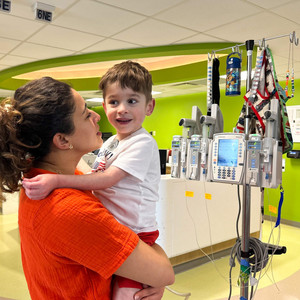
I went to Children's Hospital of Philadelphia to meet one of those families who's going through kind of this unimaginable time.
They have a child on a vad, which is an artificial heart.
Mom yeah, what does that stand for?
Oh well, how many?
What type of heart do you have?
Single ventricle yeah, and what?
How many ventricles does a typical heart have?
Two, that's right.
That's Norah Strickland and her son Caleb, who's four.
He was born with a congenital heart defect.
And when he was really little, he had three open heart surgeries to repair his heart.
So that by his fourth birthday, he was actually living the life of a pretty normal kid.
C-A-L-E and then B. So what does that spell?
Caleb.
I mean my name?
You mean your name.
I mean my name.
But last spring a virus sent his already weak heart into failure and he spent the last three months at the hospital with an artificial heart pump.
It's keeping him alive while he waits for a transplant, but it's pretty limiting.
Lift me up.
Lift you up?
Okay.
Actually, I'm pretty heavy.
You are?
Okay.
Here, why don't you sit on my knee?
The artificial heart device is filled with blood, and it hangs from Caleb's skinny little frame.
The iKiss driver which powers the device is on wheels and it weighs about 300 pounds and can only be unplugged for about 30 minutes.
I'm going to unplug taco.
Caleb nicknamed his heart pump taco.
And when he goes down to the hall, to the playroom, he basically has 20 minutes to get himself plugged back in the wheeled pole with all his blood thinning medicine.
That one also comes along.
You're going to have to, Push broccoli.
It's called broccoli.
Basically, he named all the things that help keep him alive.
So his heart pump is Taco.
His VAD is Henry, after his favorite train character on Thomas the Tank Engine.
And he named that wheeled pole with all the blunthening medicine broccoli.
And we're taking all three of them with us.
We have to because, look, they're connected to me.
See, they're connected to me.
All right.
This is my VAD, and it helps my heart.
Let's go.
I mean, you know, it's so hard to hear Caleb because he's just a kid.
And it's so unfair what he is going through.
Yeah.
Yeah.
Listening to like Caleb and his mom, it just seems so far away from the idea of, like college and research funding cuts and all of that.
But they are still being impacted directly by those decisions and those policies that they have no control over.
Yeah, absolutely.
The stakes of this research affect real people all over the country, just like Caleb and his family.
Can we whisper?
It could be worse.
It could be worse, Mom.
It could always be worse then.
But then, you know, later Nora told me, like, it could also be better.
She took a leave of absence from her job and spends her days at the hospital with Caleb.
She says, you know, if Caleb could have a portable implant, Caleb could go to the playground.
He'd be home, and he'd be out and about.
He wouldn't need to be plugged into a wall, and he wouldn't be tethered.
How has the administration responded to the concerns from Dr Antaki and Caleb's mom that these cuts could harm the health of American kids?
When asked about why Dr Antaki's research was canceled, the grant officer at the DOD said in an email that it was quote at the direction of the administration and provided no further details.
Now, this summer, the FDA added pediatric ventricular assist devices to their medical device shortage list.
But when I reached out to the Department of Health and Human Services about this irony canceling a grant focused on developing just that they didn't have a comment on that.
They did say quote ensuring the public has access to safe and effective medical devices is a top priority for the FDA.
So what's the outlook for Dr. Antaki and his lab?
Well, one hope is that the university makes a deal with the Trump administration.
And then that gets this funding for Dr Antaki and hundreds of other Cornell researchers to be reinstated.
And there has been a roadmap for this.
So far, both Columbia University and Brown University have agreed to deals to restore research funding.
Colombia went first.
They agreed to pay $200 million over three years to the federal government.
It's basically money that goes to the treasury, like into the general fund.
So it's actually not clear what that money is going to be used for.
They also agreed to take steps to curb anti-Semitism on campus and to share data related to admissions, among other things.
And in return the government said it would restore access to about 13 billion in federal funding for Columbia.
That amount includes resuming frozen grants and opening up opportunities for future research.
And then the second school to make a deal, Brown University.
They essentially looked at what Columbia did and they tried to get a better deal.
So, in order to restore more than 50 million in unpaid federal grants and allow them to be eligible for future grants, Brown agreed to pay that same amount 50 million over 10 years.
And instead of paying the federal government, they agreed to give that money to workforce development organizations in Rhode Island.
And the details about those organizations have not been made public yet.
Brown says they're still working to identify all the grantees of that money.
So now, Aisha, I'm kind of watching to see what other universities agree to.
I mean, Trump has said he wants to put more money into vocational and trade programs.
So these deals, these future deals with colleges could be a way to get universities to fund that.
So Trump and his allies are framing this as kind of like the elite colleges, the big research universities versus, you know, the smaller vocational schools or community colleges.
Does that hold up, you know, upon scrutiny?
Well, it's a really interesting question because most American college students actually attend community colleges and regional four-year public universities.
And those are the places that educate students on trades.
And yet taxing Harvard or canceling research grants at Cornell, that doesn't mean that that money is being redistributed to schools that teach trades.
And so, while Trump's idea to fund trade schools is perhaps an idea that people across the country and across the aisle could really agree on, a lot of higher ed leaders I've talked to aren't convinced that this administration's approach is actually the way to do that.
This seems to get to this larger idea where it seems like a lot of the Trump administration and others are, you know, painting higher education as bad for America.
It's anti-conservative and it's pushing, you know liberal quote, unquote woke ideology.
And you know it's just a bunch of people in their ivory towers looking down on the little regular people, not to mention the, the cost and the, all the student loan debt that you take on to go to college.
Like is it.
Is it really needed in this day and age?
Is a degree needed in this day and age?
I guess let's first start with kind of Americans' perception of college.
This has been declining and new research this month from Gallup shows Americans are putting less importance on going to college.
Only about a third of U.S. adults surveyed rated the value of a college education as very important.
That's down from 53% in 2019 and 70% in 2013.
And the research also found that this dwindling perception it's happening regardless of political party affiliation.
Now, I think you're absolutely right in terms of Trump's base.
This fight against elite universities fits in with the common man appeal that Trump maintains.
I think that one thing we should talk about is the difference between these elite schools and the rest of higher education.
You know, I've been covering this beat in higher ed for more than a decade and I've talked to a lot of students and families who feel like the admissions process for these competitive schools is just unfair.
But there is such a big difference between those kind of 200 schools that have really high rejection rates and the rest of higher education.
Like those elite schools, Aisha, they educate less than 2% of Americans that go to college.
And so this perception of these elite schools.
They've really shaped the overall perception of college, even though that's really not most people's experience.
You know, the pandemic saw about a million fewer students enrolling in college.
And it's taken basically five years to kind of crawl back to pre-pandemic levels of folks going to college.
But there is, I think, a lot of trepidation among college leaders because there is a demographic cliff coming.
So that means fewer high school graduates are going to be around in the coming years.
And so I think, regardless of this administration's stance towards higher ed, enrollment is going to continue to be a struggle for institutions and I think we're going to see in the next decade.
You know what colleges and universities do to survive, because it's pretty challenging out there to be a university, to be a college.
Alyssa, thank you so much for all of your reporting.
You bet This episode of The Sunday Story was produced by Justine Yan and edited by Jenny Schmidt, mastering by Robert Rodriguez.
The Sunday Story team includes Andrew Mambo and our senior supervising producer, Liana Simstrom.
Irene Noguchi is our executive producer.
I'm Aisha Roscoe.
Up First is back tomorrow with all the news you need to start your week.
Until then, have a great rest of your weekend.
This message comes from the Nature Conservancy.
Nature is common ground for everyone and uniting to protect nature can help solve today's challenges and create a thriving tomorrow for future generations.
For many families, remembering loved ones means honoring the details that made them unique.
Dignity Memorial is dedicated to professionalism and compassion in every detail of a life celebration.
This comes from NPR sponsor Sierra.
How businesses connect with customers defines their brand.
Sierra is the platform for building better, more human customer experiences with AI.
No stock answers, no hold music, just real solutions fast.
Visit Sierra.ai to learn more.