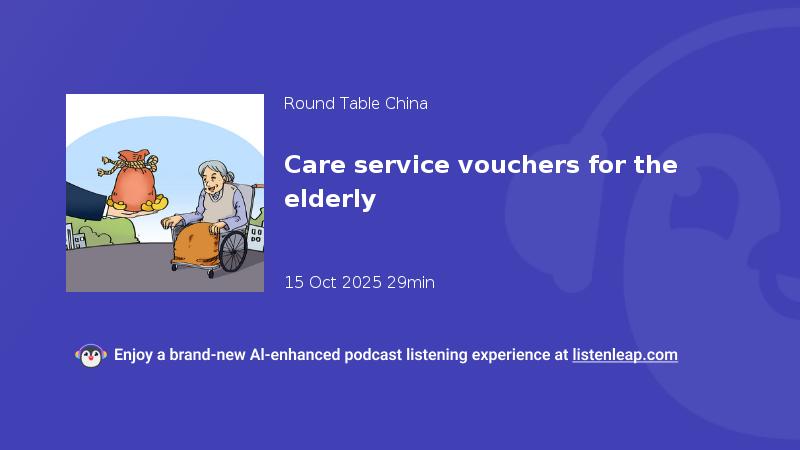
Imagine the physical, emotional and financial weight of caring for an aging parent with significant disabilities.
This July, China launched a new subsidy program aimed directly at lightening that load.
In pilot areas, the response has been immediate.
Over 243 vouchers used thus far.
But is this innovative approach enough to lift the burden?
And what hurdles does it still need to clear?
Coming to you live from our studios in Beijing, this is Roundtable.
I'm Steve.
I thank you so much for sharing your time with us today.
And for the show, I'm with Yushan Angoyan.
First on the program.
This past July, China initiated a landmark subsidy program targeting a pressing social challenge the care of its elderly citizens with moderate to severe disabilities.
The early data is telling.
As of October 8 that was just days ago eligible seniors in pilot regions have already utilized over 243000 consumption vouchers, representing a direct investment of about 182 million yuan that's nearly 26 million into their care.
This initiative, it promises to alleviate the profound financial and logistical strain on families.
But with the success of the program, there are critical questions that need some answers.
What about the long-term viability?
And also, how effective is this aid reaching those in need?
And what systemic challenges could hinder its success?
Lots of questions, hopefully lots of answers as well.
Goyen and Yushan, good afternoon to you both.
Let's get straight into it.
So let's learn what this subsidy program is all about.
Yeah, this is still a very good news indeed when I first heard about it.
It's important to have such policies and it's really more important that people are actually using and benefiting from it.
So this program, this subsidy program for providing care for elderly citizens, it's specifically targeting those with moderate disabilities and above.
And this program.
It was launched together by the Ministry of Civil Affairs and the Ministry of Finance just in this July.
So eligible elders will get subsidy for say, purchasing elder care services like hiring home care services or asking for assisted bathing.
These are all what the subsidy basically covers.
And also, before they get such subsidies, they need to get evaluated first.
And usually there is such a thorough and comprehensive and scientific evaluation that will take place.
And also it's based on 26 specific indicators for four dimensions.
There's self-care ability involved basic motor skills, involved perception and social participation criteria, and also evaluation on the mental state of the elder.
So once they take this very thorough evaluation more or less like an examination of their general health, i'll say and the assessment result will be given to them, and are they're going to be classified into five different levels.
There's the full self-sufficient level, the mildly disabled level, the moderately disabled level, severely disabled level and completely disabled level.
So this is basically what the subsidy program is, um structured, i'll say so.
The vouchers can be used for various things right um, It's all about saving money for people who need it.
And the category that they are classified into is determined through an evaluation.
We'll come back to that perhaps a little bit later on.
But let's learn more about how this program works and how these vouchers get to the people who need them.
Well, the program will provide electric vouchers through the Civil Affairs Ministry's digital platform to eligible seniors assessed as having, just like Yushan mentioned moderate, severe or complete disabilities.
And they can apply voluntarily through the platform using available assessments.
And this pilot program's implementation begins this month in selected regions, including Zhejiang and Shandong provinces both are coastal provinces in China as well as China's southwest Chongqing municipality and the cities of Shenyang in Liaoning province in northeast of China, and also in some middle provinces like Anhui province and Jiangxi province, and also the Chengdu in Sichuan Province.
A nationwide expansion is scheduled for late 2025.
That nationwide expansion must be coming soon because we are in late 2025 already.
So this pilot program...
Seems like it's going to be a quick one.
Where's the money going to come from for this?
Well, funding will follow a tier cost sharing model, with the central government covering 85 of the cost in eastern regions and 90 in central areas and 95 in western regions.
And I think these levels are dependent.
These levels depend on the development of the, considering the differences of different regions in China.
Certain regions would need it perhaps a little bit more than others, and that's why you're seeing the differences in the percentages there.
Okay.
So how has the pilot worked thus far?
Well, the vice minister of civil affairs himself said that the pilot programs up till now are progressing in an orderly manner and also achieving phased results.
Like you mentioned at the very beginning Steve, over 243000 consumption vouchers that's worth of 182 million yuan or 25 million US dollars used in the first two months within pilot areas.
That's no joke.
And each pilot region, they have introduced the implementation plans tailored to their local conditions as well.
Because, like we just discussed, China is such a vast place and each region has its own so development status that require different levels of financial supports here and now.
And the assessment, like I mentioned earlier on disability level is also ensured on the higher standard, according to official reports.
These pilot regions.
They have set up professional assessment teams to handle evaluations in an organized way.
So basically...
There is such an online platform called.
That's a digital platform where you can apply for such a assessment.
And there are a list of accredited third party medical service providers who are able and also dedicated to provide such assessment for you, to ensure that any senior who wants to be assessed can do quickly and get their subsidies without delay.
Okay, so the way it works is this is done online in terms of how the seniors can receive the vouchers.
That's done digitally.
But the assessment in terms of what category the seniors would fall into the categories that we discussed before or whether they would qualify at all, that's done through a third-party agency that the senior or the senior's family can contact, and then they come or they go somewhere and have the assessment done.
However, that's done.
Ideally, yes, that's how it's at current stage planned out.
And also there are sufficient service suppliers to be exact, more than 8600 care institutions in the pilot regions.
They are all trying to sign up the integrity pledges and apply to be, or rather to join, the subsidy program.
So to make sure everything runs fairly the civil affairs authorities they have rolled out clear management rules and started doing random checks on these facilities, both online and on-site offline, to catch individuals, any cases of fraud or poor quality services.
Sure.
But the goal here is to get the assistance to the seniors as quickly as possible.
And they've been doing a great job by that.
And the numbers prove that.
This is from October 8th, and this is what I mentioned earlier.
The eligible elderly individuals and their agents in the pilot areas mentioned.
They've received 365100 consumption vouchers and 243200 of them were used.
And that offset the cost by a total of about 182 million yuan or $25.5 million.
And like I said, the numbers... are proof that this is successful so far.
And this, at least to some extent, has to have reduced the financial burden of care for eligible seniors and their families so far, which is the goal of the entire program.
So why now?
Why is the program now?
And what is the idea behind it?
Well.
This program aims to support China's national aging strategy, improve elderly care services and boost consumption.
And because the demographic challenge has obviously become very pressing in China.
According to the latest national census in 2021, over 260 million people in China are aged 60 and above.
That amount of population means that the support for the elderly, especially the older people with disabilities, is a pressing issue here.
Yeah, and that number jumped to 310 million people over 60 by the end of 2024, and that's 22 of the entire population.
Right.
And also we have to say that elderly care consumption, among all other categories, is indeed a major sector in China's overall consumption and undeniably an important contributor to the economy.
So by trying to attract say, or rather boost, consumption through the manner of giving vouchers or such a voucher program, it is expected to attract more social investment in elderly care in general and also boost sector development and cultivate new economic growth drivers.
Yeah, so when we hear the word boost consumption in this conversation, i was a little confused in the beginning because i thought okay well, these vouchers are meant to support um, the elderly who needed.
So what's the connection to boosting consumption?
Because when i when i hear boosting consumption, we talk about it all the time on roundtable about, you know, increasing spending at shopping malls or in the tourism industry or things like that.
We're not talking about the elderly going to the mall and buying a new blouse.
We're talking about consumption within this seniors care market.
Right.
So this is about, Like I mentioned earlier, how to better take care of them, instead of how they can maintain a better livelihood like buying rice or fruits and vegetables, stuff like that.
So officials said that eligible seniors will receive monthly digital vouchers.
That's roughly 800 yuan, or about 112 US dollars, for long or short term institutional care and daycare.
And 500 yuan for in-home services that include perhaps just hiring someone to come to your home to help cook for you, to help you walk to the bathroom.
In my family case, that's something really important.
Very much needed because my grandpa was unable to help my grandma, who cannot move without a wheelchair.
So hiring someone to do these jobs is essential, and it's also part of the so-called boosting consumption strategy.
The very fact that somebody is hired to do these jobs.
Yes.
So there's two important takeaways here, I think, from these vouchers.
Well, maybe even three.
The first is the value of them.
800 yuan or about $112.
And that's monthly, right?
That's received monthly.
Right.
And that money and this is the second point or those vouchers can be used for a variety of different things.
It's whatever the seniors happen to need right their homes and, as you mentioned, it could be things like bathing support or rehabilitation, nursing or meal assistance or again whatever, whatever it is that you might need, which is a really, really good thing because it allows for flexibility, doesn't it, in how the seniors can use them.
But how much of this cost can actually be covered, because we haven't talked about the cost of the health care yet.
Well, when purchasing services, these vouchers can offset 30 to 60 of the cost, with the initial offset rate set at 40.
For example, a 100 yuan in-home service would cost the senior 60 yuan after applying a 40 yuan voucher.
That's not bad.
It's significant.
It's almost a half of that cost.
Yeah.
Yeah.
I mean if the cost was astronomical or if the costs were lower than that and you're looking at certain percentages, then it might not be that impressive the way the numbers work out.
But this is a really significant percentage for the seniors to save.
And it's a good incentive to use these vouchers as well.
What are experts saying about this so far?
Many said that this policy is highly beneficial for elderly people, especially those with disabilities and, of course, their families.
So this, Mr Zhang Kunyu, who is the leader of an aging industry policy research group at Peking University.
He said that elderly individuals with moderate disabilities and above they have a strong need for professional care services.
So these subsidies can really address their pain point and ease both the financial and emotional burden on family caregivers as well.
Like I mentioned earlier, Without hiring someone in my grandparents' home, it's impossible for my grandpa alone to take care of my grandma in that case.
So, from a very practical point of view, It's essential that such subsidies is offered to families who have such needs.
And it's an incentive, like I said, to make use of the services.
Because without these vouchers and we're just about to get to the cost of the care in a moment but regardless of the cost of the care, without any financial support or any kind of incentive to use the programs, then older people might say something like my grandparents used to say oh, I don't need that.
I can do this by myself.
But oftentimes that responsibility and I mentioned this in the opening of our chat that responsibility will fall to the children, right?
To the 50, 60 year old or 40 year old children of these parents.
I mean, that can be a huge financial burden because they can have kids of their own.
So this is this is really good news.
Now, with that said uh, let's talk about the cost.
What types of, what type of money are we talking about when we're looking at elderly care institutions or services?
According to an investigation by China City News, hiring a professional caregiver for an elderly person with disabilities in the elderly care market costs at least 15 times more than caring for a fully self-sufficient senior.
And caregivers are required to master over 10 basic skills, including bed sore care and non-skeletic feeding.
Typically, elderly care institutions charge around 10,000 yuan or 1,400 US dollars or more per month for caring for disabled seniors, a price that many families don't find and affordable.
Yeah, for very good reason.
I mean, it's very, very expensive.
10,000 yuan a month, about $1,400.
That's not saying that it's not money well spent.
It's not saying that that's not worth it, but it is still expensive and it's just out of reach for a lot of people.
Again, proof why these subsidies are needed.
These vouchers are needed.
So, okay.
We know that, you know, we know it's a good idea.
But there are still some issues that need addressing, some challenges, some bumps in the road.
Indeed.
First of all is just how accurate these assessments for disability levels can be.
Because we talked about how the officials they're trying to ensure such a fair and standardized and timely evaluation for the seniors in need, especially on their functional abilities.
But just these level of standardization.
It may vary based on how much resources are allocated to this particular region.
Sure.
And we talked just a second ago about how there are different regions that require more support than others.
Here I'm going to quickly share one example. relatively good example.
That's the kind of like a very vivid and sort of the only example I can find online so far.
That is what's going on at the Kuivin district of the city of Weifang in eastern China's Shandong province.
So this is how they're doing it.
So the assessment is locally carried out by their local third-party organization called the Weifeng Chengming Elderly Care Service Evaluation Center, in accordance with the local standard calling the standards for assessing the abilities of older adults.
And elderly individuals who have already been assessed as moderately or severely disabled within the 12 months before the end of July 2025.
And those whose assessment results are confirmed by the Kewen District Civil Affairs Bureau do not need to undergo such a new assessment.
And whether it's the first time... If they've had it done already.
If they've had it done within the past year from this July.
And whether it's the first time you do it or not, if the previous or this time the evaluated disability condition still matches with your current condition, then no assessment fee will be charged for you to the elders and in some cases people do maybe overly describe their condition and the exam result doesn't necessarily fit 100 with that then you probably will have to pay a little bit for the assessment, but not too much.
As far as I've researched.
So that's how the city of Weifeng is doing.
And in Shandong in general, on the provincial level.
Older adults or their family members representatives, whichever way you call it can log into the Minzhengtong public office web page or home page, click on the elderly care service consumption project section and just submit an assessment application there.
So this is how they're doing it and this it sounds like it's systematically arranged, but still there's there can be mismatched depending on the cases.
Well the, the.
The difficulties wouldn't come from the application for the vouchers right, because that's all digital, it's done online.
The difficulties might come from the assessment itself.
Yeah um, because When you're rolling something out, as we learned, the plan is to roll this out nationwide by the end of 2025, which is within a couple of months.
You have to have some sort of nationwide standard for quality control, I would think.
But that might be one of the big challenges, correct?
I was chatting with Goyen, who's had ample experience of reporting about the elderly population conditions and economies, and elder care service and industry in general.
You mentioned to me earlier Guoyan, that for many other say subsidies or insurance or other projects or social welfare projects, there are also such evaluations conducted.
And usually it's rather strict in terms that they want to make sure that the help goes to those that need it the most.
Right.
And sometimes I think it makes sense, because people, some people who maybe, who doesn't have that disability, might apply for the subsidy and that would make those who are real in need don't can't receive the right, the correct help.
Well, there's that side, perhaps the fraudulent claim side, but also there's a There's a big reason why agencies would want to get involved with these programs as well, because this again, is to boost consumption within that industry.
So if you're an owner of an agency, a privately owned agency, and you think oh, I want to take advantage of this program too, I don't necessarily have the qualified staff necessary.
But you know, I'll just make up something and I'll try to get my program or my company involved in this as well.
So yeah, having strict measures in place for again that quality control service is really important.
Also, I guess, logistically speaking, from an administrative point of view, the coordination of this would be of the utmost importance.
Yeah, it's already shown that this is a project that's aligning multiple departments the civil affairs, the finance department, the health and community organizations, etc.
All are here to manage funds, data and service delivery efficiently.
And that can be hard.
According to this report from China Daily civil affairs departments, they will bear primary implementation responsibilities requiring dedicated staffing and training and quarterly progress reports as well.
All of this takes people and all of this needs money.
And finance departments, of course, they will need to enforce full process fund supervision.
And speaking of funding, the funding sustainability itself can be challenging, let's say.
Long-term financial support for these subsidies.
And then, of course, while you're balancing your own government budget.
That's going to pose a big challenge as well.
And then, again, as we mentioned before, regional disparities too.
You're trying to make a platform that's... equal for everyone.
So everyone has access to the same level of support.
But that again, when you're looking at a country the size of China and a population that size, it's not easy to do.
But it is a goal worth mastering, that's for sure.
And it's been really popular so far, you know, 240 some thousand vouchers already in use.
That's flooding those agencies, isn't it?
Maybe those services were always available, but the demand for the services might not have been to this level.
So they're busy these days, which is a very good thing, of course.
What about from the government's point of view?
What kind of measures has China adopted to help with the elderly with disabilities?
Some recent report from September this year says that a total of 49 regions have participated in the National Pilot Program for Long-Term Care Insurance.
And that's ever since 2016, this insurance had already started.
So this one now covers 190 million people, with cumulative expenditures exceeding 85 billion yuan, that's over 12 billion US dollars.
So that's Another big project that's relatively more long-term than the current one, the voucher one we're talking about right, Guyan?
Right.
And actually, I'm writing stories about the aging population in China a few years ago.
And I traveled to some cities that adopted this long-term care insurance.
It's a pilot program.
And I remember a few years ago, I traveled to Nantong.
Nantong is a city that That's about two hours drive to Shanghai.
And in that city, about a third of local population are aged 60 and above.
One third.
One third, right.
And some towns of the city are renowned for the longevity of their residents.
So we decided to visit to the city to see how they deal with this demographic challenge.
And I discovered that the city has already adopted this long-term care insurance, which means that seniors who choose to stay at home they will get weekly service like bathing support, haircut and some other daily services from local communities.
And that's government subsidized?
Yeah, that's government subsidized.
And for those who choose to stay at nursing institutions they will get maybe half of their subsidies are covered by this government support.
That sounds similar to how it is in Nova Scotia, where I'm from in Canada.
So the government for elderly care assistance?
The government pays for the health care services themselves.
And then the resident or the patient, however you want to refer to the individual they pay for the Personal expenses are for the accommodations or whatever type of situation they happen to find themselves in.
But the health care services are paid for by the provincial government.
And then financially, there's an assessment done that determines a person's ability to pay because again, the individual is responsible for accommodations, if necessary, and personal expenses.
But If the government deems the individual unable to pay for that, then they have something in Nova Scotia called the Seniors Care Grant that helps with low-income seniors.
So it's like a double check to make sure that they can at least somehow get the care that they need.
And those who need it, there's extra government assistance for that.
Really cool that you get your hair done once a week.
Yeah.
For some man who needs to, you know, keep their hair looks clean.
Yeah.
So then I'm wondering, just as we finish our conversation, if technology can play a role in making this project run smoother somehow, some way.
Well, like home service AI robot.
Yeah, yeah, exactly.
I'm thinking about exoskeleton because it doesn't need to get to when you turn 60 or above to think about how technology can help you say, walk people like my parents, who's only in their late 40s or 50s.
They're already talking about how exoskeleton is so widely applied in all aspects of society nowadays, how people use it to climb mountains, like we discussed earlier on roundtable, and how it's helping logistic worker to protect their lower back, let's say, to lift when lifting heavy weights, so that, totally personally speaking, i totally see the huge potential of how that can be adopted to elderly care.
And from, I think it's another news team colleague who reported about this a couple of months ago.
It is the direction indeed in many home care centers and institutions.
They're already trying to use the technology of exoskeleton to as wearable devices for the elders of their institutions to wear and to just get, to.
Just help them get around, just move around.
That's one way of getting rid of wheelchair.
Let's say that's where technology should go.
Yeah, the robots too.
I was thinking that with the, if you're worried about consistent quality care from region to region well, using robots can help to level that playing field, because then you don't need to worry as much about the qualifications of the healthcare assistant the human I mean when you have a pre-programmed robot to do that.
And in Shenzhen, at a nursing home, their robots, they're already using them.
They're an integral, integral part of daily life.
They even play chess together with the seniors yeah, like a companion.
Yeah yeah, exactly so they do that.
And then there's different types of therapy that the robots provide, and and then with mobility assistance too.
So there's lots being done for the elderly community here in China.
And as go in and share with us at the beginning, There's a good reason for it.
The aging population here in China is an issue that's going to be with us for quite some time, for sure.