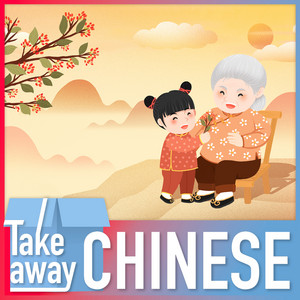
Take away Chinese, where you can take some Chinese away and experience progress day by day.
Take away, Chinese!
We will promise you a difference.
Welcome to Take Away Chinese.
I'm Nyongong Lin and joining me today, ta -da!
Steve! Hello Steve!
Welcome back! Ta -da!
Steve, I'm gonna put that on my business card.
That's my new introduction now.
I love to have you on the show.
You have a genuine enthusiasm when it comes to learning Chinese and you're actually quite good as a beginner.
And also you have a very fresh pair of eyes, looking at the culture and language and everything.
It's just so fun to end the show with you.
Oh, thanks. I appreciate that.
I like doing it too.
And I agree with you in the sense that I'm enjoying it as well, seeing things for the first time again.
I mentioned that before on the show.
And it's fun to share the experiences, what it's like to kind of relearn how to live if you will.
You're relearning how to live and you're learning a new language, which can be challenging and exciting.
And I want to ask you, after not doing the show for around two weeks or so, have you learned any new expressions that you want to share with our audience and friends out there?
I agree! Oh that is a good one!
Agreeing with people makes them happy.
It's a useful one yeah.
Even if you don't agree then you can still say that you do agree if you want to see a smile on someone else's face.
I'm gonna give you one more word to add after that.
Dàn shì, daan shì, daan shì, daan, shì it means but.
Like, you're behind?
I agree but I want to add something more.
Dàn shì, daan shì, daan shì, daan, shì it means however but there's something more I want to say.
So now you know how to say I agree and you know how to say I don't agree.
Yeah in a polite way.
But the problem is if I say Then i'm expected to keep talking so I need to learn what I have to say next That's your plan after all anyways, right?
Yeah of course it is.
Yeah so yeah, so but I think when you're learning a language words like because so but And these words linking up the sentences and especially in the chinese language we talk about Chinese language being a high -context language a lot, and it means that we sometimes omit certain parts of the sentence because you would be able to guess what's omitted based on the context.
And occasionally different parts of the sentences make sense on its own separately, yet with different linking words like but or end, or simultaneously, these words would give you the between the different sentences so that you know exactly what Chinese people would like to say because sometimes we tend to be subtle, we tend to be very polite and by being very polite sometimes you would find it a little bit vague understanding but knowing these linking words actually helps.
Got it. Dan sie. I feel good, I've learned something already on the show today.
Great to see that. In Chinese we have a saying, It's never too old to learn.
So being able to learn something new in every stage of our lives is important.
Which is why sometimes we say we might be getting old in age but our heart keeps young all the time.
Great, you're using it already.
And I keep mentioning age not because it's vital to me, but because actually getting older, getting wiser is something quite significant in Chinese culture.
We would respect the elderly.
We even have a festival for the elderly.
Oh cool, specifically for the elderly?
Yes, to celebrate them, to honor them, to be with them in different places, and even organize different activities in the neighborhoods, in malls, and just to celebrate the fact that they have lived through so much and they're still thriving.
That's wonderful. Culturally speaking I don't think I've ever heard of anything like that before, any kind of celebration.
So this time of year, the fall season, is when we have that celebration?
Is it always at the same time of year?
Well, it is in the Chinese calendar sense.
Actually, in Chinese calendar, there is a day that is particularly significant for the elderly and it's a day to show respect and care for them and that is chong yang jie yes so chong means double yang is yin yang the yang have you heard of yin yang the idea yes yes so yang and jie is the festival chong yang jie so So Double Yang Festival and here Yang is...
Nine? Yes, Yang is nine because according to traditional Chinese culture, nine is considered the biggest Yang number, whereas six is the biggest Yin number.
By the way, can I stop you right there for one second to teach something that's very visual, but I learned it recently as well.
through podcasts I don't know if this is going to work or not but anyway in China there are certain hand gestures that represent numbers just like in English if you want to represent number one you hold up one finger same in China yes in English number or in Western I don't know what the right word is there but anyway in the West two fingers mean numbers too same in China to them in China okay three fingers means three yes and also you can only use the OK gesture for three, because three fingers still.
Index finger and thumb together and hold up your remaining three fingers come in three.
Four fingers means four.
Five means five. Yes.
OK, now six is where it differentiates a little bit, because in six, I would hold up five fingers on one hand and one finger on the other.
We do not need two hands.
Exactly. So how do you represent six with your hand in China?
We have the thumb and our picky finger out there, and the remaining three fingers hold together.
Yes, so that represents 6.
Yes, I did not know that, but I learned that recently.
Which, by the way, that symbol, that hand gesture in Hawaii means like, hang loose.
Oh really? Yeah, in Hawaii it means like, chill out, brother, or something like that.
Anyway, here's a fun one that I learned.
9. nine and the reason I learned this is because during the holiday I was asking the gym are you open tomorrow and if yes until what time and they said way and then she made a fist with her index finger up a little bit and then scrunched it down and then showed me that it's like what's that universal soul is only Chinese that's 9 and she was trying to say to me nine o 'clock it's open until nine o 'clock so there you go in China if you want to represent the number six hold out your thumb and your pinky finger only that's for six and four nine make a fist hold up your index finger a little bit but keep
it scrunched and that represents the nine because and it totally makes sense because that's the shape of the number nine yes but if you want to use both of your hands 1 -5 and 1 -4 and tell people it's 9.
I'm pretty sure people would find it a bit awkward but still understand you.
Oh, you can do that too?
You can do that. And the number 9 in Chinese is educators, number 9.
And here, the double ninth festival in Chinese is Remember that is the nine being the biggest single digit young number.
That's why we say Cheung Yang Double Nine Double Yang Festival.
Cheung Yang Ziyi. Anyway, thank you for allowing me to explain all that.
That is actually very important.
I've never, I think I've never explained it on Takeaway Chinese, even though we have hundreds of episodes.
I didn't know what she was trying to tell me by holding up her finger like that.
But it was very useful and I'm pretty sure now you remember how to do that.
I do. Yes, so for our dear listeners, if you're interested in Chinese culture and you want to get a grip on the Chinese language, then this is the show for you.
Stick with us for 30 minutes and you soon see the rewards.
And for more fun Chinese learning, follow our Facebook page Learn Chinese to watch many fun videos and livestreams.
But now let's provide you with some free Chinese free takeaway and today's free Chinese concentrates on the Double Ninth Festival.
Jeong Yangjie, so we already talked a little bit about the Double Ninth Festival being the festival that celebrates the elderly doing things to show them respect, doing special activities to honor them, and that's what's happening currently in the modern Chinese society.
But this festival has been there for hundreds of years, yet the festival has been there for a really long time.
I have to say traditionally, it's not exactly a festival solely focusing on the elderly.
It focuses also on the ancestors, focuses on reminding one of their homes, and since it falls on the ninth day of the ninth lunar month on the Chinese calendar.
It also is around autumn time, which means some seasonal things can be done.
And one thing that's particularly The interesting and the popular is 女清 climbing mountains or high places cancer.
女清 is climbing mountains 女清 is climbing or hiking.
你就是 or 你就是. Okay, so that's climbing climbing mountains and 女 is high so high places.
Okay, going up to high places.
What's the significance of that?
Doing that would make you - Well, one thing is that it is believed this acceding to high places can bring good luck and protect one from evil spirits, and by standing on a very tall and high place you would be - You know, look really far.
You can look at the direction of your homes and think about your hometown friends, and think about your families in your hometown and it's considered a ritual that can be done in this period of time.
And it actually makes sense in a way that during autumn time, we have this word qiu gao qi shuang.
So qiu is qiu Tian Autumn.
Gao is referring to the sky, which is very high because it looks clear with clouds and everything.
And qi is Tianqi weather and shuang is cool.
So it's a cool weather and it's beautiful and do a little bit of climbing.
It's actually quite pleasant.
Do you enjoy hiking?
Yes, I do! Yeah, I prefer flat surfaces.
But standing in high places would allow you to see far.
That is very true and give you a different perspective as well.
Different perspective.
That's cool. And besides that, we also have qizuo.
Qizuo? Yes, qizu means to honor.
And qizuo is ancestor.
Jizhou is another typical custom during the double -ninth festival.
People would visit ancestral graves to pay their respects and show foliopiety to their ancestors and the elder in the family.
And another thing would be Fanzhiyuan, or Fanfongchong.
Fongchong is the kites, so flying kites.
Another very seasonal activity.
And is this also related to being high up, the same kind of theory as the climbing mountains?
You can do them the same day, but they're not necessarily bundled together.
Gotcha. So, yeah, because...
Well, actually, I feel like respecting elderly in their Chinese culture is quite significant.
We are a culture focusing on, for example, listening to the elderly in the family.
And one very interesting example is that we know in the Western culture when you're speaking in English, you refer to people, even you're respecting.
You're showing respect.
You're referring to strangers with Mr. or Mrs., and maybe their last name if you have them.
Or Sir, or ma 'am, or madame or, yes, yes.
And when it comes to people that you work with, your friends, your supervisors, sometimes if you're close enough, you use their first name.
If you're on a first name basis, it shows that you're close.
But in China, no matter if we're talking about strangers, or your coworkers, or people in your family, you refer to them.
If it's in your family, you refer to them based on the relationship between you.
Brother, sister, cousin, yeah.
Does it get very specific, for example, older brother, younger brother?
Yes, it's older brother, younger brother.
Guo -guo would be older brother.
Ziejie would be older sister.
And besides that, when it's strangers, we would sometimes refer to the elderly with grandma and grandpa.
it's a sign of respect it's a sign of closed -ness instead of a sign of calling them old.
In China being called old in this way is considered you're showing respect instead of in other world if you're calling someone grandpa it's just a bit weird.
Yeah this is a this is a different culture difference in language in the West if we are talking to our own grandmother or grandfather that's fine then of course you say grandma -grandpa or whatever you call them people tend to have different names within the family and it differs from family to family but a stranger just because they are elderly even if you can see they are in their 80s maybe 90s you wouldn't say Grandpa or Grandma it would be considered rude that's the thing because I think it's quite important to make it clear for those who are learning Chinese because you're not only learning
the language, you're also learning about the language, learning the culture.
And in China when we do that, actually it means to start with, we respect the elderly, even though we do not know them, and we consider being, well, not being old, but being, you know, aged, a blessing.
We say, who is a man then what would I say?
Well, um, it also depends on your age a little bit.
So it's kind of like your relationship with this person.
But if they're a stranger, I don't have any relationship with this person.
No, it's like, if you imagine this person in your family, what kind of generation he represents with you?
So for example, I am in my thirties, if I'm talking to someone who's sixties, which can be called a grandma or grandpa by a five year old.
I will not say grandpa or grandma.
I would say da -ye, or ai -yi, so aunt, auntie, uncle, something like that.
But if I am talking to a 90 -year -old, I would definitely say ye -yea.
Yea -yea. Yea -yea. That's grandpa.
Yea -yea. Mhmm. And na -I -na?
Sounds like Nana in English.
Na -I -na is grandma.
Grandma. Na -I -na -i.
Na -I -na -i. Na -I -na -i.
Grandma. Okay, so YEIGE and NAI nai.
Yes, grandpa and grandma.
And you can even put someone's name first and then put YEIGE nai nai afterwards.
For example, if you know this person, it's your neighbor, and you talk to them all the time, and their surname is Wang, you can call them Wang nai nai.
Yeah, I get it, yeah.
Yes, that's, yeah, grandma Wang.
And that's if you at least have some sort of relationship membership with the person but with a stranger, obviously you don't even know their name.
Oh, you know what, actually you can do that as well, for example, you are in a school, you do not really know your principal in the way that you know each other and you know each other's life story, you just know this person is the principal, and if the principal approaches you, you can call them principal grandpa.
So Xiao Zhang, yieyie.
Oh. Xiao Zhang being principal or headmaster.
Yeah. And yieyie is grandpa or knight -knight grandma.
What if the principal is, like, 40 years old?
Then don't do that.
Yeah, I understand.
So there's no connection between the job title and the yieyie at that time.
The idea is only that because we can address people with their names or with their titles, as in their job titles, you can also do that with the ye ye or nai nai or shou shou hai, especially if you're a kid.
Question, yes I'm out in public and let's say I'm blocking the entrance of an elderly man and he's waiting for me to move.
I don't see him but suddenly I see him and I want to say oh I'm sorry, and then you move out of the way.
Can I say tue bui qie yeah, yeah sure you can totally say that.
Okay that means like I'm sorry grandpa Yes, and when you say that when you say it in English, it doesn't sound good, but in Chinese It's totally acceptable especially if you're like in your teens or 20s Do that in Chinese and you're an aspect and you're learning the language And if you're doing that, people would definitely appreciate the respect and they would help you a lot I guess.
We already mentioned that in the Chinese Society and Chinese culture, we respect the elderly in the family.
That's because family is a very important unit, a very important element in the Chinese society in Chinese culture.
And that is why we have this concept of filopiety.
Is that a word that you find familiar with?
I think the average English speaker doesn't know what that word means.
It's actually a translation of xiao or xiaoshun.
So xiao meaning that you're being very respective and kind and considerate and good to the elder generation in the family.
And it's not talking about the elder on the streets that you do not really know.
It's talking about in the family.
I think there's a maybe I don't know if we can call it a misconception or not.
Maybe that's too strong, but I know from my experiences here in Asia, in China, and in Korea as well, showing respect to the elderly is something that is a natural part of everyday society, and I've heard that people make the assumption that oh in the West we don't respect our elders to the same degree we don't have a hierarchical way of speaking, depending on the age of a person.
We don't have that in English, but it's not true that we don't respect our elders.
We certainly do, and we certainly treat them with more respect than we treat the average stranger.
Yes. But I can say with confidence, it's not to the same degree, I wouldn't say.
Or at least it's not conducted in the same manner.
Yes, I would agree with as well, and we don't have things like the Double Nine festival.
I guess that's why you do not have xiaoshun, a good translation for xiaoshun in English.
We translate it as filial piety, but I get it that it's not something that's quite familiar with average English speakers.
It's not a commonly used word in the English language, of course, yeah.
But in Chinese, xiao carried the meaning of respecting especially the elder generation in the family.
Respecting, following their orders, doing things for them, being very considerate, love them in a very respectful way.
Something like that.
And shun carries the meaning of being obedient, listening to what they want to say and listening to their orders.
And especially in ancient China, it is considered as a vital moral standard that you definitely have to follow.
In today's age, we still value Xiao Shun quite so much, but it's done in a more mutual, respective way.
Our parents, our grandparents would also listen to what we think.
They would also open to new ideas that we want to introduce to them.
And I feel like for at least my generation, my parents are not the kind of, quote unquote, traditional parents that has been there for around thousands of years, but are slowly extincting in the recent couple of ...
I know what you mean.
The couple of decades that are very bossy, that would meddle with your lives.
It's not no longer like that anymore.
See, this is where I think that cultures cross paths.
It's the same thing in the West as well, right?
My grandparents had a particular way of thinking, a particular way of doing things.
And then when my parents came along, there were certain things that my parents didn't understand, they didn't agree with.
And then when I came along, there were certain things that I did that my parents couldn't understand, couldn't agree with or within society itself.
But I think we see that happening in the West now too, where maybe 50, 60 years ago, you would have had, You know parents strictly only telling their kids what to do follow these rules But now it's more of an open dialogue about what decisions to make in life and that's changing in Chinese culture now, too Huh?
Yes, that's changing Chinese culture.
We still want to Listen to our parents listen to their ideas and recommendations, but at the same time they listen to us I mean, that's interesting because I think in the West and I apologize if we're getting off topic a little bit I think when we watch Western media, and we see Chinese characters in films, or television shows, or reality shows, or doing interviews, they often reference, you know, Chinese parents are tough.
And they always talk about how it was tough growing up because their parents expected them to do very well in school and to be a doctor, to be a lawyer, to be an engineer, or something like that.
So I think in the West, when we think of Chinese parenting culture - of course we don't know The media is the only reference point we have, right.
So obviously we're not very well informed, but that seems to be the information that we receive.
My question is twofold, in the past, would you say that that's accurate, that's an accurate depiction?
And number two, is that kind of changing now?
Well, to start with it has been relatively accurate for again, thousands of years, but not the recent decades.
And I think one of the reasons is that we talked about families being a very important element of the society.
And actually, the concept or the definition of family has also been evolving.
In previous generations, families are really extended big families.
They live together.
Your second cousin might be living just several miles away from you.
And you work together, you help each other, you support each other.
On a wedding, for example, you would have all of the extended family coming to your house, helping you, not only attending the wedding but helping you organize and welcome guests and just helping you organize everything.
And the extended family concept means that there would be someone, quote on quote ruling the family the almost the claim and they are telling people maybe how to develop the entire claim and the entire claim might be working in the same industry.
And in that sense the Chinese Society has been working based on this kind of structure.
So for example, if you're ruling a local area, a county or a small village.
village, then there are three to five or even 10 of these major clans.
As long as you talk to the leader or the boss or the major person in each family, you basically know how to rule the entire village.
So that's the society's structure in previous generations, previous centuries, and it has been like that for a really long time.
And that means the relationship in the family is actually very important.
That means the elder generation in the family would do a lot to support the younger generation, which means the younger generation in return would like to, and would find it wise to listen to the orders, the recommendations, the suggestions from the elder generation.
And in return, they would, when they grow up, when they have the ability to support the entire clan, the entire village, they would do so.
So that was the situation.
That was the reason that the parents would have to be very tough for their kids, because it's kind of like the last 30 % of their life depends on their children's success.
Yeah. And then they're continuing on the family line as well.
It's almost like, I don't know if this is a fair comparison or not, but if we think about how a company is run, it's kind of the same thing.
When you start out early in the company, then you're a junior and you have to listen to your bosses and you're given your role and you stay in your lane and you follow that role, kind of like when kids are young.
Their job is to study, their job is to do well academically, and their parents put pressure on them because they're setting them up for a successful future so that they can assume the head of the family at some point.
Yeah right. But even in that sense when it comes to being obedient to the parents listening to what they want to say.
It's not just simply a one -way street.
Actually we also have things like… So if the father is kind, the kid would follow filial piety – a bit better.
And also if the older brother, who is considered to be a little more respectful than the younger brother, so the younger brother should be looked up to the older brother.
yet the older brother should be kind and friendly to the younger in the family, and the 下 means the younger brother should be very respectful.
So it's still a mutual relationship.
It must be challenging for the generation of Chinese parents that are going through that transition where the kids have their own thoughts and their own ideas about what they want to do with their future.
and they don't necessarily agree with everything that the mother and father or grandmother and grandfather tell them and they don't necessarily want to do everything that their mother and father and grandmother and grandfather tell them to do if this structure family structure has been around for centuries in China and that's the way it's been and That's such a massive part of Chinese culture in the family Then that has to be a very very very difficult thing to accept this transitional phase where children are becoming more independent with their behavior and with their thoughts?
I think the good thing is the transition is happening through generations instead of just one generation of parents which is like a gradual process and we talked about families being a very important element in the Chinese society don't get me wrong it's still very important yet we have the pension we have social welfare system now so technically speaking parents are not solely relying on their kids to take care of them when they get older.
And on one hand, it definitely allows kids to be more independent in their growing stages in life.
On the other hand, it also triggered the idea of silver economy booming in the Chinese society.
And to know more about silver economy, here, we have Yang Wen who is a refers to a range of economic activities aimed at providing products and services to the elderly, as well as preparing for the aging stage of life.
This includes public services, such as dining, healthcare, care gaming, and cultural and recreational activities.
The silver economy was elaborated in a key resolution adopted during an important session of China's leadership.
This session plays a crucial role in shaping the country's long -term policies, setting out strategic plans that will guide China's further reforms and development.
The mention of the civil economy underscores the government's commitment to addressing the challenges and opportunities associated with an aging population.
Official data shows that China was home to nearly 300 million people aged 60 and above by the end of last year, accounting for 21 % of the country's total population.
And currently, China's silver economy stands at around 7 trillion yuan in size and is expected to reach 30 trillion yuan by 2035.
The silver economy has been growing steadily and it's got huge potential in the next few years.
Developing the silver economy is a crucial measure and a necessary response to actively address population aging, foster new drivers of economic growth and improve the overall quality of life for the people.
And that is the concept of silver economy.
So basically we have a lot of things, a lot of services, a lot of industries, catering to the needs of the elderly in the country, giving me a little more hope of you know, enjoying my retirement age.
You're already thinking that far ahead.
It's great to have that in the picture anyway.
I don't even see you wanting to retire with your personality.
I don't know. It's good news, isn't it?
Yeah, and changes happen in society.
It's 2024 now, and as we go through decades and decades of new generations and new generations, things change, and things change for the better, always for the better, hopefully.
Hopefully. That's the goal for any society around the world, but this sounds like a really cool thing.
Yes, and in the past couple of years, China has increased its investment in age -friendly transformation and renovation.
Leading mobile payment apps in the country have upgraded their services to cater to elder people.
More than 96 % of bank branches across the country have made progress in age -friendly adaptation and all these are making the society more suitable for the needs of the elderly.
and I think that is a real large -scale application of xiao filial piety in the sense of a society of a country.
Yeah, I've only been in the country for a short amount of time, but I'm loving Chinese yieyies and nainais so far.
because where we are in Beijing, there aren't really a tremendous amount of expats living here in this particular community.
Not really, not as far as I see when I'm out and about.
So when I do things like go to the bank or go somewhere where I'm sitting and waiting, and I happen to be sitting next to a yayay or a nai nai, they always look at me and like, Hmm, where are you from?
Like, they're just super friendly.
Yeah, always a smile on their face.
They're so cute and they're so curious about me about where I'm from and what am I doing?
And things like that.
They're so cute and actually if you talk to them you learn a lot about the country.
Oh, of course Yeah, seen things they've experienced things and hopefully they are enjoying their lives Absolutely and to everyone out there Chong young to a quietly a happy double 9th festival and that brings us to the end of today's takeaway Chinese I'm Yeo -Ho Lin with Steve here in the studio for more episodes of the show You can visit our website at video .cgtn .com and go to the column podcast You can also listen to the show and read the script there find us wherever you listen to your favorite podcasts Just search for take away chinese Don't forget to leave your questions comments and a five
star rating Thank you