NPR.
NPR.
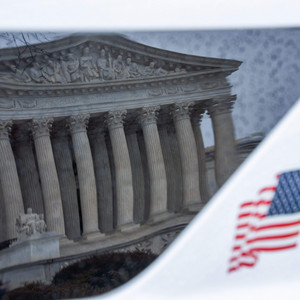
Yesterday morning, the Supreme Court dropped an economic bombshell.
In a 6-3 decision it struck down a huge portion of the tariffs President Trump imposed over the past year.
The court says the Trump administration has been relying on a law that doesn't actually give him authority to levy tariffs.
The Supreme Court's ruling on tariffs... is deeply disappointing.
President Trump at a news conference yesterday.
And I'm ashamed of certain members of the court, absolutely ashamed for not having the courage to do what's right for our country.
This decision has big consequences for the economy.
So what happens next?
That is what we're talking about in this special bonus episode of The Indicator from Planet Money.
I'm Darian Woods.
And I'm Adrian Ma.
After the break, a trade lawyer will help us break down the court's decision.
And we'll talk with a small business owner about what he's hoping will happen next, now that tariff refunds might be on the table.
So can you tell me just how you're feeling this morning?
I appreciate you asking.
You know, I am feeling fine.
To help us unpack the Supreme Court's decision, we reached out to Ted Murphy.
He's a lawyer for the law firm Sidley Austin, where he specializes in global trade.
Well, when a decision this big comes down for somebody like you, are you sort of like a kid on Christmas morning and you're like I can't wait to tear open the box and see what's inside.
Yeah, yeah.
Although I guess I will say I mean yes.
While there is a little bit of that sort of opening present on Christmas morning reading the opinion, you've got to sort of transition pretty quickly into okay, now what does this mean sort of in the real world?
And we'll get to what this means in the real world.
But first let's recap how we got here.
So about a year ago, President Trump got up on the world stage, turned to all our trading partners and said everybody is going to get tariffed.
You know, whether you're a island with just penguins or if you're one of America's largest trading partners, everybody gets a tariff.
Yes.
And wow, there were so many tariffs.
There were the universal tariffs he placed on basically all imported goods.
There were the so-called reciprocal tariffs that he placed on specific countries.
And of course there were also the tit-for-tat tariff snafus that he got in with China, Mexico and Canada.
And the legal justifications the Trump administration gave for many of these tariffs was a statute called the International Emergency Economic Powers Act, or IEPA.
So Ted Murphy says IEPA basically has two parts to it.
There's sort of part one, which says the president is authorized to declare a national emergency.
In this case, Trump pointed to fentanyl imports and trade deficits and said these are national emergencies.
And then if you have a national emergency, then that unlocks certain powers.
And these powers, according to the statute, included language about regulating and importation.
And even though the word tariff doesn't appear in the statute, the government argued that the words regulate and importation give it power to slap tariffs on the world.
But then midway through last year, a couple of small businesses said no.
I don't think that's right.
So they sued President Trump, and their cases wound up in front of the Supreme Court.
And in yesterday's 6-3 decision, they ruled in favor of the businesses.
So what was the majority's reasoning?
Ted broke it down for us.
The Supreme Court didn't really get into whether or not there is a national emergency here.
But instead, what they did was look at the powers.
So, assuming there's a national emergency, does the powers that IEPA provides the president include the power to impose these tariffs?
Yes.
And this is where the court basically just said no.
You know, under our constitutional system, the power to impose tariffs is bestowed on Congress right.
So that's in the Constitution.
Doesn't say anything about the president.
Doesn't say anything about the president.
And what it means is that if Congress is going to give away the power to impose tariffs to another branch of government the executive branch they need to do so explicitly.
Now Ted says there are various statutes that explicitly delegate tariff authority to the president, but they purposely constrain this power, requiring certain procedures and limits to be followed.
Problem was… President Trump didn't want to have limits, right?
He wanted sort of unbounded abilities.
He wanted to play like tariff jazz.
Exactly.
They can be imposed, announced on Wednesday, and go into effect on Saturday.
Or he can set them at one rate today and adjust the rate tomorrow without any process.
Now the administration argued that the president is allowed to do this under his AIPA emergency powers.
But in the end a majority of the court said there is just no way that Aipa gives the president unilateral authority to impose tariffs with no limits.
Now three justices did dissent, among them Justice Brett Kavanaugh, who argued that what the Trump administration was doing was legal.
He also expressed concern about the practical effects of the court's decision.
Is the government going to refund billions of dollars it's collected?
He said that would be a mess.
And this gets us back to the question we asked earlier.
What real-world effects should we expect to happen next?
Well, for one thing, Ted says don't expect tariffs to just disappear.
While the president can't impose tariffs under IEPA anymore, there are other statutes he could rely on.
I think people will be paying the same tariffs, just under a different legal umbrella.
Yeah, on Friday afternoon, Trump announced his plan B.
Today I will sign an order to impose a 10 percent global tariff under Section 122, over and above our normal tariffs already being charged.
Section 122, by the way, is one of the statutes that Ted mentioned earlier, which give the president limited power over tariffs, rather than the sort of carte blanche approach that he took under IEPA.
So for now, it looks like there are other statutes the president will try to use.
But that does not mean that the government is suddenly off the hook for the more than 100 billion worth of IEPA tariffs it's already collected.
Ted says his clients will certainly be interested to know whether they can get refunded for the tariffs already paid.
So how would the refund process work?
That's a really good question.
You know, the short answer is, yeah, we don't know and nobody knows.
Nobody knows, including apparently the president.
When a reporter asked Trump whether the government has to issue refunds, this is how he responded.
Wouldn't you think they would have put one sentence in there saying that keep the money or don't keep the money right?
I guess it has to get litigated for the next two years.
Still, you could bet a lot of business owners wouldn't pass up the chance to get their money back if they could.
I hadn't even thought about that.
But if there's a refund available, I would love to have that go back into the company.
Daniel Haberger is founder of Woof, a pet products company.
We spoke to him just under a year ago, just as Trump's tariff spree was really ramping up.
He says the hundreds of thousands of dollars his company has spent on paying tariffs.
He'd rather have spent it on the company.
Hiring new people, building new distribution channels, inventing new products.
I mean, that's where I want to be spending our attention, and I don't want to be spending our attention on tariffs.
We also asked Daniel if his company did somehow manage to get a refund, would he pass those savings on to customers?
He said, possibly.
And I don't want to commit too early to something and all of a sudden find ourselves surprised down the line.
But yeah, I would love for that to be possible.
I think that would be really, really great.
At the same time, Daniel says he's got to be cautious.
While he's excited about today's news, he's also nervous about more uncertainty to come.
This episode was produced by Corey Bridges and engineered by Jimmy Keeley.
It was fact-checked by Vito Emanuel.
Cake and Cannon is our editor and the indicators of production of NPR.
And how to accept change.
A little bit of humility and a little bit of genuine human interaction really matter.
Understand our changing state on River to River, an Iowa Public Radio podcast.
Part of the NPR Network.