Ted Audio Collective.
You're listening to Ted Talks Daily, where we bring you new ideas to spark your curiosity every day.
I'm your host, Elise Hugh.
There is a research -backed way to foster connection and reduce biases even in communities that are divided and come from different perspectives.
The tool is curiosity.
But as author Scott Shigeoka lays out in his talk, getting curious is a lot more than just an intellectual exercise.
He explains after the break.
Need to improve your English communication skills for global business or international travel?
Learn English five days a week with Lindsay, Michelle and Aubrey.
On the All Ears English podcast, Small Talk, Business English, Grammar and more.
All Ears English is downloaded four million times per month.
So come join us. Open your search bar now and type in All Ears English and hit follow.
And now our Ted Talk of the Day.
So back in 2017, I went on a trip to Joshua Tree and I started to experience auditory hallucinations.
They lasted for days and then weeks and then months.
And they said really nasty things.
They said, you're a freak, you're unlovable, you don't belong here.
And so like most people, I tried to push them away.
I tried to ignore them, pretend like they didn't exist, but they kept coming back louder and stronger.
And so I was a really good millennial and I went to my therapist who said, have you ever tried getting curious about those voices and really hearing what they're saying?
And that was a clutch of pearls kind of moment for me, because I was like, you want me to get curious about what I fear.
But he had never led me astray, he always helped me to grow.
Shout out to my therapist.
And so I took his advice.
And the next time that the voices came back, I really listened.
And over time, I started to notice that those voices mirrored what I had been told as a kid, or what I even told myself when I was feeling shame, or when I was bullied for being queer or socially awkward.
And I realized these voices weren't dark forces that I needed to repel.
I realized that they were pointing me to a younger version of myself that was inside of me, that was yearning for attention, that was yearning for connection, and really wanted to heal.
And that's why I learned to love my voices.
It also taught me a lot about my work.
I work at UC Berkeley's Greater Good Science Center.
And I lead research -based explorations on the division that we're experiencing here in America and across the world.
It's how we shame people, or dismiss them, or judge them, because they voted differently than us in the last elections, or because they hold an identity that seems to clash with our own.
And what I've learned through my work is that one way we can navigate through this time is if we replace our certainty about what we think we know of other people with a curiosity about what we don't yet know, or what we might have gotten wrong.
And that led me to a road trip for a whole year, went around the country in my little Toyota Prius, and I traveled to Trump rallies.
And I met with religious communities.
And I lived in rural towns.
And what I was guided by is rather than see people as the other, could I actually call them in and connect with them rather than cancel them?
Could there be a way where I could even find commonalities and a shared humanity?
Could I actually learn to love them like I learn to love my voices?
And what I learn on a personal level is actually what psychological research also says.
That the more you come into contact with people who are different from you, the less likely it is that you'll feel threatened by them.
On one stop in my road trip, I went to a convent and I met a group of Catholic sisters that were living with this really motley crew of millennials.
They were living there for six months as part of a group called Nuns and Nuns.
And what they did was they explored really interesting topics like belonging, and justice, and spiritual practice.
But they also talked about the vows that Catholic sisters take.
The vow of chastity, the vow of poverty, and the vow of obedience.
And Sarah Jane Bradley, who is one of the residents there, a millennial, she told me that she once carried a negative connotation of the word chastity.
She saw it as a tool to exert power over women or to control their bodies.
But Sarah's also fiercely curious, and she wanted to uncover what she didn't yet know.
And so she had conversations with the sisters and asked them about it.
And slowly over time, she realized that the vow of chastity was actually something very different.
She called it the deprivatization of love.
That when Catholic sisters take this vow, they're able to give care and love to many more people beyond just a partner or immediate family.
And she even drew comparisons between the vow and queerness, the ways in which we think about love and non -traditional family structures.
The most beautiful part of Sarah's story, I think, is that she was able to move past her understandings, her initial understandings of what she thought of the vow.
She was able to have real conversations with these Catholic sisters.
And it shows us that this curiosity that we have isn't just an intellectual tool to understand and learn things about the world.
It's actually a force for connection.
It's a force for real change in the world.
And now back to the episode.
On another stop on my road trip, I went to a Trump rally in Minnesota and I remember getting there and there was a sea of red of people who were voting very differently than me in the elections.
And I went up to them and I started having conversations and they told me about their children, their upbringing, what they like to do for fun.
We shared stories, we laughed.
But something really interesting also happened because I was genuinely interested in them.
They started to get curious about me.
And I told them about my road trip.
I told them about my work in curiosity.
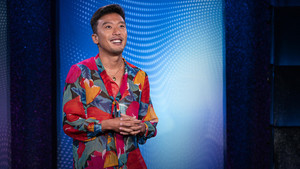
But I was also wearing a particularly fabulous outfit that day.
But what I mean to say is that I didn't erase or hide my differences.
I told them stories about being queer.
I told them about my grief about the climate crisis.
And to my surprise, many of them actually shared that.
And what happened is that who I personally saw as a Trump voter began to change.
It wasn't just the stereotype that was fueled by the news and social media and what other people told me.
I saw them as real people.
I saw them as real people just like me.
And what I've learned is that maybe we didn't change our perspective on who we were going to vote for in that election and those conversations.
But what we did do was we interrupted our biases of each other.
We moved past othering one another.
We were able to find commonalities and even a shared humanity.
What I've learned from the voices that I've heard to the story of my road trip across the country, to the book I wrote about curiosity.
I learned something really critical about love.
And yes, I'm going to drop the L word right now, you all.
I think it's really important.
There's that old adage that some of us might have heard that love is a verb.
But my question was always, OK, what's the verb?
How do we actually practice this?
What's the action? And what I've learned through my years of research and experience is that the best way that we can love better is for us to practice curiosity.
Because when we practice curiosity, we turn towards someone.
We say, I want to know your story.
I want to know who you are.
I want to understand your full humanity, your nuances, your complexities, everything that makes you you.
And I want to do this not because I want to change your view or your perspectives or who you are.
I want to do this because I want to get to know you because you matter to me, because I care about you because I love you.
Curiosity is not just this intellectual tool.
It's also this heart centered force that we can bring into our life.
And I think it's a practice that we really need right now in our country and in the world.
It also reminds us to look for the good in our lives and not just focus on the bad.
It reminds us to look for what's uniting our communities and our country and not to just focus on what's fracturing and dividing us.
It also tells us to prioritize the questions that we're asking as an important step to problem solving because we can't just focus on the answers, whether that's our schools or in our workplaces or in our communities at large.
But the most important thing about curiosity, I think, is how it can help us to love better, whether that's our children, our parents, our partners, our friends, our colleagues, or even someone who holds a very different belief or view or perspective from us.
If we can practice curiosity more, I really believe that we can love better.
Thank you. That was Scott Shigeoka at TED at BCG in 2024.
If you're curious about TED's curation, find out more at TED .com slash curation guidelines.
And that's it for today.
TED Talks Daily is part of the TED Audio Collective.
This episode was produced and edited by our team.
Martha Estefanos, Oliver Friedman, Brian Greene, Autumn Thompson and Alejandra Salazar.
It was mixed by Christopher Faizi -Bogan.
Additional support from Emma Toppner and Daniela Valarezo.
I'm Elise Hugh. I'll be back tomorrow with a fresh idea for your feed.
Thanks for listening.