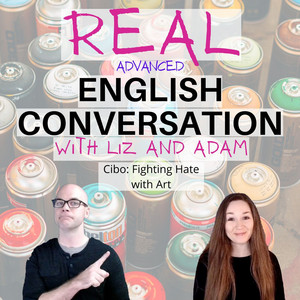
Hello, and welcome to a real conversation between two native English speakers.
I'm Liz Waid, and this is Adam Navis.
Hi, Adam.
Hello, Liz.
And we are here to discuss the Spotlight English program, Chibo, I think it is, right?
Chibo?
I don't know how to, I'm horrible at pronouncing things.
No, it's Chibo fighting hate with art.
So it is, as you know, like uh.
Well, as you can probably tell, chibo is not a word that i'm used to saying uh, because it is actually the italian word for food.
So uh yeah, so i uh yeah anyway.
So i don't really use that word very often, but we are talking about the artist who calls himself chibo And he makes murals over hate graffiti.
So if you haven't checked out this program, you can check it out on our website, where you can listen and follow along with the words.
And that's at spotlightenglish.com.
Or you can go to YouTube and follow along as the video displays the words and plays the audio.
And you can also find it wherever you get your podcasts on our Spotlight English podcast stream.
So I hope that you have listened to that program, either in the classic version or the advanced version, and then that you can come along and join us in this conversation.
So Adam, tell us a little bit about this artist from Italy.
So this artist is a... I'm sure that there is more to Chibo than what this program focuses on.
But the focus of this program is about a lot of hate... graffiti.
Now graffiti is... Which exists everywhere.
Which exists everywhere.
Everyone's seen hate graffiti.
Yeah.
If you've never, if you don't know what we mean by the word graffiti, people generally take a marker or a can of paint that you can spray and they'll put hateful words or hateful symbols um on a wall.
Usually it's a very public place.
Um, And sometimes graffiti can be quite beautiful, quite artistic.
Yeah, when it's art.
It's art.
So I'm sure that Chibo does a lot of things.
But this program really focuses on his – he was walking through his own city and has had his own personal experiences with hate, specifically neo-fascists which, I'll be honest, I'm not entirely clear.
What makes someone a fascist, but okay.
So the the program actually goes through a little like a very, very short history of fascism.
So, and i when i mean really short, it's only a few sentences.
So basically it's a kind of government where there's like um, a political, like like an authoritarian government right, so so fascism, and there were like like uh, nazi germany was a fascist government, and so that's the most famous example i would.
I would say, except that actually italy has a had a fascist government, so has a history um of of that sort of government, And in this case, in Italy, some people still hang on to that old idea of fascism as a best way of government.
But they're new, so neo-fascists.
Well, that makes a lot of sense.
I just don't.
I can't get in my head or my heart why anyone would want to be a fascist or support fascism.
Yeah, no.
So, that's official.
Spotlight does not, I'm going to go out on a limb here and say Spotlight does not support fascism.
We are against fascism.
Completely.
That is our official stance.
There we go.
See, that was an easy official stance.
Yeah.
We're also against war.
War and fascism.
I feel like those are two basic things that we can definitely stand against.
Right.
So, Chibo encounters graffiti, fascist graffiti.
And thinks to himself, I don't like this, but I want to do something about it.
So starts to modify through his own graffiti and his own mural.
I guess when you're an artist, you say it's a mural.
Yeah.
You know, through his own artistic expression, adapting them to more peaceful, even more fun kind of ways of Well, but they're always food.
Right.
Right. which is why he calls himself Chibo.
And it's hard to show.
Like well, it's impossible to show in an audio program, but we do have some pictures, some links to his Instagram on our website.
And if you have not checked out Chibo's Instagram yet, I'm sorry.
I know I should not tell you to stop this video and go somewhere else.
But you should definitely check out his Instagram.
And we do have a link to that in the website or on the website.
So you should definitely go check it out.
This food is...
Just everything.
So my favorite is the example actually in the beginning of the program where there's a Nazi symbol and it says my Hitler in graffiti on this wall.
And he paints muffins.
So I think they're teal muffins with like purple frosting.
And instead of saying my Hitler, it says my muffins.
Yeah.
Which is so delightful.
Well, I think there's something about food that is both non-threatening, but also even comforting.
Everybody can agree, food is.
You can find pleasure in food and connect over food, even if you don't.
If I don't like what you like and you don't like what I like, we all have some kind of food that we enjoy.
And it's taking these very hateful things and transforming them into a very... friendly thing.
Right.
Well, and even um Chibo talks about um, how well, at the end of the program, we share a quote about how caprese salad is one of the things that he likes to paint, because it is a salad that is a sort of Italian dish.
So it's a, it's a food that's very common in Italy.
I love it by the way.
I love caprese salad.
It's mozzarella and tomatoes and basil and oil and, like usually, balsamic vinegar and maybe a little sprinkle of salt.
So he points out that you have all of these.
You have this food that's an Italian food, but.
It comes from all over the place.
You might get the cheese from Italy, but the tomatoes from somewhere else and the oil from somewhere else, like a different country or different region.
And then they all come together because of course we didn't mention this in the, in the description of fascism, which was admittedly very short.
But many of these neo fascists are doing this graffiti against fascism neighbors, against people with different color skin or who speak different languages or who are immigrants.
And they don't want to have a welcoming community for those people.
They want to tell them to go back home.
So Chibo's message is really, we all need things that come from different places.
Like we all, it can all come together and create something beautiful or delicious in the case of a caprese salad.
I think that's a great mentality.
But my question for you is Liz, I don't think you and I are going to go out and paint on walls because probably in our communities even covering up with a more beautiful thing would be not considered a good thing.
Well, and I'm not really a spray paint artist.
Yeah.
But are there ways that you've thought about, and I'm putting you on the spot a little bit here.
Yeah.
Maybe I'll ask our viewers.
Are there ways that you could, if you encounter hate, that you kind of react to it in a way that is like that
Not necessarily arguing or saying it's bad, but transforming it into something else right yeah, or even ignoring it right, like so many times with, like hate graffiti.
Like you look at it and you maybe feel bad about it and then you go on with your day because you don't.
What can you do about it?
What can you do about it?
And it's not your building to to maintain, or it's not your sign that they maybe you're not a graffiti artist, right?
Um, but i think this adam is a great uh plug.
I don't, I don't know what else to say.
Like, that's a different there's a there's a word for it.
But this is a great opportunity for people to check out our 10 ways to fight hate series.
So this is actually a series based.
It's called the 10 ways to fight hate.
And it's based on the 10 ways to fight hate in your community from the Southern Poverty Law Center, which is an organization that works against hate, especially in the southern United States.
And they put together a list of 10 ways that people can use to fight hate in their communities.
So what I really love about that series, because I do think this is a great companion program to that series.
What I love about that series is that it is 10 different concrete ways, ways that a person can say oh, I can do that.
I can do this one step.
Like oh, maybe I'm not really good at organizing a rally, but I am really good at, you know, speaking up or whatever.
So I think that that is a good place.
If you don't know what to do about hate in your community and you're not a graffiti artist you can't do this thing that Chibo does that you can check out that series and find a thing that you can do to improve relations in your community.
There are a lot of good options and I think everybody will find something they can do to fight hate.
Yeah.
So, wrapping this up, I really hope that you take the opportunity to go to a.
Chibo does have a Facebook group and he has an Instagram page.
He has an Instagram.
I'm old.
I don't know how to talk about those things.
And you can see tons of videos there about how he covers up all of this graffiti.
It's really encouraging.
It's lighthearted and fun.
And if you wanted to support him as well, he also has a Patreon where you can give a few dollars a month and you can.
That provides paints for him to, to you know, continue his work.
What I also love.
Sorry, I will put in this one last bit of information before we leave, because I do love it is that social media has really helped him find the hateful graffiti and then cover it up.
So I just I do love how that example of how social media is really bringing people together to fight hate.
So they tell him like.
Hey, there's a, this is texting to me.
There's a hateful graffiti on this street corner.
You should go get it.
And then so he reads that.
See, now this is, yeah, now I'm making sense.
So he reads that and he says okay, I'm gonna go fix it.
And then he does that.
So anyway, if you haven't checked out those things, I would really encourage you to go check out his work.
It's great.
I would also encourage you if you have not listened to that program Chibo, fighting hate with art.
I really encourage you to go find that.
Let us know If that is a problem in your community.
Is neo-fascism a problem in your community and how does your community deal with it?
Yeah.
And check us out.
Check out Spotlight on Instagram, Twitter, Facebook, YouTube and wherever you get your podcasts.
Until next time, listen, watch, practice and learn.
Spotlight out.