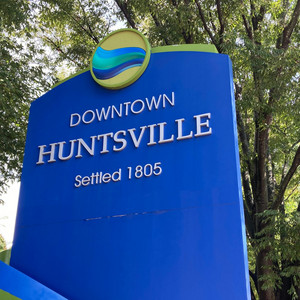
Huntsville, Alabama is growing fast.
About 18 people move there every day.
And you can see lots of reasons why.
It's where the rocket that put the first man on the moon was developed.
There are plenty of space and defense sector jobs, a big music venue.
And in the center of town there's an art museum and a pond where Rachel Ramos and her daughter, Reina are feeding the ducks.
See, it's only 25 cents for a cup of duck food.
Yeah, I gotta get more duckies.
25 cents might sound like a great price, but the price that really matters for Rachel is $1,250.
That's how much she pays each month for a three-bedroom apartment.
Three bedrooms.
That is a steal.
Yeah, I thought my two-bedroom in Birmingham was cheap, but this is definitely a steal.
And Rachel also thinks the city's pretty affordable.
Affordable.
Compared to other places that I've lived, like Montana and Florida, I find it less expensive to live here.
The cost of homes in Huntsville by square foot is about 25% cheaper than it is nationally.
But Rachel is worried about those good times and low prices lasting.
I am concerned about it because, just with any place that I've lived where there was a lot of expansion, prices tend to kind of go up.
This is an economic paradox that many cities face.
One of the drivers of high prices is people moving to a city for low prices.
This is The Indicator from Planet Money.
I'm Waylon Wong.
And I'm Stephen Massaha.
On today's show we look at this conundrum how a low cost of living can boost growth and how growth threatens a low cost of living.
Support for this podcast and the following message come from Indeed.
Spend more time interviewing candidates who check all your boxes with Indeed Sponsored Jobs.
Claim your $75 sponsored job credit now at Indeed.com slash indicator.
Terms and conditions apply.
This message comes from WaterAid, whose mission is to change the world through water.
Imagine walking miles every day to collect water because your home has no taps, toilets or clean water.
That's the reality for one in four people worldwide.
Your support can help change the future for them, because WaterAid believes everything.
Health food opportunity starts with water.
Donate to WaterAid and your gift will be matched, going twice as far to bring clean water to everyone, everywhere.
Donate at wateraid.org slash podcast.
This message comes from Capital One with the Capital One Saver Card.
Earn unlimited 3% cash back on dining and entertainment.
Capital One.
What's in your wallet?
Terms apply.
Details at CapitalOne.com.
This affordability catch-22 is not an easy problem to solve.
It's very hard to win the national housing affordability, you know, rollerball.
Jonah Fremark is a researcher with the Urban Institute, and there is one city in particular that tends to be like the poster child for this lower-to-higher-cost flip-flop.
Austin is a great example of a community that went from relatively isolated, not particularly interesting at a national perspective, into suddenly a booming center of employment and interest in people moving in.
So it has grown at enormous rates over the last decade or so.
And with that, there has been a vast increase in housing costs in that city.
Austin grew so fast because it was seen as such a great place to live.
Not only was it cheaper and had a ton of tech jobs, but also plenty of culture from food to music.
Over the last two decades, home prices have just about doubled nationally.
In Austin, it's more than tripled.
Austin prices have come down a bit recently, but they're still pretty high.
And Austin's not the only city that's dealt with this.
Atlanta's another example of this growing population, growing costs problem.
So you get stuck in this challenging loop that is difficult to get out of unless you have substantially higher rates of housing production.
But building a ton of houses takes time.
So part of that challenge is predicting the need for all those houses early.
City planners in Huntsville think they got that timing right.
That's according to Dennis Madsen.
I'm the manager of urban and long-range planning for the city of Huntsville.
So you're the man with the crystal ball.
I don't know if there's such thing as crystal ball in the planning world.
It's a lot of best guesses.
And Dennis says about 10 years ago, Huntsville's best guess was to prepare for an upcoming housing crisis.
Not because of anything specific to Huntsville, but because it was happening across the country.
Yeah, one estimate puts the current housing shortfall at 2.8 million units.
And that number has grown dramatically since 2013 when the housing crisis began.
And that was a crystal ball that was fairly clear because you were seeing it happen nationally.
The housing crisis is a national crisis.
Dennis says recognizing the housing crisis early was a key way to start working on encouraging building.
Number one easily is supply.
Just making sure that we're getting a lot of housing supply on the ground.
Since 2020, just within the city of Huntsville, we've put 16,000 apartment units on the ground.
And that number is even larger when you look at our broader North Alabama.
The South in general has been building new homes way faster than the rest of the country.
And a big reason for that is because the South has fewer building regulations, slowing down construction.
There also tends to be a lot more room to grow.
That's definitely true in Huntsville.
It's surrounded by lots of open land.
We are...
About 228 square miles, which is Chicago in terms of land area.
Let's say I'm city planner of Stephenville and I'm surrounded by all these other cities.
I don't have the option to grow to build more houses.
What do you say to me when I come to ask you for advice?
Yeah, I think if you can't obviously add a lot, I think one of the keys is diversifying.
By diversifying, he means building different kinds of homes.
Last year, the city granted permits to build 900 traditional houses, but also 1400 apartments and 200 townhomes.
Yeah, and making cheaper apartments to keep costs down does make sense.
But Dennis also says even expensive apartments going up actually make the city more affordable.
What that means is that people who can afford those are moving into those.
If those don't exist, then they start to look downstream and they start looking at apartment complexes that are existing, that maybe those complexes had been providing affordability.
But because there's nowhere else for folks who are willing to pay 2000 for a unit, they'll start looking at units that are less expensive and they start pushing those folks out of the markets.
So sitting here, This doesn't sound too difficult.
Have a variety of houses and have a lot of them.
Why is this so hard and so many cities have struggled with this that have been growing?
I think a lot of cities struggle only because in the last half century a lot of our zoning codes were built to support a certain type of housing.
And really, that's where the market was.
Dennis says zoning laws were all about encouraging single-family homes.
For that classic nuclear family.
But compared to say, the 1950s, there are a lot more different types of families today, like single-parent households, grandparents raising kids, adults with no kids.
And they might not want that classic big house with their front yard or even be able to afford it.
But our zoning hasn't always said yeah, you can build what's frequently termed as missing middle housing.
A lot of stuff that used to be everywhere around America that you can see in some of your older neighborhoods.
You can see these quads.
Quads.
Okay, as a Midwesterner, I'm not sure I know what this kind of housing is.
Yeah, they're a lot more common in the South, at least from what I've seen.
Like, picture what looks like a house, but divided into four separate units.
That is a quad.
They're bigger and more expensive than a sprawling apartment complex, but cheaper than a single-family home.
That's the missing middle Dennis is talking about.
Frequently in many cities got zoned out of existence and there's A tremendous number of planners, both in the public and private sector, who are working to kind of reestablish codes and regulations that allow for that diversity of housing.
But cities need more than expensive fancy apartments, at least according to Una Fremark with the Urban Institute.
That is not enough to support low-income people.
The reality is that low-income people in the United States need additional subsidy to be able to afford quality homes in our communities.
Yonah also says rising home prices should not always be seen as this terrible outcome.
I don't necessarily think we should think of growth and affordability as in contrast to one another.
Because growth occurs, because people see appeal in living in a certain place.
If there are really high costs of living in a certain place, it's probably because a lot of people want to live there.
That's the case for places like Manhattan or San Francisco.
People continue to want to move to those communities and see an overall benefit to the quality of life that comes with the costs of those places.
Huntsville is definitely still growing.
President Trump is moving Space Command from Colorado to Huntsville, and that will bring well more than 1000 jobs.
And while there might be no such thing as a crystal ball in city planning, Dennis Madsen is predicting a future where Huntsville defies the odds and remains affordable.
This episode was produced by Julia Ritchie with engineering by Robert Rodriguez.
It was fact-checked by Sierra Juarez.
Cake and Cannon is the show's editor.
The Indicator is a production of NPR.
This message comes from Mint Mobile.
At Mint Mobile, their favorite word is no.
No contracts, no monthly bills, no hidden fees.
Plans start at $15 a month.
Make the switch at mintmobile.com slash switch.
That's mintmobile.com slash switch.
Upfront payment of $45 for 3-month 5GB plan required.
Equivalent to $15 a month.
New customer offer for first 3 months only.
Then full price plan options available.
Taxes and fees extra.
See Mint Mobile for details.
This message comes from Capital One with the VentureX business card.
Earn unlimited double miles on every purchase and enjoy purchasing power to spend more and earn more.
What's in your wallet?
Terms apply.
See CapitalOne.com for details.
This message comes from Mint Mobile.
Starting at $15 a month, make the switch at mintmobile.com slash switch.
$45 upfront payment for three months.
5GB plan equivalent to $15 a month.
Taxes and fees extra.
First three months only.
See terms.