This message comes from Organic Valley, a dairy cooperative of small organic family farms that is dedicated to protecting the land and all the plants and animals that live there.
Learn more at ov .coop.
Support for NPR and the following message come from Yarl and Pamela Mohn, thanking the people who make public radio great every day, and also those who listen.
You're listening to Life Kit.
From NPR. Hey, everybody, it's Marielle.
In November of last year, I went to my doctor for an annual checkup, and she felt a lump in my breast.
I hadn't felt it myself.
After multiple mammograms, ultrasounds, and biopsies, I was diagnosed with early -stage breast cancer.
Yeah. It was a shock.
The latest statistics tell us that one in eight women will get breast cancer over a lifetime.
Now, I'm in my mid -30s.
I didn't have a strong family history of breast cancer, don't have a genetic mutation that would raise my risk.
I never expected this would happen to me at this age.
But in the past decade, there's been an increase in breast cancer diagnosis rates for all women, but even more so for those under 50.
Dr. Jason Malabi is a medical oncologist at MD Anderson Cancer Center.
He focuses specifically on breast cancer, and he says more than half of his patients are under 50.
Initially, breast cancer was known as more of a disease of the elderly, but I can tell you that it's getting more and more common in the younger population.
The good news is breast cancer survival rates have been improving, too.
Breast cancer deaths have dropped by about 40 % since 1989.
That's because of better screening and better treatment options.
And survival rates are especially high when you catch the cancer early before it has a chance to spread.
In those cases, you have a better chance of wiping it out so it never comes back.
Dr. Tiffany Unger is a breast oncologist at the Cleveland Clinic.
Early diagnosis is crucially important not only for the outcomes, but also the treatment is going to be less complex and easier to get through.
I went through treatment, and while nothing in life is guaranteed, the prognosis is really good.
On this episode of LifeKit, we're going to talk about breast cancer screening and diagnosis.
I'll share what I've learned through my personal experience and through my reporting.
You'll hear from oncologists about how to understand your personal risk, when and how often you should be getting physical breast exams and mammograms, when mammograms are not enough, and how to advocate for yourself in the healthcare system.
Because, as I learned over the past year, there are big gaps in how we screen for breast cancer, and we have to know our bodies and look out for ourselves and the people we love.
And let me say, I'm still processing what just happened and what I went through.
But it was important for me to do this episode now and to share all this knowledge I've been amassing.
If it makes someone's life even a little bit better, or helps someone catch their cancer at an earlier stage, that would mean the world to me.
This message comes from WISE, the app for doing things in other currencies.
Send, spend, or receive money internationally and always get the real -time mid -market exchange rate with no hidden fees.
Download the WISE app today, or visit WISE .com.
Tease and seize apply.
This message comes from Indiana University.
Indiana University performs breakthrough research every year, making discoveries that improve human health, combat climate change, and move society forward.
More at iu .edu slash forward.
Support for NPR comes from NPR member stations and Eric and Wendy Schmidt through the Schmidt Family Foundation, working toward a healthy, resilient, secure world for all.
On the web at the schmidt .org.
It's a high -stakes election year, so it's not enough to just follow along.
You need to understand what's happening so you are fully informed come November.
Every weekday on the NPR Politics Podcast, our political reporters break down important stories and backstories from the campaign trail.
Do you understand why it matters to you?
Listen to the NPR Politics Podcast wherever you get your podcasts.
When I was diagnosed, I thought that if you got breast cancer, especially at a young age, it was probably hereditary.
You know, you had a strong family history of the disease.
But I've learned that's not the case for most breast cancer patients.
Here's Dr. Tiffany Unger again.
We say that the risk for finding a heritable cause of breast cancer is only about 5 to 10 percent of the population.
The truth is anyone who has breast tissue can get breast cancer.
There are some factors that increase your risk.
While women are getting breast cancer younger than they used to, and researchers are still trying to understand why, age does play a role here.
As we get older, you know, as we have the good fortune of experiencing more birthdays, we also are increasing risk for not only breast cancer, but other types of cancer as well.
And there are a lot of other factors, too.
We won't go through all of them, but some things that can increase your risk of breast cancer drinking alcohol, a lack of physical activity, smoking cigarettes for many years, having high -dose radiation to your chest during treatment for another cancer, and having dense breast tissue, which we'll get
to later. Also, hormonal treatments.
Researchers are still learning about this topic, but studies show that your risk of breast cancer can increase, at least temporarily, for example, if you take birth control pills or have a hormonal IUD.
Or even through menopausal treatments, there are many women who go through hormone replacement treatment to help with menopausal symptoms.
We do know that that can increase the risk for breast cancer.
Your risk may also increase if you're a transgender woman and you've done gender -affirming hormone therapy.
The doctors I've talked to all said there are likely other environmental risks, too.
Exposures to certain chemicals and toxins that may increase your risk of developing cancer in your breast.
Researchers are still learning about these as well.
The first thing you want to do when you're thinking about breast cancer is to get a sense of your personal risk as much as possible.
This is Takeaway 1.
That'll shape when, how, and how often you should get screenings.
It helps to do this with a doctor you trust.
Unfortunately, there's a lot that's unknowable about your breast cancer risk, at least as of October 2024.
Like, have you been exposed to some environmental toxin that makes it more likely?
But there are some ways to get a sense of your risk.
One is by putting your information into an online calculator.
These will give you an estimate of how likely you are to get breast cancer based on some of the factors we've talked about.
You'll notice these calculators ask questions about whether you've given birth and at what age, and when you got your first period, if you menstruate.
That's because of the role hormones play in this type of cancer.
One of these calculators is called the BICRAT, spelled B -C -R -A -T, Breast Cancer Risk Assessment Tool.
That's from the National Cancer Institute.
It's only available for women 35 and up.
Another is called the IBIS, International Breast Cancer Intervention Study Tool.
I know it's a mouthful.
Dr. Mwabi at MD Anderson recommends looking at both on your own or alongside your doctor.
Both tools have their positives and negative.
The BICRAT tend to underestimate the risk, and the IBIS tend to overestimate the risk.
So what I do is, because I don't want to underestimate or overestimate, I check both, and I tell my patient your range is between those.
Now, thankfully, they give you numbers that are pretty close to one another.
It's not like one gives you 2 % and the other one gives you 50%.
Now, I will say, after I was diagnosed, I used the BICRAT to see what it would have told me about my risk level before.
And it said I only had a 0 .4 % risk of developing breast cancer in the next five years.
That was about average.
IBIS said I had a 0 .9 % risk over a decade and about 11 .5 % over my lifetime, which was also basically average.
So, these are imperfect, but they are a tool in your kit.
And if they say you're at higher risk, that would be 20 % or higher over a lifetime.
You can be proactive about that.
Another way to suss out your risk, and this is something your doctor should ask you about, is to know your family history.
While most people who get breast cancer don't have a strong family history of this or a genetic mutation, if you do, your risk can increase significantly.
So takeaway two is if you have access to this information, learn about your family's history of breast cancer and talk to your doctor or a genetic counselor about genetic testing.
When you're gathering your family history, it's especially important to know about your parents, siblings, and children.
But also consider your grandparents, aunts and uncles, and cousins.
And don't focus solely on breast cancer.
Dr. Unger says some genetic mutations can increase your risk of getting multiple types of cancer.
You know, one mutation can increase the risk for breast cancer, but can also increase the risk for ovarian, sometimes pancreatic cancer, sometimes prostate cancer, all with the same genes.
So maybe the uncle had prostate cancer, the mom had breast cancer, and so we want to make sure that we capture all of those.
You should also note whether anyone in your family has tested positive for a gene mutation, if you're of Ashkenazi Jewish heritage, because that can increase your breast cancer risk, and if a man in your family has been diagnosed with breast cancer, because that's quite rare and it can suggest a genetic
mutation. If you do find that you carry a genetic mutation that increases your risk of breast cancer, you can talk to an oncologist about your options.
You may decide to do extra routine scans to take preventative medication or even to get surgery to remove your breast tissue.
And if you test negative for a genetic mutation, but you do have a strong family history of breast cancer, Dr.
Unger says you might consider starting mammograms or other screening earlier than the general population, because you might have a genetic mutation that researchers haven't discovered yet.
Now that you have a sense of your risk, let's talk about how we find breast cancer.
A lot of the time we hear about breast cancer presenting as a palpable lump.
Dr. Moabi says that's not always the case, though.
One in five patients.
Those do not present as a mess.
Instead, you might notice your nipple starts bleeding, inverts or changes color.
You might notice that one of your breasts has gotten bigger or firmer.
You might see an unusual discharge or see the skin of your breast dimpling.
You could see a scaly rash, swelling, reddening of your skin.
This could even show up as breathlessness or back pain.
So take away three.
You'll want to get to know your body and your breasts specifically, how they look and feel and what's normal for you.
And if you notice a change that lasts longer than two weeks, see a doctor and get imaging done.
Feeling your own breasts shouldn't be your only method of breast cancer screening, but it is an important foundation.
The lump, my doctor felt, was small, and it was basically under my arm.
I honestly didn't realize that was even a part of my breast.
But as I've learned, your breast tissue spreads far and wide.
It actually encompasses a really large area.
Dr. Unger says breast tissue extends from your collarbone down into your ribs and lower if your breast hangs below that point.
And it goes under your arm from your armpit down to your ribs.
She recommends that you feel your breast tissue at least once a month.
Run your fingertips over these areas.
You could go in circular motions.
Starting at your nipple, you could go in a grid up and down.
I encourage women to examine their breasts both in the upright position as well as in the laying down position because the tissue moves.
You'll notice, like, okay, if I can feel my ribs a little bit more in this position.
She recommends that you also feel your breasts while lying on your side and then flat on your back.
And look at them in the mirror.
With the arms down, arms on the hips, arms up, and looking for differences in the breasts, you know, from maybe the last time that they observed their breasts.
Dr. Unger says if you menstruate, you should also get to know what your breasts feel like at different points in your cycle.
Because they can feel different before, during, and after menstruation.
And she says if you notice any changes that last longer than two weeks, see your primary care doctor or gynecologist.
You could also reach out to a local cancer center.
They'll often do screenings for breast cancer.
From there, you'll want to get a physical exam, and your healthcare provider will likely recommend a mammogram or ultrasound.
Dr. Unger says it's important to do that imaging.
If there is a woman who finds something in her breasts that is abnormal, and again, if it stays for two weeks, it should be evaluated by imaging.
And if imaging is unclear at all, typically would follow this up with a biopsy.
Now, it is possible that your doctor will dismiss your concerns, especially if you're young.
As a medical community, I think sometimes we forget that we are seeing this increased rate in young people.
A lot of our culture is dismissive, especially when somebody is worried at a younger age.
They tend to do stuff less quickly.
The key here, and I hate that we have to do this, but be pushy.
Advocate for yourself.
Sometimes I find it easier to defer to the quote, hire authority, and say, my sister will not get off my back unless we get this looked at, or my husband, or my wife, or whomever.
If you feel a little bit awkward, or you feel like you're getting pushback and they're not taking you seriously.
And these moments can be pivotal, right?
If you go in with a small lump and it gets dismissed, and then you come back six months to a year later, it could be a much bigger problem.
Dr. Unger has seen this firsthand.
Her aunt, her mom's sister, had breast cancer in her late 30s and died before she turned 40.
And even with that history, when my mom presented with a lump underneath the arm, my mom was dismissed and no one, you know, no one ordered any follow -up, and then she came back six months later saying, this is bigger.
And then ultimately she was diagnosed with stage 3 breast cancer.
Dr. Unger's mom went through treatment, and she is doing okay now.
Our next takeaway, takeaway four.
If you're 40 or older and you have breasts, consider starting annual mammograms if you haven't already.
If you're under 40, talk to a doctor about your risk and when you should start.
So, mammograms. They strike fear in the hearts of many women, especially if you've never had one before.
I am here to tell you they're not that bad.
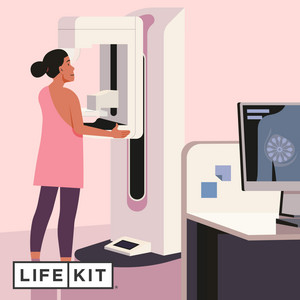
Basically, you show up, put on a gown, go into a room, and stand or sit next to this machine.
The technician will put your breast up on this kind of slab, and if you have smaller breasts, they really have to scoop it up there.
And then, yeah, they squash your boob like a pancake, but your breast is not going to stay that way, and it's over before you know it.
This might be a little uncomfortable because there is some squeezing of the tissue, but it shouldn't be overtly painful.
Dr. Unger says you might want to avoid going for a mammogram when you're menstruating, because your breasts can be more sensitive than.
The images they're taking will help them see if you have a suspicious -looking lesion or tumor that needs to be investigated further.
Some things to note about mammograms.
Dr. Milwaukee says they're not all created equal.
Some machines are better at detecting cancer than others.
3D mammograms, for instance, better than 2D.
Once again, you're going to have to advocate for yourself.
If you're going to do an imaging, you want to do the best one available and the one that has the best detection rate, right?
So I always tell my patients, it's their health, it's their life at the line, right?
Ask those questions, you know, and if the physician doesn't know what machine they have, then they can also learn something about what type of machines they have by asking.
Now, there are several groups that issue cancer screening guidelines, and for years, those groups have disagreed on when women should start getting mammograms and how often.
The United States Preventative Services Task Force now recommend that women at an average risk of breast cancer get mammograms every other year from age 40 to 74.
The American Cancer Society says women at age 40 should have the choice to start annual mammograms.
Women ages 45 to 54 should definitely get annual mammograms, and women older than that should get mammograms every one or two years.
The National Comprehensive Cancer Network recommends annual mammograms starting at 40.
Yeah, unfortunately, the guidance is conflicting.
But Dr. Mwabi said he and his colleagues generally go with that last guideline, yearly mammograms starting at 40.
If you're under 40, you'll want to get a sense of your personal risk, talk to a doctor about that.
And Dr. Unger says if you have a strong family history, you might want to think about earlier screening.
That's also true if you've needed to have breast biopsies before, because that can raise your risk of getting breast cancer.
And so those patients might qualify for earlier screening depending upon the age at which they were diagnosed, what specifically was found.
The guidance that I just shared is what the medical community recommends for cisgender women.
If you're a cisgender man, you'll want to talk to a doctor about your personal risk, including any possible genetic mutations, and decide whether mammograms make sense for you.
Yes, they can actually do mammograms for men.
If you're transgender, talk to a doctor and also look at the screening guidelines from the American College of Radiology.
They give recommendations for trans folks based on different factors.
Okay, so another tool in breast cancer screening is the clinical breast exam, a physical exam where a doctor, a nurse practitioner, or another health care provider feels your breasts for changes.
Breast exams have actually been falling out of fashion among health care providers because they, like all other screening tools, are imperfect.
Doctors miss things, or the cancer isn't obvious, or it's still too small to feel.
And actually, the American Cancer Society doesn't recommend them because it says research has not shown a clear benefit.
But for women under 40 who are often not eligible for routine mammograms, physical exams may be the only way they're getting a breast cancer screening.
Doing a yearly breast exam can be very beneficial, especially, especially if they're not in the age where they can do a mammogram or ultrasound.
Again, there's disagreement here among the groups that issue the guidelines.
The American College of Obstetricians and Gynecologists does recommend regular breast exams every one to three years for women 25 to 39 and yearly for women over 40.
The National Comprehensive Cancer Network recommends the same.
Dr. Unger says if your doctor is not giving you routine breast exams, ask them to.
Just say, hey, I need one.
If it's not today, can I come back and get this done?
Both Dr. Unger and Dr.
Malabi stressed, though, that these physical exams do not replace the mammogram.
They work in different ways.
Back to mammograms.
It's important to understand that they are also just one tool.
And in many cases, they're unreliable.
That's because many people have what's called dense breast tissue, and dense breast tissue makes mammograms hard to read.
It might sound like density is something you could tell by feeling your breasts.
But actually, you can't.
We actually know it has nothing to do with how the breasts feel.
It has everything to do with the ratio of glandular tissue to fatty tissue as it's seen on a mammogram.
The reason density is important is if you have fattier, less dense breast tissue, your breast will look gray on a mammogram.
Then if there's a cancerous lesion, that can show up as bright white.
But if you have really dense breast tissue, your entire breast will look white.
So you usually can't see the cancer if it's there.
It's terrible. It is terrible.
I cannot tell you how many cancers were hidden behind breast densities that I've seen in my life.
The good news is that healthcare providers are now legally required to tell you that you have dense breast tissue after a mammogram.
I got that information in a letter.
And there are different categories, some more dense than others.
You might also see this in your mammogram report under breast composition.
So take away five. Find out if you have dense breast tissue.
If you do, you'll need to consider a different kind of breast cancer screening.
And your chance of getting breast cancer also increases.
So this is another risk factor to be aware of.
So, as far as screening, if you have a lump in your breast and a mammogram shows that you have dense breast tissue, your doctor may also recommend an ultrasound.
During an ultrasound, a technician will press a wand against your breast and use sound waves to visualize and take an image of the lump.
Dr. Mwabi says ultrasounds work well if you've already located a suspicious spot on a mammogram or during a physical exam.
But they don't work as well for routine scans of the entire breast.
Sometimes doctors will also recommend that women with dense breast tissue get routine MRIs if they're at high risk for breast cancer.
Again, that's a 20 % or higher estimated lifetime risk or if they've had breast cancer before.
That's because if you have dense breast tissue, MRIs are often much better at revealing cancer.
But they're expensive and it's possible your insurance won't cover them for you.
After you get whatever imaging done, you'll get results, usually dropped into an online patient portal.
I started calling these Friday night portal drops because it seemed like the hospitals would only release results after hours on Friday.
I'd get a ping in my inbox saying, you have a new test result, but it was 5 .45 p .m.
and then I'm thinking, do I look?
If it's bad, I won't be able to talk to my doctor until Monday.
If you do decide to look at the results of your imaging, you're going to see a radiology report.
And those typically include a ranking from 1 to 5.
This is called the BI -RAD system.
The numbers correspond to the likelihood that you have cancer.
A 4 means the area looks suspicious for cancer and you should get a biopsy.
Sometimes you'll see 4A, 4B, 4C.
If you want to know more about the likelihood for each, the American Cancer Society has a breakdown on its website.
A rating of 5 means very suspicious for cancer, like 95 % likely.
And you should, again, get a biopsy.
During a breast biopsy, a doctor will remove a piece of the suspicious tissue from your breast using a needle or sometimes a surgical scalpel and then send it to the lab for testing.
Dr. Moabi says the experience of getting a biopsy done changes from place to place.
If it's done in the right setting with people that are well trained and stuff like this, the experience can really change drastically.
Takeaway 6. If you need a breast biopsy, get it done at a hospital with a dedicated breast cancer clinic or team.
Dr. Moabi says biopsy techniques are different depending on what kind of cancer they're looking for, right?
Like, is it in your bone?
Is it in your esophagus?
Is it in your breast?
And if a hospital has a dedicated breast cancer team, that means they'll have radiologists and surgeons who've done this procedure many times.
And their pathologists, the doctors who look at your tissue in the lab, figure out if it's cancerous and what type of cancer it is, will also have a lot more experience reading those slides and diagnosing breast cancer.
So it's really important if patient can have the means, go to a place that specializes in that type of cancer.
This might require traveling and taking time off from work, and I know that's not an option for a lot of people.
But there are resources available if money is the concern.
Local and national groups that'll pay for free and discounted transportation and lodging for cancer care.
You can find those at websites like breastcancer .org, cancercare .org, cancer .org, joeshouse .org, and many others.
And if you have health insurance, call the number on the back of your card and ask if you can be assigned a care navigator or a personal nurse advocate.
I was connected to a nurse who shared resources like these with me and called every once in a while to check in.
Okay, let's talk about what a breast biopsy entails.
There are a number of techniques your doctor will recommend the one they believe is right for your situation.
Sometimes during a breast biopsy, a radiologist will stick in a small needle and remove the tissue that way.
Sometimes it's a much bigger needle about the diameter of a straw.
Dr. Mwabi says some biopsies are automated and you might be left alone in a room with a machine that injects a needle into your breast and takes a tissue sample.
And sometimes patient freak out because they'll be like, what's happening?
The machine is really doing the biopsy for me.
If you're getting one of these done, ask what your options are and if a member of your health care team can be in the room with you.
Other biopsies use a vacuum system to take tissue samples.
I had one of these done and it wasn't painful, but it was deeply unpleasant.
I had to stay perfectly still while technicians took MRI images and also while a doctor stuck a large needle into my breast and sucked out my flesh into a vacuum system.
I'm not telling you this to scare you.
I actually think it's a miracle that we have these technologies.
I say it because it can help if you know what to expect.
If you know what you're expecting, you can anticipate for it the experience becomes much better than going blind via.
I don't know what's going to happen, you know.
Dr. Mwabi says before you go for a biopsy, ask the cancer center or hospital questions.
Like, what type of biopsy is this?
Why are they using this approach?
What will it entail?
Will they numb your skin?
How? You could also ask, who will be in the room with you?
Can you bring a loved one for emotional support?
Because you'll be topless, maybe you'd prefer to have healthcare staff of your gender.
You can request that.
As you wait for results, remember, you don't have all the information yet.
Try to take a deep breath.
I know it's hard. But most of the time, breast biopsies come back benign.
And I can say from personal experience, the results will be what they are, whether you panic right now or not.
In some cases, folks will get a diagnosis of LCIS, which is not cancer, but can raise your risk for getting cancer in the future.
If that's you, you'll talk to your doctor about next steps.
If your results are positive and you have cancer, my hope is that you'll get a call from a doctor letting you know before you see that information in a patient portal.
Even better than that, I hope they'll have a plan in mind and a breast surgeon to refer you to.
Unfortunately, your experience will be different everywhere you go.
I found the bureaucracy of the healthcare system was often crushing and impersonal.
I found that I had to be constantly alert and aware of what I needed, that I needed to let my friends and family step in, to be there for me and to advocate for me when I was too tired.
If you are diagnosed with cancer, Dr.
Mirwabi says it's important to know that you have options.
Get a second opinion.
Get a third opinion.
A fourth. Having one opinion is never a good idea, especially when you go to a doctor that just gives you one plan.
There is always multiple ways of doing stuff.
And if you go to a doctor and you don't like their plan, find somebody else.
Up until now, I've been talking about getting to the doctor and getting your imaging done quickly.
But the thing is when you're dealing with cancer, you want to be strategic about how you spend your time.
Getting delayed because of red tape or medical bureaucracy, that's just not worth it.
But taking the time to find the right care team, that is.
Getting the right plan is much more vital than starting right away with any plan.
That's something very important for patients that are dealing with cancer for the first time to know.
The cancer didn't happen overnight.
Taking an extra week, taking an extra month, it's okay to get it right, to get the team that you feel comfortable with.
I started this episode by telling you about my personal experience and I'm going to end it the same way.
While nothing is 100%, and I hesitate to make any sweeping statements about this, I finished my acute treatment in July, and all my tests look good.
Now I'm healing and moving forward with this big, beautiful life that I've been blessed with.
Okay. It's time for a recap.
Takeaway one, get a sense of your personal risk of breast cancer as much as you can.
That'll shape when, how, and how often you should get screenings.
It helps to do this with a doctor you trust.
Takeaway two, if you have access to this information, learn about your family's history of breast cancer and talk to a doctor or genetic counselor about genetic testing.
Takeaway three, get to know your breasts, how they look and feel, and what's normal for you.
If you notice a change that lasts more than a couple weeks, see a doctor and get imaging done.
This shouldn't be your only method of breast cancer screening, but it is an important foundation.
Takeaway four, if you're 40 or older and you have breasts, consider starting annual mammograms.
If you're under 40, talk to a doctor about your risk and when you should start.
Also consider asking for an annual breast exam from your healthcare provider.
Takeaway five, find out if you have dense breast tissue.
If you do, you'll need to consider a different kind of breast cancer screening, and your chance of getting breast cancer also increases.
So this is another risk factor to be aware of.
And takeaway six, if you need a breast biopsy, get it done at a hospital with a dedicated breast cancer clinic or team.
Ask whatever questions you need to request whatever will make you feel more comfortable.
You know, if it's cold in the room, ask them for a blanket.
If you want someone to stay with you during the biopsy, request that.
Try to make this as easy on yourself as possible.
And if you are diagnosed with cancer, remember treatments are getting better and better.
And you have the strength in you to handle whatever's ahead.
If you have questions about breast cancer or cancer treatment, if you have story ideas on this topic or personal experiences that you want to share, reach out to us at lifekitatnpr .org.
And for more LifeKit, check out our other episodes.
We have one about caffeine and another on how to vote.
You can find those at NPR .org slash LifeKit.
And if you love LifeKit and want even more, subscribe to our newsletter at NPR .org slash LifeKit newsletter.
This episode of LifeKit was produced by Claire Marie Schneider.
Our visuals editor is Beck Harlan, and our digital editor is Malika Garee.
Meghan Kane is our supervising editor, and Beth Donovan is our executive producer.
Our production team also includes Andy Tagle, Margaret Sereno, and Sylvie Douglas.
Engineering support comes from Cena Lofredo.
Fact -checking by Ida Porosad, Nicolette Kahn, and Jane Gilvan.
Special thanks to Dr.
Sophia Moriver. I'm Mary Elsigara.
Thanks for listening.
This message comes from Grammarly.
The work week can be fast -paced, and it's hard to focus on getting everything done.
93 % of professionals report that Grammarly helps them get more work done.
Download Grammarly for free at Grammarly .com slash podcast.
This message comes from Deal.
Deal has helped over 35 ,000 businesses simplify global hiring, onboarding, payroll, and compliance.
Visit deal .com to learn more.
That's D -E -E -L dot com.
This message comes from Wwise, the app for doing things in other currencies.
Send, spend, or receive money internationally, and always get the real -time mid -market exchange rate with no hidden fees.
Download the Wwise app today or visit wise .com.
Tease and seize apply.