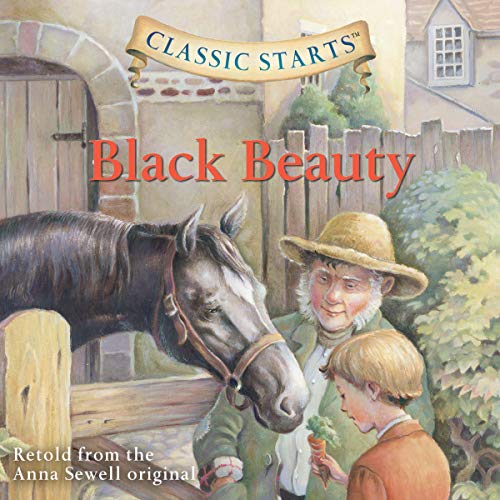
Chapter 14, An Old War Horse Jerry had a cab or a taxi of his own.
His other horse was a tall white animal named Captain.
Captain had a proud way of holding his head and was a good-mannered old horse.
He told me that when he was young, he was in the war.
He belonged to an officer in the cavalry, something we talked about later.
The next morning, Polly brought me a slice of apple and Dolly gave me a piece of bread.
I felt like the black beauty of old times and tried to show them I was friendly.
Polly thought I was a very handsome horse, too nice to be driving around a cab.
Let's call him Jack, after our old horse, said Jerry.
Captain went out in the cab all morning.
Harry came in after school to feed me and give me water.
In the afternoon, I was harnessed into the cab.
Jerry worked hard to make sure my collar and bridle fit well.
What a relief it was to be comfortable as I rode.
After driving through the side street, we came to the cab stand.
On one side of this wide street were high houses with shops.
On the other side was an old church and yard surrounded by an iron fence.
Alongside the fence, cabs were lined up, waiting for passengers.
Bits of hay were strewn on the ground.
We pulled in the line behind the last cab.
Two or three men came around and began to look at me.
They talked for a minute, during which Jerry said some very nice things about me.
Then up came a jolly-looking man dressed in a gray coat and pants.
His hair was gray, too.
He looked me over and said, He's a good horse, Jerry.
I don't know what you paid for him, but he's worth it.
This man's name was Grant, but he was called Gray Grant or Governor Grant.
He was a pleasant man.
He seemed to be the one in the group who settled arguments and disagreements.
The first week of my life as a cab horse was difficult.
The noise, the hurrying, and the crowds of horses, carts, and carriages made me very nervous.
I soon found out, though, that I could trust my driver.
After that, I got used to it.
Jerry soon found out that I would do my best.
He never whipped me, for he knew I would go on when he wanted.
In a short time, my master and I understood each other well.
In the stable, he kept us clean and gave us many different feeds and plenty of them.
He also gave us lots of fresh water, leaving it by us night and day.
But the best thing we enjoyed here was our Sundays for rest.
It was then that I learned to love the company of Captain.
Captain had been an army horse, and his first owner was an officer in the Crimean War.
His master treated him with great care and kindness.
He told me a horse's life in the army was pleasant, but when it came to being sent across the ocean in a ship, he had almost changed his mind.
"'Our bodies were strapped, and we were lifted off our legs and swung over the water to the deck.
We were placed in small stalls and didn't see the sun or sky for a long time.
We couldn't even go for walks.'
The ship rolled about and we were knocked around.
We neighed for joy when we once more felt the ground beneath our feet.
We soon found that the country we had come to was very different than our own.
"'What about the fighting?'
I asked.
"'Weren't you scared?'
We stood around a lot, waiting to go into battle.'
As long as we felt our riders firm in our saddles and their hands steady on the reins, we didn't give way to fear.
Many horses died, but I still carried on bravely.
My master's cheery voice made me feel as if he and we couldn't be killed.
When he was guiding me.
I never felt terror until that one day.
I shall never forget that One autumn morning we heard the firing of the enemy's guns.
My dear master and I were at the head of the line.
He leaned down and stroked my neck that morning more than I think he ever had before.
He said, We shall have a time of it today, Bayard, but we will do our duty as always.
We were used to the gunfire in the battles, the cannons, muskets and heavy guns, but today it was the worst ever.
Many brave men and horses went down.
Fearful as it was, no one stopped or turned back.
Our group kept getting smaller, but we continued to charge ahead.
My master was cheering on his soldiers with his right arm raised high when one of the cannonballs whizzed past my head and hit my master.
I felt his sword fall, and then he fell backward.
The other riders swept past us, taking me with them.
I wanted to stay by his side, protecting him from the rush of the horse's feet, but I couldn't.
Our side had been beaten badly.
Some of the horses were walking on three legs, while some fell to the ground struggling to get back on their feet.
The cries of the horses and men were awful to hear.
After the battle, the wounded men were brought in and the dead were buried.
"'What about the wounded horses?'
I asked.
"'Were they left to die?'
"'No.'
They were helped by the army doctors, but many horses didn't make it back.
I never saw my dear master again.
I believe he died when he fell.
I never loved any other master so well.
When the war was over, I came back to England.
People talk about war like it's a noble thing, I said, looking at the brave horse beside me.
Those people have never really seen war.
It is fine when the enemy is far away, but when thousands of brave men and horses are killed or hurt for life, war looks very different.
Do you know what they fought about? said I. No, a horse can't understand such things.
The enemy must have been very wicked if we went all the way over that ocean to stop them.