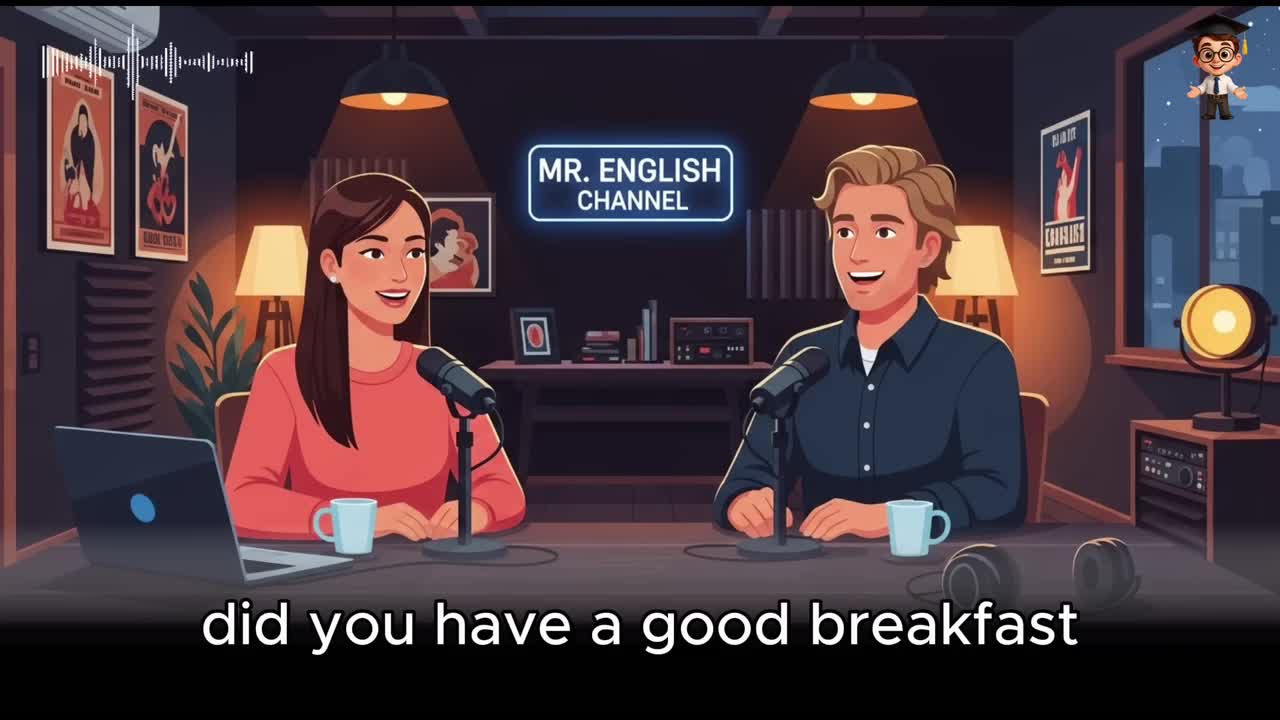
Hello everyone and welcome back to Mr. English channel where learning English is easy and fun.
I'm Emily.
Hello Emily.
Hi everyone.
It is so wonderful to be here today.
I am very happy and I am ready to talk.
I am happy too, Paul.
You look very energetic today.
Did you have a good breakfast?
Yes, I did.
I had eggs, toast, and a big orange juice.
And of course, I had my coffee.
Coffee is very important for our podcast.
I have my coffee too.
It is hot and delicious.
That is great.
So, Emily, I am very excited about today.
What is our topic for this episode?
Today is a special episode, Paul.
This is another episode of our series, The Best Way.
Oh, I love The Best Way series.
It is very helpful for our listeners.
We always talk about the best ways to do things in English.
Yes, exactly.
And today, the topic is The Best Way to Use New Words in Real Life.
Wow, that is a very important topic.
Many students learn new words, but then they forget them.
They don't know how to use the words when they talk to people.
That is true, Paul.
It is easy to see a word in a book, but it is hard to say the word in a conversation.
We want to help everyone use their English words every day.
I am ready to hear your ideas, Emily.
But wait, before we start our big chat, we should say something to our friends listening.
Oh yes, good idea, Paul.
Everyone, if you like our podcast, please click the like button right now.
It is a big help for us.
Yes, and please subscribe to Mr. English channel.
When you subscribe, you can see all our new videos and podcasts.
And don't forget to share this with your friends.
If your friends are learning English, they can learn with us too.
Sharing is caring.
Yes, it is.
Okay, Emily, let's talk about these new words.
Why do people forget new words?
Well, Paul, I think people forget because they only look at the word one time.
They write it in a notebook and then they close the notebook.
Hmm, I see.
The word stays in the notebook, but it does not stay in the brain.
Exactly.
To remember a word, you must see it and use it many times.
You must make the word part of your life.
So what is the first, best way to use new words at home?
My first tip is the sticker method.
I love this method.
It is very fun.
The sticker method?
What is that?
It is simple.
You take small pieces of paper.
They can be yellow or pink or blue.
You write one new English word on each paper.
Okay, I have my paper and my pen.
What do I do next?
You put the paper on the object in your house.
For example, you learn the word mirror.
You write M-I-R-R-O-R on the paper, and you put the paper on the mirror in your bathroom.
Ah, so every morning when I brush my teeth, I see the word mirror.
Yes, and you can say the word out loud.
You look at the mirror and say, mirror, this is a mirror.
That is very smart.
You can do that for everything.
You can put a sticker on the fridge, the door, the window, and the table.
Yes, and for basic learners, you can even use sentences.
On the fridge, you can write, the fridge is cold.
I like that.
It helps you see the word in a real situation.
You are not just reading a list.
You are looking at your real house.
Exactly.
When you see the word 10 times a day, your brain says, OK, this word is important.
I will remember it.
That is a great tip for things in the house.
But Emily, what about words that are not objects?
For example, words like happy, busy, or beautiful.
You cannot put a sticker on happy.
You are right, Paul.
You cannot put a sticker on a feeling.
For those words, I have a different tip.
I call it the mirror chat.
The mirror chat?
Do I talk to the mirror?
Yes, you talk to yourself.
I do this when I learn a new language.
You stand in front of the mirror and you use your new words in a small story.
Can you give us an example?
Sure.
Imagine you learned the words excited and wedding.
You look in the mirror and say, today I am excited.
My friend has a wedding.
Oh, I remember our last chat.
Your friend Maria is getting married.
Yes.
So I can practice my words by talking about Maria.
I say, Maria is a beautiful bride.
I am happy for her.
I use the words beautiful, bride, and happy.
That is very good.
When you talk to yourself, you don't feel nervous.
There is no one there to judge you.
It is just you and the mirror.
Yes.
It is safe practice.
And you can see your face.
You can see your mouth moving.
It helps with your pronunciation, too.
I think that is a wonderful idea.
I sometimes talk to my dog in English.
Does your dog understand English, Paul?
I don't know, but he looks at me and wags his tail.
I say, buddy, you are a good dog.
You are very fast.
I use the word fast.
It is good practice for me.
That is perfect.
Pets are great listeners.
They never say your grammar is wrong.
Exactly.
They are very kind.
Okay.
So we have stickers and talking to mirrors or pets.
What is another way to use new words?
Another great way is the phone record.
We all have phones, right?
Yes, I have my phone right here.
You can use the voice recorder on your phone.
Every day, choose three new words.
Try to make one sentence with each word.
Then record your voice.
Oh, so I listen to myself.
Yes.
For example, if the word is delicious, you say into your phone, this pizza is delicious.
Then you listen to the recording.
Is it helpful to hear my own voice?
Very helpful.
Sometimes we think we sound one way, but the recording shows us something different.
It helps you get better.
And you can save the recordings.
In one month, you can listen to your old recordings and say, wow, my English is much better now.
That is very motivating.
It's like a diary, but for your voice.
Yes, a voice diary.
It's a great way to use new words in a sentence because a word alone is not very useful.
You need to put it in a sentence to communicate.
I agree.
Apple is just a word, but I want to eat a red apple is a conversation.
Yes.
And speaking of conversations, my next tip is about the internet.
Paul, do you like social media?
I do.
I like looking at photos on Instagram and watching videos on YouTube.
Well, that is a perfect place to use new words.
When you watch a video on Mr. English channel, you can leave a comment.
Oh, I see.
You can try to use a new word in the comment.
Yes.
For example, if we talk about food, you can write, Today I learned the word breakfast.
I had a big breakfast today.
That is a real connection.
You were talking to us and you were using your English.
And we read the comments.
When someone uses a new word correctly, I feel so happy.
I often reply and say, great job.
That is true.
Using English on the internet is a real-life situation.
You were talking to real people.
It's not a book exactly and you have time to think.
You can look at your notebook, find the word and then type it.
It is very low pressure.
I like that.
So stickers mirrors, phone recordings and internet comments these are all great.
Do you have a tip for when we are outside, like when we are walking or shopping?
Yes, i call this the mental label.
The mental label like a sticker, but in your head.
Yes,
When you walk down the street, look at things and say the English name in your head.
Okay, let me try.
I am walking.
I see a car.
I see a tall building.
I see a blue sky.
Perfect.
And if you see something and you don't know the word, you can stop and look it up on your phone.
Ah, for example, I see a small bird, but I don't know the word bird.
I look it up.
Now I know.
Bird.
Yes.
And because you saw a real bird, you will remember the word better.
You're connecting the word to a real experience.
That is very powerful.
I remember one time I was at the supermarket.
I wanted to buy garlic, but I forgot the word.
I looked it up on my phone.
Now I never forget the word garlic because I remember that moment at the supermarket.
That is a great story, Paul.
Real-life moments are the best teachers.
When you need a word to buy food or ask a question, your brain works very hard to remember it.
So, maybe we should try to use new words even if we are not sure?
Yes, be brave.
Like we said in our other episode, communication not perfection.
If you go to a coffee shop and you learned the word milk, try to use it.
Say, coffee with milk, please.
Even if your English is not perfect, the person will understand coffee and milk.
Exactly.
And when you get your coffee, you feel a small victory.
You used a new word in the real world.
I love that feeling.
It makes me want to learn more.
Me too.
Now, Paul, I have one more tip.
It is about emotions.
Emotions?
Like sad or happy?
Yes.
When you learn a new word, try to connect it to a strong memory or a feeling.
How do I do that?
For example, the word vacation.
Don't just think vacation equals holiday.
Think about your favorite vacation.
Think about the beach, the sun, and the fun you had.
Oh, I see.
I think about my trip to the beach last year.
It was beautiful.
Now say the word vacation.
You feel happy, right?
Yes, I do.
That feeling helps the words stay in your memory.
You are not just learning a sound, you're learning a feeling.
That is a very deep and helpful tip, Emily.
Words are not just letters.
They are parts of our lives.
They really are.
Well, Paul, we talked about many things today.
I think we should remember our main points for our friends.
Yes.
Let's do a quick recap.
It was a very good chat.
It was.
So we talked about the sticker method for your house.
Right.
Putting labels on the fridge, the door and the mirror.
It helps you see the words every day.
And we talked about the mirror chat and talking to pets.
And we talked about the mirror chat and talking to pets.
Yes.
Talking to yourself or your dog.
It is safe practice and it helps your mouth get used to English.
Then we had the phone record. using the voice recorder to hear yourself.
It is a great way to see how you are getting better.
And don't forget the internet.
Yes, writing comments on YouTube or social media.
It is a real way to talk to people using new words.
We also mentioned the mental label when you're outside.
Labeling the world in your head while you walk, the car, the sky, the bird.
It's very fun.
And finally, connecting words to emotions.
Yes, thinking about memories and feelings to help the words stick in your brain.
Wow, Paul, we really had a lot of ideas today.
I hope our listeners find them useful.
I'm sure they will.
These are easy tips, but they're very strong.
You don't need to be an expert to start.
You just need a pen, some paper, and a little bit of bravery.
Well said, Paul.
Bravery is the most important part of learning English.
It really is.
Well, everyone, we are almost at the end of our episode.
We are so happy you listened to us today.
Yes, thank you so much.
We love making these podcasts for you.
Now we have a question for you.
Please leave a comment below.
We want to know, what is one new English word you learned this week?
Yes, tell us the word and try to use it in a sentence in your comment.
We will read all of them.
It is a great way to start practicing right now.
Use the internet comment tip we talked about today.
That is a perfect idea, Emily.
Practice starts now.
And before we go, please remember to subscribe to Mr. English channel.
And click the like button and share this with your friends.
Thank you for being part of our English family.
We'll see you in the next episode of The Best Way.
Yes, see you soon.
Good luck with your new words.
Bye-bye, everyone.
Bye-bye.