Hello everyone and welcome back to Mr. English Channel, where learning English is easy and fun.
I'm Emily.
Hello Emily.
Hi everyone.
It is so wonderful to be here with you all today.
I am feeling very energized and ready to chat.
I can see that, Paul.
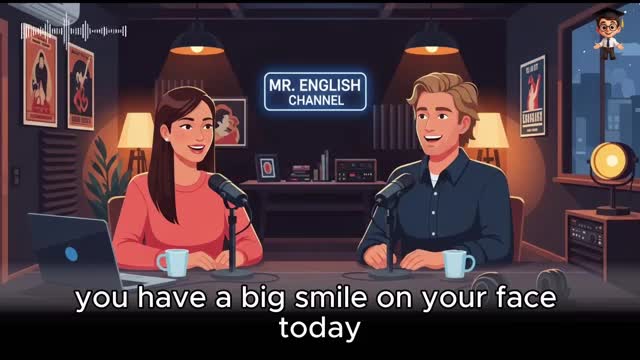
You have a big smile on your face today.
Did you have a good morning?
I did.
I went for a long walk, I saw the sun, and I had a very delicious breakfast.
It was a perfect start to the day.
And you, Emily, how are you doing?
I am doing great.
I am very happy because today's topic is something that so many people ask us about.
It is a very special episode.
Oh, I love special episodes.
What is the big topic for today?
Today, we are going to help our listeners answer one of the most common questions in English.
Whether you are at a job interview, a party or meeting a new neighbor, someone will eventually say tell me about yourself.
Wow, that is a big one.
Even for me, sometimes that question is a little scary.
You think, where do I start?
What do I say?
Do they want to know about my cat or my job?
Exactly.
It can be confusing.
But don't worry, everyone.
We are going to make it simple, natural, and fun today.
We will give you a clear plan so you can speak with confidence.
That sounds perfect, Emily.
I think this will help so many people.
But before we dive into the tips, we have to remind our wonderful friends about something important, right?
Oh, yes.
Thank you, Paul.
Everyone, if you enjoy our chats and you want to support us, please click the like button right now.
It really helps our channel.
Yes, it does.
And if you are new here, welcome.
Please subscribe to Mr. English channel.
We make these podcasts because we want to help you love English.
And don't forget to share this episode with your friends.
If you have a friend who is preparing for an interview or just wants to improve their conversation skills, send this to them.
Sharing is caring.
Okay, Emily, I am ready.
My notebook is open.
How do we start answering the question, tell me about yourself?
Okay, Paul, the first thing to remember is that you don't need to tell your whole life story.
We don't need to know what you ate for lunch when you were five years old.
Oh, good, because I don't remember that anyway.
So, no life stories.
What is the goal, then?
The goal is to give a snapshot of who you are right now.
I like to use a simple three-step plan.
I call it present, past, and future. present, past, and future.
I like that.
It's like a timeline.
Can you explain the present part first?
Sure.
You start with the now.
Who are you at this moment?
What is your name?
Where are you from?
And what is your main focus right now?
For example, your job or your studies.
Ah, okay.
So if someone asks me at a party, I could say, well, I'm Paul.
I live here in the city.
And I currently work as a podcast host and English enthusiast.
Exactly.
That is short, clear, and friendly.
It tells the person your name and what you do with your time.
It gives them a starting point for the conversation.
That feels easy.
But what if I'm in a job interview?
Is the present part the same?
Great question.
In an interview, you want to be a bit more professional.
You could say, I am currently a marketing specialist with five years of experience in social media.
You're still talking about the present, but you're highlighting your professional identity.
I see.
So you adapt your answer depending on who is listening.
That makes a lot of sense.
Yes.
Always think, who am I talking to?
Now, Paul, let's look at step two, the past. past.
Hmm.
Do I talk about my school or my previous jobs?
You talk about the things that led you to where you are today.
It's like a bridge.
You can mention your education or a big project you worked on.
It shows that you have experience.
Okay.
So I could say before this I studied communication at university and I worked for a small radio station for three years.
That is where I learned how much I love talking to people.
Perfect.
You see, you connected your past experience to your current passion.
It makes your story feel very natural.
I'm starting to feel more confident already.
Present, past, and the last one is future, right?
Yes, the future.
This is where you talk about your goals or what you're excited about.
It shows that you're a positive person with a plan.
Hmm, let me try for the future part.
In the future, I want to travel more and maybe start a second podcast about cooking.
I am very excited to learn new recipes.
A cooking podcast?
I would listen to that, Paul.
I know you love food.
But that is exactly right.
It ends your introduction on a high note.
It shows personality.
So if I put it all together, it's like a little story about me.
Present, past, future.
Yes, and the best part is, this works for B1 learners because you can use simple tenses.
You use the present simple for the now, the past simple for your background, and want to or would like to for the future.
That's a very good tip, Emily.
Simple grammar is often the best grammar when you are nervous.
If you try to use very difficult words, you might get stressed.
I totally agree.
It is much better to be clear and simple than to be complicated and confused.
You know, Emily, I think another thing that helps is the why.
The why?
Tell me more about that.
Well, when I tell people about myself, I don't just want to say, I am a teacher.
I want to say why I like being a teacher.
For example, I am a teacher because I love seeing my students smile when they understand something new.
Oh, Paul, that is beautiful.
And you're right.
Adding a little bit of why makes you sound much more interesting.
It shows your heart.
Thank you.
It also helps the other person know what to ask next.
If I say I love seeing people learn, they might ask what is the most interesting thing a student has taught you?
Exactly.
A good introduction is like an invitation.
You are inviting the other person to talk more with you.
Let's try a little role play, Emily.
I will be the person asking and you answer.
Let's imagine we are at a professional networking event.
You are meeting someone for the first time.
Okay, I'm ready.
Go ahead, Paul.
Hi there.
It's a great event, isn't it?
So tell me a little bit about yourself.
Hi.
Yes, it's a wonderful event.
Well, I'm Emily.
Currently, I'm an English teacher and I create content for a YouTube channel called Mr. English.
I've always been passionate about languages.
In the past, I lived in three different countries to learn their cultures.
Now, I'm really focused on making English easy for everyone.
In the future, I hope to write a book for English learners.
Wow, Emily, that was fantastic.
You used the present teacher and YouTube.
The past living in different countries and the future writing a book.
It was so clear.
Thank you.
And notice, I didn't use very hard words.
Passionate, focused, focused on.
These are great words for B1 level, but they are still easy to understand.
I also noticed your energy.
You were smiling and you sounded excited.
I think that is just as important as the words.
You are 100% right, Paul.
Body language and tone of voice are huge.
If you say I am very happy to be here, but you look at the floor and your voice is very quiet, people won't believe you.
True.
You have to believe in your own story.
Paul, let's think about another situation.
What about a very casual situation?
Maybe meeting a new friend at a sports club or a gym.
Okay.
In that case, you don't need to talk about your job so much.
You can talk about your hobbies.
Yes.
Hobbies are a great way to tell people about yourself in a casual way.
So maybe something like, hey, I'm Paul.
I've been coming to this gym for about a month now.
I used to play football when I was younger, but now I'm trying to get stronger.
My goal is to run a marathon next year.
That is perfect for the gym.
It's And the future, marathon.
And it wasn't too long.
I think sometimes people talk for 10 minutes when someone asks tell me about yourself, and the other person gets bored.
Oh, definitely.
A good introduction should be about 30 to 60 seconds.
It's a mini intro.
If they want to know more, they will ask.
That's a great rule.
60 seconds maximum.
You know what else is helpful, Paul?
Having a hook.
A hook, like for fishing?
Sort of.
A hook in a conversation is something interesting or unusual about you that makes people want to ask a question.
Oh, like saying, I have a collection of 500 vintage hats.
Yes, that is a great hook.
If you say that, the other person will definitely say, wait, 500 hats?
Where do you keep them?
I don't really have 500 hats, but I do have a lot of books.
See?
Even I am a big book lover can be a hook.
People might ask what you are reading right now.
This is all so useful.
I think the key is preparation.
You don't want to think of these things for the first time while the person is looking at you.
Exactly.
I always tell my students, write it down.
Write your present, past, future introduction in your notebook.
Practice saying it in front of the mirror.
I agree.
Practice makes not perfect, but confident.
I love that.
Practice makes confident.
That should be our new motto.
Yes.
So Emily, we talked about the three-step plan, we talked about the why, we talked about body language and we talked about the hook.
What about when we get stuck?
What if we forget the words?
It happens to everyone, even to us.
If you get stuck, just take a breath and smile.
You can say, sorry, I'm a bit excited today.
It's okay to be human.
People like people who are real.
That's true.
You don't have to be a robot.
You were just a person talking to another person.
And remember, the person asking the question probably wants you to do well.
They're not testing you.
They just want to know you.
That's a very healthy way to look at it.
It takes the pressure off.
It really does.
Paul, I'm looking at the time and we've shared so many good tips.
I think we should do a little recap for our friends.
That's a great idea.
Let's see if we can remember the main points together.
Well, first, we said that you don't need to tell your whole life story, right?
Right.
Just a snapshot.
And we have that great three-step plan.
Present, past, and future.
Start with who you are now, mention a bit of your background, and then share a goal for the future.
Yes.
And don't forget the why.
Tell people why you love what you do.
It makes you sound much more interesting.
And we talked about keeping it short, about 30 to 60 seconds.
Don't talk for too long or the other person might fall asleep.
Exactly.
And use a hook, something fun or interesting about you, to keep the conversation going.
Plus, body language.
Stand tall, smile, and look at the person.
It shows you are confident, even if you feel a little nervous inside.
And the most important thing, practice.
Write your intro down and say it out loud.
The more you say it, the easier it becomes.
Wow, we covered a lot.
I feel like I know myself even better now.
Me too.
It's always good to reflect on who we are and where we are going.
Well, everyone, we hope you found these tips helpful.
Now you have a plan for the next time someone asks you that big question.
Yes, you can do it.
We believe in you.
And before we go, we want to hear from you.
We have a question for our wonderful listeners.
Oh, yes.
Tell us in the comments below.
Tell us a little bit about yourself.
Use the present, past, future plan we talked about today.
Yes, we would love to read about you.
What do you do now?
What did you do before?
And what is your big goal for the future?
It's a great way to practice your English writing.
We will be reading your comments.
And if you haven't done it yet, please subscribe to Mr. English channel and give this video a like.
It means so much to us.
Share it with your friends, your family, your coworkers, anyone who is learning English.
Thank you so much for hanging out with us today.
It was a real pleasure.
It really was.
You all are amazing.
Keep practicing, keep smiling, and we will see you in the next episode.
Bye-bye, everyone.
See you soon.
Bye, everyone.