Get the unmissable news stories of the day.
This is the Beijing Hour, examining the events that impact and shape china and the rest of the world.
This is the beijing hour one hour of news and information brought to you every weekday.
Now here's your host, shane bigham, with you on this thursday, september 4th 2025.
You're listening to the beijing hour coming to you live from the chinese capital on today's program.
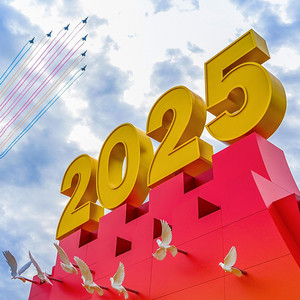
Beijing's commemorative events for the 80th anniversary of victory over japan and the world anti-fascist war have struck a chord with people far and wide And, following the V-Day events, international historians are saying China's contribution to victory in World War II was essential.
Israel has rejected a Hamas ceasefire proposal and is preparing for an all-out assault in Gaza City.
In business, China's reforms for attracting foreign investment.
In sports, Sinner and Osaka advance at the U.S.
Open in New York.
In culture and entertainment, China's grand gala for the V-Day celebrations.
Now check in the day's top stories.
Beijing held grand commemorative events at Tiananmen Square on Wednesday to mark the 80th anniversary of the victory in the Chinese people's war, resistance against Japanese aggression and the world anti-fascist war.
The message of peace and a common future has struck a chord with people from far and wide.
Around 50,000 people were at the scene in downtown Beijing witnessing the events unfold firsthand.
Compatriots from Hong Kong Macau, Taiwan and overseas Chinese communities, as well as international guests, expressed their excitement and pride.
This is something I would never even dream of happening, yet today it actually became reality.
Seeing so many people singing our national anthem together made me deeply touched.
I am so proud of being Chinese.
Eighty years later, I witnessed firsthand how prosperous our motherland has become, with such advanced military equipment serving as the foundation for our growth.
This made me very emotional.
During the war my grandfather led a fundraiser among overseas Chinese in the South Pacific to send back to China.
He donated an aircraft, using his entire life savings for the motherland.
Now, witnessing the strength of our homeland is the pride of all Chinese overseas.
Today's celebration not only showcases the strength of our national defense, but also serves as a reminder of our shared history.
It was the sacrifices of countless anti-war heroes that brought China the peace and stability we enjoy today.
We must encourage all sectors of Hong Kong to actively contribute to the nation's development and rejuvenation of the nation.
People from across the world have also joined the commemorations and they shared their stories with us and spoke about the importance of honouring history.
Well, I'm very proud to represent George Hogg's family at these events.
And I know that many Chinese people helped the Allies during the war as well.
So there was a lot of mutual help and assistance.
He didn't set out to do this to gain fame.
When he saw the conditions that people were living under and their bravery, he decided to devote what ended up being the rest of his life to China and its people.
So the Chinese contribution is largely unknown in the UK, which is a great shame, and I think it's always important to look back in history and see what we can learn.
I think that, looking at the 80th anniversary, it's an opportunity to focus on a period of major change.
And I think that there's so many lessons to be learnt from that.
How the international cooperation and international solidarity and the way that people fought shoulder to shoulder, the British and the Chinese, the Americans and the Chinese.
When people who remember whose parents were involved in the fight against Japan.
We're all getting old.
I'm 80 years old.
So it's the end of an era.
This marks the end of an era.
And I think it also marks China's coming out in the world.
Because I understand that this procession will be even bigger than the one for the 70th anniversary, which I also attended.
So I felt an obligation to.
There's a Danish term that's saying honour the one that ought to be honoured deserves to be honoured, right.
It's an old-fashioned term.
Those were the descendants of the overseas friends and volunteers who fought shoulder to shoulder with the Chinese during World War II.
At the events on Wednesday, Chinese President Xi Jinping hailed the victory 80 years ago as the country's first complete triumph against foreign aggression in modern history.
He said it was achieved under the National United Front, advocated by the CPC, and came at immense sacrifice, contributing not only to China's survival but also to the defense of world peace and human civilization.
He also expressed gratitude to foreign governments and international friends who supported China's resistance.
President Xi stressed that only by treating each other as equals, supporting one another and rejecting zero-sum mentalities can nations eliminate the root causes of war and prevent history's tragedies from recurring.
The Chinese leader reaffirmed his country's adherence to being a force for peace, stability and progress, while urging other nations to learn from history and work together to build a better future.
The president also declared that the rejuvenation of the Chinese nation is unstoppable.
And with more.
Tianlu spoke with Victor Gao, vice president of the Center for China and Globalization.
Mr Gao.
In President Xi's speech, he reiterated the idea of building a community with a shared future for humanity.
How do the V-Day commemorations reinforce this vision in the current international landscape?
First of all, the September 3rd victory parade held in Beijing was a spectacular and most magnificent success.
In my recollection, this is the largest scale and the most sophisticated military parade in history, demonstrating and showcasing the very sophisticated military weapons, both hardware and software robotics, missiles of all kinds, including ICBM missiles.
However, I think the underlying message is very clear and very straightforward.
That is, for China to defend peace.
Defending peace is extremely important in the world of today because there are headwinds caused by certain other countries which want to bully many countries in the world, tantamount to holding a gun at the head of many countries.
Therefore, when President Xi Jinping said that China's committed to building a shared community for mankind, I think he meant that this shared community for mankind for all the countries in the world more than 200 countries should be based on equality and mutual respect, meaning we should live in a civilized world and everyone should abide by the rules, rather than allowing any single country to dominate over other countries by holding a gun at their head, by issuing ultimatums and forcing others to come to terms of this big power.
So I think this call and the speech by President Xi Jinping was not only for the Chinese audience at home.
I think he was talking to the 8 billion people in the world charting out a way of life and a way of structuring the world order in a very constructive way.
Now allow me also to mention President Xi Jinping was talking about multilateralism or multipolarity, etc.
And some people say, well, this is aimed at recreating a new world order.
However, I would say the world order established back in 1945 upon the unconditional surrender of Nazi Germany and the Japanese fascism was meant to be multipolar in nature.
Just look at the composition of the Security Council of the United Nations five permanent member states, each with a veto power, meaning no single member.
No single permanent member of the Security Council of the United Nations was meant to dominate above other permanent members or other members of the Security Council, and they cannot just rough their way around by imposing their will on top of other countries.
Among the five permanent member states.
There was meant to be checks and balances, and the aim was to prevent the outbreak of another world war.
Therefore, now we are in 2025.
We just celebrated the 80th year anniversary of the defeat of Japanese fascism and the world victory against Japanese fascism and fascism in general.
I think we really need to go back to the original intent of the founding fathers of the United Nations and we should really aim at promoting multipolarity multilateralism, and we should also stand ready to defend free trade.
Because otherwise the world may actually slide back into the law of the jungle and The result most likely will be many countries will be delegated to secondary class, for example.
They will not be able to express their wills freely and on equal terms.
And I don't think that kind of world, dominated by one single country, will be appealing to any country in the world.
So the message delivered by President Xi Jinping at the grand ceremony in Beijing marking the 80th year anniversary of the Chinese people's war of resistance against Japanese fascism and world's victory against fascism in general was really the most timely, a most urgently needed message for the world as a whole.
That was Victor Gao, Vice President of the Center for China and Globalization.
Earlier, we spoke with the Press Chief at the UN Information Service on the significance of China's Victory Day, 80th anniversary.
Orlando Gomez called it a moment to reflect on peace, reconciliation and multilateralism.
It's a very important occasion, of course, for China and many other states who are actually commemorating the end of World War II, which is 80 years ago, at which point the United Nations was founded.
For us here at the United Nations and the United Nations office here in Geneva.
It's also an important reminder about the importance of reconciliation, about peace, about renewing multilateralism and saying never again to war.
Sadly, the reality is war still persists in many parts of the world.
That's why the UN, this building behind me, why the negotiations that take place here, is supremely important to end the scourge of war in the spirit of the charter that was adopted 80 years ago.
Certainly, we are always looking to de-escalate tensions.
And here at the UN office at Geneva, we have the conference on disarmament, just to give you an example.
And of course, other meetings that are held here, diplomacy is key.
And this is a unique stage here where issues such as escalation of conflicts are discussed.
It's a unique space where views like this can otherwise not be expressed.
So this is our firm position.
It has been for 80 years to de-escalate, to get people to the negotiating table and to hopefully prevent any further wars from occurring.
That was Rolando Gomez with the UN Information Service.
In the meantime, President Xi Jinping is held bilateral meetings with foreign leaders attending China's Victory Day commemorations in Beijing.
Qi Jie has details.
At the meeting with Lao President Tung-luu Sisi-luu, President Xi stressed the two sides should approach bilateral ties from a long-term and strategic perspective and support each other on issues concerning their respective core interests and major concerns.
Dong Liu said the Laos-China relationship is at its best in history and the country is ready to continue working with China to implement the new five-year action plan on building a China-Laos community with a shared future.
President Xi also met Vietnamese President Luong Tung, saying China is ready to work with Vietnam to safeguard the common interests of the global south and contribute more positive energy to the world.
Long Son said Vietnam believes that China will continue to develop and grow, achieve the goals of Chinese modernization and play an even greater role in regional and global peace and development.
When meeting Cuban President Miguel Diaz-Canel, President Xi reaffirmed support for Cuba's fight against external interference.
President Diaz-Canel said Cuba looks forward to strengthening all-round cooperation with China and work jointly in promoting high-quality Belt and Road cooperation.
The two sides also issued a joint statement on accelerating the building of a China-Cuba community with a shared future.
Xi Jinping has also met Zimbabwean President Emerson Unangagwa.
The two leaders announced an upgrading of the bilateral relationship to an all-weather community with a shared future.
During the meeting with President Denis Sassou Ngesel of the Republic of the Congo, the two leaders announced that bilateral ties will be elevated to a high-level community with a shared future.
President Xi called the partnership a model of China-Africa friendship, noting that Congo will soon benefit from China's zero-tariff policy, opening new opportunities in trade and investment.
Calling Serbia a steel friend.
As he met President Alexander Vucic, President Xi reaffirmed China's support for Serbia in safeguarding national interests, ensuring social stability and pursuing development paths suited to its own conditions.
Vucic said Serbia will never forget China's valuable support during difficult times and will continue to firmly back China on issues concerning its core interests.
When meeting Slovakian Prime Minister Robert Fico, President Xi urged the two sides to practice true multilateralism and promote the reform of the global governance system.
Prime Minister Fico said Slovakia welcomes investment from Chinese enterprises and is willing to work with China to make active efforts to reform the global governance system.
That was Qi Zhi reporting.
Coming up, historians acknowledge China's critical role in the World War II victory.
United in purpose.
During World War II, the Chinese military and people stood as one, fearlessly resisting Japanese fascism.
China's unwavering whole-nation effort forged the pivotal Eastern Front.
Through fierce battles, immense sacrifices, heroic endurance and decisive support to the allies on the european and pacific battlefields, china has helped secure liberation, the final victory and the lasting legacy for global peace and human progress, resolve and resilience.
The main eastern battlefield of world war ii.
Only on cgtn.
That's 16 minutes past the hour.
International historians and leaders say China's resistance against Japanese aggression was crucial to ensuring Allied victory in World War II.
They say the sacrifices China made are often overlooked in the West and deserve far greater recognition.
Dr. Christian Lubka is a military historian from Germany.
When we in Europe say that September 1 1939 was the beginning of the Second World War, that is only part of the truth.
By then, China had already been resisting Japanese aggression for years and had paid a heavy price.
Renat Mitter is a historian from Britain.
China played in many ways a very central role in World War II.
The reason I want to stress that is that in the wider Western world We tend to think of the big three the United States of America, the British Empire, the Soviet Union all of which were absolutely key actors in the ultimate Allied victory over the Nazis and Japan.
But China also played a very, very central role in terms of the overall strategy.
Vince Cable is the former UK Secretary of State for Business.
Because the war with China by Japan started was caused an enormous amount of casualties and horrific experience in China.
But the fact that the Chinese kept fighting tied down the Japanese forces and made it possible for the West, particularly the US, eventually to win.
And I think China's contribution in the war is something we probably don't understand enough, appreciate enough and should revisit it.
These perspectives add to the growing international discussion on China's contributions in World War II.
General Zhang Zhejiang commanded Chinese forces in many battles in Shanghai during the War of Resistance against Japanese aggression.
He's remembered by his granddaughter, Zhu Xiaozhou, as a gentle grandpa.
Li Jianhua sat down with her to learn more about the general's legacy.
It's 1945.
My grandfather, Zhang Zhizhong, flew the airplane, went to pick up Mao Zedong Chairman, Mao Chairman, Mao Zhu De, the general General Marshall and Zhou Enlai and went for the peace talk which is a turning point against Japanese war.
My grandfather in my memory is very kind, always smiles, holding a stick, and will ask how are you?
What's your study?
And with strong Anhui accent.
And he like to think about things quite often on his own.
But he just is very caring.
Did he look like a military man?
No, I didn't know he had ever been a battle when I was little.
He just very kind, very gentle.
You didn't know?
No, I didn't know.
Nobody told me.
You thought he was just a regular grandpa.
Yes, exactly.
And until I read his autobiography.
General Zhang fought in two major battles against the Japanese forces back in the 1930s and 40s.
So what did these battles mean to him personally?
Did he talk about that with you at all?
No, he didn't because I was too young.
But to him, through the reading I see his autobiography.
He feel the urge in him as a nationally.
He feel the first battle for the Shanghai the army who's fighting it without the support of the other army.
It will not last longer.
And all the army is very far away.
So he voluntarily to the head to go to as a support to support the Shi Jiu Jun.
Continue the fighting.
That was Zhu Xiaojiu sharing her fond memories of her grandfather, General Zhang Zhizhong.
Coming up, Israel rejects a Hamas ceasefire proposal and prepares for fighting in Gaza City.
U.S.
President Donald Trump has defended his decision to issue 600000 Chinese student visas, despite opposition from his supporters.
Beijing welcomed the move, but questions remained.
Is this a genuine shift or just political maneuvering?
Can the promises be trusted when Chinese students still face interrogations and deportations at US airports?
To explore the backlash, the stakes for American universities and what it all means for the future of education exchanges.
Join us this week at the Chat Lounge, wherever you get your podcasts, and on CGTN Radio.
About 21 minutes past the hour, Israel has rejected a Hamas proposal for a Gaza ceasefire as its military prepares for a major assault on Gaza City.
Hamas has offered to release Israeli hostages in exchange for Palestinian prisoners, while also calling for a permanent ceasefire.
Israeli troop withdrawal and the reopening of border crossings.
Israeli Prime Minister, Benjamin Netanyahu, has dismissed the plan, saying Israel will only end the war if Hamas accepts full Israeli control of Gaza and demilitarization of the enclave.
Defense Minister Israel Katz says preparations to seize Gaza City will continue at full strength.
Gaza's health authorities say more than 63700 people have died since the conflict began in October of 2023.
In Israel, tens of thousands of reservists have been called up again as the army prepares for its new offensive in Gaza City.
But unlike past mobilizations, turnout this time is faltering.
Many reservists and even high school students soon to be drafted are questioning the government's goals in the continuation of the war.
Jonathan McGeough reports from Tel Aviv.
The columns of armored vehicles are ready.
The anti-tank barriers are taken down.
The next phase of Israel's war in Gaza is already here.
We are preparing for the continuation of the war.
We are going to enhance and deepen our operation, and that is why we called you.
We called you to join, says the chief of staff who met the reservist soldiers.
But many of those who'd previously signed up time and time again are not doing so this time.
In the Lebanon war, second Lebanon war and in the protective edge war we saw 200 of turn in turn out people that enlisted themselves.
In this war, we see the opposite.
So the army can say what they want.
At the end of the day, people in the street are voting with their legs.
They don't come.
There are various reasons why many reservists now refuse to join the war.
More than anything they say, it's the feeling that the conflict, which began as a military campaign following the October 7th Hamas attack on Israel in 2023, has dragged on for all the wrong reasons.
The government does different things in order to stay in power, including and that's a worse case, including maintaining this war in an ongoing struggle for no reason.
And it is not only today's reservists who feel that way, but also the soldiers of tomorrow.
High school students all across the country in their last year of school before joining the mandatory military service disrupted the first day of the new school year this week, demanding action to free the remaining Israeli hostages being held in Gaza.
We're starting with protests or with a strike, or not going to school, or doing certain events or wearing certain clothes to remind people and to not forget our siblings and brothers and sisters who are being held captive.
The Israeli army is the people's army.
And as such, the divisions within Israeli society are also seen in the army.
And the current controversy, possibly the biggest one Israel has ever seen, is already having a major effect on the military service, especially when it comes to the reservists who leave their civilian duty to join the fighting.
That was Jonathan Regev reporting.
The trial of former Brazilian President Jair Bolsonaro has reached a critical phase.
The Supreme Court's now considering the verdict and sentencing, which could take some time.
Bolsonaro's been accused of plotting a coup after losing the 2022 election.
The proceedings are deeply divisive inside Brazil and have drawn wide attention from abroad.
Paulo Cabral reports from Sao Paulo.
At the end of this trial, former president Jair Bolsonaro and seven other defendants could face prison sentences of more than 40 years.
They stand accused of attempting a coup d'etat and several associated crimes.
Judging them, a panel of five Supreme Court justices.
The first to speak was Alexandre de Moraes, the judge who's led the case and now has to present a report to his peers.
The country and the Supreme Court can only lament that in Brazil's Republican history there has once again been an attempt at a coup d'etat, an attack against the institutions and democracy itself, with the intention of installing a state of exception and a true dictatorship.
It is a highly divisive case in a country already marked by polarization, and one with international repercussions.
US President Donald Trump has weighed in calling Bolsonaro's trial a witch hunt and linking Washington's 50 tariffs on Brazil, among the highest in the world, to the proceedings against the ex-president.
Justice Moraes, who has also been personally targeted with sanctions by the US for his role in this case, defended the Court's independence and Brazil's sovereignty.
The Supreme Court will not accept coercion or obstruction in the exercise of its constitutional mission, which was sovereignly conferred by the Brazilian people through the National Constituent Assembly.
National sovereignty cannot, must not and will never be violated, negotiated or extorted, for it is one of the foundations of the Federative Republic of Brazil.
As the trial goes on, opinion here in Brazil is split.
Bolsonaro's supporters see a case of political persecution.
His critics say prosecutors have solid evidence of an attempt to subvert democracy.
The former president is under house arrest wearing an ankle monitor, a measure imposed by Morais that has outraged Bolsonaro supporters.
Allied members of Congress protested by taping their mouths, denouncing what they call persecution and an attack on freedom of expression.
But Brazil's general prosecutor, Paulo Gounet, says the indictment is solid and proves beyond reasonable doubt that Bolsonaro orchestrated an attempted coup.
The charge includes the dramatic storming of Brazil's main government buildings in Brasília on January 8 2023.
The trial is scheduled to run across multiple sessions, ending on September 12.
The country eagerly awaits the outcome.
That was Paulo Cabral on the highly charged trial of former Brazilian President Jair Bolsonaro.
A Sudan's appealed for international aid after a landslide destroyed an entire village in the western Darfur region, killing more than 1000 people.
The landslide struck the village of Tarsin in the Marat Mountains on Sunday after days of heavy rainfall.
Much of the affected region is inaccessible to aid groups.
Nabat Moheddin has more from Khartoum.
There is no comment from the Sudanese government and also from the Sudanese foreign ministry.
So there is no new statement regarding the number of people who got killed by the landslide.
So the SLM are still insisting on their narratives that the number of people who got killed by the recent landslide is above 1000, justifying that the village population is above 600000.
But newcomers and new villagers were displaced to their villages and they are expecting that the death toll is higher than this.
The area is very vulnerable to such landslides because of its geological formation of the volcanic rocks, which is very vulnerable to landslides and erosion.
So assistance could be finding people who got killed, rescue teams finding, helping in burying the dead people and also evacuating villagers from surrounding villages and raising awareness.
Other assistance include food and medicine for people who are in need.
That was Naba Mohideen reporting.
At 29 past the hour, Beijing's down to 21 degrees on Thursday evening.
Moderate rainfall and 24 in the forecast for Friday.
Shenyang will have moderate rainfall and a low of 19, then heavy rains and 18 degrees.
Nanchang's down to 29, then cloudy and 36.
Guangyuan's down to 19 overnight, torrential rainfall and 21 on Friday.
Elsewhere in Asia, Islamabad's down to 22, then sunny in 33.
Vientiane's 24 overnight, then a slight rainfall in 32.
It's time for a short break.
So far this hour, Beijing's commemorative events for the 80th anniversary of victory over Japan and the world anti-fascist war have struck a chord with people far and wide.
Following the V-Day events, international historians are saying China's contributions to victory in World War II were essential.
Israel has rejected a Hamas ceasefire proposal.
Shane Bigham with you.
Stay with us here on the Beijing Hour.
Listen up.
Can you hear the heartbeat of our world?
It's vibrant and pulsating with the essence of life itself.
From the stem of trees to the gurgle of rivers.
From the silent strength of mountains to the icy whispers of glaciers.
Even the solid ground beneath our feet.
Right there, in the midst of all, beats the heart of humanity.
What if those other heartbeats were to stop?
Would ours keep on ticking?
Get on our wavelength every week to find out what's real with China-Africa Talk.
Find us on your favorite podcast.
We'll see you there examining the events that impact and shape china and the rest of the world.
This is the beijing hour one hour of news and information brought to you every weekday.
Now here's your host, shane begum, with you on this thursday.
Still to come in business china's reforms for attracting foreign investment in sports center and osaka.
Advance at the us open in new york in culture and entertainment china's grand gala for the v-day celebrations.
To contact us, you can email radio at cgtncom or follow our X account at cgtnradio.
Now checking the day's headlines, here's Tianlu.
Thank you, Shane.
Chinese President Xi Jinping has held bilateral meetings with foreign leaders attending China's Victory Day commemorations in Beijing.
He has already met visiting North Korean leader Kim Jong-un in the Chinese capital.
Earlier, during his meeting with Vietnam's Luan Tsun, President Xi said that Beijing is ready to work with Hanoi to safeguard the common interests of the global south and contribute more positive energy to the world.
When meeting Lao President Tung-Lun Cicelys, President Xi called on the two countries to upgrade key cooperation projects and further unleash the potential of the China-Laos railway as a golden corridor.
He also met Cuban President Miguel Diaz-Canel and the Chinese leader suggested the two sides promote bilateral relations to a higher level and deliver more benefits to their people.
The two sides also issued a joint statement on accelerating the building of a China-Cuba community with a shared future.
While meeting the Zimbabwean president, President Xi Jinping and President Emerson Mnangagwa agreed to upgrade ties to an all-weather China-Zimbabwe community with a shared future.
The Chinese leader also met presidents of the Republic of the Congo and Serbia and the prime minister of Slovakia.
Chinese Foreign Minister Wang Yi has described the friendship between China and Hungary as an example for China and Europe to enhance mutual trust and expand cooperation.
He made remarks while meeting his Hungarian counterpart in Beijing.
Peter Sirato attended the V-Day commemorations on Wednesday.
Wang said China-Hungary relations are at their best in history and the successful bilateral cooperation demonstrates China and Europe are partners instead of rivals.
Zerato said Hungary looks forward to further deepening relations with China.
He said cooperation between Europe and China brings about opportunities rather than risk, and regarding China as a systemic rival is the biggest misjudgment.
At least 60 people have died after a boat carrying more than 100 passengers capsized in Nigeria.
The accident occurred in the north-central Niger state on Tuesday.
Officials say the vessel struck a tree stump before overturning, sending scores of passengers into the water.
Women and children reportedly made up the majority of those who perished.
Authorities expect the casualty figure to rise further.
Boat mishaps are not uncommon in the West African nation due to overloading, poor maintenance and hazardous conditions.
U.S.
President Donald Trump says American forces will remain in Poland and that their numbers could even grow, dismissing speculation about troop withdrawals from the NATO ally.
Speaking at the White House alongside Poland's new president, Karol Nawrocki, Trump pledged continued US support for the country's security, adding that his country would help Poland protect itself.
Nabrowski, making his first overseas trip since taking office last month, expressed gratitude for Washington's commitment to defense cooperation.
Poland has long sought a stronger US military presence on its territory, viewing it as a crucial deterrent on NATO's eastern flank amid heightened tensions in Europe.
Trump's remarks appeared aimed at reassuring Warsaw following recent debates about the future size and scope of America's overseas deployments.
A US federal judge has ruled that the Trump administration illegally froze billions of dollars in research funding for Harvard University, siding with the school in a high-profile lawsuit.
District Judge Alison Burroughs says officials at the Departments of Health and Human Services and Justice used anti-Semitism as a smokescreen for a targeted, ideologically motivated assault on the country's premier universities.
The dispute began on April 11, when Trump administration officials sent a letter to Harvard demanding that the university address anti-Semitism on campus and dismantle diversity programs that supported certain minority groups.
After Harvard rejected those demands, the administration froze 22 billion in multi-year research grants and 60 million in contracts.
Burroughs ruled that the freeze violated the Administrative Procedure Act, the First Amendment and Title VI of the Civil Rights Act of 1964.
By granting summary judgment, she effectively resolved the case in Harvard's favor without a trial.
Thank you very much.
That's Tianlu with headlines.
Coming up in business, China's reforms for attracting foreign investment.
Thank you Shane.
Stock markets on the Chinese mainland closed lower on Thursday.
The Shanghai Composite Index was down over 1.2%.
The Shenzhen Component Index declined more than 2.8%.
Stocks in the food, paper-making and photovoltaic sectors led the gainers.
Those related to industries like semiconductors suffered major losses.
In Hong Kong, the Hang Seng was down 1.1%.
Elsewhere in Asia, the markets in Japan finished higher on this day.
The Nikkei gained 1.5%.
China Securities Regulatory Commission says the number of qualified foreign institutional investors had reached 900 by the end of July, with 40 new additions since the beginning of the year.
The commission says it will introduce more reforms to optimize the program as part of the efforts to advance high-level institutional opening up of the capital market.
For more.
We are now joined by Zhou Mi, a senior research fellow at the Chinese Academy of International Trade and Economic Cooperation.
Mr. Zhou, thank you for taking the time.
So, from your perspective, what do these figures tell us about the current appetite of international investors for Chinese assets compared to previous years?
Well, we have seen that there are quite a lot of new investors who are trying to come to China.
I mean they are not just coming here to buy the stock market share, but also trying to do more investment.
I think that represents that they really want to benefit from the development of Chinese economy.
I think that economies are trying to give them better support on much more diversified world.
And I think that one of the reasons why they come here is because they really want to put it together about the benefits and also the risk aversion.
I think that is really important for them to just try to do more to be involved in China's economy's development.
So how does an increase in foreign institutional investors ultimately affect the Chinese economy and the financial opportunities for domestic retail investors?
Well, I think that is also you know, when we are looking back in the history, Chinese economies and investors and many other companies are benefiting by cooperating with foreign counterparts.
So this time I believe that is also true, because we are trying to learn more about the financial derivatives innovation, different kinds of doing businesses.
So we are trying to open our market.
I think it's two ways of opening.
When we are opening our market to the foreigners and we are coping with them and they are learning more from us and both of us are trying to adjust ourselves to, trying to have better connections in a different direction.
And that definitely will help us if we are going to do more in the globalization.
One last question.
Now we know many emerging markets are competing for foreign investment.
How does China's qualified investor system stack up against similar programs in other major economies?
I mean, this is coming from the fact that China's market is super large.
I think that super large market is what the companies want to have, especially for some of the sovereign capital.
They want to have stable returns in maybe decades.
So, as for China, I think that the benefits of a Chinese economy is the huge abilities for meeting the demand of the foreign investors.
So, no matter from the foreign direct investment or the non-direct investment, I think that all the stakeholders are helping each other to understand the scenarios better.
I mean, if the companies want to invest here in China, they have to also consider about the possibility of putting more resources in China and also trying to make it a better way.
As you can find from SEO and other initiatives, China is not just trying to keep ourselves from a better development.
We are also providing so many opportunities for our counterparts and also the trading partners around the world.
All right.
Thank you very much.
That was Zhou Mi, a senior research fellow at the Chinese Academy of International Trade and Economic Cooperation.
One of the world's largest apparel fabric shows has wrapped up in Shanghai.
The event drew more than 3700 domestic and international exhibitors, with a vast array of new technology on display.
Chen Tong reports.
Denim shirt made from nylon, while denim is usually made from cotton.
This manufacturing innovation makes the shirt at least 50% lighter.
It's the first time American fabric maker Burlington has showcased the technology.
We could see cost benefits, for sure, but we also are targeting the weights that typically aren't associated with denim or cellulosic.
So we were able to achieve lightweight products that give you a similar appearance both in wovens as well as knits.
Innovations are not only happening on the production side.
The AI-based assistant for fashion designers.
It can provide designers with fashion advice based on their own inspirations and sketches.
In the traditional fashion design process, designers need to spend from a few weeks and even up to a few months to edit, modify and finalize the fashion collection for the upcoming season, based on the initial creative idea and also the mood board.
It seems like AI can really help to speed up this process.
And also at the same time, generative AI can also inspire designers' creativity.
From new tech to new fabrics, innovations are what exhibitors are showcasing.
But the question is with all these innovations coming out, will the traditional textile industry, which provides immense job opportunities, be challenged?
Last year, textile industry drops accounted for over 8% of the entire manufacturing sector in China.
Industry insiders believe the rapid development of new technology may bring some challenges but also considerable benefits.
Of course there will be a change, definitely also for the employees, but I see more chances than risk for this kind of industry.
First, I think there are two directions.
First, in the textile processing industry, for the production of garments and also of textiles, that you have, for example, cloud solutions to produce smaller quantities, on-demand production and, in addition, for designers, that designers are able to create something new for the industry in a very, very short time.
Thousands of exhibitors attended this season's inter-textile show in Shanghai.
Eight overseas buyer groups were also there to explore the latest industry innovations.
That was Chen Tong reporting.
China says it will impose anti-dumping levies on some types of U.S. single-mold optical fibers.
The Chinese Commerce Ministry says it reached the decision after an investigation.
It found that U.S. exporters circumvented China's anti-dumping measures.
Beijing's latest move to relax home purchase rules is boosting the local property market.
In August, new home sales rose 2.3% from July.
Sales of second-hand homes also rose up 4.1%.
That followed the removal of restrictions on the number of home buyers can purchase outside the Fifth Ring Road.
Other cities like Shanghai, Suzhou and Shenzhen have also loosened purchase rules this year.
Policies have helped drive up housing transactions.
In Shanghai, online signings for second-hand homes in August jumped to more than 11 from a year earlier.
Analysts at Morgan Stanley expect major developers to see better business in the second half of the year.
The China SCO SciTech Innovation Cooperation Center has officially launched in Qingdao.
The new center on China's eastern coast aims to promote academic exchanges and drive collaborative innovation among member states of the Shanghai Cooperation Organization.
It has already initiated 10 key international projects spanning fields like biomedicine, high-end equipment and modern agriculture.
Qingdao has pledged to deepen scientific and technological cooperation with SCO members and other countries around the world.
The city in Shandong Province plans to develop the center into a dynamic platform that gathers global innovation resources, enables efficient resource allocation and delivers collaborative outcomes.
Representatives from more than 70 countries and regions are gathering in Russia for the 10th Eastern Economic Forum.
The forum that runs until Saturday focuses on cooperation and sustainable development in the Far East.
Events on the first day included discussions on falcon conservation, traditions and creative industries.
The event's business program will also feature over 100 sessions on topics like investment, innovation and urban development.
Thank you very much.
That's Wang Ziheng, with Business coming up in SportsCenter and Osaka Advance at the US Open in New York.
Sideline Story brings you all things sports related.
The hottest topics, latest events, juiciest stories, all with a very personal take.
Subscribe to Sideline Story podcast for heated sports discussions covering events that are happening in China and around the world.
47 past the hour now.
Turning to sports, and here's Yang Guang.
Thank you, Shane.
We start with tennis.
Defending champion Yannick Sinner continued his dominant run at the U.S.
Open, defeating 10th seed Lorenzo Mussetti 6-1, 6-4, 6-2 in the first all-Italian men's Grand Slam quarterfinal.
The world's number one, who also holds the Australian Open trophy, extended his hard-court winning streak to 26 matches And we next face Canadian 25th seed Felix Oceania Sim.
He talked about his feeling when facing his good friend on the courts.
Obviously, we know each other very well.
We are from the same country.
We have so many Italian players.
Every time in the draw, I know here are many Italians.
So, you know, it's nice to play together.
To play here.
Obviously you know, playing Davis Cup together and stuff like this, we have to take the friendship away.
You know for the match.
And then, obviously, when we shake hands, it's everything fine.
And you know, from my point of view it was a great performance, very solid, especially starting very, very well in the match.
Cena unleashed powerful hitting from the start, racing to a five-love lead.
Mussetti's first point drew the loudest applause of the evening, but it was his only highlight in the opening set.
Mussetti briefly threatened to break early in the second, but Sinner held firm, doubled his advantage and then sealed through the final set with a clean hold.
And women's side, Naomi Osaka defeated Karolina Muchova 6-4 7-6 in the women's singles quarterfinal, delivering a gritty performance that showcased her resurgence on the sport's biggest stage.
Four years after claiming her fourth Grand Slam title, the Japanese 23rd seed returning last season from a lengthy maternity break, extended her unbeaten streak in major quarterfinals to 5-0 and set up a semi-final clash with Amanda Anisimova.
Muchova, who had spent over 10 hours on quarter-cross four taxing rounds, received treatment for a left leg issue after dropping a tight opening set.
She returned to brick at the start of the second and fought through limited mobility, using her inventive shot-making, to take a 5-4 lead.
Osaka regained control and sealed win in the tiebreak.
Earlier home favourite, Amanda Anisimova, earned a straight sense victory over second seed Yiga Svantec 6-4, 6-3 to reach the semi-finals.
Anisimova couldn't hide her joy for taking revenge after losing to Svantec two months ago in the Wimbledon final.
So freaking special and I've been having the run of my life here.
I mean, the first day I got here I was like okay, let's try and get through one round.
But um yeah this, this has been such a dream.
And to come, to come back from Wimbledon like that is yeah, it's really special to me.
And The 24-year-old American started strongly breaking early and taking the first set 6-4.
She gained another key break in the second and held her serve to clinch the set 6-3, ending Svantec's hopes of a fifth major title.
Also at the U.S.
Open, it was a good day for Chinese players in the wheelchair category.
Zhu Zhenzhen, Li Xiaohui and Wang Ziyin all made it to the quarterfinals in women's singles.
Zhu opened with a dominant 6-2 6-0 win of American Molly Phelps, setting up an all-Chinese clash with Li.
Li defeated Dutch woman Iske Griffian in straight sets, winning a tight second set tiebreak.
Wang Li's doubles partner, overcame Dutch player Ginty Boss 7-5-6-2 to reach the last eight, where she will face Colombia's Angelica Bernal.
Wang and Li also advanced to the double semifinals against Griffian and Lucy Schuka.
In football, China moved closer to qualifying for the Under-23 Asian Cup with a 2-1 win over Timor-Leste in Xi'an.
Bahram Abduwali opened scoring late in the first half before Wang Yuzhong doubled lead on the stroke of half-time with a neat finish from outside the box.
Timor-Leste pulled one back early in the second half, making the closing stages tense, while Xiang Yuwan missed two clear chances to restore China's two-goal advantage.
Chinese coach Antonio Pucci says more work needs to be done.
I've been working several years as head coach and playing many games.
I've also accumulated lots of experiences facing Asian opponents.
I know it is tough to play an offshore match like this.
Today, I'm satisfied with our performances because I saw the fighting spirit from our players.
We create a lot of chances and should have scored more goals.
We deserve this victory for sure and now we have three points in hand.
But this is just a start and we need to prepare well for the next two games.
The victory keeps China on course in Group D with their next match against the Northern Mariana Islands on Saturday.
Timo Leste will face Australia and the top two teams from the group.
We advance to the finals in Saudi Arabia in January.
Thank you very much.
That's Yang Guang with sports.
Coming up in culture and entertainment, China's grand gala for the V-Day celebrations.
Welcome to Climate Watch, the podcast that brings you the latest on climate change, energy and sustainability today, all in under 30 minutes.
Each week, we speak with global experts, from energy policy pioneers to wildfire historians, uncovering the stories that matter most.
Climate Watch is your go-to source for insightful, inspiring conversations.
Tune in to Climate Watch on your podcast platform and let's navigate the path to a sustainable future together.
Turning to culture and entertainment, China staged a grand evening gala at the Great Hall of the People in Beijing to mark the 80th anniversary of victory in the Chinese People's War of Resistance Against Japanese Aggression and the World Anti-Fascist War, with the theme Justice Prevails.
The five-part performance presented poetry music, dancing and plays that captured key moments on the eastern battlefield.
The event honored martyrs, celebrated peace and stressed China's resolve to safeguard global security.
President Xi Jinping, senior leaders, war veterans and representatives from across society joined the audience to commemorate the historic moment.
The National Center for the Performing Arts will premiere a new Chinese opera called Red Sorghum in Beijing at the end of the month.
Adapted from Nobel laureate Ma Yan's celebrated work.
The production features a script written by Ma and music composed by Guo Wenjing.
First published in 1986, Red Sorghum tells a story of rural love, resilience and sacrifice during the war of resistance against Japanese aggression.
Its vivid imagery of sorghum fields symbolizes vitality and survival, themes that resonate far beyond China.
Mo Yan, who's seen his novel adapted into film, TV and dance, already says the opera version offers a unique chance to merge literature and music, blending traditional opera elements with poetic lyrics and regional influences.
The work aims to present a fresh, immersive retelling of this iconic tale.
A new Peking opera production, Yan Jingqing, will premiere at Beijing's National Center for the Performing Arts later this month.
Jointly produced by the Jingju Theatre Company in Beijing.
The story tells the story of Yan Jingqing, the Tang Dynasty calligrapher in general, celebrated for artistic brilliance and battlefield courage.
The opera follows Yen's journey from scholar to national hero, highlighting his loyalty, moral integrity and ultimate sacrifice.
At age 75, Yen still wrote in the battle, embodying values of justice and devotion that resonate today.
A blending traditional Peking opera with Shanxi folk influences, a multimedia staging and innovative design.
The production seeks to bring fresh vitality to the art form, while honoring its roots and timeless themes of patriotism and resilience.
The Russian film Blood Type will premiere in Chinese cinemas on Friday.
The film depicts orphans in the former Soviet Union who were used as blood donors for wounded German soldiers during World War II.
At a recent Beijing premiere, the head of Gazprom Media Holdings emphasized the film's historical significance, highlighting the sacrifices of the Soviet and Chinese peoples during World War II.
He stressed that the movie aims to remind audiences of past atrocities – honor heroic deeds and uphold historical truth.
Rather in a reciprocal exchange.
The Chinese war film Dead to Rights, set during the 1937 Nanjing Massacre, will soon screen in Russia.
These screenings represent a significant step in cultural exchange, allowing audiences in both countries to explore each other's wartime histories and shared experiences.
Patrick Hemingway, the last surviving child of Nobel laureate Ernest Hemingway, has died at the age of 97 at his home in Bozeman, Montana.
Inspired by his father, Patrick spent years in Africa as a hunter, safari guide and UN forestry officer.
He later oversaw many posthumous works, including the editing of True at First Light and approving reissues of classics like A Farewell to Arms.
Born in Kansas City, Patrick Hemingway recalled a childhood spent around the globe, from Cuba to Key West, surrounded by his father's trophies and adventurous lifestyle.
Unlike his brother, Gregory Patrick embraced the Hemingway legacy, blending literary stewardship with entrepreneurial ventures.
Patrick's long life celebrated his father's influence and his own adventures, keeping Hemingway's spirit alive across generations.
We're at 57 past the hour, checking the forecast before we go for the day.
Beijing's down to 21 on Thursday evening.
Moderate rainfall and 24 in the forecast for Friday.
Shenyang will have moderate rain and 19 overnight, then heavy rains and 18 degrees.
Nanchang's down to 29, then cloudy and 36.
Guangyuan is 19 overnight, then torrential rainfall and 21 degrees.
Elsewhere in Asia, Islamabad's at 22 this evening, sunny and 33 on Friday.
Vientiane's at 24 overnight, then a slight rainfall in 32.
Phnom Penh's 24 this evening, moderate rainfall in 32 tomorrow.
In Africa, Nairobi's getting some rain and 26 degrees on Friday.
And that's it for this edition of the Beijing Hour.
Making news today.
Beijing's commemorative events for the 80th anniversary of victory over Japan and the world anti-fascist war have struck a chord with people far and wide in Israel's rejected Hamas ceasefire proposal.
On behalf of the staff.
This is Shane Biggum in the Chinese capital, hoping you'll join us for the next edition of the Beijing Hour and open a window to the world together.
Find The Beijing Hour at precisely 6pm Beijing time.
We meet you on podcast and on air every weekday.
The Beijing Hour, your window on China and the rest of the world.
He can't live without the Yellow River in his eyes.
The Yellow River is so noble and elegant.
Both my grandpa and dad made the living from the river.
Would you like to move away from the Yellow River?
I don't think I will.
I love it so much.
The Yellow River, the second longest river in China, is regarded as a shaping force in the history, economy and culture of northern China.
Today, about 100 million people live within its water basin, making up nearly 9 of the country's population.
How is climate change felt at its headwaters?
And what are the locals doing to cope with it?
What are the descendants of the boatmen doing?
What has kept some people from leaving their home village by the river?
And what has drawn others back?
Could the fading fishing community revive in a time of digital transformation?
From 2021 to 2024.
Our reporters visited the upper, middle and lower reaches of the Yellow River, talked to the herders farmers boatmen, fishermen and eco-activists who share a close bond with the river, and present their stories in pictures, podcasts and videos, all in our 12-part series, The Yellow River Mosaic, available only on CGTN Radio.