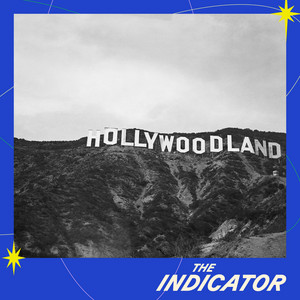
NPR. All right, Darian's taking us on a little hike through pre -Hollywood history.
Nice work, everybody.
Alexi and I are climbing up a steep path in Fort Lee, New Jersey to tell the origin story of American filmmaking.
making. We're kicking off our week -long series on the economics of movies here, because before Hollywood there was Fort Lee, New Jersey, overlooking the Hudson River.
You can see Manhattan on the other side.
Yeah, the center of the movie -making world was filmed here.
This is where the term cliffhanger was popularized, on these very cliffs.
Wow, and you can kind of tell why.
They're really stark, jagged, very tall cliffs.
We're right at the edge here.
And Alexei, I brought this rope here.
I don't know if that looks...
Is that strong enough to support human body weight?
I thought we could reenact one of these silent films with you dangling off the cliff.
Well, I still do have a lot of questions that we need to answer in this show.
There's only one way to make people stick around to find out.
This is The Indicator from Planet Money.
I'm Derryn Woods. And I'm Alexei Horowitz -Ghazi.
Today on the show, the birth of Hollywood.
How moviemakers traded the steep cliffs of the Northeast for the temperate valleys of Los Angeles.
And what this teaches us about economic hubs.
Okay, Darian, can you pull me up now?
Stay tuned to find out.
Darian, no! Support for NPR and the following message come from Indeed.
Just realizing your business needed to hire someone yesterday?
Speed up your hiring right now with Indeed.
Claim your $75 sponsored job credit now at Indeed .com slash indicator.
Terms and conditions apply.
This message comes from Capital One with the Capital One Saver Card. Earn unlimited 3 % cash back on dining and entertainment.
Capital One. What's in your wallet?
Terms apply. Details at CapitalOne .com.
This message comes from NPR sponsor, Oracle.
In business, they say you can have better, cheaper, or faster, but you only get to pick two.
What if you could have all three at the same time?
Oracle Cloud Infrastructure is the blazing fast platform for your infrastructure, database, application development, and AI needs.
With OCI, you can run any workload in a high -availability, consistently high -performance environment and spend less than you would with other clouds.
To try OCI for free with zero commitment, go to oracle .com slash indicator.
We wanted to uncover how the film industry started in the New Jersey, New York region, and why it then moved all the way to Hollywood.
In the early days, the Northeast had two main special ingredients, Broadway and Thomas Edison.
They gave the region a huge advantage.
montage. Richard Kaczorski is a historian focused on that period, and he starts the New Jersey story with one of those main ingredients, Edison.
In the late 1800s, Thomas Edison's team invents the first motion picture camera and viewer.
They have this kinetoscope machine.
It's a less than one minute of moving image, and you look into a little box like a peep show, and it's fine anything.
So I I can put these in amusement parks and arcades and they start production.
So Edison is doing two things.
First of all, he's making the hardware, but now he's in the entertainment business.
So he has to keep supplying films for this machine because nobody else has camera equipment.
So Edison has to start making films for the kinetoscopes that he is selling to people.
They build a little studio at the factory site in West Orange.
That is, West Orange, New Jersey, a complex where Thomas Edison has brought together engineers and chemists to invent.
But it's a bit far from our second ingredient, you know, the performers on Broadway.
But then in 1907, Edison's company shoots Rescued from an Eagle's Nest in Fort Lee.
That's right across the Hudson River from New York.
The movie's about an eagle that abducts a baby and takes it to its nest on a cliffside.
The hero's played by an actor by the name of D .W.
Griffith. And of course, he tries to save that baby by dangling from a rope over that cliff.
It wasn't a cliche at this stage.
Many of the film companies, and by now there are a lot of them, say, this is pretty good.
All we have to do is get on the ferry.
We can go here and we can plant the camera and film in any direction.
In that direction, it looks like an urban tenement.
But if I turn in another direction, there are farmhouses or there are fields and then there is cliffs.
lifts. A predecessor to Universal Studios constructs the first permanent building, soon followed by others.
There are dozens of different companies that establish what we would think of as a studio facility.
So filmmaking is centered in Fort Lee, wedged in between Thomas Edison's innovation campus to the west and Broadway just over the river.
The New Jersey -New York area becomes this hotbed of moviemaking, forming what is known as as an industrial agglomeration.
William Strange is an urban economics professor at the University of Toronto.
He explains agglomeration like this.
You can produce things more cheaply in a big city like New York, in part because there is expertise in New York that you're not going to find in a smaller city because a smaller city just doesn't have the scale that will support this.
People were making movies in New York and New Jersey because people were making movies in New York and New Jersey.
Williams says because of this scale effect and this kind of density of knowledge, the cards were initially stacked against L .A.
as becoming a movie -making hub.
The obstacle to starting an agglomeration is almost always that the existing center of activity in the industry is going to be really attractive to participants in the industry.
There are growing frustrations among filmmakers.
Like, Thomas Edison's innovations are not free.
Around 1908, Edison pools together as many patents relating to filmmaking as he can.
If you want to buy rolls of film, you have to buy it from Edison, who tries to gatekeep which studios can make movies.
And he forces filmmakers and cinemas to pay him licensing fees.
Richard Kaczarski says Edison actually sends out detectives to bust filmmakers using his equipment without paying those fees.
He was the king of using patents and using lawyers to enforce his patent control.
Another obstacle for filmmakers is how dependent the film cameras are on sunlight.
Artificial lighting exists, yes, thanks again Thomas Edison, but it is expensive.
If they had to build the interior of somebody's home, quite often they would create that on an open air stage.
You look at some films from 1912 or 1915 and you see it looks like somebody's home, but the tablecloths are blowing back and forth.
This ended up being the first big reason why the New York, New Jersey area didn't stay the movie -making capital.
Winter. So they said, okay, in the winter, we'll still stay in New York.
Let's send company out to Florida.
They tried Florida.
They tried Cuba. They tried the island of Jamaica.
A lot of the same problems there.
There's no infrastructure.
It's hard to get to.
No air conditioning.
So then they begin going further afield.
Production in Texas.
They go to Arizona.
Some movie makers like D .W.
Griffith, who's now become a director and soon becomes famous for his notoriously racist birth of a nation, people like him start to try out California for their winter shoots.
And then after a couple of years of that, he prefers working in California because there are better landscapes.
The mountains are better.
The ocean is better.
You know, more artistically interesting for him.
Land is cheaper and so are labor costs.
Los Angeles was famous as the biggest open shop city in the country.
That is, no unions to worry about.
Without unions, the electricians and carpenters and tailors have less bargaining power to negotiate higher wages.
Another thing to worry about less in California, Thomas Edison.
In California, Edison still has his people to serve lawsuits.
suits, but being a more spread out place, it might have been more cumbersome for him to enforce his monopoly against independent movie makers.
Richard Gaszewski ultimately thinks California's varied landscapes and cheaper cost of land and labor were the bigger drivers of the shift, though.
By 1921, 80 % of the world's movie market is shot in LA, and a few years later, the first feature with dialogue has key parts filmed on Sunset Boulevard. The Jazz Singer.
And even as Los Angeles' labor and land costs rise through the years and even as more indoor shooting becomes possible, Hollywood maintains its dominance.
Urban economist William Strange uses an analogy to explain why.
He says in the 1800s, factories were powered by water wheels and so cities grew up around four lines, where the rivers plunged forming waterfalls and you can harness more of that water power.
Water wheels have not mattered for a century.
And yet... We still see really big cities existing at the fall line in a bunch of places.
So history still really matters.
Even after much of the original reasons for Hollywood being Hollywood were taken away, it still thrived.
That said, the transition from Fort Lee to Hollywood shows that economic clusters may not last forever.
That's what people in L .A.
are worried about today.
We'll investigate that on tomorrow's episode.
Check out our Instagram for a silent film Alexi and I made with the expert direction of our summer fellow, Ella Feldman.
We are at Planet Money.
This episode was produced by Angel Carreras with engineering by Robert Rodriguez.
It was fact -checked by Sarah Juarez.
Kate Kincannon edits the show, and The Indicator is a production of NPR.
This message comes from Ritual.
What makes Ritual Vitamins different?
Ritual Vitamins are made with bioavailable, clinically studied key ingredients and a patented nutrient delivery system that aims to help your body use the nutrients you're getting.
Ritual's essential multivitamins are made with you and your body in mind and backed by scientific research, filled with key ingredients as well as the essence of mint so you can enjoy taking your vitamins.
Get 25 % off your first purchase when you visit Ritual .com slash NPR.