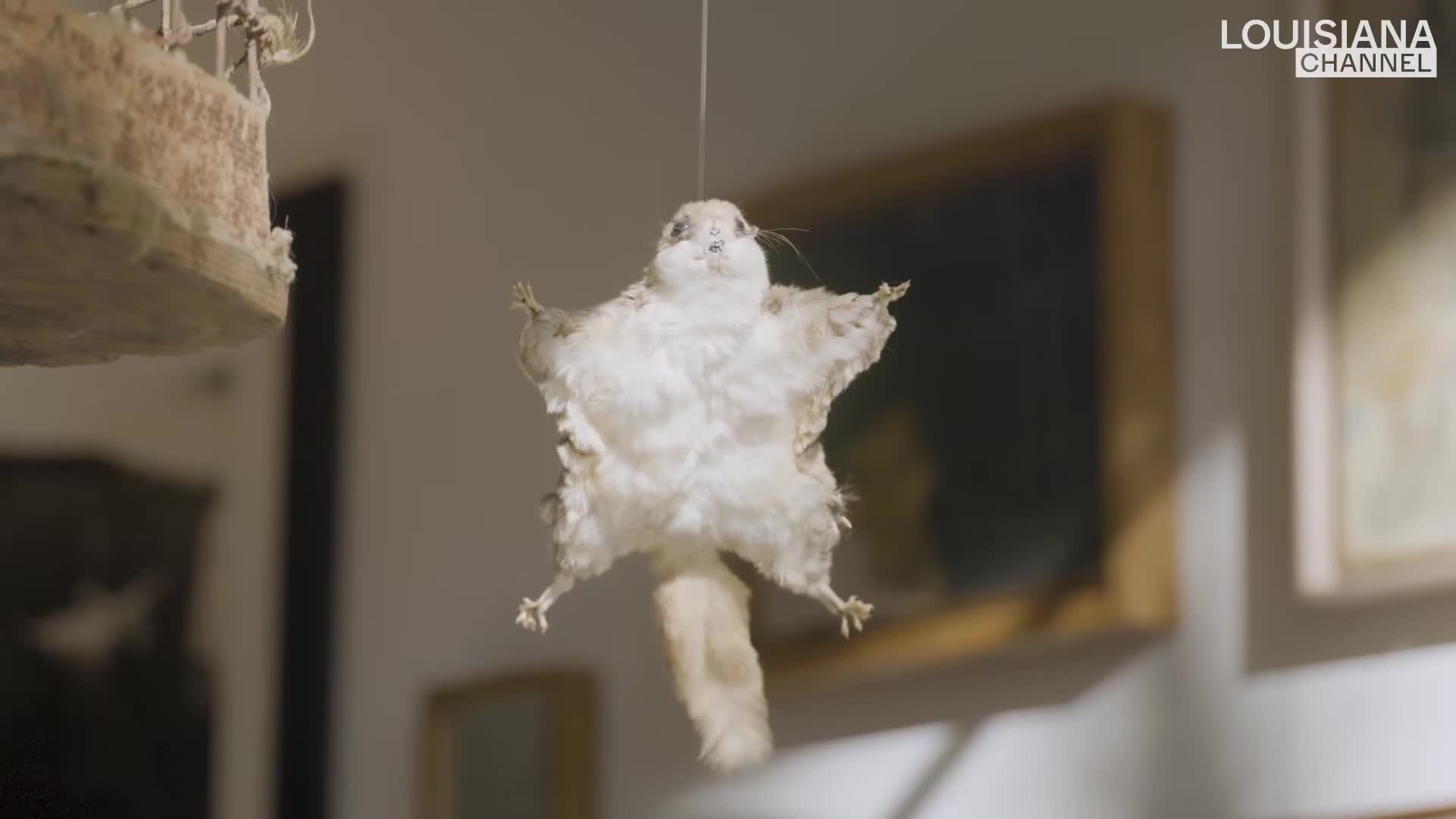
All my stuffed animals are someone from my life.
When I have a new friend, I look for an animal for that friend to be in my house somehow.
So that's my mother.
So when my mother died I bought that giraffe, because when she looks at me she's always there up there and she has this kind of sad and sad look that she had also.
She was going out every day, every night nightclubs, coming back three four, five and more often six seven, eight.
And we had a deal that she could go out and leave me alone.
I accepted very early to be left alone.
I accepted, it was not an obligation.
And I accepted in exchange that she wakes me up at four five, six or seven and telling me what she had done quickly, because usually i was totally asleep.
But so that was the deal, like keeping the control a little on on her absence.
And she had the alcohol extremely funny, like she was never sick.
When she was depressed she stopped drinking.
When she was happy, she drank.
I transform generally those difficult moments into a work of art.
At the beginning, I think it was not... conscious.
But then, you know, I'm 72, I know myself.
Anything bad that happens to me, I immediately go like a greedy dog saying, what can I take of that?
This used to be a steel factory.
And we bought it, a group of not only artists, a group of friends or whatever, in 79.
So I'm here since 79.
I never thought I would stay as long.
When I do the boring things, it's when I find my ideas generally.
You find an idea when you're on the subway writing a list of things to do and suddenly you have the idea.
Or when you search something in the computer, you find things you didn't expect.
That's how I find most of my ideas.
So that's why I work here and that I don't need a studio.
Because an artist like me I'm not a sculptor, so I write the text on a computer.
I can do it in my bed, or in the subway, or in the cafe next door.
This is about me, all of it, you know, my father and me.
That's the work of Annette Messager, Better Married Than Dead.
Next is Louise Bourgeois.
We were in the same show at the MoMA and I approached her and when she saw me, before I could say a word, she said if you have any question for me, ask my son.
So I said, I have nothing to ask you.
I was immediately shocked.
I have nothing to ask you, lady.
And she said, Oh, aren't you the one that always ask questions?
That's me, a photograph by my grandparents.
I look so pretentious and that.
What kind of a child was I?
I don't know because I have very different memories.
I know that for one moment of my life I was terribly secret, lonely, reading, not playing, serious.
Then when I was about 14 years old, the South of France taught me how to play.
In the South of France, my friends were different, they were wild.
I remember my father seeing me dancing, going out saying, oh it's beautiful, do it, because soon you you won't be able to.
Life will take you and you won't be able to be as wild.
And he said this to me when I was 18, then he said it to me when I was 25, then when I was 30 he said you know, take advantage because.
And then when I was 40, and then when I was 50, and then he stopped.
So I have this mixed memory of being totally lonely and secret and being independent and using that independence.
My relationship to my parents were complete love for my father, because he didn't live with us, because he was away, because he was a doctor.
And when I go to the hospital, he was director of the hospital.
So he was like so complete admiration and and and crazy love for him because he was the absent one.
My mother was the most funny person I had ever met.
Ever and still I've never met somebody as hilarious.
So my friends were all crazy about her because she would arrive somewhere and everybody was laughing and any place became wild when she was inside.
My mother was not interested in me.
She loved me, I loved Amit, but we were not the obsession with my father.
I was protected by them.
I could be totally free and do everything and be wild because I knew they were there somewhere.
They were there, but they were not.
And after, when I start to be an artist, come back to France.
When I was 26, it was very close from both of them.
That's my father, strength and fragility, wearing the the fight on his face, and but strong.
Here is paula cooper, my good friend dominique.
Yes, definitely.
I was to seduce him, definitely.
That he would be proud of me.
He was not proud of me.
I was lost.
I didn't know what to do with my life.
I was completely I traveled for seven years going.
I loved that life.
But he didn't like it because he could not see what would happen.
And suddenly I decided it was enough that I was 26.
Maybe it was about time to I could not live all my life hitchhiking, little jobs.
It's what I did for seven years.
And so I came back in Paris and lived with him for the first time of my life, because he was divorced with my mother when I was two or three.
And I looked at his walls and he was a good collector.
He had a lot of work.
And I saw what he liked and I decided to try to do this, to enter in his sphere of admiration.
So I did photo and text.
I showed him and suddenly looked at me differently.
It was really so.
Yeah, my purpose was to do something he would admire.
I took from both of them.
I took the image from one and the seriousness protestant from one.
Like i work, i am, And I took the craziness and the words from my mother.
My mother was reading and reading.
I think storytelling started when I first I was very good at school.
I was good in writing and bad in mathematics. chemistry and all this.
So writing and reading was my mother's gift to me.
So this, I was always close from, you know, I read when I was little and I read a lot.
And my father helped me a lot in my work.
I became an artist.
He was my first eyes.
I would show everything to him before anyone.
I would follow his advice.
So he was also, he was a necessity in my artistic life, the only person I trust.
When I came back in France, I was searching for an idea things to photograph, even to lie to my father, even to simulate wanting to be photographed.
I needed some subject to print.
I had been using the lab of somebody in California because she was a photographer and I rented a house.
And because she came back in my house and said oh, she had not slept all night.
And she said can I use your bed?
And I think I just said something like oh, it's funny, a bed that would be busy night and day, like in factories.
You say les trois huit, the three eight.
You know, when you work eight hours the factory never stops.
I thought it would be You know, interesting to have a bed where there is always busy.
So she slept and miracle was that I invited a girl that I crossed at the market next door for food market.
I asked her, I knew her.
Frankly, you know, I said, do you want to sleep in my bed?
I'm doing this for one week, people sleeping eight hour shift.
She said yes.
And she was married with an art critic called Bernard Lamarche Vadel.
That was organizing the show at the Musée d'Art Moderne de la Ville de Paris for young artists Biennale of Young Artists.
She told him she had been sleeping in my bed, that I took photos every hour.
He came and see me. and invited me to that show.
And I remember telling him, that's work of art, that's art.
And really thinking in my head alone, is that art?
I was not sure it was art.
And he decided, by inviting me, he decided for me that it was art.
So in a way, I became artist without having decided it.
I thought I was just searching around.
And that make photo, was it really For me, it was to please my father, to do something.
It was not clear.
But in the same time, all this was clear, but at least unconscious.
Those two works, The Sleeper and The Sweet Venetian, have the same thing in common at the start.
It is that I'm lost in Paris and I don't know what to do.
I didn't know what to do in the morning.
I may as well stay in bed.
So I decided to follow people just like that.
I could maybe discover a neighborhood in Paris, a cafe, a shop, whatever.
So it was just to use people's energy. as a motor.
And I loved it.
I loved not having to decide.
I loved that errance, that promenade through other people's decisions.
I loved that relation without reciprocity.
It became addictive.
I realized immediately that photos were not good enough and they needed some text.
So it was part of my work immediately.
So I guess it became me by the force of the repetition, the habit and the fact that I like to take photos and I like to write, and that it became me.
I don't know why the gaze interests me.
It's not only the gaze that interests me, it's also the disappearance, things finishing a man that goes, a mother that dies, a painting that's stolen.
But it's both, the gaze and the... and the absence.
I remember one day being left by a man, abandoned by a man, that I wanted to leave.
I'm the one that decided it's over.
I didn't have time, he left me before.
Then I suffered for one year because it was not absence, it was humiliation.
Sometimes You suffer for something and it offers you a boulevard of pleasure.
I have been, When I did Take Care of Yourself.
The man that left me made me an amazing gift, because his departure was one million times better than what we lived together.
I was much more happy because I had a project about him. take care of yourself.
The project made me meet 107 women that I was crazy about.
I all wanted them as best friends.
I was excited because I knew the project was good.
Then it was going to the Venice Biennale, which was a dream.
This man would not have left me.
I would have been one more year miserable with him because he didn't love me, obviously.
And he went.
It's the most beautiful gift he could do to me.
So his absence became huge because it was my project, my show at Venice, but it was not his absence.
It was the pleasure of using his absence to do a project that was incredibly exciting.
So every time it's a bad moment yes, I want to take a camera to put something in between me And what I don't want to see, or I want to take a pen to describe it.
So it's a way to look.
I remember Jean Baudrillard told me the most clear analysis of this when I did the exquisite pen and that I photographed the bed in India in the hotel room with the telephone that brought me the news that my boyfriend had left me.
I photographed the bed with the red phone.
And when I interviewed Baudrillard about what was the worst moment in terms of pain of his life, he said but you didn't suffer.
I say, yes, it's the worst suffering moment.
I remember in my life, he said, no, you didn't suffer.
I said, what allows you to do this?
He said, you've thought about photographing the telephone.
So already you step on the side and you photograph it, and you are out of it.
You are not with the telephone.
And so that's why I cannot describe the happy moments, because I don't want to look at them.
I want to be inside the situation.
And that's why I want to photograph and tell all the bad moments, because I want to put something, a barrier, between them and me.
In my work Truth and Fiction, I would say that it's only truth, But nothing is true.
So it all happened.
I don't invent a situation.
I followed people where I said I followed them.
I, you know, I...
I did what I say I did, but it's not true because it's already edited.
I tell one minute when there is 10 hours before or 10 hours after.
That are part of the story, but I tell the moment when I think can be shared by others, or the moment where there is an image maybe, or the moment where I can find the style for the way to tell the story, but it's not the story.
So it's fiction because it's not the way it happened, because it doesn't explain the context.
It's just a moment that I take.
So I can only say that it happened.
I like to mix, you know, how do you say, mingle fact and fiction.
Here, this one is real, and this one is fake.
You know, same with the glasses.
But it's always between fiction and reality.
So then I start to collect.
So it's not important to have the object.
It's just a pleasure.
And also, in a way, I learned my work doing this, because when I make that wall, that I install it, it's like studying for the show, in a way.
I'm used to... I change my walls nearly every day.
Yesterday, this wall was not like that.
This was here.
So I change every day.
And one day I wondered why it doesn't stay.
But I think that it's a way for me to... to learn about ending a show.
My father used to mix totally the important works with a postcard.
He was putting a big work by Tremblay next to a little postcard.
It's not what I do exactly because I don't have big trombone unfortunately, but it's also I like when a house is too perfect, some collector house with a big, nice painting, and I find them a little dead.
So I hope my, my house is alive and not like a showroom, like I don't want not to know where to put the dirty things, like the coats and the stuff I don't want not to know, you know.
So it is.
I like this mixture of artwork and banal little memories.
I think that behind most of all those works, I have a story.
I remember, on the opposite crossing, a blind person on Boulevard des Invalides, next to the blind school.
And that person says, oh, I saw a beautiful movie yesterday.
And this I remember hearing it, that's for sure.
And for one year I didn't do it because I was afraid of the cruelty of the phrase.
Ask somebody that has never seen because it had to be blind that had never seen.
What is the most beautiful thing you saw?
The question was a paradox.
And generally, when I ask questions, it's a paradox I'm searching for.
And one day in Montpellier, I stopped a man with a cane, suddenly, without having time to think.
And I asked that man, are you blind from birth?
And he said, yes.
And they say, what is the most beautiful thing you've seen?
And he answered, the sea, the sea going so far that you lose sight of it.
I just could not believe it because the poetry of the answer related.
It's like if this man was saying, go on, you can go.
Generally, when I make a project, I try to find a natural ending.
And in The Blind, he said, I hate beauty.
I've never, since I cannot see, I don't even understand.
He refused the question.
And I stopped with him because luckily it was not the second day, but one year later.
And I thought he was offering me the end.
Because it's difficult sometimes to find the end.
Why stop?
So sometimes I stop because there is the project that's too close and you have to stop.
Sometimes I stop because of such an answer that closes the problems.
Sometimes I stop because of the perfection of the answer, whatever.
But I'm always, since the minute I start, I wonder what could be the end.
Well, art projects have changed all my life.
So that's already solved, you know.
My life is what it is because of art projects.
So yes, it changed my life.
It changed the fact I could stand my mother's death.
It changed the fact I can live with it without doing something I like to do, instead of having a job I don't like.
It changed my relation to people because they Even people that don't like my curiosity answer because, who knows, maybe it's for an art project.
It changed everything.
And now I don't wonder.
It's my life.
I don't even think.
It just happens.
Something happens, I look at it.
If it's something I can tell, it's in my blood now.
It happened at the beginning, as I said, by frustrations, chance, and now, I don't think about it.
I'm an artist, you know, I'm an artist.