Never say very in front of these words.
I'm not saying that you should never say very, but you should never say very in front of quite a few very specific words.
I will also teach you quite a surprising way that you can use it.
Before we get started, i want to let you know that i've created a very guide, which sounds grammatically incorrect in itself.
It's a guide all about the word very.
It's a free pdf download.
It covers everything that we cover in today's lesson, plus lots more examples, and not one to very quizzes.
Sorry, it just is funny because it sounds so incorrect to say very quizzes.
If you would like to download that for free, just click on the link in the description box or scan that qr code there.
Join my mailing list and i'll send the pdf guide directly to your inbox.
Okay, let's begin.
When do we never use very?
Take a look at this sentence.
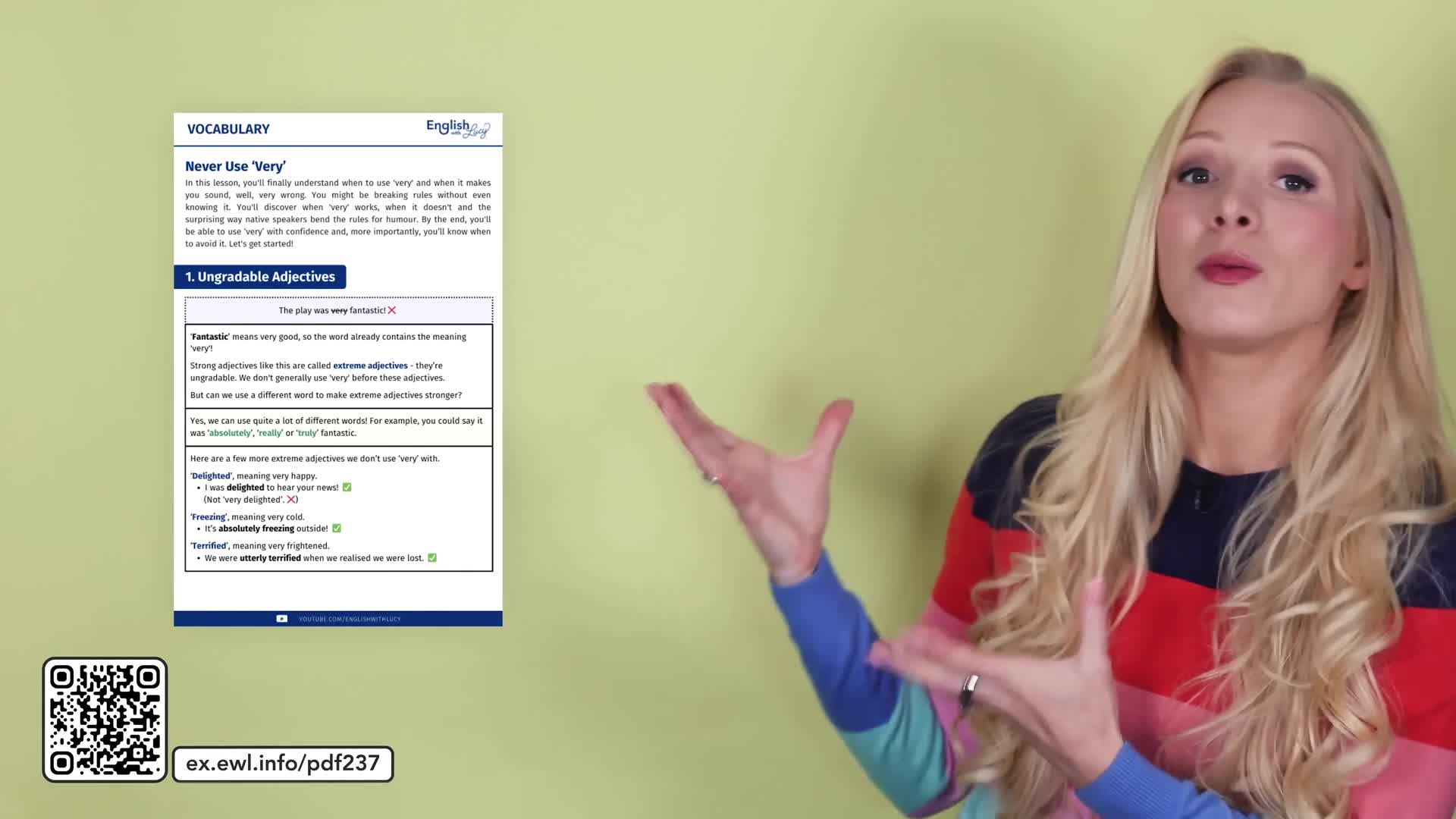
The play was very fantastic.
We can't use very here.
Why?
Well, because fantastic itself means very good.
So the word already contains the meaning very.
Strong adjectives like this are called extreme adjectives.
They are ungradable.
We don't generally use very before these adjectives.
So we'll remove very here, but can we use a different word to make extreme adjectives even stronger?
The answer is yes. and we have quite a lot of different options.
For example here, you could say, it was absolutely fantastic, really fantastic, or truly fantastic.
Let's look at a few more extreme adjectives that we don't use very with.
Delighted, meaning very happy.
I was delighted to hear your news.
Not very delighted.
Freezing meaning very cold it's absolutely freezing outside and terrified meaning very frightened.
We were utterly terrified when we realized we were lost.
I love the word utterly utterly.
It's so expressive.
Okay, how about these next adjectives free, impossible and perfect?
We cannot use very before these words because they are also a type of ungradable adjective.
They're not extreme adjectives.
They're what we call absolute adjectives.
This means they describe absolute qualities.
Something cannot be a bit free or a bit impossible.
It either is free, is impossible, or is not free, is not impossible.
But once again, we can use other adverbs to intensify those words.
Here are some examples.
The course is completely free to residents.
Or it was absolutely impossible to solve that problem, or our holiday in Greece was simply perfect.
We cannot say very free, very impossible or very perfect.
You will hear native and proficient speakers use very before, some ungradable adjectives to say that a quality is really obvious.
Now, this is often done for humour and or emphasis, and it's informal.
Take a look at this sentence.
John's very married.
You're either married or you're not, right?
Well, what if I say it like this?
John's very married.
He never stops talking about his wife.
Here we're using very because it's an obvious thing about John.
Another example is dead.
You're either dead or you're not.
What if I use it in a sentence like this?
Oh dear, that plant looks very dead.
I don't think we can bring it back to life.
So when you want to convey this meaning, make sure you give extra energy and emphasis to the word very
John's very married.
That plant looks very dead.
Now, this doesn't work with all ungradable adjectives, so be very careful when using it yourself.
Do not use this in an exam, it's informal.
I wanted to tell you about it so that you understand why you might hear people using very with ungradable adjectives.
I've added lots more examples in the PDF.
So click on the link in the description box or scan the QR code to download that for free.
Now let's move on to our next category, verbs.
What I'm going to say next is wrong.
And I hear it pretty often from my students.
I very like football.
Now we do not use very directly before verbs.
So it's not very like or very enjoy or very want.
However, you can say something else instead.
You can say very much plus a verb.
It sounds quite formal.
I think it sounds quite nice.
I very much like football.
When I say it, it reminds me of my grandmother.
It sounds quite old fashioned, quite formal, but some people like speaking like that.
It's much more common to use very much after the object of the verb.
I like football very much.
We enjoyed speaking to you very much.
We don't usually put very much between the verb and its object, so this is not correct.
I like very much football.
We often just use a different word than very.
Can you think of a super common one to complete this sentence?
I hate waking up when it's still dark outside.
Have a think.
Really is probably the most common word here.
There are lots of other alternatives.
We can't say very hate, but we can say really hate.
Okay, let's think a bit more about verbs now.
Is this sentence correct?
She's very known in the local area.
Well, it's not really correct, though you might hear this among native and proficient speakers, but according to most grammar rules we shouldn't use very directly before past participle forms of verbs when used in passive sentences.
We could simply say she's known, or we could intensify it with well, she's well known, or she's very well known, but not she's very known.
You might hear it, it's not technically correct.
More examples like this include Your input was very much appreciated, not very appreciated.
You might hear it, but it's technically not correct.
I'm just giving you the information, you can choose how you use it.
Another example, the performance was greatly admired by the judges.
Greatly is quite formal here. and it's not very admired.
Note that we can use very before past participle adjectives like worried or frightened.
They're very worried.
I'm very frightened of mice.
Let's stick with adjectives.
We have another no-no for very.
Do not use very before comparative adjectives.
For example, it is incorrect to say my cat is very lazier than my dog.
Incorrect.
It is incorrect to say she is very better at following directions than I am.
How can we correct these sentences?
Well, We can simply remove very.
My cat is lazier.
She's better.
Or we could intensify the comparison by using much instead of very.
My cat is much lazier than my dog.
She is much better.
A lot also works too.
My cat is a lot lazier than my dog.
So that's comparatives, but what about superlatives?
Which one of these sentences is correct?
That was the very most embarrassing moment of my life.
Or that was the very best moment of my life.
The second one is fine.
The first one is not.
It's very much not fine.
So can we use very before superlative adjectives?
Sometimes.
We don't generally use very before superlatives formed with the most.
So, this is wrong.
She told me the very most interesting story at dinner.
We should simply remove very.
For emphasis, we could use by far instead.
By far the most interesting story.
However, we can use very before superlatives that end in est est, and that includes best, and those ending in st, like worst.
We do this for emphasis this is the very worst restaurant in town or the shop has the very lowest prices in the city.
We could also use by far in those sentences by far the worst or by far the lowest.
So expressive.
See, you thought I was just gonna remove very from your vocabulary today, but instead I am filling your vocabulary with lots of expressive alternatives.
Okay, we're on our final point now.
I hear my students say things like this sometimes.
We ate very much good food while we were in Spain.
So we don't tend to use very much in this way in positive sentences.
We usually say a lot of instead.
We ate a lot of good food.
Is that nice and clear?
That's a simple one.
Okay, now it's time to check what you remember.
Let's see if you've taken this all in.
We're going to do a quiz.
There are five questions in total.
Share your results with me in the comments section.
Okay, first, I will give you two sentences to correct.
Number one, Maria very loves dogs.
We don't use very directly before verbs and there are lots of ways to correct that.
You could remove very.
You could add much, very much loves.
Or you could even change very to another word like really.
Give yourself a point if you got any of those answers.
Number two, we should drink very much water when it's hot.
Please correct this for me.
So, the best way to correct that sentence is to replace very much with a lot of, a lot of water.
Remember, we don't tend to use very much like this in affirmative sentences.
Okay, number three.
You have a gap to fill now.
Today is than yesterday.
Is it very warmer or warmer?
Did you say very warmer?
I hope not because it should just be warmer.
We don't use very before comparative adjectives.
Number four.
Is this sentence correct?
It was very freezing yesterday.
No, it's not.
We don't use very before extreme adjectives.
We could remove very or we could use a different word like absolutely.
It was absolutely freezing yesterday.
That sounds nice and natural.
And number five.
Is this sentence correct?
Anna's very English.
She drinks tea at five and loves the rain.
Yes.
This is correct in the sense that you will hear people saying this.
Even though English here is an absolute adjective, the speaker is using very to emphasise an obvious quality.
Anna is very English, so English.
So, how did you do?
Let me know your score in the comments and don't forget to download the very guide, your guide to everything.
Very
It's a free PDF download.
We put a lot of work into it.
It's a really helpful one and it has not one, but two quizzes.
The link is in the description box and you can scan the QR code here.
I very much hope you enjoyed this lesson.
I will see you in the next one.