I really need to bring a duster and a mop down here with me next time.
There could be absolutely anything hiding down here, maybe even gold.
And if there is some gold, there's a good chance that it was dug up or panned in a river during the Australian gold rush way back in the 1850s.
I reckon some of you, especially if you're in year five, might even be talking about that at school this term.
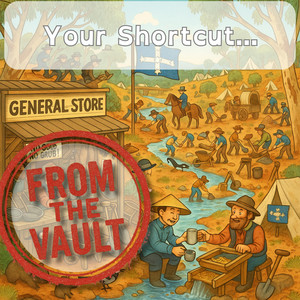
So grab your prospecting licences and your shovels, and let's take a listen to this shortcut from the vault on the Australian Gold Rush.
This is a Squiz Kids podcast.
Your fresh take on what's happening in the world around you.
It's the third most valuable metal on the planet.
It ignited a case of gold fever amongst colonial Australians, and this shimmering substance transformed Australian society forever.
This is your Squiz Kids shortcut to the Australian gold rush.
The podcast where we dive into the who, what, when, where, why and how of the big news stories.
I'm Christy Kijerina.
And I'm Bryce Corbett.
Bryce, you're a little bit more jangly than usual today.
I'm glad you noticed, Christy.
I thought I'd bring my bling along.
Wow, those chains sound hefty.
Are we talking real gold or are they from a dress-up box?
I'm almost offended you have to ask.
But, Christy, revealing that would be giving away far too many secrets.
Let's just say, if they were real, they might just be relics from a time when Australia was gripped by gold mania.
Oh, yes.
Just imagine strolling along a creek, sifting through the water and striking it rich with enough gold to buy a fancy carriage or at least a sturdy wagon.
It's a prospector's life for me, Christy.
So today, the call of gold beckons us to find out when the Australian gold rush took place, who joined the hunt for gold and what lasting effects the gold rush had on the nation of Australia.
So, fellow explorers, grab your maps and your gold pans because here we go.
Listen carefully.
There's a squeeze at the end.
When?
Hey Bryce, even though we've probably all seen something made of gold, like maybe a ring or a necklace, it's actually quite rare.
Just imagine you're a supervillain.
LAUGHTER
And you wanted to melt down all the world's gold to fund your supervillain lifestyle.
Cool.
Did you know?
Experts estimate that all the gold ever mined would only fill three Olympic-sized swimming pools.
What?
All the gold ever mined ever in the world would only fill three Olympic-sized swimming pools?
That is crazy.
I was picturing mountains of gold.
No wonder everyone's gaga about it.
I know, right?
And even though Australia's not a big country population-wise, we are sitting on a gold mine, literally.
Aha, I see what you've done there.
About one fifth of all the gold on earth is under our feet in Australia.
Whoa, one fifth.
That is incredible.
So, Christy, when did Australia's gold rush actually begin?
That's a great question, Bryce.
So undoubtedly Australian Aboriginal peoples knew about gold for many thousands of years because some of it was just lying around on the surface.
But as far as we know, they didn't place a whole lot of value on it.
Not until Europeans started arriving.
Yep, that's right, Christy.
And there were whispers of gold as early as 1788.
But early leaders put a lid on the gold gossip, fearing that the convicts, who were quite the rowdy bunch, might go on a murderous gold-fuelled rampage.
When a geologist that's someone who studies rocks showed Governor Gipps his gold find in 1841, Gipps was heard to respond put it away, Mr Clark, or we shall all have our throats cut.
Oh, no.
But then, when California, on the west coast of the United States, experienced its own gold rush, people from all across the world, including Australia, rushed there, hoping to make their fortunes, as gold brought huge wealth to America.
Yeah, of course, up until then, in Australia any gold that was found technically belonged to the Queen, Queen Victoria, who was sitting all the way back there in England.
But seeing the potential, New South Wales and Victoria's governments started dangling rewards for anyone who could find gold, which of course meant that people set out immediately in the hope of making a lucky strike.
And then, drumroll, please.
On May 22 1851, Edward Hargraves, fresh from the Californian goldfields, found gold at Ophir near Orange in New South Wales.
He only found five little flecks, but that was enough to get everyone's gold-digging gears a-grinding.
Only five flecks?
Uh-huh.
That sounds more to me like a gold trickle than a gold rush.
But that was nevertheless the spark that lit the bonfire.
The rush was just starting.
So tell us, Christy, who joined in the gold frenzy?
Who?
Who joined the gold rush?
More like who didn't.
Men from all across Australia Europe, Asia and America dropped what they were doing and headed for southeastern Australia.
Now, at that time, Australia's wool industry, its largest, was becoming less profitable.
So shearers, sheep handlers and farmers swapped their sheep for shovels.
Blacksmiths, shopkeepers and bankers traded in their day jobs for the chance to get out to the gold fields and strike it rich.
They sure did.
And strike it rich they did.
At first, at least. much of the gold discovered was what's called alluvial gold meaning all you needed was a pan or a sieve and voila you grabbed some gold from a creek or a dried up riverbed however this surface supply was soon exhausted very quickly and miners then had to start digging to get that golden prize oh sounds like hard work the chinese migrants who had come to seek their fortunes were very good at this more intense type of mining as they were excellent at teamwork but unfortunately not everyone was cheering for them their success stirred up a storm of jealousy and unfairness amongst some of the other miners leading to tension and sometimes sadly fights yeah it did indeed now at first the goldfields looked like a tent city from a wild adventure story but soon Real towns sprang up as women and children joined the quest, turning the hunt for gold into a family affair.
And with people travelling from all across the world.
Within only 10 years, the population of the colonies had tripled.
Wow.
Yet for every lucky prospector, there were many who didn't strike it rich.
They still had to pay hefty government fees for their mining licences.
It's a bit like buying a treasure map that leads to a grocery list.
Yeah, good point.
And I guess there were lots of people who weren't too happy with that outcome.
Now, this gold rush is a mixed bag of fortune and flop, Christy.
So what lasting effects did this gold frenzy leave on Australia?
What?
As you can probably guess, Bryce, all this wealth transformed lives and shaped our nation.
Australia saw a boom in infrastructure.
Governments rolled up their sleeves and got to work building roads, laying down rail lines and even setting up libraries and theatres.
Yeah, and in those bustling mining towns, dreams were built on more than just gold.
Folks opened up all sorts of shops, hairdressers, shoe stores, general stores, you name it.
Different forms of transport like steamers and stagecoaches also flourished.
They did, but it wasn't all shiny and bright for everyone.
Despite some Aboriginal people benefiting from the gold rush, many faced tougher times.
Their lands were overtaken, as camping and hunting sites were destroyed, and the pristine waterways they relied on were muddied and polluted.
And Christy, remember those pesky mining licences?
Uh-huh.
They also stirred up quite the storm.
In 1854 fed up with the system.
Thousands of miners at the Eureka Goldfield in Ballarat said enough.
They burnt their licenses and built a stockade which is like a big wooden fence, standing their ground in a bold fight for miners' rights.
And what a fight it was.
Although it led to tragic losses, the rebellion sparked change.
Miners gained the right to vote and settle down on their own slice of land, And those steep licensing fees were slashed.
Now, over the next few decades, the gold mining centres moved to the Northern Territory and Western Australia.
WA is still digging up the shiny stuff and is one of the world's top gold producers to this day.
These days, gold mining is a whole different ballgame.
Most mining is done by big companies with enormous equipment in deep pits and deep underground.
But there are still modern-day prospectors out there with their pans and sieves and metal detectors living the dream.
Yep, finders keepers still applies.
So as long as you've got your mining licence handy, you're good to go.
That's right.
So there you have it, folks.
The Australia gold rush.
Not just about striking it rich.
It's also about the journey and the mark that it left on our nation.
So who's ready to hunt for gold?
Remember, there is gold in them thar hills.
Time for the quiz.
This is the part of the podcast where you get to test how well you've been listening.
Question number one.
What is the name of the place where gold was first officially discovered in Australia?
Music Well done if you remembered Ophir near Orange in New South Wales.
Question number two.
One group of miners were particularly good at working cooperatively to mine for gold.
Which country were those miners from?
Music Good listening if you said China.
Question number three.
What was the name of the gold field where a stockade was built in a fight for miners' rights?
Music Yeah, that's right.
It was, of course, Eureka.
Well, that's all we have time for today.
Thanks for joining us as we explored the who what how when, where and why of the Australian gold rush.
Teachers.
There's a whole heap of excellent classroom resources related to this topic on the Squeeze Kids website and there's a link to them in the episode notes.
In the meantime, though, get out there and have a most excellent day.
Over and out.