To our game dev listeners, are you wondering how to expand your game around the globe?
Well, wonder no longer.
Xsolla Payments is a solution built for global game commerce and monetization.
It boosts player engagement with localized checkout experiences using your players' preferred payment methods.
The simple user interface makes it easy for gamers everywhere to pay for your games and in-game content exactly how they want.
Even better, they can save their favorite payment methods for quick purchases to help them get back in the game faster.
And you'll love Ixola Payments because of its customizable checkout and integration options with everything from sidebars and iframes to fonts and images, making the buying process feel like an extension of your gaming experience.
For payers
Ready to go global?
Visit xsolla.pro slash aiasp or click the link in our podcast description to learn more.
Hi, my name is Austin Wintory, and this is The Game Maker's Notebook.
Today I am speaking with the Reverend Dr Bradley Meyer, the first such reverend we've had on The Game Maker Notebook.
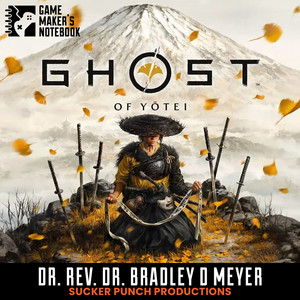
He is the audio director at Sucker Punch, and so we, of course, spoke about his experience at working on The Ghost of Tsushima and Ghost of Yotei, his long fascinating, winding road through the game industry prior to that, outlooks on life and, of course, the backstory on why he is the Reverend Dr Bradley Meyer.
So he's a profoundly interesting guy, a lot of fun to talk to.
I think you'll enjoy.
Welcome to The Game Maker's Notebook, a podcast featuring a series of in-depth one-on-one conversations between game makers, providing a thoughtful, intimate perspective on the business and craft of interactive entertainment.
The Game Maker's Notebook is presented by the Academy of Interactive Arts and Sciences, a member-driven organization dedicated to the recognition and advancement of interactive entertainment.
Bradley Meyer.
I believe our first reverend on the Game Maker Notebook.
How are you doing?
I'm great.
Yeah, I'm doing very well.
My credentials are actually, I know there's no video in the actual podcast.
Oh, there will be on YouTube so you're fully on display.
Legitimate right there, right?
Yeah well, we're gonna, we're gonna perform a wedding right here on this episode.
That's right, i saw, i.
So i so want to.
Uh, one of the things i've been looking forward to in the sort of years that i've been pining away, fantasizing about doing this, is to unpack.
Unpack that because it's it's so rare.
It's like um, i've had many, i don't know how well or if at all.
You know peter mcconnell, But his his father, I believe, was a minister and he kind of grew up around seminary world and and it has led to lots of interesting conversations over drinks and whatnot, over a kind of the intersection of metaphysical questions and, you know, artistic ones, or musical ones and whatnot.
And I'm totally for what it's worth uncredentialed, unqualified or whatever to have conversations like that.
But I certainly like spurring people on who have a slightly more kind of you know ammo to bring to bear to that.
Well, I might let you down then, if you actually kind of understand what those credentials really are.
Well, maybe so.
I mean I've, whenever i first came across uh, when i don't remember, when i kind of first became aware of who you are from just the power of the internet, i don't.
Honestly, it was years ago but i can't quite remember how or why, but of course i was curious and i looked it up and i remember going interesting i'm, i'm curious to ask, uh at some point um, and then i i basically stuck a pin in it from there but but But, before we dial into more specifics, I'm just I'd love, How are you doing in the?
We're recording this in the relative immediate wake of the release of The Ghost of Yotei.
And how has the release treated you?
How are you riding a wave of glory?
I would say it's a wave of relief.
I think it's been like a now... uh, probably six weeks.
No, it's been two months.
So about two and a half months of relief that started when the reviews came out, because that was like you know, when you work on a game, even if you think it's good, you don't really know until other people play it.
And you know we're so close to these things that like, even if you think it's, it's good to you, just can't give a really subjective answer.
So that was great.
And then once fans and players started playing it, that was amazing just seeing everybody's positive responses.
And the thing that I've really appreciated and felt very, very kind of lucky about is the amount of love that the audio has gotten.
You know, I've heard call outs to the music, of course, but the sound design, even people explicitly calling out the mix, which was really special to me that people are listening that intently and kind of noticing these things and that They seem to be liking them.
So yeah, it's definitely been a very kind, of light and happy last couple months, as we've realized that we have not made a terrible thing.
Yeah.
Yeah.
Isn't it a kind of cruelty that you can spend a pretty non-trivial percentage of your entire life on a single project and not know what the outcome will be?
Or it could even be one of those.
In this case, you guys did have one nice thing going for you being a kind of follow up.
It's probably more accurate than to say sequel, but sort of a chaser, as it were, to a game that has already rather successfully established itself as a sort of beloved.
Um, like i loved when it was announced that people say oh, it's a new ghost game, as if that's like a 20 year running.
That is a shorthand for this really long running ip id.
You know what i mean, which is to me it's a powerful.
That's an interesting kind of implicit approval in its own right.
But um, so yeah, even despite, in other words, having the goodwill uh, to build on which can be its own double-edged sword in in many ways.
I'm sure we'll get into that, but Still, it's crazy how you just simply can never know.
I mean, it's, you know, like if you think about a really long career would be like a 50-year career.
There's probably very few that end up even being that long, because it essentially means starting at age 20 or 18 professionally, which you know few of us are lucky enough to achieve that, or even even trying that, and live and living and working without retirement well into one seventies.
It's basically, so you think about that.
So even if it was a 50 year career and it's not uncommon to spend five years on a game, it's literally 10 of one's career could easily be sunk into a single project without knowing the outcome.
So I've, I've been thrilled for you guys.
This one, Erica, she has been a friend of mine for a long time.
Um, and so it was a, kind of a fun, double-edged... That was a surprise.
She very dutifully honored the NDAs, because I found out alongside the rest of the world.
But that just.
I've wished for the success of this game, in other words, along multiple wavelengths, and it's been really lovely to see Thanks.
Yeah.
And in a year with plenty of competition in that regard too.
Oh, for sure.
It's been.
I mean, looking at the quality and the breadth of games coming out this year and then even looking forward of like things that are coming out next year, it's just like wow, there's so much good stuff.
And I mean you yourself.
You've had, you know, a handful of really amazing titles this year as well, and it's just.
There's just so much good stuff, and the only thing that i hate about it is my backlog.
Oh my god, and i just don't have the time to play.
Yeah, it is a.
It is a.
It is a real struggle.
Um, i i really try to aggressively keep on top of of playing current releases, knowing that when invariably, the end of the year comes and I'll be asked to vote on things you know in various organizations that vote on things, um to to not basically try to survey a year's worth of games in December.
It's the thing I'm always trying to avoid.
Part of it is a joyous task because I really love playing games.
I would do it anyway.
And it helps having podcasts like this one and I do another one as well, where it helps provide kind of fodder.
It's sort of this wonderful, self-fulfilling feedback loop in a way where it helps those shows...
To be able to kind of really stay that and the other one to stay really current.
But I also.
I get such professional benefit from that as well, you know, because I think having one's ear to the ground of well, where does the bar really live?
What are people doing?
What are the experiments that are being tried?
Yep, yeah, absolutely, I mean.
Yeah, we definitely try to.
I mean, we haven't obviously for the last year or so because we've been so busy finishing the game.
But you know, as an audio team we generally try to pick a game once a month and all get together and play it together.
We can not only like, oh, yeah, we're playing it separately.
We have our opinions.
We share them in chat, but like actively playing through. critically listening together and just hearing what what people are doing and seeing if we can glean ideas off of that or just you know analyzing that's awesome what other teams do it's yeah it's it's a ton of fun because we get to play games together and then it's also just really enlightening and also often super inspiring just kind of to do this really deep listen to what other teams are doing because it's often so cool you know what other teams are doing you kind of pick up on those little nuances of their systems you're like wow that's so cool how could we do that in our engine and with our tools is there an example from the last year of one of those or last you know a couple years or basically i imagine as you ramped up towards release those got harder and harder to schedule but yeah uh i'm just curious what has jumped out at you basically what in doing those what has kind of made you all look at each other and go oh wow I'm trying to remember, like, I remember we did play through Demon's Souls when, like, it was maybe early-ish during Yotei, because we wanted to, you know, kind of hear, like, kind of a lot of different things about that game um you know from their you know 3d spatialization to their foley to obviously you know sword combat um but then the other big thing for us um actually the other two big things one was like what was their kind of physical object kind of physics and destructiveness of sounds like how did they handle that because ours you know like the ghost games compared to Infamous are very kind of night and day.
And, you know, like Infamous Second Son, everything was destructible.
Ghosts were much, much more kind of reserved.
And we let that go a little bit more on Yotei.
But still, you know it's that fine line of.
It's very expensive to make everything a physics object.
So you know, how do you make the world feel reactive without having to kind of tag and model every single object um, and then also their sound propagation and kind of like reverbs and and um and just kind of occlusion, obstruction and all that stuff.
So um yeah, it was.
It was great just to hear you know a really great sounding game and hear what we felt they were doing really well and things where we thought we could do better and and just kind of taking some ideas.
I mean, I guess we do.
Also, since that was a PlayStation game, we also had the advantage of oh, we could actually talk to those people and figure out like hey, how did you design the you know, IRs for your outdoor spaces or whatever it was.
But yeah, that one was definitely, and also I can't.
I love playing games, but I suck playing games and and usually it's like I want to get through the game.
So I play it on easy and I just get through so I can experience the story.
I can experience everything without challenging myself because I'm too old to play something over and over again.
I just get too frustrated.
So the Souls games, because there's no such thing as easy.
I just, I've never really been able to play them.
And so Chris Wallacek, one of our, my sound designers loves Souls games.
So it was great to actually get to like, see and hear you know, a game that otherwise I can only experience watching on YouTube, with its outstanding audio compression and all that.
Yeah.
It's funny.
I had a similar relationship with Elden Ring where my wife, became really fixated on that.
And I think because in her case in particular, she was always a kind of She has always been a kind of on-again, off-again gamer.
If you go back 10, 13 years, she had a real fixation on Bioshock Infinite.
And there's been games periodically throughout her life that have gotten their hooks in.
But then she'll go long periods without playing much um and just focus.
You know she's a visual artist and she'll just kind of be focusing on her work for long stretches of time.
But i think the the multiplayer aspect of elden ring, as as distinct from all the other from soft titles, it became a way she's from costa rica.
It became a way for her to kind of hang out with her, her old friends that she basically hasn't seen in in years um with any regularity.
It was like it became a kind of a party game for them.
But she got so into it as a result that I mean her clock time total is like 300 or 400 hours.
She platinumed the game and then played through and basically platinumed it a second time.
I mean, it's a level of commitment that's on a whole other level from my understanding.
But to your point, there were so many times where I'd be kind of walking through And I'd hear something because I always appreciated those games.
But I don't put 400 hours into basically any.
There's very few games that would approach that for me.
And So I just ended up missing a lot.
So yeah, it was pretty awesome actually to be able to vicariously or she would constantly, she'd kind of curate, she'd sort of time it, knowing when I'd be getting home and say, oh there's this thing you really need to check out.
I really need you to hear the music in this boss fight or whatever.
And so I was able to get quite a lot through osmosis in a similar way that you're describing, which is pretty valuable, because it's always a shame I always feel guilty to kind of bounce off of a title, or not even bounce off, but just feel intimidated by the sheer quantity, knowing how much work went in by a bunch of really top level professionals, especially in our corner of it, you know, just wanting to hear all that sound, design and music.
And like you said all that, I mean all of it, like you even impulse responses in a going.
Well, they have 500 different dungeons in this game and they probably made them all sound distinct because it's just one of those kinds of games.
I'd be curious to unpack that, but life is frustratingly short.
Um, and, um, but, uh, in any case, well, all right.
In a way I don't want to.
I don't want to, uh.
I sometimes semi-organize these a bit chronologically to get a sense of how we've arrived professionally at one's latest you know, conquered hilltop, in this case, yotei.
So why don't you uh, why don't you back me up?
I actually because this it's always fun when i i actually don't know the answer and i get to just learn in real time, as opposed to prop something, someone up to lay things down for the record that I that I already know.
Cause I don't know, I don't know your, your your sort of origin story and how you got into the audio world and what, what your you know sort of childhood experiences, how that interfaced with games.
You know all that sort of thing.
So why don't you, why don't you step me through that?
Okay.
Yeah.
I mean, so, so going way back, um, I mean, I guess I've always been a gamer.
And I think my dad is probably the person that I can thank for that.
Because when I was four, I think he bought an Atari 2600.
And so I remember playing that thing.
But he also played it a lot.
And actually, I think we still have the picture.
Because back then...
If you got a good score on a game, you would take a picture of yourself in front of the screen and then send it into Atari and they'd be like cool, you got a great score.
And so I think I have a picture of him with this game Dragster, which was like a truck tractor pulling game with like his high score.
But but yeah so, so he had, or we got the Atari and i love that thing.
And then from there, i mean, i instantly gravitated towards pcs and um, when i was, i think when i was seven or eight, oh yeah, so i was eight and i went to summer camp for a week and there they, they taught us logo, which was this like rudimentary programming language, where you had a green triangle that they called a turtle.
It didn't look like a turtle, but they said it was a turtle.
So you're like, cool, that's a turtle.
And you just like kind of use this like it was like basic um language, kind of telling it to move in patterns, and then it would just create lines.
And so you could draw things.
Um, and I thought that was super cool.
And so I would like go into like computer stores as an eight year old and like just kind of have conversations that were often above the head of the salespeople there, you know, asking about Ram and and stuff like that.
And so, yeah, so I've just always been really into games since then.
That gives me such a flashback.
Sorry to interject, but I, I, I had a similar perspective. relationship with the employees of my local you know radio shack and best buy and that kind of stuff and i'll never forget going about i was maybe about 10 or 11 years old and i don't remember maybe i was a little older than that and but i seem to recall Um, it was around the time of LucasArts releasing X-Wing, the original X-Wing.
Oh yeah.
And cause I remember going in and I was, there was a kind of elderly.
What I gathered was grandparents wanting to buy something for their grandkid and they're asking, and I was kind of eavesdropping to the Best Buy employee talking to them and they, they kept saying
Our grandson is really into Star Wars.
We want to get him a Star Wars game, but we don't really know what that is.
And the employee grabbing like Wing Commander and going, yeah, give him this.
And I remember I kept thinking, do I intervene?
Is it the right thing to do?
And I didn't.
And I mean, here we are.
30 years later.
And I like still remember I can picture the disappointment.
Hey, little Jimmy, we know you love Star Wars.
So take a look at this and opening up and fighting, you know, and not no shade thrown to wing commander or whatever it was.
But if just you know, to a 10 year old, or however old the kid would have been uh, i'm sure it was a disheartening moment.
It was one of those moments where i realized i, i could get a job here.
I think uh, because these people apparently there's no like test, uh on the video game knowledge uh yeah, strangely seminal childhood memory.
So anyway, whereabouts was this taking place, by the way for you?
Where this was in?
In uh, in a suburb of atlanta, georgia.
Um yeah, And and then, actually it's funny, I'd never put these two things together.
But so I started video games about then.
1981.
I was five years old.
And we had a guy in the neighborhood who worked for the cable company.
So he gave us a scrambler.
So we had all the cable channels, including this new one called MTV.
And so MTV just started, I was in kindergarten.
And I watched MTV.
I think I went to school for four hours a day and I probably watched MTV for about eight hours a day.
Like I would get up early, watch MTV go to school, get home, watch MTV have dinner, watch MTV go to bed.
Like I was obsessed.
And so it was around the time that I was five.
I decided I want to be a rock star.
And and then my first kind of step towards becoming a rock star was I want a guitar.
Um, my parents got me an acoustic guitar for whatever birthday or holiday or something.
And the first thing I did with this guitar is I just tweaked every tuning peg, because that's what the rock stars did on MTV.
I don't think I ever got that guitar back in tune, but i, i took one lesson the performance, the performance of the tuning pegs, exactly.
I mean, i want to be a rock star, i want to learn how to play the thing, um.
So yeah, i took one lesson.
I learned how to play mama, don't let your babies grow up to be cowboys in a, because this was georgia uh, and i never took another lesson and i didn't pick up the guitar again until i was like 15.
Um, and then, from from when i was 15, i started getting more into into music and actually taught myself how to play.
You know, basic chord structure and all that stuff.
I still can't read.
I, i guess i can read music, but like at a, like semi-literate, like i can like look at at a note and be like a e a, d oh okay, that's g sharp yep uh e a, b.
You know i can't like actually like sight read but um, But yeah, so.
So in in my adolescence I started playing guitar and then got a four track and then, you know, started just getting.
That was probably around the same time that I was getting very interested in surrealism and you know, just kind of.
I think that's where I got turned on to music, concrete and and Maurice and like all this weirder shit.
And so I started just.
I guess I, in between the MTV and the adolescence phase I did do a lot of just playing around on audio cassettes and doing like editing audio cassettes, making my own little audio plays.
And like I would like remix a song by taking, you know, two cassettes and like editing editing, editing it into like two different things.
And so I was always fascinated with audio, um and always loved playing video games and didn't ever expect that they could kind of smash together.
Um, i graduated college, um in 1997.
Um, i went to uc berkeley up in bay area, was unemployed for a month.
I actually worked on a video game while i was unemployed.
I did a bunch of voices for a game and i don't think ever came out called space cadet.
I had some friends who were like QA tech support at this local video game company and they were trying to make their own game.
So I was like, sure, I'll come in and do some voices for 50 bucks.
So that was my first paying game job.
And then yeah, I got tired of being unemployed, went to a temp agency in Berkeley and they saw me and they said oh, you look like a freak.
You should work at Berkeley Systems.
It's just like, okay, what's Berkeley Systems?
Oh, it's a video game company up the street.
So...
So they ended up placing me there.
My first job was they.
So Berkeley systems was famous for the after dark screensavers, which was like the flying toaster back when you needed a screensaver on your computer.
Yeah.
Yeah.
And then they also had been working with, it's like oddly iconic.
Honestly, it's one of those, it's kind of like that.
It's kind of like that photo of the green Hill.
It's also kind of, I think up in the Bay area somewhere.
Yeah.
The wind it's like, the most seen photograph of all in all history or whatever uh because of uh the use of the default desktop similarly like those some of those early screensaver it's kind of like have you ever seen the little um mini documentary about the guy that made all the apple stock sounds um no like you know like he sampled his canon camera for the screenshot sound um and also he it was it was one of those where i'm trying to remember the specific but the kind of error noise was something that he had kind of subtly sampled from like a beatles song um and that's why he labels labels it so sue me but it's phonetically spelled out as there's always this in the old like apple 2g era there'd be this stock maybe a little after that but kind of early early mac os kind of era there was that sound that's called like s-o-s-u-m-i uh so sumi where it was always kind of like what does that word mean it turns out that it was kind of him like goading the lawyers there's a i'm i know i'm remembering the details wrong but you can find a little documentary interviewing this guy about how he you know he's uh he was paid basically an hourly rate and and his sounds are some of the most known ever right but anyway all that uh a field so yes the after dark toaster screensaver yeah so you found your you found your home yeah well i started working there uh my first job was they just gotten bought by um so wait uh it's so hard to remember they got bought by sierra and sierra in turn got bought by a company called sendent and so mergers consolidation they had just laid off as in the like Ken and Roberta Williams, Sierra.
Yes, which actually, to tie that back in, I loved the Sierra games as a kid.
You know, Space Quest, King's Quest, Police Quest, all those.
And it was my dream.
Leisure Suit Larry, man.
Leisure Suit Larry, I bought at Egghead Software.
I now moved to Southern California.
Bought it.
I beat it in two hours and I was so pissed that I returned it and got a refund because I was like It was too easy.
I probably didn't understand half the jokes, but that's hilarious.
But um but, yeah.
So so my my, my dream as a kid was to work for Sierra, and I didn't realize it until I became a sound designer at this place and got my first paycheck and it had the Sierra logo on it.
That was like, Oh shit, I did it.
That's so funny.
All downhill from here.
That's hilarious yeah, but so so yeah, so my first job was cleaning out everybody's desks that just got laid off after their murder and um, and then i they liked me so they kept me there and i was just doing administrative duties presumably did an excellent job cleaning those desks.
They were like you know, we're gonna keep oh here, look at all of our hr files now and see what everybody makes.
And um, You're 20.
Who cares?
And then they hired me on as their shipping facilitator.
So I basically started my video game career in shipping.
What a wonderful snapshot of the era in which you were joining, basically.
Yeah, I mean, nowadays kids are coming out of school with master's degrees in sound design.
And I'm just like, well, I like making sounds on my four track.
Well, and I'm also assuming that shipping in a way involved logistics of literal physical shipping.
I'm assuming is what you're... Or is... or is it, does it mean shipping in the launch sense?
No, no, no, no, no.
Yeah.
Yeah.
I was, I was sending out boxes of merch of like, yeah, right.
Exactly.
That video games to electronics boutique, or I'm sending hats to this radio station, or yeah, it was right.
Right.
It was that mundane shipping.
Um, and, um, but yeah, I was an entitled young white kid.
So I thought that I should be doing something creative.
Um, and so I was very vocal to them of like, Hey you guys, you should hire me to do something creative.
And I met their sound designer once and which was a rare thing cause never saw him.
And he took me out to lunch, told me about this thing called MIDI.
And, um, I was just like, wow, dude, that's such a cool job.
And then, like a few weeks later, the VP of product development calls me into his office and says so, we hear you're into sound.
I'm like, uh-huh.
Well, we just fired the sound designer.
So what kind of experience do you have?
Meaning the guy that had taken you to lunch?
Yeah.
Because I happened to see him on one of the rare days that he ever came in.
He basically stopped coming into work.
Ah, I see.
So it's not that you had the Midas touch.
No, no, no.
Yeah.
They were just like, well, here's a cheap replacement maybe.
Yeah.
And so I lied to him, told him I had a ton of experience.
And and they're like, cool.
I was like, oh, yeah, I've worked on student films.
And I'd never worked on a.
I'd never, I'd never worked on a computer program related to sound at that point.
I think the the most I'd done with computers and sound was like programmed you know, play notes in basic, or something like.
I'd always kept those two worlds separate of i.
I tried to learn you know programming and basic, but i didn't understand what the word syntax meant.
In syntax errors, i kind of gave up, and on the music side, or the sound side, i just did weird experimental shit with samplers and four tracks.
I never could imagine those two worlds colliding for me, um.
What i love about this story though, is that it highlights that none of us ever really know what we're doing until we're suddenly accountable to that knowledge.
Probably the most recurring or one of the most recurring questions that I get when I speak to students or folks kind of trying to get the lay of the land of the industry is something to the effect of when will I know?
I'm ready to tackle and I will frequently point to stories, and now yours is gonna be my new go-to story of.
I say, not only are so many of the careers of people who've really managed to stay in the industry for a long time, almost never did they start with something like that.
It's just they found themselves at a crossroad with opportunity and frequently had to just kind of bullshit their way into letting someone trust my story.
One of our circles mutual, was chucked out when when that game company was making their first title flow and he started asking me all these questions and i was literally still a college student and i basically lied to chuck and told him a bunch of things.
I told him i was about six years older than i was and i'd done all this stuff and i was like i just have to be able to get through this meeting and then i can probably survive.
And so many stories start that way you know where there's people not necessarily lying per se, but just the idea of you know.
Do you know what you're doing?
Not really, but they don't need to know that.
I just need to trust that as soon as I'm off this phone call or I'm out of this room, I can go dig into a manual or go look up a tutorial or call someone who can help me and figure it out.
Yeah, passion and drive are very uh, misunderstood attributes, i think, for in a lot of people and that can get you a lot of where you need to go.
But you know, even to that kid's point though i mean, i i still frequently in my career question like fuck, can i really do this?
Am i really doing this?
Holy shit, it's what.
Are they gonna figure this out?
I couldn't agree more.
That's a perfect.
That's a perfect kind of addendum to the point is that at no point do you seemingly just sit back and go.
I'm the master of my domain.
Anyone who does think that is almost always creating garbage.
Cause you know all the checks and balances and all the hard time that you give yourself that you might've yielded something good.
If that process goes away, then you know, like none of none of us are are that good.
You know, if you, if you don't, if you're not critical of the work, it's just never anyway yes, so i, i love that, i love that, i love that you, that you you, your story sort of validates the thesis yet again.
So so, all right, so continue.
So you, so you managed to convince them right so so, yeah.
So i basically ran home that night i, i banged out some stuff on my four track, claimed it was from a film, um grabbed some other stuff that i had written.
That was just, it's god awful.
Um threw it on a cassette because this was 1998, and yeah, and um, and so yeah, he listened to it, said it's nothing you're ever going to hear in any of our games, but yeah, it shows you know what you're doing.
You got the job And then, kind of to your point before.
So they fired the sound designer because he hadn't been coming in.
And so they had farmed out all of their work for the next six months.
So I now had this buffer to lock myself in my office and teach myself MIDI and Pro Tools, and you know how to sound design.
And actually the first thing that I did to teach myself audio editing is I had I learned how to rip CDs because we had a CD burner and a CD like a CD-ROM that could like.
It was crazy.
And so I took Slayer's Seasons in the Abyss and I edited out all the guitar solos, because I fucking hate guitar solos and I like riffs.
That was how I taught myself to do audio editing is is.
I just removed all the guitar solos from that album and and reburned it to a CD.
I feel like I feel like that approach, applied to a lot of sort of iconic seventies and eighties metal, will will make for some very succinct, short songs.
Exactly.
It was like, cool.
This is now like the length of a punk rock song.
I like it.
But iron butterfly now three minutes long.
Um, That's their karaoke version.
Yeah, exactly.
That's so funny.
Also, crazy opportunity that you got effectively six months of paid training.
I mean, I couldn't have done it otherwise.
I was so fucking lucky.
And I also had very supportive people that I worked with.
I mean, I remember one of the producers there.
Her name's Amy Dallas and she's like the head of Clutch Play, which is a game company in Portland now.
But I remember her like basically my first bout of imposter syndrome, you know in 1998, of me being like I don't know what I'm doing.
I'm making this shit up.
And how are they going to allow me to do this?
And her just being like, well, this is your job and you can figure it out and you got it.
And, you know, the fact that I managed to fake it long enough.
Did they give you a sense of what at the end of that you know six months, when like what was coming, so you could kind of cater what you were?
Not really.
It was more just like, well, we don't have anything for you right now, but we will.
And so actually it wasn't like, oh, I can't do anything for six months.
Just learn.
It was that, well, all of our projects are farmed out, but we'll see if we can give you some stuff.
So I think the first thing that I did was they made a series of set of games called After Dark Games.
It was just basically games based on their screensaver.
And it was all just like clones.
I mean, there was like, solitaire there was a pac-man game but it was like they had a lawnmower a dude on a riding lawnmower as a screensaver so there it was like pac-man with the riding lawnmower and we did like a zaxxon clone that was the flying toaster and so it was just stuff like that so that was like well they'd hired um this woman to do all the music and sound effects but i talked to her i was like well could i do like maybe some sounds for these games and she's like yeah sure so that was kind of like how I first started doing stuff was just like, Hey, you're working on this thing, but I'm here now.
So can I do some work with you?
But it was, it was also really siloed.
Like I didn't ever have any kind of like audio people to talk to.
And and in fact, the first audio person I met, who I'm fortunately still really good friends with, was Karen Widener.
Um at eight ball sound, and she like reached out to me and and she'd had this amazing resume at that point of like some of my favorite games i've i'd ever played and i was just like why, how is this person even, why did, why does she even care to talk to me and um and um.
And so it's cool that you know we are both still making it work and and and still still going.
But But it wasn't until my next job that I actually had like an audio team and kind of learned of like oh wow, I can actually bounce ideas off of other people and I can learn from other people.
It was just living in this weird silo of I'm trying to figure everything out myself with nobody, no sense of community.
I mean, this was like very early days as far as as like a the sense of a game audio community even.
So I just was was in the silo and then.
But yeah.
So from there we got bought and turned into a dot com and then I started.
You know I was basically went from making interesting online and CD-ROM games to making glorified advertisements for online only, like slot machine kind of crap.
So I started looking for another job.
And I got hired.
How old were you around this time?
So I started, I was 21 when I got hired as a sound designer.
And so, yeah, I've been doing this for 28 years now, I think, which is insane.
This is the only career that I've had.
I mean so beyond fortunate that, like the things that I love, I somehow tricked the world into letting me do for a living.
Breach into the choir, man.
And it's been, I mean, luck all the way through my career.
I mean, so from working in Berkeley, I moved to Hawaii and worked at Konami for five years.
I don't think I realized that Konami had an outfit in Hawaii.
So in 99 or 2000...
The state of Hawaii started offering tax breaks for tech companies in an effort to start luring more business there, so that they could rely on something other than tourism.
And so Square moved offices there.
What a slam dunk offering from the standpoint that if so much of the tech world is constantly trying to hold hands with Japan.
Yeah.
I mean to be a hell of a lot closer to Japan than anywhere else in the U?
S is a great it was.
It was a brilliant idea.
It just didn't really work for anybody.
I mean, cause square did the the final fantasy movie out there and part of final fantasy nine or 10, I think it was probably nine.
Right.
And when the final fantasy movie tanked, they shut down.
Uh, I mean the Konami office, we just made shovelware basically.
I mean, a lot of our games, even if they were good, they were only making 20, 30,000 units of them.
Right.
I see.
Uh, Tetris was out there cause that's where Hank Rogers lived.
And so they were out there.
Um, but yeah, I mean it was.
It was wild uh, to live in Hawaii for five years, but it was also like all of the stories that you heard about Konami in that time were all true.
Um, It was also a hard place to be.
I'm in paradise, but I'm stuck working way too many hours on 15 Frogger games.
Sure.
But yeah, so I was actually.
I was going to leave the industry at that point because I'd felt like well fuck, my career is being driven in the ground and I got to get off this rock.
I'd been there for five years.
So I was going to go back to school and study um?
Uh, basically ways to make knowledge retention more effective.
Uh for education.
Um, and what, what got you onto that?
And, and do you specifically mean early education or do you necessarily know at any, at any?
So, uh, So basically, I decided like I was having a moral quandary at that time.
I was in my mid 20s.
I was stuck on this island, very kind of bored and overworked.
And I decided, like you know what video games I'm seeing, like my friends and they're like younger brothers and stuff.
And they're just sitting there rotting their brains playing video games.
And they're not they're not going outside and enjoying this amazing place that we live.
They're not getting exercise.
They're not having like actual meaningful intellectual conversations with their friends.
They're just playing video games and drooling.
So I was like I need to get out of this industry and I need to do something for the good of humanity.
So I started looking at educational degrees and I found this one at Stanford that was learning design and technology.
And I was like, this sounds interesting.
And I had to take the GRE for that.
And so the way that I studied for it, for the vocabulary language part of it was I wrote a song and then I took all of the vocabulary words and I sang all those vocabulary words over this song.
And I just listened to it over and over again.
And just like your ABCs, I was able to then recall all those words based on the melody of the song.
And so that was kind of the impetus for like, well, we, we learned this by watching Sesame street.
It obviously still works when you're an adult like Why can't we figure out how to use this more to help make knowledge retention more effective for humans?
So that was my plan.
At the same time, I was still applying for jobs constantly.
And I had applied for one however long ago.
And they had gotten back to me.
And it was a studio called Shaba Games in San Francisco.
And so I started talking to them and interviewed with them.
And I'm waiting because the college applications are due and I'm waiting to hear from them.
And I decided look, if they offer me the job, I'm not going to apply to college because this would move me back to the Bay Area where I was.
All my friends are.
And I don't want to know that.
I got into Stanford.
If I am taking a job and they're going to, they're going to move me out there and blah blah, blah.
Um, the, the deadline's coming.
I don't hear from them.
I apply the very next day.
They offer me the job.
So I took the job and then I found out I got in to Stanford like four months later but I was like I can't in good conscious.
I cannot take this job.
They just moved me out here.
I'm in the middle of a project.
I can always go next year.
Um, and that was the last time I thought about a new career.
Um, but uh, but yeah.
So then I was at the shop of games for four or five years and we did Tony Hawk and Shrek and Spider-Man, and then Activision shut us down, started a startup with some coworkers there called free range games, which is actually still around.
I think they just did like a middle earth game.
And at that time we were making the transition from Facebook games, which were big, because this was like 2008 or 9, to making online games, again with Unity.
So yeah, I did a bunch of games.
And then I saw the job posting at Sucker Punch.
And I'd been a huge Sucker Punch fan since Sly Cooper.
In fact working on a Frogger game we had, like Sly Cooper up in Hawaii, as like.
This is what we want.
Like we want our Frogger to have the personality that Sly Cooper does.
Why can't we do this?
And there's a lot of reasons for that.
But yeah, so I applied just thinking like, well, it'd be good to practice my interview skills.
I don't know that I would take the job because there's no way in hell that I want to leave the Bay Area again move up to seattle.
I interviewed and uh, the interview was awful in that every single person i met was amazing and the interview like couldn't have gone better and it was just like every single person i met i was like fuck, i really like them.
This place seems really cool.
This sucks.
I don't want to take this job and you know, by the end it was like i just I have to do it.
And so, so yeah, I was like, look, worse off.
I can just come, I can quit and come back in a year.
And that was almost 14 years ago.
So the jury's still out technically.
Yeah, I guess so.
Yeah.
Well, so I want to step through your, obviously like sucker punch, sort of the lineage there.
But you do have a doctor, a doctorate.
Do you not?
I do.
Okay, yeah.
So where in the timeline, is that like a thing that has happened post-Sucker Punch?
No, no, no, no, no.
Okay, so I got my ordainment and my first doctorate and my first job.
And the reason for that was my roommate...
Uh, my roommate actually worked for Psygnosis at the time, which was actually another Sony studio at the time.
Um, and, and he got ordained through the universal life church and the universal life is like, yep.
Classic online thing.
And my father was also, yep.
You want to get ordained?
You give him your email address.
Boom.
Congratulations.
You're a minister.
So, and he got that on his business card.
I was like, oh dude, that's cool.
So I was like I want that on my business card, but I can't copy him, so I gotta go one step further.
They offer doctorates.
So for $35, I got my Doctor of Metaphysics.
So wait, that's... And what is entailed in... Well...
There's what it says it entailed and what it actually entailed.
So what it said it entailed is send us $35 and we will send you some reading materials and a test.
And take the test, send it back.
If you pass, we will send you your degree.
Otherwise, read it again, take the test again, and we'll keep going.
You don't have to pay again, but you just got to get it right before we send you your degree.
So I was like, great, that's awesome.
They sent me the reading material and my doctorate.
There was no test.
That's hilarious.
So they just assumed, yeah, you're... I guess they're just like, cool, we got your money here.
You can say you're a doctor.
I actually, I was really upset about it because I actually wanted to at least feel like I earned it.
But instead I just basically paid an online... Mail order, a mail order doctorate in metaphysics.
But, but yeah, so I became Reverend doctor at that point.
And I never intended to use it like, as like, oh, this is my title.
I'm the Reverend doctor, whatever.
But it definitely caught on after a while.
I found in those early times, it was very useful more for dealing with annoying landlords.
Like, when I moved to Hawaii, I'm hilarious.
I moved in with a buddy of mine and and we got this like letter.
Like you guys are leaving your surfboards by the bicycle parking and we're going to find you.
Blah blah, blah.
And I just sent them a letter.
I'm sorry.
I just moved in and I would never do such disrespectful activities.
You must have me confused with somebody else, Reverend doctor.
And they're like, Oh, so sorry, sir.
We didn't, we didn't realize everything's fine.
You know?
Oh my Lord.
That's so funny.
Yeah.
And then.
So they had two doctorates at that time, a doctorate of metaphysics and a doctorate of immortality.
And I was like, oh, fuck, the immortality one would be pretty cool.
And then I decided later, like, I should get that too.
And it was gone.
And I was so disheartened.
So it was not an, in fact, immortal offering.
Exactly.
However, fast forward to uh, september 2014 and they they got them again.
Yeah, i'm gonna put this like that they've reinstated, they re-added.
The immortality probably was a big seller, so i i, i got that in 2014.
The good news about that one is they actually sent me a test, so i actually had to earn that one, so i earned my immortality.
And what exactly do they ask you to?
Uh, I can't fully remember right now because it was over 10 years ago, but it was actually like the, I mean, you know the the, the reading material or whatever it's.
You know, the universal life church is very non-denominational and it's just kind of like whatever kind of spiritualism you want to believe in.
And so it was definitely kind of more along the lines of metaphysics and quantum physics and just kind of the the unreality of everything.
Then then like Oh, here's how you become immortal.
It was.
It was more just like well, you know, time isn't really linear and and and you know kind of more just the, the absurdity that, that of the constraints that that we put around our existence.
And how much does it continue to frame your, especially first encounters with people?
I definitely get it.
For people who, like, have heard of me, I do get a lot of the, like, so what's the deal with that?
Yeah.
Is that serious?
Like, and, you know, I'd be like, no, I'm not like.
I didn't go to school for this shit.
I just paid for it or gave them my email address.
But it looked good on a business card.
Crucially, have you officiated a wedding?
Yep.
I have officiated three weddings and I renewed my parents' vows for their 40th wedding anniversary.
And so, yeah, some of my very best friends, I've had the pleasure and honor of marrying, which has been... super awesome funny thing is i think yeah i think all of them i i married in california and you do not need to be a a minister to marry people in california you just i was gonna say i was i was gonna be my literally my next question is that is that i uh my understanding was that basically as long as the court gets the proper paperwork filed the ceremony has essentially no consequence and so the whole concept of being ordained is somewhat anachronistic but but i was not sure if i i thought you're at this point much more likely to know than i did uh but uh um that's so funny uh hilarious i just love that you're you're however many decades running just owning owning this branding, basically.
Not a lot of ministers who have five-year-old, eight-hours-a-day MTV stories, I would suspect.
That is a very tight Venn diagram.
Yeah.
Well, okay, fantastic.
So the great Reverend Doctor has begun their journey at Sucker Punch.
What were the first titles...
And also, and forgive me, say again, your actual title coming in?
Or the nature of your responsibilities, I guess.
Yeah, I mean, I was hired as audio lead, I think was my technical title.
But, you know, I mean, something that I'd learned.
So Konami was a really great experience because, as I said, it was the first time that I'd had an audio team.
And our audio manager there was phenomenal.
His name's Jun Funahashi, and he's such a wonderful human.
But he taught me so much about how I operate now as a manager.
And one of the cool things about how we were set up there was we were a small team.
I think we were at our peak.
There was like three sound designers. and we were working on three to five projects at a time.
So the way that we were able to do that is, we were each the lead on one project and then we all helped each other out.
So it was also nice, because then I mean, I worked on seven Frogger games in five years, but even though I got really sick of Frogger, I was still able to jump on Dance Dance Revolution or this motocross game or this soccer game or Jurassic Park.
So I was still always able to do other things to keep my design skills fresh and just to keep my brain moderately more sane.
But being a lead on a project, even if it's a Game Boy Advance game, it was like I still had to like do the dialogue plus the music, plus the sound design, which is also what I'd done at Berkeley System.
So I'd always had it instilled in me of like, I'm a sound designer, so I mostly do sound design, but I have to be aware of the entire package and I have to make sure everything is happening correctly.
You know, I quickly learned that there are much better composers than me and much better voice actors than me.
Um, but you know, still being aware of all that stuff that kind of transcended, um, my whole career.
And I kind of became the audio director at Shaba games because I was the person there who knew how to do all that stuff and who did do all that stuff.
Right.
And and that just kind of transitioned into what I was doing um, doing at at uh at, sucker punch when I got here was you know.
I instantly jumped in and was kind of, you know, talking to the music team and making sure that we were kind of on the same page and building the systems correctly.
And you know, talking to the folks running the dialogue to make sure that that everything was set up and and kind of running, running all of that.
But, but I was also still.
I mean, this was like infamous second son and infamous first light was was what I?
I got to sucker punch in pre-production for infamous second son.
And it was still, it was myself and one other sound designer.
So I was still doing a lot of sound design.
And even on Ghost of Tsushima, I did a lot of sound design.
And it was really only like towards the end of Tsushima that I started to like walk that back a little bit and kind of finally accept like I need to kind of step back and be the director and the manager more than the sound designer.
I still get to do some stuff occasionally, but I am definitely trying to focus more on letting my team make awesome stuff rather than making not quite as awesome stuff as them.
Well, but I also imagine out of practical necessity.
It's each one generally speaking, especially at a studio like that, it seems like, despite the fact that the Infamous games were not exactly small games.
I would think that that these ghost games are like they on the face of it seemed like a kind of order of magnitude more assets and complexity and systems and obviously a big, open world game.
Even even, despite the, the selling points.
I remember it very well with the destructible terrain or destructible everything you know.
That was sort of the calling card.
I'm sure, added a lot of novel sound design considerations that you would not have had to contend with.
It's still, it's still just the sheer mass of game.
Yep.
Yeah.
It was a whole other level larger.
I kind of considered Tsushima like the first open, the first true open world game.
That sucker punch made because the infamous series was considered open world but always took place in one city and that was it.
Right.
And, and this was, I mean, going from second son to Sushma, I think it was 14 times bigger.
And so, you know, that definitely caused by, by like map size or something.
Yeah.
Yeah.
By map size.
And and probably when?
Well, I guess, when you think about time, it was probably four to eight times bigger, depending on how how much of a completionist you are like the golden path you could probably get through, you know.
I mean, Second Son, I don't remember.
It was maybe a 10 to 12 hour game, I would guess.
And Tsushima was 40 to 80.
So yeah, it was definitely.
You know, I think a lot of what we did in those transitions, even from Second Son to Tsushima, was a lot of like we need to reassess all of our systems and figure out how can we, you know, effectively do more with less?
How can we propagate sounds across a wider swath of the world and sound good?
And we kind of doubled down on that for Yotei of like cool, we now have these great systems, How can we make them better?
And how can we, you know, continue to do more with less?
Because we need to always be smart about, kind of, the resources that we're using and how much time and money things cost.
And did you say that Second Son was midstream when you joined?
Is that what you said?
No, no, we were in pre-production.
Oh, it was pre-production, okay.
Yeah, that was one of the actually the two things that finally sealed the deal for me to come up here was you're going to get to work on Second Son.
I was hoping it was going to be Sly Cooper, but you're going to get to work on Second Son, which is a PS4 launch window title.
And so you know the thought of, especially now I'm working at like a startup doing mobile games to you are going to be working on the next console that's coming out like before it's even out.
That was exciting.
And then and then the other thing was like and then, after Second Son, we're going to work on a brand new IP.
And that is what eventually became Ghost.
And at that stage in my career.
I've been a sound designer and an audio director for 15 years, or whatever it was at that point.
I had never worked on a brand new, unique IP from conception to completion.
Everything had always been a sequel or a licensed property.
I'd never like had the opportunity of like here's a new IP and it didn't get canceled and we released it.
So, so those two things were just so compelling to me.
Oh yeah.
I never would have dreamed they turned out like they would.
But again, I just, I'm exceptionally lucky so far.
Was, was it Amon Tobin that did Second Son?
No, he did.
He did Infamous 2.
Oh, that's right.
That's right.
Which was really awesome.
And so Second Son, we had three composers, actually.
We had Mark Canham, Nathan Johnson and Brain Montoya.
And yeah, I mean it was interesting because that was, you know kind of part of it.
I think was just like navigating the relationship with the Sony music team and trying to figure out kind of how that worked.
Um, and you know I was kind of the new person there because infamous one and two had been um, you know, Nate Fox here, creative director, and Dave Malloy, who is kind of our video wizard.
Um, those two guys had been very involved and then i kind of jumped into the mix along.
I think my old uh friend, jim dooley also worked on.
Uh yeah, do we did miss like the first one and two.
Yeah yeah yep yeah yeah, right.
That's why i was curious to ask is because if you're kind of stepping in, even if the game was in pre-production, there's going to be elements of it that pre-exist or which are conscientiously a break from the past, and i was curious to kind of learn you know to what extent you were stepping into that.
Also because you highlight an interesting trend.
Might not be the right word, but there's a lot of people in audio lead or audio director positions that that nonetheless, it's mostly sound and mix and then someone else jockeys to kind of own music.
And so you're kind of just receiving it from them to make sure that it plays with the other elements.
And then obviously there's other audio directors that that music is their principal baby on the project.
And it's always a little different and a little hard to kind of know.
And especially when you're starting in a new position.
That's where I was curious to kind of learn how those came together, as someone who's obviously selfishly very interested in music as well.
So, and just how different studios navigated, it's always fascinating.
Yeah, I mean it's funny because So before I moved up, I went to the PlayStation campus in San Mateo because I was living in the Bay Area.
So I was like, oh, cool.
I'm going to be working with you guys.
Let's have a little face-to-face.
And the PlayStation music team was like oh, you're the same team that does Uncharted and all these big, amazing.
This was what, like you said 2011, 2012.
2012, yeah.
Okay, yeah.
So all the familiar... names were were there yeah i mean it was like wow these these guys are great they actually showed me when i went in to talk to about peter mcconnell again they were working on the sly cooper thieves in time game and so they were playing me mixes that they'd just gotten up some of his you know amazing stuff and um it's funny because he's so associated with double fine and of course uh like uh the um the world of warcraft um i'm suddenly the hearthstone but Sly Cooper I always feel like is kind of underappreciated it's sort of a wonderful cousin of his Psychonauts music where it's got that sort of slightly jazzy very very peter yeah he's one of to me grim fandango is like the apex predator of game music and so anything peter just always gets a special place in my heart and anyway i don't get occasion to talk about sly cooper very often so you're making my day here but anyway that's i love that yeah um but yeah so so i definitely went into it of like cool i can be more hands-off on the music because we have this amazing team um And, and then I think when we got to the ghost games, we were trying something a little different and it was such a fine line of wanting to do something that felt authentically Japanese while still kind of making sure that we, we check all the boxes of hitting our big narratives, making everything epic, you know,
There's definitely this, this kind of tendency for them to, you know, want to go big on on the orchestral sections, on strings and brass and all that kind of stuff.
And I think so I started kind of getting more involved on Tsushima, and Yotei was actually the most involved that I had been with the music specifically.
And I, you know, I look at it.
And I think it was definitely the right decision.
And you know, I think, what I will be hopefully doing moving forward, which is not to say that I mean the music for Yotei.
I am blown away by
And it's, you know by far the result of Tomo Otoa, the composer and the soloists, and you know the entire team that put that together more than me you know trying to to to keep the the, the balance between wild west and feudal japan in line.
Oh, i want to get to that in just a minute, because that that uh, there's so much i want to hear uh, and but i'm i'm curious on tsushima, i did, i did one of these with ilan um and the immediate break of that game coming out, and i remember him talking about the um uh, it was music from one of his refines movies that I guess was kind of was yeah, exactly.
And and that that had made him very intrigued uh uh uh, to work on the project, because it wasn't.
It was like a super, not generic title to kind of get to him through, you know,
Um and So, having heard his side of that story, I was curious if you had you know what your version of that was and how that all obviously went from there.
Yeah, I mean so with Elon specifically.
I mean we knew this game was going to be huge and we weren't convinced that a single composer could do it.
So we wanted a Japanese composer, um, for a multitude of reasons.
I mean somebody who understands the culture, that can write in that style was really important to us.
Um, and we found uh, Shigeru Mabiyashi and um, you know he's, he's done way too much stuff to say even then.
Yeah.
Bit of a legend.
Yeah.
And so he was great, but we, we, his music felt very like, this is our time machine.
Like he will, he will transport us to Japan, feudal Japan.
It's so great.
But we felt like we were missing kind of the, the melodic elements that we needed for the story and and and all that.
And, and so Elon really interested us because like so many of his scores were just so unique.
And Coriolanus was definitely the biggest one of like It's.
It's just I mean I'd seen the movie years before and really enjoyed it.
Um, but just listening to the score on its own, it's just like such this, like brooding, but also very sparse, um kind of, and and just a really unique instrument palette.
And so, uh, it just felt like this guy's pretty interesting. you know, there'd been some kind of, uh, him and, and Ume, uh, had actually worked on, on titles together.
So we were hoping for some synergy there, but um, but uh yeah, I mean it ended up working great and and Ilan just took to it, you know, I mean he, he did some really deep dives into, you know from learning and writing in Japanese scales.
He found like every kind of player of japanese instruments in england and and um, and you know we ended up recording, of course, plenty in japan as well, but um, but yeah, he really really kind of took to the assignment and obviously um, you know, all the music there was great and you know, one of the things that i loved about the score at the end is, you know, our editing team at playstation does so much to really kind of uh, present the music within the game.
Much of what the composers write and what is on the soundtrack is not what you hear in the game.
That stuff is all kind of created through the editorial of the music team.
And they were making edits that seamlessly blended Ume's music and Ilan's music.
And it was so awesome how two amazing composers, but very different stylistically.
And yet music was able to kind of like interlock and just work well within itself.
You know something that you just said, that I don't know, that I knew, or if it even came up in my conversation with him, I may have forgotten, which means I need to study your knowledge, retention work, published essays from the alternate timeline where that became your career.
I did not realize there was a significant enough time gap between bringing on Ume and Elan that you would make it sound like there was a little bit of a sitting with material and then widening from there.
I can't remember like the exact timeframe there was, there was time like it was the entire process for music on on Tsushima was.
It was definitely longer than I think we would have been comfortable with and looking at in retrospect, but obviously everything worked out great.
So we can now just be like, Oh yeah, it was fine.
But but yeah, I mean, I I do remember now that, like We had, I believe that we had Ume writing some music for us for our initial demo for E3, and I can't remember what year that was.
That might have been 2017?
God, is it that far back?
I don't remember.
And then we either brought Elon on right after or right before that.
I can't remember.
And I remember that we were in, we were actually recording at abbey road um, when elan had just finished writing jinn's theme um, that was like the main feature in our 2018 demo that i think premiered at like the game awards or something with a live orchestra and all that.
And i remember like hearing that um, and you know, Ilan had already been writing a bunch of stuff, but that was like kind of the Oh my gosh, this is this, is this, this is the theme.
This is so good.
Um, so yeah, I, I, I don't remember if it was, you know, three months or, or more, but right.
A little bit of, of staggering there.
Yeah.
Yeah.
Yeah.
Interesting.
I just didn't, I didn't remember that there was a staggering in my mind.
Me neither.
Somehow it was a, it was a, a bit of a, just a, two pronged approach.
Yeah.
I mean I think it was yeah, just I mean, like you said, these games are so fucking big, like getting one person to write, you know, three hours of music or four hours.
I forget what we had allotted for that one.
It's, it can just be hard.
And, and I think we were realizing that, oh yeah, we, we don't know if we can get all this in time.
So then obviously you ship the game.
It goes great.
Going from that into Yotei seems like an interesting challenge because it's not the normal follow-up.
Usually it's either a direct sequel, you know, God of War into God of War Ragnarok or whatever.
Like usually these are very linear paths or it's, we're doing something totally different.
Yeah.
Um, this was sort of both of those things.
Cause there's obviously anyone that played Tsushima will feel a lot of familiar mechanics and surface level aesthetics and whatnot, but it's practically a new everything.
So like, how did you, was that always understood to be that way?
Obviously you're.
You know, neither ume nor ilan were involved in yote, so clearly there was on some level, a feeling of let's start fresh, i assume uh, but yeah, i mean it.
So so you know the the, i think we did some soul searching, like really at the end of tsushima it wasn't, it was even before we started on yote that it was like what is a ghost game.
You know, we thought really hard about that and and you know what we came up with was, you know, lethal combat, transformative feudal japan um uh, you know time machine um, and you know huge open world exploration.
You know, those are kind of the things that make it a ghost game.
And um, you know, i remember when, when nate and jason, the creative director's, kind of presented the pitch of Ghost of Yotei to the team,
And I think it was nearly universal how excited everybody was.
And I think part of it was that we didn't just want to make, I mean, Ghost of Tsushima.
2 would have just been like okay, cool.
Now Jin goes on more adventures.
And this was such a unique, challenge and just a whole new palette to deal with.
So we had these pillars that we were going to work with, which made all the sense, because these are the things that we had gotten good at over the last six years.
But for us, I think, it was just like this excitement of like, oh awesome, this is a new place, so that means, you know, a completely different ambient experience.
You know, this is a new kind of feel, i mean being taking it to ezo and this giant expansive frontier.
That's kind of where we came up with this.
Well, why don't we do wild west through the lens of feudal japan?
For the score, and because we were doing that, you know new, new hero, new story, new location, new time period, it just felt like it.
It felt right to find a different voice for what the music was going to, to be as well, because the game itself was so distinct in those ways, while still being a ghost game.
And um, the fact that we found Toma and he wrote the music that he did, I mean I can't imagine a better scenario.
Yeah, I'd love to hear about that.
I've known him for almost 20 years, but I hadn't seen him in a while since, I think, before the pandemic had been a little bit.
I remember doing one of these with Mark Mothersbaugh and he had helped out on on the Ratchet and Clank game that they had done.
But I remember when he did this game called Africa.
That was, you know big, audacious orchestral score, recorded in Los Angeles no less, which was crazy, unheard of now.
And um and uh that around the time I did flow uh, cause we were kind of in suddenly the circles of Hey, here's a new thing.
And they were both Sony projects.
Uh, and so, yeah, so it's literally been like 19 years or something that I, that I've known him.
And, but so it was when I saw his name show up, his new name, uh, uh, uh, in the, um, in the credits i was kind of immediately like oh this will be interesting because he's an interesting guy and obviously has a lot of technique as a composer the thing i wasn't expecting which is by far my favorite aspect of the whole thing is what you just alluded to i remember i was playing the game and i i was like am i hearing a harmonica um i was like sneaking around in one of the first step i mean within the first 90 minutes of the game i remember going And it felt suggestive.
It felt like you kind of eased in in terms of how much hard leans on the kind of Wild West stuff.
But then it lets that grow and grow, which I thought was a very interesting choice.
First off, it's an exciting choice because as somebody who's just, you know, I'm just always...
The games that light me up are the ones that kind of take these wild swings and it's something I always try to do in my own work as well of just all right, what's the thing that no one's really going to expect?
And why Elon and I also got along, because it's similar.
It's the thing we have in common.
You know is okay.
Well, what's the thing that There's a lot of people that can write, you know orchestral music or can do this or that, but what's the thing that you don't expect?
And so this I was like oh man, they actually, they really went a lot harder with a stylized choice than on Tsushima, which made me very excited.
But also there was an interesting kind of judicious unfurling of that choice.
It didn't feel like the opening of the game was, ha ha, Leone.
It really kind of snuck in.
And I would love to hear was this a thing that took a lot of trial and error iteration to kind of find that balance and step me through all that?
Cause it's it's.
For me, it's the thing that absolutely elevates it into one of the years.
Uh, very noteworthy.
You know titles because it it wasn't just craft.
There's a, there's a, there's a point of view that makes it really singular.
And I just, I can't get enough of that sort of thing.
Awesome.
Thank you.
Yeah, it was.
Uh, It was definitely something that we were constantly tweaking through the whole project.
We were always asking ourselves, is this too Western?
Should we lean a little bit harder on Western here?
Is this going a little too orchestral?
So there was yeah, it was it was constant.
And there was even an early version of the beginning of the game that that was a little bit harder on the Western.
And I was exactly to your point.
I was like that we can't start like that.
Like this is it's a Japanese game.
It is a Japanese story.
And we want to be a little bit more judicious about how we kind of introduce the Western aspect, especially when, when the player starts.
It's not like I'm in the wild west of Japan.
You know you got to like get through that first kind of mission and be launched into the open world before you understand the expansiveness.
And so so, yeah, we were definitely very kind of judicious.
I think one of the other interesting things about the score compared to other games I've been thinking about is, like on Tsushima.
Our, you know, we would temp in music to try to get the feel of things.
And so our temp score was actually music from Ume and Elon.
Like, even before we had booked either of them, we were using their music because it was like this is what is we want this game to sound like.
For Yotei, there was nothing.
That music didn't exist, so we didn't have anything that we could plug in.
We didn't want to put in Morikone stuff because we didn't want it to sound like Morikone.
And Touma did the perfect thing of making those two genres blend.
And it's funny because I didn't learn this until we started doing press together as the game was launching that um.
So he he's from japan and what i didn't know is as a teenager he did a foreign exchange and was sent to oklahoma and you know, being this like non-english speaking exchange student he, he spent time in oklahoma and that's kind of where he learned english and you know obviously, um Oklahoma in the 1990s or whatever, is a far cry from the 1880s.
But you know, it was still this formative experience of him being in the American West as a teenager and that being his first experience in the country, that you know kind of, I think, helped synthesize his understanding of the assignment.
Yeah, that's so...
That's so interesting.
So did you?
Was this one of those things that you and the powers that be at Sony or whomever, wanted to go in that direction and then went and found him and he, you know, fit the bill and was able to do it?
Or did you find him?
And then the, Especially because the Western it's like a modifier, you know it's like, it's like your boom in Hades.
Like the Western thing adds such a such another spice that I could.
I'd be curious sort of what your order of operations was here.
Sure.
Yeah.
I mean so.
So it's interesting the kind of when we first started talking about the music for the game.
So Jason Connell's one of our creative directors.
The first thing that we started talking about is he was like I'm thinking folk music and I know that's weird, but like like, let's see what there was as far as Japanese folk music.
So I started researching and I found some stuff and then he found, um, this amazing artist.
Her name is Hoko, Hoko, Hoko Yamasaki.
And um, she is this amazing singer-songwriter and she had this incredible album in 1975 called Tobi Masu.
That is just her and her guitar singing these sad, sorrowful songs about being a jilted lover.
And I guess I'm wrong.
I said, oh, we didn't have any kind of temp tracks.
We would put her music in as we were writing kind of in the frontier.
It was like her music and Ainu music.
This guy, Okikano, who is this Tonkori player, which is the Ainu guitar.
And those were kind of the temp tracks that we would use of.
Just I'm writing through this vast plain of Ezo.
How does this feel?
And both of those were like, oh, wow. this feels pretty cool.
This could work.
And then from there, we started looking for composers.
And you know, again we were like this is a tall order, but you know, we want a Japanese composer because we think that they're going to understand the Japanese side of it.
And we were thinking more kind of folky at that point.
We weren't like full bore Wild West.
I think Over a couple months, that started to solidify.
What if we try to do Wild West through the lens of Feudal Japan, through the instruments of Feudal Japan?
And that's what we started with.
But where did that insight come from?
Because it's so noticeable that the game doesn't have Yes, of course, the the kinship that this and, of course, tsushima both have with like kurosawa, which is so interwoven with exactly western.
But it's it's it's it's it it'll it's, it's a sleight of hand, more than anything, it's suggestive, like you don't.
Yes, of course there's like the standoff bits and what, but it doesn't, it doesn't Scream Western.
The music is the biggest signpost of that influence.
If you just take a snapshot of the game, because I think it does a very earnest job.
Like, it's not obsessively doing these Leone send-ups and stuff, you know what I mean?
Or even Kurosawa, obviously takes its own identity.
So that's where I go.
You describe it in this post-hoc way, as if it's self-evident, but I'm searching for that moment because it really had to have been a kind of brilliant insight on someone's part.
Well, yeah, I mean, it was a slow process.
And you know there were some things that, like we came across early on that were like oh, that's very Western-like, like
One of the first missions in the game.
You go up to this inn and we'd already always had planned of like, oh yeah, she walks up to the inn and then boom smash, wide shot of her in the doorway backlit, and just slowly walking in there.
You know like the classic oh, the gunslinger walks into the saloon, kind of thing.
But as far as the music, what we started with was we don't, this, this is a small intimate thing.
Like this is not a big kind of orchestral thing.
Uh score, this is a very intimate personal story and the music is going to have to reflect that.
So our initial kind of idea of what the the kind of instrument palette was going to be and this is before we had a composer, this was me and jason and and the playstation music team kind of came up with the okay, we're going to have a small orchestral ensemble like maybe you know cello violin, viola.
And we're going to have, you know, shakuhachi shamisen, because that is Atsu's kind of literally wearing one.
Yeah.
Yep.
So so that's got to be in there.
And then I think I was like, oh, and we should do nylon string guitar.
Because that can blend in, that can provide a little bit of a kind of Western flavor, but also kind of not be like over the top.
And it's funny because we had some demos come in with steel string guitars and it's just like no no, that sounds, that's too Western and it's too harsh and percussive.
And even just the nylon strings is like OK this, this is blending into that instrument palette better.
And then from there, that was what we started with.
And then the really awesome thing was that from there, it was largely organic.
With that palette, that is kind of where we selected Toma.
And we had a few other composers we were looking at.
And we opted for Toma for a few reasons, and one of which was that his demos had this amazing wild West through the lens of feudal Japan.
Feel that nothing else hit in quite the same way.
And his melodies were also just like.
I mean, we were really after memorable melodies and all of the melodies that he wrote in his demos were like.
I mean, we played them for people in in the studio and then you're just hearing everybody whistling and humming those melodies.
So you're like, yeah, that's, that's working.
Um, yeah, there's no, there's no, uh, There's no test on that.
I remember once having coffee with a girl named Molly Elfman, who's Danny Elfman's daughter.
And I asked her, what's your earliest memory of your father's music?
And she said, when I was maybe nine or 10, he was writing Nightmare Before Christmas.
And she said he would play me the songs and then send me off to go play in the yard and listen to see if I would be humming to myself the songs from nightmare as his test of if they're ready.
And I'm like, boy, what a great method that, cause you're exactly right.
If someone's sitting there at their desk humming a piece that's you know, because it was part of a presentation and there were something like that.
Like there's just no substituting what that feedback is.
You can't convince someone a thing is memorable in other words.
So yeah, that's awesome yeah, and and so.
So, from there, what to me was what?
What solidified it was just how much so many different people then brought to the palette and how the palette expanded.
So you know um, when we were talking about doing music for the kitsune, who was like in the like snowy ninja area, you know, toma had the idea of like oh, what if we do, like foot stomp percussion, which is what they do in no theater, and it was just like oh fuck yeah, that's brilliant, and none of us would have come up with that, but you definitely did.
And then Pete Scaturo on the music team found Justin Johnson, who plays lap steel, and that was like this whole other dimension that we hadn't even thought of before.
And hearing the lap steel and like Biwa or Koto playing at the same time was just like whoa, this.
I don't know that those instruments have ever played together before, but this is, this is special, this is amazing.
And then um uh yeah, toma brought in the whistling, which again, kind of an homage to morricone, but we never like, ever said like we need whistling because that is wild west.
It was just well.
And it never reads as kitschy, it never reads as a, it almost reads as a bit of.
This is a strange analogy, but it's almost like convergent evolution.
If you read a biology textbook, how bats and birds developed wings independently from one another.
It's just because sort of different lineages discovered quote-unquote, a value in having wings and they developed along a separate wavelength.
But birds are not descendants of bats or vice versa.
They sprung independently from a common ancestor that did not have wings.
And it kind of feels like that where you have a lot of these gestures, the harmonica, the pedal steel And but they don't.
It doesn't feel like a parody.
It almost feels like in some strange way you came to that conclusion on your own.
And so, because we live in this world, it resonates as a Western, but it's not trying to be this hammy, you know.
Wink and wink wink wink knock, nod at a, at a at the Westerns, which is so weird, impressively narrow of a target to hit.
I think, because it's just so easy, because this game, you know, opens with this kind of brutally savage narrative premise and to then be kind of like check it out, you know, once upon a time in the west was my favorite movie growing up also like it just would totally ruin any attempted actual pathos that your story is chasing after.
Um And cause yeah, it's really hard.
You know, there's very few movies that do the Western thing.
Like the three 10 to Yuma remake.
I remember from a few years ago or like true grit from the Coen brothers, where they're trying to evoke the Western, but in a totally not cheeky way, you know.
Yeah.
And it's just really rare.
It's most, most Westerns they're owning it.
You think about, like I think it was the third pirates, where they're doing like a big, you know widescreen showdown thing.
And Hans goes full electric guitar Morricone homage because the pirates of the Caribbean movie and parody and all that is perfectly comfortable.
You know what I mean?
So I was just yeah, I remember I increasingly, the further I got into the game, I was increasingly impressed at the ability to uh, walk that line.
And I yeah, I found myself thinking this must have been a lot of okay.
One step too far on this queue.
Oh, this one actually could go a little further.
Let's push it a little.
I mean even like the voices come in at the very end of the game you got there's like male choir kind of thing.
It was like it's all.
All these ingredients are there, but they all somehow feel earned and justified.
I was just thoroughly impressed.
Oh, thank you.
Yeah.
I mean, it's funny, though.
One last anecdote on that is, you know, you mentioned Once Upon a Time in the West.
And one of our designers was working on a prototype for a mission of like Atsu walking into another kind of inn or something that was all like creepy and like tense.
And so he used Harmonica Man from Once Upon a Time in the West.
And of course, it worked great in his prototype.
It's like, that sounds pretty cool.
And played it for the music team.
Okay, cool.
We'll get harmonica.
I was like, well, we don't, I don't know that we want to go crazy on harmonica.
Like, it's cool that it works here.
Let's go for that vibe and that tone rather than we got to get a bunch of harmonica.
And it wasn't until I think the first time that I heard it is when you finish the game.
And then you kind of go to the, like, um, kind of like rewind the clock and you can keep playing.
And the first kind of music piece that begins as you're like okay, I'm resuming my journey now is um, one of the harmonica pieces, and it just fits so perfectly that it's just like and, and we did use it sparingly.
You know, you did hear it in the beginning, but I think those might be those two, and maybe one other place is the only places we use it.
And, but yeah, you're right.
It was a kind of, we were constantly kind of just working with like, is it too much?
Is it too little?
Can we roll that back?
Can we push that a little bit more?
Did you ever have a moment of doubt where you thought have we drunk the Kool-Aid?
On that idea?
We thought was cool, but actually we're totally ruining this game.
Because I have that about every six weeks on a project where you get down these rabbit holes and you're like oh, what if it's this and then this and then this?
And all these things start to compile and then you take a step back and go, oh my God.
I mean, it was, so we had that until our announced trailer.
And it was just like we were talking before.
It's like you're so close to this and you're listening to it and you're like this is really good, this is great.
Oh my gosh, this is so unique, this is so cool.
What if we're just too close to it and everybody's like wow, cultural appropriation much, or you know whatever.
Like what if the reaction is negative and and you know it, but we had enough confidence in ourselves of like we think this is right, we think this feels good, it works so well with this trailer that we've created and I mean this is what we're doing.
This is the game.
Right.
And the justification was when it came out and just seeing all the comments about people reacting specifically to the music and reacting positively to the music.
I mean, it was definitely like, oh, thank God.
You know, there was this like huge relief of like, OK, we weren't crazy.
And it does seem to be resonating with people.
And, and so you know, was last year yeah, i think so.
Yeah, i think it was about a year before yeah so, in other words, had the trailer been this massive, like let's say, everyone goes, oh my god, best trailer ever, except the music is horrible, like.
So, in other words, the game seems to be highly anticipated, but this one single detail is, i mean, one year to decide?
All right, do we just say look, This is our vision and people may or may not like it?
And that's the nature of art.
Or do we try to take this feedback?
Having a year to decide that and then execute it would have been quite the feat.
So, you know, sort of didn't have a lot of choice, I suspect.
And it was mostly just relief that you weren't going to be in there.
We had probably like recorded... we'd recorded at least a third of the score at that point, I think.
So so yeah I, I mean we could have you know work some magic with edits and stuff, but yes, it was.
It was definitely a lot of relief of like okay this, this seems to be resonating.
We did not make a stupid decision.
And thank goodness people, people like this.
And and then you know it was just every cue that Toma wrote was just like they just kept getting better and, and you know, just incorporating everything and just kind of, you know, building on top of of the foundation that he started with.
So it was, it was really hard to get to the point of like, yes, we figured it out.
This is it.
This is the music of, of Yotei.
But then once we kind of cracked, that it was.
It was so fun hearing kind of what he would come up with next.
Yeah, I can imagine.
In my experience, when the kind of profile of a score has been figured out, when you've cracked that, it's not quite right to call it the formula, but it's kind of like the silhouette almost is a weirdly more accurate, despite being more vague way to describe it, because feel like then the music kind of starts to write itself because you suddenly understand.
It's like suddenly being fluent in a language where you just suddenly know what it needs, and sometimes that can come quite late in a project, before that breakthrough happens, and sometimes it's literally.
You know just, i've had it, i've had it every way.
I've had projects where i was asked to demo, i demoed and for whatever reason that i can't explain, that first instinct from the demo process ended up forming that basis of our vision all the way through to the end.
And then there's some times where I look back at the, at the demo that landed the job, and I'm like, Oh my God, we're a mile away from that.
Now we, we really iterated our way into something completely different.
Yeah.
Yeah, for sure.
And um, but yeah, I can picture.
Once you really had that worked out, then it's just this playground of of understanding the ingredients and and um.
Well, and I mean so Toma's demos.
Uh, he gave us three demos and all three of those were in there in the final product.
There are three of the most iconic songs in, in the score.
Oh, wow.
And which is also rare.
Yeah, exactly.
I mean it.
It took me a while to kind of, like you know, towards the end of the project, kind of listening back and realizing and and and.
The other crazy thing is It's not like oh cool, this was a demo.
Yeah, that's good.
Rework this, rework that, rework that.
It's like, oh, this is in the game almost exactly as it was in the demo.
Yeah.
Which I think is a testament to it.
And, you know, I think I almost feel like we maybe weren't as sure of ourselves as as we we maybe wanted to be, so we kind of wandered for a bit away from that to try to figure out, like well, should this be something else, does this need to be something else, before we kind of circle back and realize, oh no, we've been doing it right the whole time.
We just need more, and right yeah well uh look man, it's been an hour and a half of your time.
Uh it's, it's what a what a it really does um and um, what a crazy arc.
Uh uh, both for you, but also just hearing about the game and and uh, like just the whole process, and i've been just so happy for you guys.
Like i said, i can't remember if we were recording yet or not, but but i had.
There were a lot of, a lot of reasons why i was hoping that this one was gonna do well, and my attitude is always.
There are certain projects that it sort of becomes a rising tide, raising all boats if they come off well.
You want to live in a world where a big studio making a big game doesn't come across like cynical, sort of generic commercial just i don't know what the term would be like sort of what would hollywood the hollywood terms was called like just generic summer blockbuster where you go yep, it's another one of those.
You know, you really you want to live in a world because i i really one of the things i love so much about games that is so unique to games versus literally anything else, is the way you can have a one-man project living side by side in the consciousness of players with a project that took 1000 people to ship in five years and 200 million.
In this year.
I was watching one of the YouTube channels that I follow, Game Analytics, listing some of their favorite games of the year.
And they would literally put a game like Yotei alongside a game like blue Prince, which I don't know if you played blue Prince, but it's literally basically a guy.
Um, and and and everything in between.
You know the, the expedition 33s in the middle and you know Hades ship by super giant is about 20 people.
Um, and I mean we They wrote me into some of that and our orchestra that we recorded in London on Hades II was about five times larger than the development team.
You know what I mean?
Like, it's one of those crazy, it's one of those funny, just crazy realities.
And so, yeah, anyway, this is one of those where something that had a kind of artfulness to it, but also flexed the muscles of things that only a project of a certain scale would even be in a position to flex.
It's just so great.
It's been so wonderful to see it actually managed to stick the landing on those things.
And so, yeah, I was so stoked.
I'm grateful that we didn't – that I am an idiot and just let it slip my mind to have you on here earlier, when we first started talking about it, so that we could – we could encompass just a whole new chapter of your work as a result.
Um, which makes me, which makes me happy selfishly as well.
And for anyone listening, because I mean yeah, to me OTA is a real achievement and and to hear you unpack it is is, is awesome.
Yeah.
This is a lot of fun.
And yeah, I think it's funny.
Cause I think he, like you, reached out like two years ago like Hey, would you like to be on on the podcast?
I'm like i would, but i really want to talk about this game and we haven't even announced it yet, so i'm just gonna, i'm just gonna um, put that off for a while and yeah, super glad to have this opportunity and you know always, always super fun to chat with you and um yeah, man it's, it had been in my um back of my mind for a while, but i'm really glad yeah, that good things came to those that waited.
I guess, Whether sort of overly intentionally or not,
So yeah, well again, congrats.
It's been exciting to see.
I'm sure there will be more.
Hopefully we'll converge on GDC and see you win a bunch of gang awards and dice and all the rest of it.
It's really cool.
And, like I said, As someone who has a long history of a sort with Toma, there are a few things that I have come to love more in this career that I've been lucky enough to have, than seeing crossing paths with people who also make music, who are just good people, just fundamentally decent human beings who are also really talented, and then good things come their way.
You know, like one thing that people probably don't know was that in the early days of the pandemic, when everyone was stuck at home, he was doing these like online guided meditation kind of things to help people deal with stress and stuff.
Uh, you know, it's like that's the kind of guy we're talking about.
You know, it's not just yeah, not just a, not just a composer with talent or not just you know, a professional or whatever, but yeah, he is such a sweet guy yeah, he is very wholesome and very yeah it's, it's just great.
I just love it.
It just makes me happy when good things happen to good people.
Basically uh, and you know never never, a short.
I have no, i have no saturation point on those kinds of little victories that i love to witness.
So so yeah, this game ticks a lot of those boxes.
In other words indeed, i think you may have just witnessed a murder.
Um, that was actually erica ishii screaming at me ah i, i have her.
I have her set up as um, as my uh notification when i have a meeting.
So um, So that was my five-minute warning.
I'm going to text her right this second to say what just happened.
That's so funny.
I never get sick of hearing that either.
I just had somebody walk by earlier today and that happened.
They were like, that wasn't the Wilhelm scream.
I was like, no, that was Erica.
She was reminding me I had a meeting.
That is so funny.
Thank you, Erica.
I'm seeing if she'll respond in the next two seconds.
But in the meantime, well, Dr. Reverend, the great Reverend Doctor.
Reverend Doctor, please.
My apologies.
What a pleasure, sir.
I feel like I learned a little bit about metaphysics and immortality, but I learned a lot about game audio, career pathways.
And so I consider it all told an excellent use of time.
Awesome.
As do I. Well, I, yeah, thanks again.
Thanks again for doing it.
And and like I said, hopefully fingers crossed get to see you all, you know, getting some much deserved accolades for the achievements.
I mean, people like it. that's that's what matters to me i mean i'm i am super proud of the team so any accolades they fully deserve but um but also like you said it's it's a hell of a great year for games so um there's there's a lot of amazing and amazing sounding games out there so uh really can't go wrong couldn't agree more thank you sir thank you austin Thank you for joining us for The Game Maker's Notebook.
For more information on the Academy of Interactive Arts and Sciences, our podcasts and our other initiatives, please visit wwwinteractiveorg.