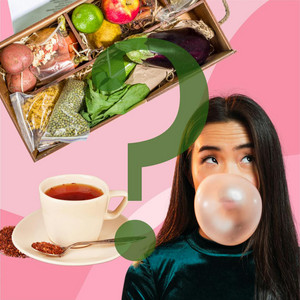
my name is valerie am calling from richlands north carolina and my question is something my husband and i have debated about for months what the heck is bubblegum flavor that is a good question i can immediately call up the flavor in my mind when someone says it because like most people who grew up in america i chewed plenty of bubblegum as a kid but there's like no bubblegum tree.
So yeah, what is it?
This business of bubblegum's true essence is not the only question on Gastropod listeners' minds these days.
The world is full of mysteries, and you are all curious about them.
Fortunately, Gastropod is here to investigate.
That's right, you are listening to Gastropod, the podcast that looks at food through the lens of science and history.
I'm Nicola Twilley.
And I'm Cynthia Graber.
And in this installment of our Ask Gastropod series, we've selected three of your questions to answer.
Bubblegum is obviously one of those.
And then Oliver, who's South African, wanted to know if it's true that all the rooibos tea in the entire world comes from a particular mountain range in his home country.
That seemed pretty far -fetched to him.
And our listener Porter has an important question about meal kits.
Are they better for the planet than just buying ingredients at the grocery store, even with all that packaging?
Has anyone done those calculations?
We have the answers.
This This episode was supported in part by the Alfred P.
Sloan Foundation for the Public Understanding of Science, Technology, and Economics.
Gastropod is part of the Vox Media Podcast Network in partnership with Eater.
And a quick heads up before we get going today, the paperback version of my book, Frostbite, is out on June 24th, so if you have been waiting for that soft, soft cover, this is your cue to get out there and purchase a copy.
It's won a bunch of awards.
The New York Times called it a page -turner that was hard to put down, and if you like this show, you'll love it.
Support for this show comes from Pure Leaf Iced Tea.
When you find yourself in the afternoon slump, you need the right thing to make you bounce back.
You need Pure Leaf Iced Tea.
It's real brewed tea made in a variety of bold flavors with just the right amount of naturally occurring caffeine.
You're left feeling refreshed and revitalized, so you can be ready to take on what's next.
The next time you need to hit the reset button, Grab a Pure Leaf Iced Tea.
Time for a tea break, time for a Pure Leaf.
is all on the app. Download today.
This episode's first mission comes from none other than listener Porter from New Mexico.
I was wondering what you guys can find out about sustainability and meal kits.
Meal kits are very convenient, as I can attest to.
My partner and I have been getting them for over a year.
But what Porter wants to know is, can she have her cake and eat it too?
Or are these oh -so -convenient meal kits actually destroying the planet with all their packaging?
Meal kit companies like HelloFresh make a lot of sustainability claims, such as reduced carbon emissions and reduced food waste.
But I find it hard to believe that such a convenient option would also be the sustainable one.
We are going to investigate.
But first, we have to start at the beginning of meal kits, which turns out to be a couple of decades ago.
We called up someone who knows something about them.
Brenna Ellison is a professor in the Department of Agricultural Economics at Purdue University.
I feel like they've morphed a lot over time, but I think the first ones really started as, you know, sending you a meal that you put together and prepare.
You chop the ingredients, you cook the food.
The concept of a meal kit apparently first hit the market in 2000, thanks to a London -based company called Leaping Salmon. This was the early days of the internet and foodies who wanted to throw dinner parties without all the planning and shopping could sign up for these snazzy new meal kits, complete with recipes from Michelin -starred chefs.
All the ingredients were in the boxes, you just had to chop and stir and sauté and serve.
Apparently, Victoria and David Beckham were early adopters.
Meal kits became a little more mainstream when they were introduced in Sweden in 2007.
The founder there, a mother of three, named her company something that translates to dinner piece, meaning that parents didn't have to worry about the logistics of the meal, and the company became popular enough that it spread throughout a bunch of countries in Europe.
But it was pretty small, very niche.
The bigger companies like the HelloFresh, you know, Marley Spoon, EveryPlate kind of companies, they've been around since sort of the mid -2010s.
This is Rebecca Bennett.
She's a postdoctoral research fellow at Deakin University in Melbourne, Australia in the Global Centre for Preventive Health and Nutrition.
Like she said, these bigger companies like HelloFresh launched in the U .S. in 2012, and the market has only grown since then.
There are more than 300 different meal kit companies out there today.
Just to pull up a nice little stat.
So in 2018, the worldwide revenue was U .S. $5 billion, but this year it was $14 billion.
Brenna and Rebecca both agree that it was COVID that really gave these companies a big boost. People being home, having time to cook, maybe not wanting to go out to a supermarket, market, wanting to stay at home.
These really convenient options really cemented their position in the market.
Rebecca told us that still today, quite a lot of people use meal kits regularly.
So I just did a study recently.
So it was a survey of participants across Australia, the UK, US, Canada, and Mexico.
And so we asked them in the previous seven days, how many of you have used a meal kit or purchased a meal kit?
And across the survey, it was actually almost 14 % So I think that's quite a lot in the previous week to have used a meal kit.
And in the US, that was the highest with 17%.
I think that's quite a lot, too.
I mean, it's one out of every six people in America.
So why are all these people using meal kits?
Is everyone just loving the convenience?
How exactly are they helping?
Yeah. So some work that's been done by one of my colleagues here at Deakin, Kylie Fraser, she interviewed Australian families to figure out why they like using meal kits.
And part of the criteria for participating in the study, you had to be the primary meal provider in your family.
So unsurprisingly, all the participants were women.
Big say. Sad but true for most families.
What they found was that for these women using a meal kit, it helped them with their mental load.
So instead of having to be thinking about, oh, what am I making tonight for dinner?
They know the meal kit sorted it out.
I don't have to go to the grocery store.
It's all in the box.
So that was the real driver of use, that feeling of reducing stress, helping with family meal planning and taking the load off mothers.
Which Rebecca can personally vouch for.
So I have been using meal kits on and off since I went back to work at the start of 2018 after maternity leave. So, you know, I felt when I read Kylie's study, I was like, oh, my gosh, it's me.
Brenna also uses meal kits and she told us it's for the same reasons.
Yeah, so I have a three and six year old at home.
And I'm gonna be honest, like meal planning is a mental activity that is just like not, not for me right now.
And so I feel it's really easy to get stuck in a rut with what I plan to cook and what we eat at home.
And so this is a way to try to diversify what we eat.
And admittedly, I'm not a very creative vegetarian cook, but I like vegetarian meals.
And so I personally really like the vegetarian options, and more international flavors that I just don't feel that confident in.
cooking on my own. Brenna told us she feels that it also helps her not throw out as much food, like if she wants to try a recipe with a new ingredient.
She told us about a meal kit that came with harissa.
It's a Middle Eastern spicy red pepper based paste or powder.
I don't have that at home.
And so this gives me exactly what I need versus me maybe going to the store and buying a whole six ounce container.
And if I don't like it, then that container might sit in my pantry for you know months on end until i eventually throw it away or if you're making you know you want to make hamburgers for two people it gives you exactly like two buns instead of a package of eight that you might not use otherwise we took an informal survey ourselves we asked you listeners if you've used meal kits and if so what you liked about them and you gave similar answers they help you out with decision fatigue they take the stress out of meal planning they help you learn new techniques in the kitchen or try new ingredients
and you hoped they cut down on food waste.
But one thing a lot of you who use Meal Kit said, and it's what Porter asked about too, is that you were worried that with all the packaging, there was no way these could be good for the environment, even if they do reduce food waste.
So let's break this down and look at food waste first. Does using a Meal Kit subscription cut down on food waste?
Brenna said it did for her, but that's just her own personal experience.
What does the data say?
I haven't seen any research done by academia.
But I know two of the big meal kit companies have commissioned studies of their own.
So I think both Blue Apron and HelloFresh have hired consultants to come in and do studies with their users.
And so they would have people self -report waste when they use the kits.
And so from a research standpoint, that's not our first preferred way of doing it.
To be really sure that you're getting accurate results, you'd want to see an independent study where researchers are weighing the amounts that are thrown away for both regular grocery store cooking and meal kit cooking.
But according to Brenna, that hasn't been done.
So we have to go with these less rigorous studies conducted by the companies themselves.
It's also better than nothing.
And so in general, both studies find or point towards evidence that like they do reduce waste.
But then, so what about all the packaging?
Does that negate the benefit of reduced food On the studies that have done life cycle analyses, they've come out saying that the benefits from reducing food waste often can outweigh the cost of the packaging, because when you put food into a landfill, it emits methane, right?
And methane is one of those gases that's really like increasing the rate of global warming, whereas the packaging waste does not quite release as much into the atmosphere.
A lot of different factors get added up into these life cycle analyses, and they operate based on averages, the average amount of packaging across all food types and meal kit plans, but also the average amount of food Americans waste.
Another thing that's included in the life cycle analyses is driving.
So the researchers have concluded that it's more efficient for a delivery truck that's already out making the rounds to take these meals to your home rather than you driving to the grocery store in your car to get the ingredients for your home cooked meals.
But what that means is, if you bike to buy your food or you order your groceries for a home -cooked meal online and they get delivered via an optimized delivery route, or you're just really good about using up your kale before it goes bad, then your results may differ and a meal kit's environmental advantages might not outweigh its downsides.
It does, on average, but it might not for you.
Also, because Brenda says maybe your drives to the grocery store are more efficient than they assume in the life cycle analysis.
And I think with those studies, like kind of have to take them with a grain of salt.
They're built on a lot of assumptions, right?
And I think some of the things that get left out, though, is like a meal kit.
I still think a lot of people, self -included, supplement whatever meal kit they get, and they still go to the grocery store.
So that last mile transport is still happening.
I still buy my kids breakfast and we still pack lunches, right?
I can't get all of those things from the meal kit.
And so a lot of the studies I've tried to compare are getting five meals from a meal meal kit company and the same five meals from a grocery store, but it might leave out the extra efficiencies you get from a grocery store.
Ultimately, it's not clear that meal kits are substantially better for the environment or substantially worse.
But Brenna said that for most Americans, the environmental benefits seem to outweigh the costs.
Okay, that's the environmental implications.
But what about the health benefits?
How good are these meal kits for us?
I know even the major players, they've really had a big focus on health.
So now there's a lot more vegetarian options.
You can choose like low -carb options.
You can choose gut -healthy options.
Like there's lots of different ways they're trying to appeal to health -conscious consumers to try and persuade them, I guess, that this is the way to go.
And do the meals live up to this promise?
So one of the things that's interesting is a meal kit is supposed to be like a home -cooked meal.
And Rebecca told us that's the pinnacle when it comes to healthy eating?
Well, we know that food that's prepared at home is just better for you in pretty much every way than food that you buy.
It's lower in fat, higher in vegetables, higher in fiber.
So we know that cooking at home is really the gold standard. That's the way to go home cooked meals from scratch. And so if you're looking at meal kits from a nutritional standpoint, do they offer the same thing?
So there's been actually quite a lot of work looking into this, particularly in Australia.
I think there's about half a dozen studies that have, you know, analyzed the meal kits and I think overall what they've found is that they do provide good servings of vegetables so sort of between the two to two and a half serves per person per meal which is quite reasonable if you're going for you know your seven serves a day but then in other things they do fall down a little bit often the sodium content is quite high often the fat content is quite high so it's kind of a mixed bag.
But then again maybe the meal kit isn't replacing a home -cooked meal.
Maybe that's not how people are using them.
Maybe the better comparison is meal kit versus takeaway or meal kit versus like a frozen lasagna or something.
That's maybe a better comparison.
And so if you stack them up against those kind of meals, they do perform quite well.
But so if the ultimate goal is home cooking, if that's the gold standard, then meal kits offer another benefit.
Rebecca said meal kits actually help people learn their way around the stove.
I think what these have found though in their nutritional analysis is they do teach people how to cook and so if you're not confident in the kitchen this is like a good stepping stone.
Several gastropod listeners confirmed this data point from your own personal experiences.
A few of you said that meal kits have for example taught you the transformative potential of adding lemon and lime zest and also helped your kids gain confidence in the kitchen.
Brenna's gone on the exact same meal kit to home chef journey herself.
Like she said, she has meal kits to thank for her newfound love affair with harissa, which turns out to be the perfect addition to roasted chickpeas.
And so like I actually ordered my first like container of harissa powder and I'm like excited to try it on my own, but I would have never done that otherwise.
And so that kind of built confidence in that way.
One of the things that makes it hard to really understand the impact of meal kits, both for the environment and for our lives is that they're kind of new, at least in academic terms. Even though we say meal kits have been around for 10 years, research moves very slowly.
So for us, you know, it takes sort of maybe even two plus years to have an idea and to see it all the way through.
So some of these things we're still catching up.
And just to make things more challenging for researchers, people don't keep their meal kit subscriptions going forever.
more than half cancel within the first six months and about 90 % cancel within a year.
You listeners confirmed this.
You told us they got expensive.
Some of you said you got tired of the ingredients and flavors they offered.
Some of you were just in a different phase of your life and ready to move on.
Plus, the market keeps changing.
Today, there are grocery stores offering meal kits, restaurants offer meal kits, and meal kit companies have a bunch of different options for all kinds of dietary restrictions and all levels of cooking.
Some meal kits are really just prepared meals.
Which is sometimes exactly the zero effort answer you're looking for.
Sometimes I think like you hit busy weeks and you're like, oh, I still don't want to cook.
Like I would say for me, that's just the personal barrier is still not being all that excited to cook, even though someone did the planning for me.
At the end of the day, whatever the research says, the point is, does it work for you for now?
And if it does, great.
And it turns out you probably don't need to stress too, too much about that packaging.
So that's good. Save your mental energy for our next conundrum.
Is it really possible that all the rooibos tea in the world comes from one mountain range in South Africa?
We've got that story after the break.
Support for this show comes from Pure Leaf Iced Tea.
You know that point in the afternoon when you just hit a wall?
You don't have time for self -care rituals or getting some fresh air, so maybe you grab a beverage to bring you back.
But somehow it doesn't do the trick, or it leaves you feeling even worse.
What you need is a quality break, a tea break.
And you can do that with pure leaf iced tea.
Real brewed tea made in a variety of bold and refreshing flavors with just the right amount of naturally occurring caffeine.
With a pure leaf iced tea in hand, you'll be left feeling refreshed and revitalized with a new motivation to take on what's next.
The next time you need to hit the reset button, grab a Pureleaf iced tea.
Time for a tea break.
Time for a Pureleaf.
Fox Creative. This is advertiser content from Adobe.
As the chief marketing officer for a tech company, I lead a team that makes fresh content on a daily basis.
But this month has been particularly nuts because we're planning a conference.
There are dozens of people working together on all the documents, slides, posters, flyers, and merchandise.
Fortunately, our event marketer is the best in the business.
And she said two words, Adobe Express.
Adobe Express has been a lifesaver.
Brand kits have kept everything consistent.
Templates mean whatever content we need to create looks slick and professional from the start.
And easy syncing of assets means that any time a change comes in, Like a last -minute swap out of our new app logo?
I know that every team member will instantly have access to the latest version.
That way I know when the curtain goes up.
Isn't that new logo gorgeous?
Everything will go off without a hitch. Adobe Express, the quick and easy app to create on -brand content.
Learn more at adobe .com slash express slash business.
We'll see you next time.
My name is Oliver. I'm from Cape Town in South Africa.
I live in Switzerland now, but I'm calling from France.
Listening and calling in from all around the world.
Love it. But Oliver's question had to do with his home country.
How can it be that rooibos tea is so popular in the world, but apparently it's only grown in a very small part in South Africa.
So I was wondering, can it be that this small little region produces enough rooibos for the whole world, or is something fishy going on here?
Ooh, here we go. We love a good food crime investigation here at Gastropod.
We do indeed. But we were also interested in answering this question because when it came down to it, neither of us really knew anything about rooibos tea.
I mean, we both tasted it, but we hadn't really thought about it beyond that.
But for Oliver, it is tea.
Yeah, so growing up, it was like the default tea that I had.
I didn't recognize other teas as teas.
And I still need to think a bit about like whether green tea and black tea is considered tea in my world.
Yeah, that is not where I'm at when it comes to tea.
Honestly, at least outside of South Africa, lots of people are not familiar with rooibos at all, including, at least originally, our rooibos expert, Boris Gorelick.
I came across the name of the tea, rooibos tea, which sounded strange to me, and I'd never tried it.
Boris is a senior research fellow with the Institute for African Studies at the Russian Academy of Sciences in Moscow.
But he also, somewhat randomly, is the author of The Story of rooibos.
He decided to try rooibos tea when he visited South Africa to do research on the history of Russian immigration there.
He liked it and he fell down the rooibos rabbit hole.
So as you've probably figured out by now, rooibos is an herbal tea.
After you brew it, it's a dark reddish maroon color.
It's a little floral, a little earthy, a little intense.
And as Boris said, the rooibos plant itself is native to South Africa.
and grows in an area that's about 200 kilometers northwards of Cape Town.
It's a semi -desert, and there's a long mountain range called Cederberg.
Very beautiful mountains.
And in South Africa, what that area is famous for is, first, in springtime, tourists flock there.
They love it because it's full of flowers.
And it's like a huge, huge multicolored carpet.
This area encompasses something called the Thanebos biome.
It's one of the six floral kingdoms in the world.
In other words, this area is home to its own unique evolutionary family of flowering plants found nowhere else on the planet.
It's a region the size of Portugal, but it's more biodiverse than the whole of Europe.
And the second reason people go there is for rock paintings paintings because the indigenous people of that area, the Khoisan people, they lived there for thousands and thousands of years and you can still find their paintings.
Baris says the area is still relatively rural.
It's only a few hours drive from Cape Town, but up in the mountains there, it's a totally different world.
And the rooibos bush is one of the many native faneboss plants that grow there.
It is a bush, but it looks sort of grassy.
And that's because like a lot of plants In the region, its leaves are needle -shaped.
They're very narrow, like spiny leaves.
And they're so narrow because it's a semi -desert, you see?
And these narrow needle -like leaves, they help the plant to keep moisture.
It's unclear whether the indigenous Khoi or San people drank rooibos tea, but they certainly knew and used the plant.
There is some archaeological evidence that several thousand years ago, people used the rooibos plant for in some way in their caves but what they used it for nobody knows when i spoke to people they told me that their parents and grandparents used rooibos not only for drinking but for instance as cosmetics so women would mix rooibos with fat and use it as rouge on their cheeks for instance and then of course there were some medicinal healing properties attributed to roevers mostly unconfirmed of course English and Irish immigrants started to settle in this region in larger numbers in the early
1800s and as per the stereotype we are indeed fond of a cup of tea but we like black tea like from Asia but Asian tea was quite expensive so people looked for substitutes, for Azad's teas.
And that's where the indigenous knowledge came in handy, because people knew, local people, the indigenous people knew how plants tasted and what plants could be suitable for these purposes.
And so with some help from the locals, the settlers started brewing cups of rooibos.
As we said, it's dark with a slightly earthy flavor, so they could pretend to themselves that they were drinking black tea, even though they didn't get the caffeine hit.
Boris told us that people in the early 1800s would gather the leaves in the wild, then they'd put a pot of rooibos on and just let it basically stew all day, getting stronger and stronger.
But the tea wasn't really known at all outside of the region.
Because it only grew, the bushes only grew in big numbers around the Citiburg area.
And Citiburg area was very far, well, in those days, that was very far.
So it was a remote, isolated area.
In the mid -19th century, he had to travel for two weeks from Cape Town to Clanwillim, which is the village, the main village there.
So it was hard for the Tea's popularity to expand beyond that one particular area of South Africa.
But that started to change when Benjamin Ginsberg showed up in town.
Benjamin Ginsberg was a Jew from the Russian Empire.
His family emigrated to South Africa in the late 1800s.
So Benjamin Ginsberg was about 15 when he reached South Africa, and they settled in the Rooibos growing area.
Apparently, they had no money.
They were quite poor.
They set up a trading post on the main road leading from Llan William to Cape Town.
They had a general store there.
And that's where Benjamin learned about Rooibos.
And apparently, being more business -minded than his father, he saw an opportunity there, and he became one of the earliest traders in Rooibos.
He came up with a genteel -sounding brand for his tea, 11 o 'clock.
Like, time to take your tea and biscuits.
This delightful little morning break is traditionally called elevensies in British English.
In Benjamin's version, the tea was rooibos and the biscuits were a South African rusk, which is apparently like a buttermilk biscotti.
Buttermilk rusks are, like, really hard kind of bready things that you need to dip into something to make them edible.
but once they are dipped, they are delightful.
And Oliver says that rooibos is great for rusk dipping at 11 a .m. or at any hour of the day.
It's the perfect tea for me because you can't steep it too much. It never gets too strong.
And it's really lovely with like honey or with ginger.
And the best camping breakfast you'll ever have, at least in my world, will be rooibos tea and buttermilk rusks.
Back when Benjamin was getting started, this wholehearted appreciation for rooibos was still a minority view.
But regardless, Benjamin went all in.
By the mid -1920s, he became the biggest buyer of rooibos, which still wasn't cultivated.
There was no cultivated variety at the time.
So he bought from people living in the mountains and people who collected rooibos tea in the wild.
But there were a couple of issues with collecting rooibos tea in the wild.
One, the quality wasn't super consistent.
And two, it was causing some environmental problems. Pickers and farmers, they wanted to encourage growth of rooibos.
They started burning, making fires in that area because it stimulated the growth of wild rooibos plants.
And all that fire led to soil erosion.
Benjamin had a friend, a medical doctor named Peter Nortier.
And Peter was becoming increasingly worried about the impact of harvesting rooibos tea on the local environment.
So Peter, Benjamin, and a couple of their friends got together to try to develop a domesticated rooibos bush that consistently produced quality tea and that grew well without fire.
The only challenge was collecting seeds to use to breed new rooibos bushes.
First problem, the wild plants are scattered sparsely across the landscape.
They are few and far between.
And then the seeds themselves are absolutely minuscule.
So these four guys hired farm workers to go search for seeds.
The farm workers had to lie down on their stomachs next to the rooibos plants and just scour the ground for tiny, tiny seeds.
And how many seeds can you collect within the day?
I don't know, 10 maybe, 5 or 10.
Which made the whole project pretty slow going.
But then a couple of farm workers noticed an ant carrying a rooibos seed.
So they followed the ant to the ant hill and they realized that ants were storing the seeds there.
they looked into the anthill, and then they saw plenty of rooibos seeds.
They could actually use a spoon and a matchbox, and they could fill that matchbox instantly, you know, within minutes.
Suddenly, Peter had a lot of seeds, and pretty soon he'd come up with a plant that didn't need fire to regenerate and provided great tea leaves.
The new domesticated rooibos bushes didn't live as long as the wild ones, but the other advantages were more important.
The timing was also great because slowly but surely, more South Africans were getting into drinking rooibos.
The demand grew first during the Second World War because it was very hard to import Asian tea from India or Sri Lanka during the Second World War.
So once again, people turned to rooibos as a stand -in.
That said, even at this point, rooibos still wasn't super popular in South Africa, certainly not as popular as the Ginsburg clan wanted it to be.
So Benjamin's son Charles, or Chas as he went by, he took matters into his own hands.
Chas Ginsberg was the man who really made Rooibos into a drink that was familiar to the whole of South Africa, to the entire country.
And it was thanks to him that the demand grew so much that he needed to establish plantations.
Chas ran ads in the country's movie theaters and got his family's 11 o 'clock tea stocked in grocery stores across the country.
He even formed a rooibos control board to make sure everything sold as rooibos was good quality.
But most South Africans still saw rooibos as a second -class substitute, not as good as real black tea.
Until Anique Turon and her sleepless baby came along.
The name Anique Turon has been synonymous with rooibos tea for more than 40 years.
She's widely credited for discovering the exceptional healing properties of the indigenous in this plant and having made rooibos one of South Africa's most recognizable exports the world over.
It all started back in 1968.
Anique was living in South Africa with a baby who was colicky and who just would not sleep.
Anique told the story in an interview.
She cried from the third day.
And, you know, right through the next 14 months, we had a terrible time with her.
And usually anicitron would give her warm milk or warm milk milk substitute so that would soothe her that would calm her down at least for for a while but one day she didn't have the milk warmed up but she did have a pot of freshly made robus so to warm up the milk she added a little bit of the hot tea with nothing short of astounding results without bringing up a milk my baby oh well she's a big girl now proceeded to sleep solidly for three hours something she had never done before and this apparently wasn't just a fluke.
Annick kept giving the baby some rooibos and the baby actually finally slept.
Annick felt like it was some kind of a miracle.
So she told the rooibos control board of her discovery.
She said, I've discovered these properties of rooibos.
Does anybody know of these properties?
Has anybody researched them?
Annick's quote unquote miracle was like a gift from heaven to the rooibos control board too.
And they quickly set scientists to work.
Boris says that they published some papers in the 70s showing rooibos does have antispasmodic properties in the gut.
We're definitely not saying that rooibos cures colic and puts all babies to sleep, nor are any scientists.
As Nikki said, there is research about rooibos helping to calm gut spasms, but that's all science thus far has concluded.
It could have been the rooibos that helped Anik's baby, or it could have just been a baby outgrowing a problem.
But either way, Chas Ginsberg and the rooibos control board marketed the living crap out of this story, and marketers didn't just tell Anique's story.
They also then claimed that rooibos could help your nose stop running and make your skin glow and cure dandruff.
Rooibos. Who would have thought that it concealed such beneficial remedies for so many ills for so long?
And it became huge.
The story became huge in South Africa, and then they tried to use it for experts to promote rooibos experts.
But exports were still pretty slow, because starting in the 60s, there were economic sanctions against South Africa and its apartheid government.
In 1994, that government fell, and in 1995, the sanctions were lifted.
So that at least opened the international market to Roybus.
Still, most non -South Africans had never heard of the stuff.
That started to change in the late 1990s when the writer Alexander McCall Smith came out with the first in the number one ladies' detective agency series.
And his best -known own creation was Mari Motswe, a fictional detective from Botswana who likes to drink rooibos and she gives rooibos tea to her clients when they come to her and they're all excited or frightened.
She would give them rooibos, rooibos calms them down, and then they start to think rationally and then you can, you know, she can interview them and get the information that she needs.
Look, I will make us a cup of bush tea.
There is no problem so great it cannot be solved by a cup of bush tea.
And she, Mara Motsva, also drinks tea, rooibos tea herself, because it also helps her to think clearly about the problems that her clients bring to her.
And then, as often happens, what helped make rooibos slightly more of a household name, at least in America, were, of course, celebrities.
Charlize Theron was into it.
Woody Harrelson was a fan.
And Dr. Oz said it would help people lose weight, specifically seven pounds per year, which Lord only knows where he came up with that number.
Food in South Africa is so multicultural, it's called rainbow cuisine.
Internationally famous fare that's embellished with indigenous ingredients.
But it's what South African women drink that they can't wait to share with the rest of the world.
In case we're not being clear enough, this whole thing Dr. Oz is promoting that rooibos will help you lose weight, it's a load of hooey.
But many people love to drink a nice hot cup of Hui.
And there was enough demand for Rooibos that in 2005, the mega tea company Celestial Seasonings added it to their lineup of herbal teas.
Today, Rooibos is relatively well known among all the herbal tea options out there.
It's pretty popular in Germany, there is a decent sized market in Japan, plenty of Americans occasionally drink a cup of Rooibos.
Which obviously does raise the question, the question Oliver actually asked us, does all this rooibos still just come from the Cedarburg Mountains in South Africa?
Or is something fishy going on after all?
Boris told us that all that rooibos is in fact legit.
It does only come from that region.
People have tried to grow it commercially outside South Africa, but the rooibos plant just didn't take.
Roybus is quite demanding because it needs wet winters and very hot, arid summers, and it needs a particular kind of soil, loamy soil, and it grows at comparatively high altitudes.
So when I heard this, I was like, wow, why is this stuff not like gold dust?
If it only grows in this one place, then surely there's a limited supply.
But Boris told me not to panic.
There's still plenty of land in the traditional rooibos growing area where they can expand rooibos cultivation.
So rooibos exports from South Africa are sufficient.
In the story of how interest in rooibos helped it break out of its small region in South Africa to make it big on the world stage, we made it sound like there's a massive demand for rooibos in and out of South Africa.
But the demand actually isn't that big.
That mountainous region in South Africa is growing enough rooibos for 6 billion cups of tea a year, which is plenty for all the rooibos drinkers in the world today.
To put that into context, all around the world, people drink about 6 billion cups of black tea per day.
In other words, rooibos drinkers are still a niche market.
And like Boris says, there's still room to grow more rooibos in the Cedarburg mountain region.
Although scientists are beginning to warn that as the plantations expand, ban, there is some evidence that some of the region's unique biodiversity is being threatened.
Still, if you like rooibos, you should enjoy it.
Maybe not as your only herbal tea.
Maybe not every day.
There is an entire world of herbal teas out there.
Lots of them are delicious.
There's no particular health reason to drink rooibos over any other herbal tea, so enjoy them all.
And now, with two mysteries solved, we're coming full circle like a bubble.
That's right, it's time to get back to Valerie and her question about bubblegum flavor coming right up after after this break.
Visit mercury .com to join over 200 ,000 entrepreneurs who use Mercury to do more for their business.
Mercury. Banking that does more.
Support for this show comes from Smartsheet.
Do you ever wonder how many times a day you toggle between different screens, applications, and windows on your computer?
Maybe 20 times? Okay, maybe 50 on a bad day?
Try 1 ,200 times a day in a single day.
Now, multiply that by all the days you work in a year, and that's 9 % of your time spent toggling.
That is so much wasted time simply clicking back and forth.
Imagine what you could do with all that extra time.
Smartsheet is here to help you take all that extra time back.
Smartsheet is the work management platform that helps your team remove roadblocks, ease friction, and cut those back -and -forth clicks down to a number that doesn't make your head hurt.
With tools that allow your team to manage their workflow all in one place, you'll spend less time toggling and more time driving results, fostering creativity, and scaling to new heights.
Smartsheet. Work with flow.
Learn more at smartsheet .com.
It's impossible to find more time in the day.
Until now. With HubSpot's suite of AI -powered tools, you can get more done way faster.
Speed up your lead generation.
And create attention -grabbing, lead -driving, quota -crushing campaigns in an instant.
Which will give you more than enough time to listen to podcasts like this one.
HubSpot. Impossible growth, made impossibly easy.
Get started today at HubSpot .com slash AI.
In case you need a reminder, here's Valerie's conundrum.
What the heck is bubblegum flavor?
Like when did this become the flavor of bubblegum?
And is it, are there standard bubblegum flavors everywhere?
And are they the same?
Has it always been like this?
It's become a weird fixation.
Let's start with the first question.
What the heck is it?
Why can I imagine what it tastes like when I bite down, but I can't exactly describe it?
I would say that's because bubblegum is what we would call a fantasy flavor.
You're not going to go be able to pick a bubblegum up of a tree.
It's definitely like made up.
This is Gwendolyn Graff, and she is a real -life bubblegum scientist who works in bubblegum R &D.
Yes, kids, that is a job you can have when you grow up.
Fantasy flavor is also a real thing.
For instance, you can't find blue raspberries in the world, but blue raspberry flavor is in Jolly Rancher candies and popsicles.
But even though bubblegum is a fantasy flavor, it is based on real flavors.
I would most likely describe it as orange plus cherry.
I think if you got two jelly bellies and you put orange and cherry together, you would mix them together and you would say it's bubblegum flavor.
Mystery solved. It's like math.
Cherry plus orange plus a lot of sweetener equals bubblegum.
But since it's a fantasy flavor, once upon a time it didn't exist. So who is the Einstein who came up with this new universal equation?
To answer that, we need to go back to the invention of bubble gum itself, which is a story we told in our chewing gum episode a couple years ago.
So bubble gum was invented in 1928 by a guy called Walter Diemer, who, believe it or not, was an accountant.
He worked at this chewing gum company, and coming up with a gum that was more elastic and less sticky So you could blow a bubble?
That was his side hustle.
But actually, the first time he made bubblegum, he actually made it like a mint flavor.
He put some like mint oils because at the time, that's what they like did with gum.
It caught on and blowing bubbles quickly became popular with kids.
But the mint flavor wasn't a big hit.
Gwendolyn told us nobody knows exactly when someone at the company mixed some fruit flavors together for their new bubbly gum.
I'm assuming just because it became associated with a kid's product, they started going towards the fruit flavors.
Because when you look at gum as a whole, you know, mints tend to be in the adult flavors and kid flavors tend to be in the fruits.
You can see exceptions to those, but that's mostly how it goes.
However they landed on this sweet orange and cherry mix, it became the standard bubblegum flavor.
And as time went on, people started using bubblegum flavoring for things that aren't bubblegum.
I literally saw bubblegum flavored soda on the shelf at a supermarket last week and I did not feel even remotely tempted to try it.
But I'm clearly not the target market.
I've seen lots of things.
Yeah. I mean, lots of obviously candies and lollipops and stuff that's already in the confection.
But even like I remember one year, I think 7 -Eleven did like bubblegum flavored slushie, you know what I mean?
Get drinks and obviously ice cream.
And for grownups who still love kid flavors, you can get bubblegum energy drinks and bubblegum vodka.
I am also not the target audience for this.
I think it sounds pretty gross.
And another thing that at least our listener Valerie's son thinks is disgusting is bubblegum flavored medicine.
They will add it as a flavor to help it go down more easily, but it makes it, it's terrible.
It makes it even worse.
And so now anything bubblegum flavor is disgusting to him.
He thinks I'm trying to drug him every time.
I give him a jelly belly that's, you know, bubblegum flavor.
Clearly a spoonful of bubblegum does not necessarily help the medicine go down.
But Valerie wanted to know, are all bubblegum flavors the same?
Gwendolyn told us that even within the world of bubblegum flavor, there are nuances.
Shades of pink, let's say.
When I was a kid, we had like bazooka and bazooka was a gum that we blew.
And that one has a slight bit of mint in it, like a slight little bit of wintergreen.
So it can kind of vary.
But even if these flavors vary slightly from brand to brand, they are still recognizable as bubble gum and they're still popular today.
I'd say if you're strictly talking about bubble gum, bubble gum is probably like the biggest bubble gum flavor.
But not all gum that you can blow bubbles with is bubble gum flavor, if that makes sense bubble gum comes in plenty of other flavors usually the first fruit that's the the most common is strawberry and then it tends to kind of go back and forth between grape and watermelon as the as the second and third gwendolyn told us that other countries have popular flavors that are a little unusual to us here in the u .s i happen to be here now in the uk right now but But their really popular flavor is blackcurrant.
It is indeed. We love blackcurrant everything.
Our purple skittles and other sweets are all blackcurrant flavored, not grape.
But Gwendolyn thinks it tastes a little bit like dirty socks.
It's funny because as a developer in the States, you're like, I'm not really a fan of this flavor.
But you just have to get acquainted with what it should taste like and then make sure that you're replicating it.
We were wondering if Gwendolyn could replicate any flavor in bubblegum form.
And Gwendolyn said actually, yeah, her own career is testament to that.
She has come up with a lot of new bubblegum flavors in her time.
If I had to give you a number, it would be in the hundreds, definitely.
Some of those flavors were seasonal ones.
We like had summer frenzy flavors where we'd put new flavors out.
We did like a new product every couple weeks because kids just like like to try new things, new things, new things.
These were limited time specials like Pink Lemonade and Triple Play Tropical.
So far, so relatively normal.
But in the safety of the R &D lab, Gwendolyn and her colleagues got up to some real Willy Wonka stuff.
I've tried lots of things.
We've tried drink flavors.
We've tried herb flavors.
We've tried vegetable flavors.
We've tried meat flavors.
We've tried pizza flavors.
We've tried cheese flavors.
There was some funny ones, like somebody was like, can we do a beef jerky?
Oh my goodness, do you know how weird a beef jerky gum is?
Like you keep wanting to swallow it.
Like it's so weird. And like I put a lot of salt and pepper in it and it did taste like beef jerky, but it kind of just messed with your mind.
So yeah, and there are some flavors that have been pretty terrible.
Oh, mayonnaise flavor, liquid filled mayonnaise flavor.
I'm going to stick with the classic myself.
Now, I was a pretty big fan of blowing bubbles when I was a kid, but one thing I could never do was blow a double bubble.
bubble. Gwendolyn can, and she gave us a masterclass.
In order to blow a good bubble, you need to have a lot of gum and you need to chew out all the sugar, first of all, because the sugar, if you think about a bubble, it's like a film.
And if you had sugar crystals in it, they're like poking holes in the film.
So you've got to dissolve all the sugar out.
So you have to kind of chew it until it's not so sweet anymore.
Or really the way to test it is to put your tongue up on the top of your mouth and run it and make sure it's not bumpy at all.
And then And you do that.
You put it up on the top of your mouth with your tongue and you flatten it to like a pancake.
And then you're going to turn your pancake and invert it here and you're going to put it behind your teeth.
Gwendolyn makes it sound so simple, which is good because I have never, ever blown a bubble in my life.
I need the baby steps.
Then you're going to put your tongue just through it just a little to make like a, you know, sometimes when you blow a balloon, you got to like kind of loosen it first, you know, you kind of blow it and then you kind of really blow it.
I do. I've done it with a balloon, and I've done it with plenty of bubble gum.
But here's where it gets interesting.
She says you don't have to blow a huge bubble, just a decent -sized one.
Then you close it off, you pinch it off with your lips, and then you go again.
You put your tongue back through the hole, and you blow another bubble inside that bubble.
I was already in awe, but Gwendolyn is not done.
Well, I can usually do a triple bubble as well, but I have a good one.
I'll leave that one to Gwendolyn.
But keep your questions coming, because Ask Gastropod will be back with a new installment later this year.
Don't forget to sign up to be a Gastropod special supporter if you'd like a South African rusk recipe to go with your rooibos.
And definitely don't forget to pick up a paperback copy of Frostbite.
I promise you won't be disappointed.
Thanks this episode to our listeners, Valerie, Oliver, and Porter.
And to our guests who answered their questions, Rebecca Bennett, Brenna Ellison, Boris Grelik, and Gwendolyn Graff.
We have links to their books and research at our website, gastropod .com.
And thanks, as always, to our awesome producer, Claudia Geib.
We'll be back in a couple of weeks.
Till then. Support for this show comes from Pure Leaf Iced Tea.
When you find yourself in the afternoon slump, you need the right thing to make you bounce back.
You need Pure Leaf Iced Tea.
It's real brewed tea made in a variety of bold flavors with just the right amount of naturally occurring caffeine.
You're left feeling refreshed and revitalized so you can be ready to take on what's next.
The next time you need to hit the reset button, grab a Pureleaf iced tea.
Time for a tea break.
Time for a Pureleaf.