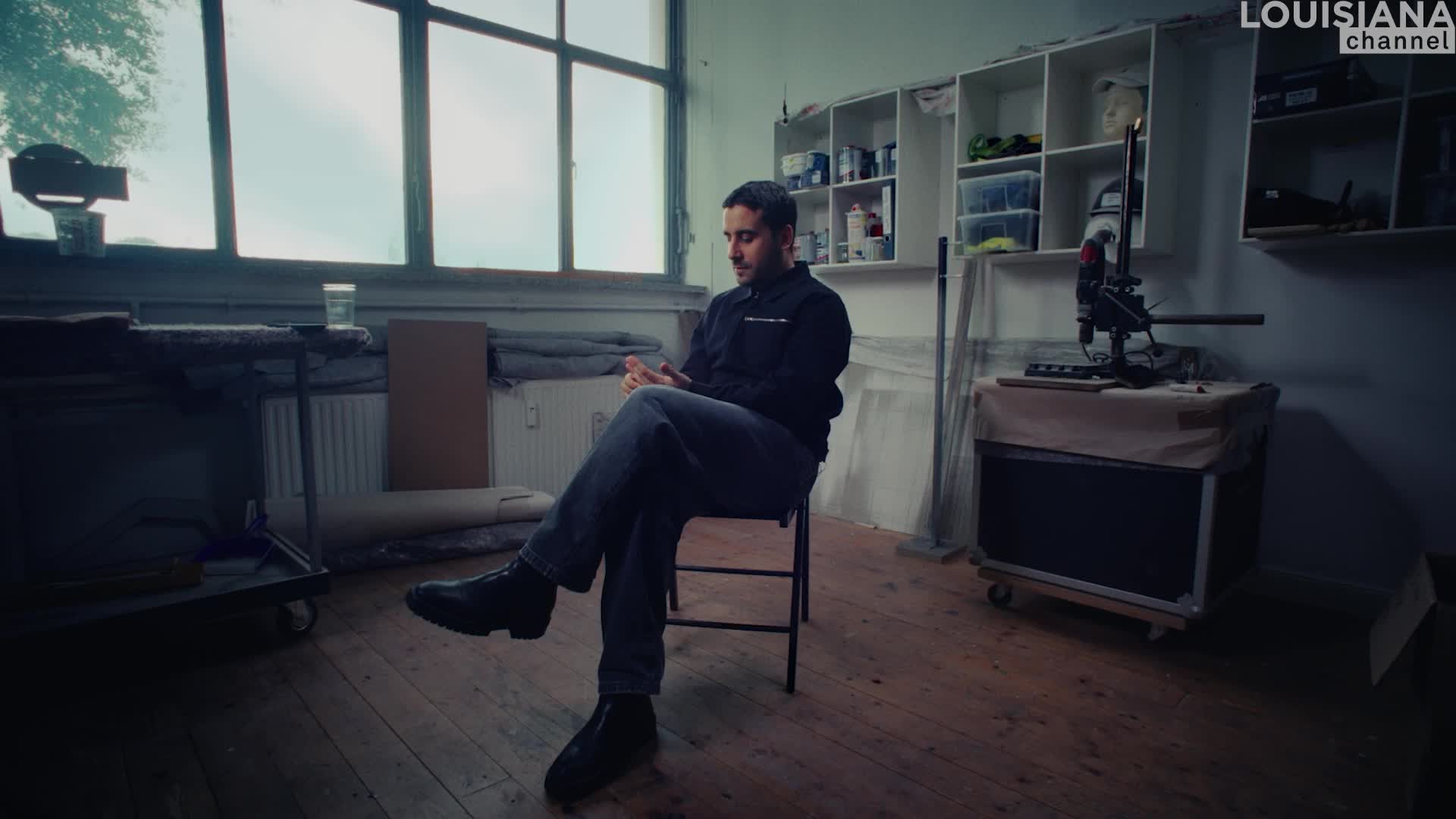
I think what goes through my work mostly is the question of the aftermath.
What happens in the aftermath of things?
What happens in the aftermath of trauma, of crisis, of exile, of migration?
And so most of the objects that I do work with are connected to the moment after something has happened.
How are we as individuals transformed by society or the context in which we find ourselves?
And how my parents had to adapt to Swedish society.
But a couple of years ago I was invited to do a residency at the Alexander Calder Foundation in France and I spent six months completely surrounded by nature.
Until that point, nature had not yet existed in my work and I started to draw a form which situated itself somewhere in between an egg, a cocoon, a seed.
I mean, it was just a form that I had drawn out on a piece of paper And then I laid down in the studio where I was doing this residency and I started to draw a line around my own body.
And then I started to create this work as a sculpture.
So I sort of just made a very rough sort of form in wood and fiberglass.
And then over the years, this form has sort of continued to expand in my work.
So sometimes they're up to seven meters high.
So these, you could almost look at them as forms that had, organic forms that have nested themselves in the corners of a museum or in the entrance of a room.
I think that they are the first works I did that incarnated this idea of levitation.
But for me it was never so much about magic, but how essentially levitation could function as a metaphor to speak about a sort of a ruthless identity.
I think my studio is sort of like a borderless studio because I work between Paris and Berlin.
And I've been very lucky to work with two friends for many years now who helped me realize this project, Sandra and Helge and i think that within, as the projects often, very often are, have specific needs, you know, depending on like obviously, when you're working with history, you never sort of know what kind of complexities a historical object entail, like working with a piano, for example, was something that I think was one of the most complex sort of projects that we did together.
So I came across the story of the piano while doing research on different forms of how we can treat trauma.
I read about a project.
So the Stainway factories in New York.
They closed them down during the war in 1939, 1940s.
Like all factories actually obliged to close and be used for the war effort.
But very quickly after the Stainway Piano Factory closes in New York, The government comes back with an idea asking them to create a piano that could be as lightweight as possible and essentially, a piano that could be parachuted to the soldiers.
Where the soldiers were camped all over Europe.
They produce about two thousands of these khaki pianos.
And so the first image sort of that appeared in my mind was this piano, you know, just levitating above one of these cocoon-formed ovoid shapes that I create within my work.
You know, this kind of child-size egg that is not letting itself be crushed by this piano but sort of levitating together, somehow floating in the space of the gallery almost.
What really interested me was the human condition.
What links us on the most profound level as human beings?
How can creation and art come and save us and help us survive and resist essentially?
As an artist, you can resurrect something from the past, bring it into the present, and how that thing could essentially sort of explain to us or tell us something about ourselves that we don't fully understand, or that we've forgotten or that we want to forget.