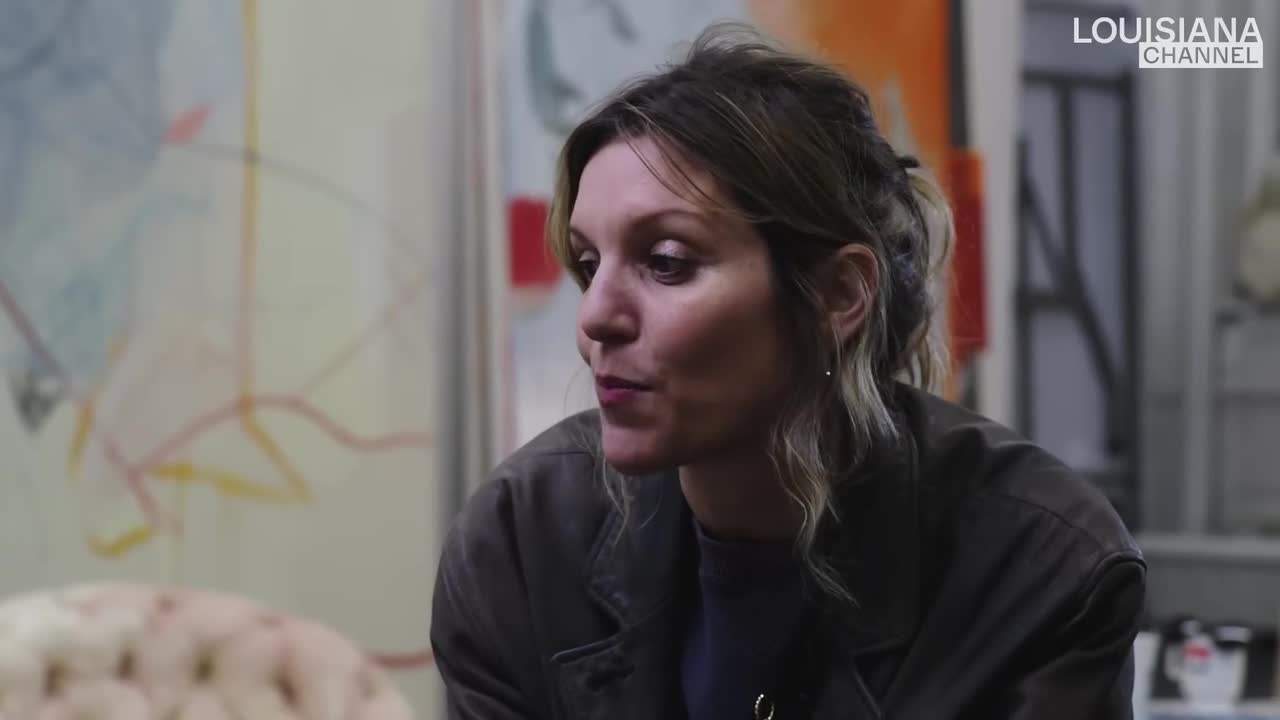
What's so special about, I mean, I don't know if I think that painting is so special.
I think it's actually maybe one of my main pursuits is to try and make it less precious or less distant or something or more connected to people.
So putting paint on the canvas to me is like having a direct line to other people, like trying to be as direct as possible.
I think that's why I'm so interested in line.
That's also why I bring things like furniture drawing on other surfaces in is because I would actually really like to kind of get up close and personal with whoever's looking at the work.
I think you know.
I think the whole battle for me for years was how to get the sketch to be a painting, and just really not being interested in painting until I could kind of get to that point where it could feel like sketching.
Like.
Actually, if I look back at my very first like graduate show, it's a collection of exercise, you know, sketchbook sketches pinned all over the wall.
It's actually not that different what I do now.
I just found a more sophisticated way to be immediate, you know?
And so it changes.
Painting has a lot more to offer in terms of like you can obliterate something and you can imbue it with another thing and tell, fuck with it more.
And say like, confuse it more.
And sketch you really have nothing to hide behind.
And so, but I think that the two for me are like, drawing is like absolutely crucial.
Sketching is absolutely crucial.
It's almost the most important thing I do and rarely show.
And I think that's true for a lot of artists.
You know, it's like riffing, it's just completely free and open.
And then you have to work a lot harder to be free with a canvas, I think and to just not have something heavier in mind.
So it took me a long time to get to that point or feel like I can.
The reason why I work so quickly, I think comes I think anything in my work comes from like several different reasons, not just one reason alone, but I think the flippant or sort of like expedient kind of like approach like this.
It recalls like a kind of To me, it reminds me of basically the 90s and the 80s, where you kind of just marker-penned on something.
Nobody likes to talk about graffiti, but graffiti where you're just so urgently needing to say something that you write it on the actual body of the city or whatever.
So there's that element.
There's also being.
It's very boring, but being a mum and just not having a lot of time and having to get out and just say this is the time that I have and this is how much I can do.
But again, I think it's really about the main reason to be quick is really about being direct.
It's like getting real, like just being like.
This is actually what i have to say.
I'm not hiding behind anything i don't have.
I'm not going to finesse this for you.
It's like wet, like you just have to rely on it.
Something happening quick and being direct and having something that the the viewer wants to relate to, like Yeah, like you know, you could talk about dancing or whatever, but I wouldn't talk about dancing as an art form.
I'd talk about it like in a club where you're trying to, like you know, relate to people, be sexy or be like whatever you want to be, whatever it is you're trying to do.
You're trying to do it in a heartbeat.
And I think that that's totally the most interesting thing to me.
It's like being now go like what, what are you gonna say?
What are you gonna?
How quick, how funny are you gonna be?
You know, and I think that's I've said before, but I think that's why I relate painting to like the walk of shame, like if you go out to a party and get really loose and wild and dance on the tabletop and then the next morning you have to go and think oh god, you know, painting is the wild bit.
Painting is the bit where you just do whatever you want and then you have to kind of think how is somebody going to view that?
But actually when i'm doing it i'm not thinking about.
The line.
For me is it could be something like a lifeline, but to me it can be.
It can be almost violent.
It can be almost like a cut, because it's high stakes with a line.
Like you're either going to work or it's not going to work, which is like also like touch.
I think it's very sensual and really like intimate, to just carve something out and be direct like that.
So I think that I like the high stakes, I like that everything balances on that one thing and the that's like a relationship, that's like you know, any kind of relationship or love or anything like that, like it's It's happening in the moment and it's happening between the person.
So you're not getting a chance to, you know, add body or change it.
And that's not so much my concern, you know.
I feel that actually my problem would be more to stop.
Like if somebody said and also you can continue down the street and there's my car, if you feel like drawing all over, I think I could go because it's reactive.
Like that's the other thing about working the way I do, it's reactive.
It's about like, what's there?
What can I work with?
How do I create something like?
I don't want to use the word generous, but how can I use the word of like, come on in like, let's like, let's have a drink and like with painting like, how can you be like, get under the covers with me, but with painting, how can you be intimate and do that?
And I think that's that that's the directness of working with line and trying to spell out, or not having a limit and not saying that's where the fine art ends and this is where life begins.
You know that they're blurring in between somehow and that maybe it's not so important to say this is the exact image that i'm trying to tell you about, but that it's more important that you go like oh, i remember her, you know, or i i feel familiar in that work, or i recognize something, or i feel close to that work, or And some people can do that with textures or whatever but the way for me is to not have a closed finish, I think.
So it's funny because I know my work is quite evidently figurative.
I mean, very, right?
And even more surprising to me somehow is that it's of the female nude, because I actually don't see myself necessarily dealing with that trope from historical painting, right.
But what I do see, what I think about when I'm painting, is not really.
I don't really I love looking at paintings.
I go and see lots, but what I'm thinking about when I'm painting is not that.
What I'm thinking about probably more is.
I mean, it's funny okay, you see lots of naked women in my paintings and you also see lots of naked women in the streets, in the billboards, in the magazines that we look at.
It's not so much about that, it's about what we're seeing.
If the world was filled with half-naked men, there'd be a lot more men in my paintings.
Do you know what i mean?
But i'm looking at media, i'm looking at how people are seduced or played with or whatever, and that that is often with half-naked pictures of girls.
So um, there's that element of it and there's a thing that that's funny to me that people like it's not.
People can often see that as a reversal of the male gaze or this kind of frolicking female nude, which it's not to me at all.
It's my body, for one, and I can use it if I want to.
But there's also an unease, I think really, with how your body is portrayed in media and living in it and your physical experience of being, or my physical experience of being, in this body, you know.
So I use it as a kind of shorthand, because I see it in media, because it's personal to me and because it's a way to think about all the other things, like memory, like colour, like rhythm, like music like, you know grief joy, all these other things.
It's a shorthand way for me to do that.
And that's because I find that image everywhere and I look at all these materials, you know.
I love to talk about color or I love to see what people take away from my palette.
Like, because there's very, very basic reasons why I use the colors I use.
Light colors if you're drawing into them.
You can use a dark line.
You can cut through.
A pigment can cut through.
So there's that, right?
If you do a huge dark painting and you try and draw through it with light colors.
Just very matter of fact, boring.
Then there's this kind of like pastel palette that I use, which is really funny because people kind of get it's very, I guess pastel is associated with like a kind of.
To me it's like a kind of 80s Disney or like Emmanuel kind of soft, feminine thing, which is funny because people either read it as that or they get quite annoyed about that actually,
But I think it's sensual and it's feminine in a kind of way to mess with, you know?
And I like the way that it's sort of sun bleached or like.
I'm drawn to those colors, but then color is so subjective, you know.
Like I'm really into it.
Sometimes I think I'm almost an abstract painter because I'm just thinking about color, hey?
But that's normal for figurative painters.
But I was talking to a friend, another painter, a friend of mine, And we just had a whole chat about green on the phone, you know.
And she was like, yeah, green's just like really sexy and really about nature.
And I was like, really?
Because whenever I paint with green, it becomes about technology.
Like what you have, what I have, relationships to paint, to colours, changes.
Like some colours feel total trash and some have this classy thing or something.
I like all the but again to me.
I think my color references really relate to the source materials that I'm looking at.
They like.
I like the way a certain blue could look very French or German or like oh yeah, that's totally New York in the seventies, but I don't know why.
So just like trying to locate the like, the references that we have for color is more interesting, I think.
And it's instinctual.
You can't mess around with your palette.
You just have to go, you know.
I sometimes go like, I'm going to make a really dark, serious painting.
It's always shit, you know, because it's not.
It's not, it's going against the grain, reinventing the wheel, or whatever.
It's a tricky one because I think of my work really working like, I mean, I think lots of painters do, because painting is, you know, about time and it's about space, right.
So a lot of people think about memory or how memory works and that can work.
In my paintings, I do that with layering.
I do that with like letting... I like nothing to be kind of fixed.
I don't mean stagnant.
I mean like made nice.
I like if you can see all the bits that happened before.
I like the dirty edges of the canvas or whatever.
I think that makes it more relatable.
But the layering and letting stuff come through.
I mean I always start painting on a surface with marker pen, because marker pen bleeds through every other surface.
So that's like the initial thing, that's the way to like imbue a canvas with a history, basically because I'm going to get rid of that, whatever is underneath, but at least there's something it's like kicking in your shoes.
You don't want brand new white trainers, you want like a little bit of life and you want some history there.
So it's like start off with something that you'll never get rid of.
It's actually just a stain basically, and then you're working, not in combat I'm not in combat with that but just that's given it a history, that's given it something to work on, and then anything else it will always come through.
And I think that there's like a dodgy area between like, memory and nostalgia, I guess, because it's looking back and often because I'm using other sources from media or whatever that word nostalgia that everybody hates to use.
Which I don't, by the way, I think it's kind of totally valid.
It's like originally I think it was made about sailors.
You know, it was a term that they used for, like people being really, really homesick, like actually physically homesick, right.
It's a really, it's about trying to figure stuff out, but it's quite sad, you know?
And it's like also trying to figure out now in the moment, going back to that through looking at like repeated cycles in the past or you know, and it's all of that stuff that leads me into um, looking at advertising and stuff like that, because it's the psychology of a moment, and then now you're, it becomes material.
If you're looking at stuff from the past, foreign I think my work is, it's deeply personal.
But that's not to say like I don't like the idea of like having a very strict personal narrative but say, for example, if I'm looking at the female tropes that exist or whatever virgin mother, clone and all of these things, and then actually like being a mum and then dealing with, like the idea of sexuality, and then you have to become, you know, very professional, very sexy, very this, and that atom gets split apart.
I look for those things in media, I look for those things in the things that I'm collecting or the artworks I'm looking at.
So that's in, that's for me, my physical body's in it, because it's what I have to hand and I know I study it.
I mean really like it's all about looking at stuff, you know.
So I see my own figure in there quite a lot.
I think that everything in my work is like an amalgamation of all the stuff that i'm interested in, of course, you know, like you could say it's very female work, you could say it's very scottish work, you could say any of these things are obviously true, you know, because i'm painting from my position and that's the thing that gets me out my bed to go and do it in the morning rather than not.
You know, and paintings like that, it's a strange, i think, especially from where i'm from, it's quite a strange thing to kind of go and do.
But the thing that I was really raised with which I think is a really feminist idea actually is that you know my mum.
She never had a studio, she wasn't a painter or anything, but she painted and she raised her children in the same breath.
And I think that that's what I'm interested in.
I'm interested in how painting can be made, not of life, but as though it were life.
So like just the same as your, it's about relationships, right?
So it's just the same as your want to be happy or turned on or comforted, or grief stricken or whatever the fuck you're thinking about.
You can approach a painting in the same way, right?
So it's not all of it, but with it kind of thing.
I mean, so many ways Glasgow shaped me, I think.
I didn't study at Glasgow, so don't consider myself like a Glasgow School of Art artist, which is a very specific thing, if you know what it is.
But Glasgow being like a post-industrial town, northern town neglect, you know, neglected by what I mean?
Westminster, this kind of political landscape of it, kind of fairly socialist in thinking, and all of these things.
These are things that are inherent in my work, but also, just in a very formal way, the landscape of it.
I mean, there's a film that I'm using in a lot of these paintings as a backdrop that was filmed there, called Death Watch.
So you know I was everyone around me actually worked in the film industry and the Scottish film industry when I was growing up.
So I think that that's like a really direct thing that influenced my work.
But there was something else I wanted to say about that, sorry.
And it's just gone out my mind and now I want to pull back because Glasgow.
I wanted to talk about Glasgow.
I wanted to talk about humour.
Like I think my work, I take work very seriously.
But also I do think there's this precedent in art, at the moment of ultra-professionalised very, very serious like I am changing the world.
I obviously take it seriously because I go and do it every day and that is actually fucking hardcore and serious.
But I think it's really important to be funny about it.
And I title down the sides of my work, partly so that I can have a bit of a giggle about it and make some sort of reference to myself.
And there's loads that I find funny about painting, you know?
And that's a very Scottish thing, I think to deal with quite hard topics or strong topics or whatever, but with an element of humour and keeping things warm.
I think that's really important, a level of generosity with it.
I think images are very powerful, but I think I'm concerned with how, like an image might feed into like a kind of psychic kind of context or something that you might just relate to it.
Rather than say this image is has a certain specific meaning.
I would much rather that someone related to something.
And that's to say, like, could one love affair change the world?
Could this one thing change the world?
Could a friendship change the world?
You know, all I think I can do as a painter is to respond and react and create things and hopefully like that.
You know that has some, but really I mean I can't really prescribe what that would be for somebody else.
I can only just go.
This is all the stuff I have, you know, and this is what I'm compelled to do every day and this is what I see on the billboards as I'm on my way in, and the advertisements and the.
You know I can only take all of that and and say this is what I'm doing and think about, like seeing the same images, think about repetition, think about how things are repeated or displayed, or you know, and I think and relate and try in a very normal way like you would to.
I mean, it's funny doing interviews because half of you just wants to get on with the person and like them.
And I think painting's a bit like that.
You just want to be like, hey, come on, what are you thinking about?
But you can't because it has this austerity of painting and the fine art world, all that stuff.
So I think it's a bit of a battle to get past that sometimes.