Agnes?
It's a character and an identity that I have started to build since five years now.
It's someone that I embody sometimes and I embrace through my work, but it's definitely something that changes.
Let's go, let's go.
That's why I chose to include question mark in my name, because Agnes has always been a question for me.
I'm condemned.
I can't get out of my art practice, and I think my art practice cannot escape my personal life.
It's not always a tragic, sad experience being trans.
Yes, it's quite tragic sometimes, but it's also fun.
It's actually very fun.
It's a very beautiful experience.
My name is Agnes question mark and I am a performance and an installation artist.
So this is a public project I made.
I just realized now that I gave this picture a long time ago and I didn't know.
Someone tagged me on Instagram and there is my image of me before after the transition with the trans flag colors.
What time does it get dark in rome?
In rome italy today, sunset will be at 1839.
Yeah, we have like an hour.
We are in Rome.
We are in my studio where I produce most of my installations and performances.
Sometimes I get asked, especially on social media, if my work is real, because it looks so ambitious in its materiality.
Sometimes people ask if it's AI generated, but no, it's all humanly made in this studio.
Wow.
They're making wax.
I always work with the same technicians since six years, maybe five years.
And I've been working with them in many different materials and many different projects, to the point that we built a strong relationship.
My father was here 15 minutes ago.
Oh my God.
And an understanding, a mutual understanding.
I learned a lot from them.
I learned how to use a lot of materials and also they learned how to make something that that I want, that I want to look like.
From...
2016, not too long ago, nine years ago.
But it's the diary in which I wrote day one.
So it's quite important, 2016.
It's the first day.
It's the day I realized someone was inside of my head.
Or better, that I was accessing another person inside of myself.
9 February 2016, Agnes steals my objects.
I'm not crazy, she really steals my objects.
Last week, my rasoio, the razor, disappeared.
If you steal my future, if you steal my heart, I swear, I swear, I'll kill you.
Wow, I didn't expect that.
I was very bored and very lonely.
I started doing performance for a need I had to express these multiple identities I had inside myself.
Slowly.
As soon as I integrated research into my work, my performances also started to absorb the research.
That's why, from a human being, I started to transform into these post-human trans-species creatures.
But the feeling is always the same.
I always need to perform this creature, this fantastic creature, as a need for me to really embody and empower myself in that transformative feeling and empower myself and say to myself it's okay to be all these infinite beings.
You don't need to be something fixed.
Yeah, that's why I decided to become like an octopus, for example, or a tentacular mermaid, or a doctor.
And those are ways for me to liberate myself from the frustrations I feel of being a queer person, a trans person, in a normative society, with a sort of biological body that doesn't represent my fluidity.
I like water.
I grew up in the sea.
I grew up in a boat.
My father was a sailor.
He sailed the world for 10, 15 years, maybe touching land once every few years.
At least three months of the year, we would live in the boat.
And for me, it was very natural.
So I grew up having that reference.
And then my father.
One day I was eight years old he said he gave me a little oxygen tank And he said jump, you can go under the water.
And for me, it was unbelievable.
I was like, what?
Can I breathe?
I can breathe under the water?
And he said, yeah, yeah, yeah, go, go.
And I remember I would go down and then after 30 seconds coming up because it was too big as an experience.
And my father said, no, stay, stay.
You can stay here even like 10 minutes.
And I still remember that was the strongest experience ever.
It was a cathartic moment, very early. age and I really thought I was a fish.
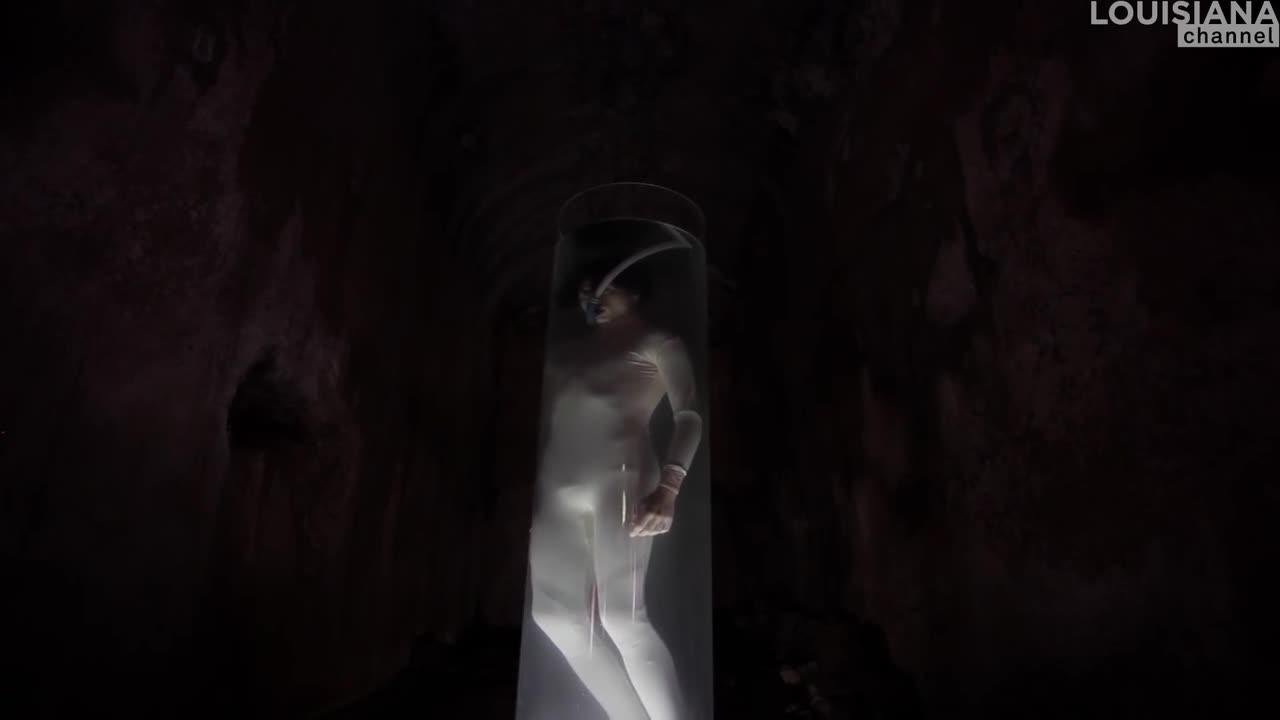
I think especially my early performances under the water in which I was breathing from a long hose.
I myself was struggling a lot and it was very difficult.
It was extremely painful because I was often in a confined space in an aquarium for fish which was way smaller than my body.
And I had to breathe from a very long hose which took the air from the same room, not from pure oxygen.
So I would really struggle during the performance and my breath would really get stronger and stronger.
And so there is a sense of pain, which is reflected in this impossibility of living under the water.
Or else, if you want to live under the water, then you have to suffer.
You have to go through this painful experience.
This underwater experience is both positive and negative.
Like there are two aspects.
And I think those are the two aspects in my performance.
It's like life and death, pleasure and pain, beauty and the monstrous.
Because there is always a sort of frustration and painful experience for me as a child under the water for not being able to really stay there forever.
When I perform as the octopus or as the tentacular mermaid, I have to go through pain because I need to sit there and lay there for hours and hours and hours.
And then, through this experience, I reach this sort of ecstatic moment in which I really believe I am the creature.
It's where I did my first underwater fish formation.
This is quite big.
I was feeling very comfortable in this aquarium because some of them were very small.
The only moments I believe and I feel I am a creature is through my performances.
But also, as a queer person, we don't need to forget that we are deemed as monsters.
We are deemed as unhealthy.
We fall into a category that goes beyond the human, the normal, what is considered normal.
And that's why naturally, we are very in tune with monsters and aliens, because we're considered as such.
So, in a way yes, there is the struggle of not being able to become a monster, but there is also this other side that consider myself as a monster without really being able to fully be one.
The dungeon.
Hi.
Hi, baby.
You okay?
Sorry, I've been neglecting you.
Mommy's back.
Mommy's back.
With a ladder and then I would come out from here and my half of the body, my torso, would get out of there and my legs and I would hold myself to those handles.
And it was pretty warm because we made it in polyester, so polyester keeps the heat.
But it was very painful.
I would consume the polyester with my feet until I started making holes inside.
Slowly I would carve.
Imagine 23 days I would carve inside the sculpture and I would put my feet inside.
It was like my anti-stress.
You are in the limit between your consciousness and your unconscious, because the pain at some point is so strong and so present throughout your whole body that your whole body somehow becomes numb and your mind as well is being abstracted from reality for so long that at some point it gets lost.
It's like a deep meditation state.
The fact that there is an audience in front of you, watching you silently and believing in what they're seeing.
That enhances the experience of transcendence.
Because through the audience, you see yourself, how they're experiencing you.
And they're experiencing you as mother octopus, as a transpicious creature.
And so through their eyes, I also see myself in that state.
I decided to transition five years ago while I was in Rome.
And I was researching a lot in underwater creatures and biology.
I was reading a lot of Donna Haraway.
And suddenly I come across the notion of tentacular thinking from her book Toulousine.
And suddenly that term really resonated with me, because I felt I needed to transform and change, and tentacles is like that.
It actually means to taste, to feel.
And I needed to develop some tentacles somehow somehow, and I was looking at the octopus and the octopus has a very strong presence in the underwater seeing, because it can change, but it also it's a very strong creature as a mother, because some of the female anchors themselves on top of the kids, of the offspring, before they're born.
And she really dedicates her last part of her life to giving birth.
And to me, that was very, It resonated with me.
It was very important somehow.
And so I decided to transform myself into an octopus, into mother octopus, because I needed to change.
I needed that strength.
I needed that power to become my own mother.
But to do that, I needed to let go of my past.
And that's why I decided to prolong the performances for 23 days and go through this painful experience again, because I needed to kill or like more than kill, destroy part of myself that I didn't belong to anymore, and I started to take the medicines the day of the performance.
So the first day of the performance was, for me, the first day I took the medicines, because I really wanted the audience to experience something that was actually changing in real life, not just in their fantasy, but a body that was scientifically, biologically changing silently inside of me.
I'm actually always very scared before a performance.
I always think I'm doing the wrong thing.
I don't think I'm being heroic.
I think I'm doing something wrong that I shouldn't do because I have no references.
And sometimes I don't really know why I'm doing that.
And because they are out of normal, I think they're wrong.
I think maybe I shouldn't do it.
I think of them more as a self-inflicting experience, like a martyrdom, rather than a hero, like a martyr that needs to be executed.
I mean, the octopus performance was like that.
It was a ritual to literally give birth to Agnes.
It was the first time I called myself Agnes and asked people to call me Agnes.
This is the same hospital where I was born and then where I came to take my estrogen.
So where also Agnes question mark was born.
Period.
To give life you have to go through pain.
You have to wound yourself.
And I think this experience is very similar to being trans.
Trans people.
They have to go through pain and through sometimes body modification operations which are literally wounds.
We're wounding our bodies.
I have scars, you know, reminiscence of doctors opening and slicing through your body for the sake of giving birth to yourself.
Here, look.
She's like, hey, girl.
And both of us, Gab and I, we both wore I had this one.
Which one did we have?
I had this one from Milan.
And I also had this one in London.
But we both had this one.
This one in Berlin.
We had this one in Berlin.
Yeah.
Yeah.
So almost all of us.
Almost all of us.
We grew up.
We started from the bottom and then we became primary.
We are the sexy doctors.
The surgical room was the first place, the first artificial place that I experienced, And it was quite uncanny as an experience.
It was very weird to enter the surgical room.
You kind of smell death, you know, but also life.
And the doctors are all, like, covered, and they're very cold.
The cold touch, they touch you, they probe you.
It's also a sexual experience.
It is a power relation, doctor and patient. hospital and patients and state and civilian.
It is a power relation.
And I'm trying to subvert it because I had to go through it.
I had to submit to the medical system as a trans person, and not just the medical system as a trans person, but also as an individual in a normative society that uses science as the tool to control people and control bodies.
¶¶, as legend says that this the creature was born through a genetic experiment in an island, and then the creature was placed in an artificial placenta and then it sort of hide away in the sea, and now she's lost in the sea.
And my story.
My role as the fictional character of this story is to find her, to look for the steps and to the proof of her existence.
These videos, also these two, shows what's inside the creature.
So I wanted to use the installation as a medical.
This is the question I got asked most of the time during my performance in the train station, in the public train station.
And at the beginning it really annoyed me because I could hear the conversations of people around, although I was in a sort of window kiosk.
The first question people asked was whether I was a man or a woman, and they were being very vocal about it.
And I was like, oh, it's true.
Sometimes I forget that I'm trans, you know, or that I'm like, I'm like, I'm fluid.
And I get reminded constantly.
I'm like, oh, it's true.
We have to go through this.
Then the second question was more interesting, was if I was a human or a doll. or a mannequin.
I think that was very interesting because, in a way, I'm making them question the reality in front of them, something that we constantly do online.
And the third question was if I was a machine or if I was something not mechanical, if I was like a robot.
Also, I thought that was interesting.
And I mean also.
My name is Question Mark.
I question myself and it's good to make the audience question themselves and their reality.
What was more interesting about that performance is that I turned the audience into doctors.
Because they were all so curious about my biology, my identity, my species.
They all inquired into that.
They all became doctors and scientists.
And I think that was very powerful.
And one day there would be question mark department.
Weird, weird surgeries.
Like, you want to have a tentacle?
You want to have a fin?
You want to have gills?
Yeah.
Sci-fi department.
Or like trans peaches department.
I'll be primary there.
Doctor?
Doctor question mark?
That's so kind.
I mean, I get to spread an important message standing for trans rights, standing for trans people in a Roman archaeological site, in a Roman door where Romans used to walk through and pass through.
Yeah, it's quite cool.
I like it.
Thank you very much.
No matter the pain I could feel, no matter the confusion, I always had one aim.
And that aim was looking for Agnes.
And I'm still looking for her.
Yeah, I think Wherever I am, whichever state I am, I know what to do.
I feel I have like, I don't know if I would call it a mission, but a purpose maybe.
And that gives you confidence also as a person because you know why you're there.
You know why you're here.
I love it and I get to perform with my best friends, because one of the most beautiful things of being trans is the community.
There is an amazing and huge community of trans people and I became close friends with a lot of them and they became my family and I get to perform with them because we share the same experience.
We share the same struggle.
And we need to make it fun because it's not always a tragic, sad experience being trans.
Yes, it's quite tragic sometimes, but it's also fun.
It's actually very fun.
It's a very beautiful experience.
And the things that we do and the things that we achieve are replenished with joy and happiness.
That's why we make surgery fun.
We can make surgery fun.
We can make body modification beautiful.
Louisiana Museum is doing a documentary, yes.
Hello.
She's here.
Hello.
Here to celebrate Agnes Question Mark.
She's hearing, she's hearing.
Huge day for Miss Question Mark.
So excited to celebrate with my beautiful friend.
When I wake up in the morning and I ask myself, who am I today?
What am I going to do?
Who am I going to be?
And I can play with that.
I can be whatever I want.
Yeah.
I think my work allowed me to gain more confidence in myself.
I knew why I was alive.
I knew what to do.
I knew I had a mission.
I felt, I felt I was meaningful.
Amen.
Amen.
Amen.
Amen. so