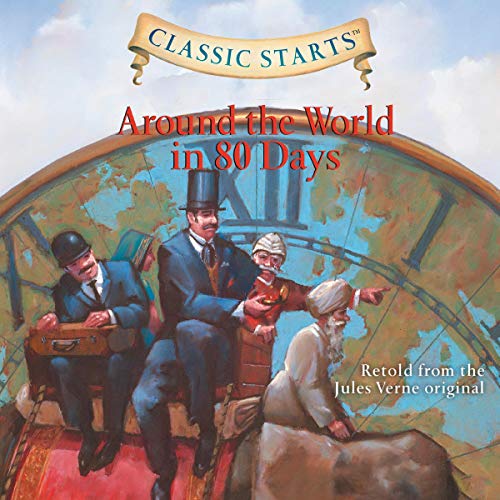
Chapter 13 Mr Fog and Party Cross the Pacific Ocean.
The trip from Japan to America was supposed to take twenty-one days, with the ship arriving in San Francisco on the second of December.
The trip from San Francisco to New York should take nine days.
This left ten full days to get back to London by the deadline.
If Phileas was at all worried, he certainly didn't show it.
By the ninth day on board the ship, Phileas Fogg had traveled exactly one-half the globe.
Now, with only twenty-eight days left, he needed to cross the other half.
Meanwhile, Detective Fix had finally gotten his arrest warrant.
It had been waiting for him when he arrived in Japan.
In fact, it had been on board the Carnatic, the steamer he was supposed to be on.
Of course, the arrest warrant was useless now that Phileas was on his way to America.
If he was no longer on British soil, Fix had no authority to arrest him.
Well, Fix steamed it will still be good in London.
I know for a fact that Phileas Fogg will have to return to his own country at some point.
Fix decided to follow Phileas until the bitter end.
He holed himself up in his cabin on the General Grant so they wouldn't know he was on board.
He didn't want to see Passapattu and have to explain what he was doing there.
But he couldn't stay inside all the time.
One day he simply needed some fresh air.
What a mistake that was.
The moment he stepped out on deck, there was Passapattu.
The butler walked right up to Fix and punched him on the nose.
Fix fell down.
Are you quite finished? he asked, holding his nose.
For the time being, yes, Passerpatu answered.
Then let me have a word with you, Fix said.
It's about your boss, please.
Passerpartout agreed, although he still didn't trust the detective.
Fix stood up and the two men went and sat on the deck chairs.
So now you know, my monsieur is an honest man, Passerpartout said, and you've given up this crazy idea that he is a bank robber.
Of course not, Fix said.
Passapartout raised his fist again.
Wait, let me finish.
The butler lowered his hand.
I am now in the game.
You see, the only way I can arrest him is if he's in England.
The only way to get him to England is for you to finish this crazy race around the world.
I know I can't stop him, so I'll do what I can to help.
Passapartout said nothing, so Fix continued.
Are we friends?
No, we're not friends, but we can be allies.
I should warn you though, I will wring your neck at the first sign of you acting up like you did in Hong Kong.
Agreed, Fix said.
He knew when he was beat.
Eleven days later, the General Grant docked in San Francisco.
Phileas Fogg had not gained or lost a day, and he noted so in his journal.
Phileas went directly to the train station to find out when the next train left for New York City.
It was at six o'clock, which meant that he and Aouda could rest at the International Hotel for the rest of the day.
While Passapartout ran some errands, Phileas and Aouda ate a lovely breakfast.
Then, as he had done in every other port, Phileas went to the office to have his passport stamped.
This time there were no mishaps and everyone, including Fix, boarded the train for New York City at exactly six o'clock that night.
Inside the train, the weary passengers fell asleep.
It had been dark by the time the travelers boarded the train, so there wasn't much to see out the window anyway.
The train sped through California.
It passed by Sacramento and started through the Sierra Nevada mountains.
The tracks wound in and out of the passes and the smoke from the train drifted through the giant trees.
After breakfast the next morning, the four passengers stared out the window at the great landscape before them.
Mountains lined the horizon just beyond the prairies.
Before long, Phileas began once again to write in his journal, as calm as he had ever been on this trip.
Just before lunch, a herd of buffalo found its way onto the tracks.
The train stopped as the engineer waited patiently for them to pass.
Passepartout couldn't sit still.
He paced up and down the cars, wondering why someone didn't get out and make the move.
By evening on the second day, they had passed into Utah.
They were near the Great Salt Lake, where the Mormons had settled.
The weather was very cold when Passepartout stepped outside for a breath of fresh air the next morning.
It hadn't stopped snowing, but the sun was shining.
The train sped by ranches and fields that would have grown wheat and corn had it been the right season.
Now the ground was covered in a light dust of snow.
Passapartout stretched his arms high above his head and thought This certainly is an interesting country.
That afternoon the train stopped in Ogden.
It was set to leave again in six hours.
This meant that the travelers had time to explore Salt Lake City.
A clay and pebble wall surrounded the city.
It had been built in 1853.
The travelers roamed around the streets.
They looked at the square houses and then made their way back to the train.
Just as the whistle blew, the wheels started to turn.
Passapartout looked out the window to see a tall man wearing a long dark coat racing toward the platform.
Stop!
Stop! he yelled.
Of course the train couldn't stop.
The man ran faster and faster and then finally jumped on the rear platform.
Passapartout smiled and thought to himself, Maybe that man's making a tour of the world, too.
The train traveled north from Ogden toward the Rocky Mountains.
Passapartout paced up and down and had a hard time sitting still.
Fix didn't like traveling through the mountains either.
It scared him a bit.
Of course, Phileas was perfectly calm, as was his nature.
It was still snowing.
Why didn't the monsieur take this trip in summer?
Passapartout wondered.
Then we wouldn't have had bad weather to deal with.
He looked out the window and thought about how gray the sky looked.
These are long and slow hours to pass on the train, Fix said.
Yes, said Phileas, but they do pass.
We could play cards, Fix suggested.
Grand idea, Phileas replied.
Let's play some bridge.
And so the group passed many hours in just that fashion playing cards, chatting with one another and eating breakfast, lunch or dinner.
Phileas was right.
The time did pass.
Suddenly a very loud whistle sounded, and the train came to a complete stop.
Passepartout, please go see what happened, Phileas said.
Passepartout rushed out of the car.
A group of other passengers had already gathered.
A red light had stopped the train just before a bridge.
The engineer and conductor were talking with the signal man about why he had stopped them.
The bridge is out, he called up to them.
There's no way to pass.
The man in the long black coat, whose name was Colonel Proctor, said We're not staying here, are we?
Taking root in the snow?
Of course not, the conductor said.
We've telegraphed ahead for another train to meet us at Medicine Bow in six hours.
Six hours, Passerpartout cried.
Six hours?
Yes, the conductor continued.
It will take that long for us to reach there on foot.
On foot!
Passerpartout said, How far is this medicine bow?
It's only a mile from here, Colonel Proctor said.
Why would it take us six hours to get there?
Well, it's on the other side of the river, the conductor said.
And we can't cross in a boat, the colonel asked.
That's impossible, the conductor replied.
The river is overflowing because of the rain.
We will have to walk ten miles north to be able to pass.
The passengers were all very upset at the idea of having to walk over ten miles in the wet, the cold and the snow.
The colonel was silent for a minute.
Then he spoke up over the rest of the people who were too busy complaining.
"'Wait,' he said, "'I think there's a way we can get over the bridge.'
"'What do you mean?' the conductor asked.'
I think we have a chance of getting over if we push the train to its top speed.
The colonel answered.
If we're at full speed, we might just make it before the bridge falls apart completely.
The passengers and the engineer were excited to try.
They were all convinced that the plan would work and that they would make it across.
If anyone was worried about the bridge collapsing first, they didn't say.
Passepartout was a bit scared, but he didn't voice his fears.
Everyone climbed back on board.
Soon the train was moving again.
The locomotive whistled and drove into action.
It sped faster and faster.
In fact, it moved so fast that it felt like the train might not even be on top of the tracks.
And then it passed over the bridge.
The entire fateful trip took but a second, as the train leaped from one bank of the river to the other.
Just seconds after it was all over, the bridge fell with a crash into the water below.