NPR.
This is The Indicator from Planet Money.
I'm Waylon Wong.
So my teenage daughter and her friends are really into blind boxes these days.
They're small collectibles, often vinyl figurines, and they come packaged so that you don't know exactly which one you'll get.
The fun is in the unboxing.
And these blind boxes are also really popular in China.
That's what NPR correspondent Jennifer Pak tells us.
So those are really kind of quick things that you can buy that doesn't cost a lot but makes you feel really satisfied for a bit, until you know the next fixing is needed.
Jennifer says one reason that blind boxes are hot in China is that people, especially young people, don't have a lot of money to spend.
Consumption's been sluggish.
This is the backdrop this week as the Chinese government unveils its 2026 target for economic growth.
Thousands of representatives are gathering for the National People's Congress.
The government will announce its gross domestic product target for the year and outline a plan for how to get there.
It's like its own kind of blind box reveal, but with much higher stakes for both China and the US, given the ongoing trade war and race for technological dominance.
Today on the show, Jennifer Pak tells us about the challenges facing China's economic policymakers.
This message comes from Capital One, presenting sponsor of the 2026 Tiny Desk Contest.
This year, NPR Music set out once again to find the next great undiscovered artist in the annual Tiny Desk Contest.
Musicians from around the country submitted original songs for an opportunity to perform their own Tiny Desk concert and tour with NPR Music this summer.
Now, the judges are diving in and selecting their favorite entries.
This year's panel includes public radio hosts, industry experts, and acclaimed artists.
You can follow along and browse all the videos at npr.org slash tinydeskcontest.
And while you wait to hear who's crowned the winner, you can win every time you go out with the Capital One Saver Card.
Earn unlimited 3% cash back on dining and entertainment.
Capital One.
What's in your wallet?
Terms apply.
Details at CapitalOne.com.
Jennifer Pak, NPR's China correspondent, you have been roaming the streets of Beijing recently.
What's the economic mood like?
I would say it's very different from 20 years ago when I first came to Beijing to work.
You know, back then we were talking about what are Chinese consumers buying?
It's the new middle class.
You know, what kind of cars are they buying for the first time?
What kind of luxury goods are they binging on?
We even went to training schools for butlers because there's... so many wealthy people.
Now I would say consumers are a bit more reserved, deflated.
I mean, one economist even described them as depressed because youth unemployment is very high.
And even those people who have a job, wages aren't rising.
And homeowners, and that's the majority of households.
They're feeling a lot poorer because property prices have been dropping for four years plus.
So it's against this backdrop that the Chinese government will be releasing its GDP target, which will be a range right for this year.
Can you talk a little bit about why the Chinese government releases the GDP target?
Sure.
This system was adopted from the Soviet Union when China's economy was planned.
And this was a goal for everyone to work towards.
Now, these days, China's economy is much more mixed, but the state still plays a very big role in it.
So these GDP targets, as well as the key sectors it lists, are really signals for entrepreneurs and investors to know where to put their money at.
Because guess what?
If China's government says hey, we're into green energy.
If you bring a project on oil and gas, maybe you're not going to get speedy approvals.
Same time, it's also a signal for normal people to know what to expect next.
In the U.S., of course, it's a really different approach, right?
The Federal Reserve has a dual mandate of stable prices and full employment, and it has an inflation target but not a target for overall economic activity like China does.
So how often does China hit the GDP goal that it announces?
Almost always.
I mean, except for 2022, when there were really severe lockdowns during COVID.
But usually when China sets a target, it hits it.
Now how it does this is once it announces this goal, everyone moves in lockstep to try to achieve this goal.
And let's say it's falling short.
The government will then come up with something to juice the economy, like when consumption was faltering.
They came up with a program that's sort of like the cash for clunkers, which is essentially like 15 20 percent discount subsidized by the government to upgrade your old fridges or your cell phones.
There is, of course, a lot of debate about the reliability of Chinese data and also whether GDP is really a good measure of economic activity, because an economics professor, David Li from Tsinghua University, once told me there's a classic joke in China where where a local official will come and say let's build a road.
The next official comes along and says, no, I don't like it.
I don't like how it's built.
Let's redo it.
And every step of the way, that counts towards GDP, but it doesn't necessarily add value.
GDP shows us how the economy is doing on average.
It's a very broad measure.
And some sectors do better than others.
And so what does the economy look like for China right now, as you're drilling down into certain sectors,
It's very much a two-track economy.
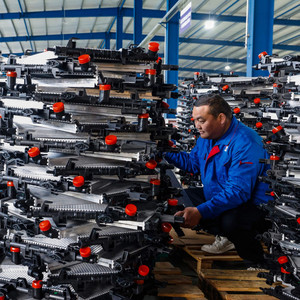
So domestically, like I mentioned, consumption is a bit sluggish, but exports, they're booming.
China's not just manufacturing small goods.
It's also manufacturing very high-tech products, drones, cars.
So somehow, despite all of the tit for tat, tariffs with the US, China's trade surplus still hit a record 12 trillion last year.
Now the International Monetary Fund says China cannot keep relying on exports to drive its economy because it says its trading partners they're really being hurt by this.
We've seen the U.S. and Europe, for example, really hammering hard at Chinese exporters.
The IMF, though, has very much encouraged China recently to prioritize consumption led growth.
But, like we said, it's very difficult because, you know, when I was speaking to young people, whether they're in Beijing or Shanghai, without prompting, they bring up the fact that they're either not thinking about marriage or they don't want to get married or have a family.
And that, by extension, means that they're not going to be looking for the apartments near the good school.
It means they're not going to furnish that apartment with household appliances and furniture.
They might not even get a car.
Right.
And this is a challenge because, as you mentioned, the IMF wants more of China's economic growth to be led by consumption.
In other words, an increase in gross domestic product should come more from people buying fridges and couches and not from say, exports or investment.
So what is a typical growth rate for China?
Yeah, I mean, in the past, like decades ago, we were looking at double digit growth.
But in the last, you know, five years, I'd say it's more about 5%.
What's that number in context for China, 5% growth rate?
Well, okay.
So remember, we go back to how the economy is mixed and they need to set a goal.
So this goal kind of works towards a target of 2035.
That's when President Xi Jinping says China needs to achieve socialist modernization.
It sounds super vague, but state media have actually put a number to it.
They're going to have to grow on average over 4% a year.
So this is something that China has to fulfill, because that's how they gain their legitimacy from the populace without elections.
And Beijing also has a five-year economic plan.
What does that look like?
This is going to be an economic blueprint for China's economy until 2030.
It comes down to two things.
China is going to double down on industrial manufacturing and also tech innovation, especially when it comes to self-sufficiency, because tensions with the US has shown that.
You know the US wants to cut off their semiconductors and high-end technology from it.
So it needs to rely on its own.
Now, that's very good for the national security part.
But the big question that I have is what does that mean for jobs?
Because those two industries are not creating human jobs.
And honestly, when I talk to people on the street, job anxiety is, you know, at the top of their list of anxiety.
And by the way, it's not it's not a lack of jobs in China.
It's really the jobs that pay well.
OK, that's lacking.
So this year we're looking at another record 12 million graduates.
That's going to be very tough.
They're looking at double digit unemployment rates and they're being now told hey, you should be happy with a mediocre job and maybe you can even go back to the factories.
Yeah.
What is the term for lying flat?
Is that the phrase that's used for kind of this, this middle age, or this ennui that the younger generation gets accused of having?
Sure.
In Chinese, it's called 躺平, which literally means laying flat.
But I have to say I think it's a mischaracterization, because the average work week in China is still, I think, what is that like 48 hours a week?
That's well above, I think in the U.S. it's like 34 hours, okay?
So while people say they are 躺平 or laying flat, really it might mean I'm not going to do 12 hours a day.
I might do 10 hours a day.
Yes, stick it to the man.
Well, thanks very much and I hope to have you back on the show soon.
Oh, absolutely.
Thank you so much.
This is fun.
That is Jennifer Pak, NPR's China correspondent.
The National People's Congress starts today, and you can follow Jennifer's coverage here on NPR.
This episode was produced by Cooper Katz-McKim and engineered by Jimmy Keeley.
It was fact-checked by Angel Corrales.
Kate Kincannon is our editor, and The Indicator is a production of NPR.