NPR. This is the Indicator from Planet Money.
I'm Waylon Wong, and today I am joined by not one, but two non -indicator hosts.
It's a takeover! Oh my goodness, who is this?
It's a boss rush. It's a hostile takeover by Planet Money's very own Kenny Malone.
Hello, hello. And, making a repeat appearance, here and now producer and NPR gaming lead, James Mastromarino.
Hey, so good to be here again.
And you guys are here for Indicators of the Week.
It is our show where we talk about fascinating numbers from the news.
On today's episode, we've got...
We've got a small...
GDP increase. Small, small.
A big stimulus in China.
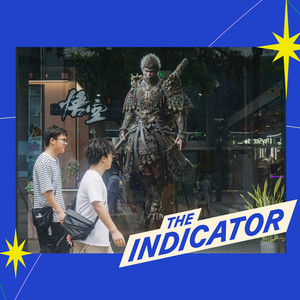
And a very hairy Monkey King.
Coming up after the break.
I know I have a beard, James, but that's not very kind.
Wilderness is changing.
More wildfires, more people, more cell service.
The How Wild podcast hits the trail to explore the history of wilderness, how it's changing, and what that says about us as humans.
Listen now to the How Wild podcast from KALW, part of the NPR Network.
The candidates for November are set.
I know Donald Trump's tight, between now and election day.
We are not going back.
A campaign season unfolding faster.
Kamala Harris is not getting a promotion.
Than any in recent history.
Make America great again.
Follow it all with new episodes every weekday on the NPR Politics podcast.
Indicators of the Week, I will go first today.
My indicator is 0 .3 percent.
That is how much gross domestic product increased in the second quarter of 2022, according to updated data released this week.
2022, Weyland? You brought us into the studio to talk about two years ago.
Hear me out, don't leave.
The Department of Commerce is the agency in charge of putting out GDP data, and it's frequently revising its figures as it gets its hands on more data.
Yes, this is not a conspiracy.
These are revisions.
They're a major part of economic data releases.
All our big indicators, like the jobs numbers, inflation, they get updated throughout the years.
It's all very normal.
And so this newly updated GDP data shows that the U .S.
economy actually expanded a teeny tiny bit in the second quarter of 2022.
0 .3 percent. And this is notable because previous estimates show that the economy shrunk during that quarter.
OK, so it was a revision that took the GDP from negative to positive, even if it's just a tiny little bit better than we thought it initially did.
Yeah, the data we had before today showed two straight quarters of contraction in 2022.
And actually, that's one rule of thumb for identifying a recession, two consecutive quarters of contraction.
Although, as Planet Money has covered, the U .S.
is not officially in a recession unless this one group of economists says we are.
And this group actually never declared a recession in 2022.
OK, so some people, though, maybe using the common definition of a recession, may have thought we were in an unofficial recession back in 2022.
But what you're saying is the new numbers show we were not even in an unofficial recession.
Like, take it out. No recession.
No recession. Good to know that we weren't even unofficially on the outs.
Yeah. Are we all feeling better?
And overall, the new GDP numbers released this week show that the U .S.
economy recovered more strongly from the pandemic than previously thought.
Plus, here's a bonus indicator courtesy of the Organization for Economic Cooperation and Development, also known as the OECD.
It raised its global growth forecast for this year.
So not a bad week for GDP enthusiasts out there.
Waylon, you can't smuggle multiple indicators.
That is against the rules.
Aha. I did it. And no one can stop me.
All right. Well, I only have one and it is this.
But it's spectacular.
My indicator is a whole lot of cash, straight UN cash.
This is because the government of China has promised an unusually big direct assistance program.
And we do not know how big, but a lot of money is going to be handed out to people ahead of the 75th anniversary of the founding of the People's Republic of China.
Oh, so like birthday stimulus checks or something.
Well, well, the language is one time living allowance for the extremely poor.
And the context here, though, is that Beijing has generally chosen other ways to stimulate the economy, more often with investment into things like factories and housing and roads.
But things in China have gotten pretty bad since the pandemic.
Like, like, yes, the economy is still growing 4 .7 percent, but their target is 5 percent.
And there's been this full on housing slump and high rates of joblessness and consumer confidence crisis.
And so people have been calling for the kinds of government spending stimulus that we take for granted here in the U .S.
In this case, something that looks an awful lot like stimulus checks.
I seem to remember a weird amount of talk about something called an economic bazooka when it comes to fixing things in China.
Is this the economic bazooka and should I be scared?
You shouldn't be scared of the bazooka, but this does not seem to be it.
It seems more like we're seeing like a shotgun blast or something.
There's been this week like a scattershot of solutions.
So in addition to this not officially stimulus check stimulus check thing, China Central Bank announced a bunch of central bank stuff, including a tool that I could imagine lots of Americans might be jealous of.
The People's Bank of China didn't didn't just announce a reduction to, like, you know, banking interest rates.
It announced a half percentage point reduction to people's mortgages directly.
Get out. So your rate is just lower.
Just lower. Straight up mortgage rate reduction.
But again, things are economically pretty bad right now.
And the general consensus seems to be that these measures are a good start, but not nearly enough yet.
And of course, what happens in the world's second biggest economy matters to the world's economy as a whole.
So I suspect it will be nice to have a bit of a positive business story out of China, which I gather you have, James.
Yeah, the Chinese gaming market is really excited about this one.
My indicator is one billion dollars.
And that's how much the new video game Black Myth Wukong grossed on the PC gaming store Steam as of this week.
Oh, this is based on the legend of the Monkey King, right?
My mom used to read us these stories when we were younger.
Yeah, that's where the Wukong comes from.
It's based on this old novel from the 16th century Journey to the West.
And you play this really bot show tricksy Monkey King character.
And it's become one of the best selling games of all time since its release a few weeks ago.
It's right up there with games like Hogwarts Legacy.
And that's really important for the gaming industry in China because those companies have traditionally focused on mobile games.
This is for big screens, consoles, and high end PCs.
Who is buying this?
Has this made it over to the West?
Are you asking if it's journeyed to the West successfully?
Yes. The answer is yes.
The game has been getting good reviews in English language media, but most of the sales we can track to China, a good 80 to 90 percent of them.
And that's because Chinese gamers have been really invested in something this big and prestigious for years.
And that's despite allegations of sexism and a toxic work culture at the studio that made Black Myth Wukong.
In fact, influencers were emailed a directive to avoid discussing so -called feminist propaganda when playing the game early, which had a lot of people scratching their heads.
Right. What counts as that?
So, for an esophaganvas, women are human beings, women deserve equal rights, what counts?
Or that women could even enjoy the game.
Uh -oh. Its art director went on a diatribe years ago saying that men and women like fundamentally different games because of biological differences and that he isn't making soft and effeminate things.
And the game's main producer has a very long history of making crass, sexualized comments.
But despite all of that, Black Myth Wukong has been doing extremely well.
And that largely speaks to how hungry Chinese gamers have been for this sort of big prestigious blockbuster game that can compete with anything that Japan or the US produces.
And they've been voting with their wallets on this one.
So what kind of buzz are you hearing in the US about this game and whether it's getting really big here?
Well, it's certainly one of the better reviewed games of the year and among the most financially successful, if not the most financially successful.
And that's because it really appeals to gamers who like these kind of hardcore action games like a Dark Souls or an Elden Ring.
It is a brutal game.
Black Myth Wukong will have you face giant bosses that will crush you into the dust.
I don't mean to like ruin the game for anybody, but I'm just gonna say up, down, up, down, left, left, right, left, right, A, B, A, B.
So let's start. It might help a little bit on this one.
If only this game was also produced by Konami.
I thought that was a universal cheat code.
I definitely did too.
That's why we need James on as the gaming expert.
Otherwise, you and I can't.
I'll give you all the new cheat codes.
Well, thank you, James and Kenny, for monkeying around with us on The Indicator today.
This episode was produced by Angel Corrares with Engineering by Gilly Moon.
It was fact checked by Sir Juarez.
Kicking Cannon edits the show and The Indicator's a production of NPR.
For a while now, you've probably been hearing about book bands, how they're gaining momentum everywhere in Texas, in Missouri, Florida, and Pennsylvania.
On the Code Switch podcast, we're taking a look at why.
Why are so many books suddenly considered so dangerous to kids?
Listen to our new series on the Code Switch podcast from NPR.
Ever look up at the stars and wonder, what's out there?
On shortwave, we ask big questions about our universe.
From baby galaxies to the search for alien life, we explore the celestial science behind these questions.
Listen now to the shortwave podcast from NPR.