This is The Indicator from Planet Money.
I'm Darian Woods.
And I'm Waylon Wong.
On Friday, we heard the long-anticipated conclusion to what has been like the economics equivalent of The Bachelor.
President Trump finally picked who he wanted to lead the U.S. central bank, the Federal Reserve.
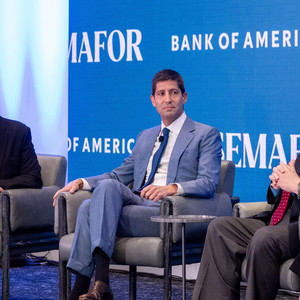
Yes, President Trump said he would nominate Kevin Walsh to lead the Fed.
Kevin Walsh started his career at Morgan Stanley.
Later, he was a governor at the Fed during the Great Recession.
And if confirmed by the Senate, he'll start after the current Fed chair Jerome Powell's term expires in May.
Kevin Walsh would lead the Fed at a tempestuous time.
The central bank's independence is under attack by the president.
Yeah, Trump routinely bashing the outgoing Fed chair publicly was only the start.
He also tried to fire Fed Governor Lisa Cook, accusing her of mortgage fraud.
She denies this and has brought a case to the Supreme Court.
We've also had the Department of Justice subpoena the Fed over building renovation costs.
And that's not even taking into account what's happening in the actual economy.
The dollar sliding, elevated inflation talks of a bubble in AI stocks and money rushing to buy up precious metals.
The next Fed chair has his work cut out for him.
In the public service, the new leader is often given a briefing.
You know what's happening with the organization, what's the landscape out there and what policy options are at their disposal.
So today on the show, we're going to do just that.
Our briefing to the incoming Fed chair.
This message comes from LinkedIn ads.
One of the hardest parts about B2B marketing is reaching the right audience.
That's why you need LinkedIn ads.
You can target your buyers by job title, company, role, seniority, and skills.
All the professionals you need to reach in one place.
Get a $250 credit on your next campaign so you can try it yourself.
Just go to LinkedIn.com slash NPR pod.
That's LinkedIn.com slash NPR pod.
Terms and conditions apply only on LinkedIn ads.
This message comes from Adobe.
Do that with Acrobat.
Have 30-plus documents that need to be simplified into a proposal?
Do that with Acrobat.
Learn more at adobe.com slash do that with Acrobat.
Jerome Powell was asked last week what his advice to a new Fed chair would be.
He had a strong message.
Stay out of elected politics.
Don't get pulled into elected politics.
Don't do it.
And for our briefing to the incoming Fed chair, we gathered the views of three Fed watchers.
They all have different perspectives on what matters for the Fed.
First is Skanda Armanoff, who runs the think tank Employ America.
That's a group who tries to support full employment and macroeconomic stability and looks for alternatives to using higher interest rates to fight inflation.
Skanda raises the big issue of the moment, which is the pressure to be loyal to the president.
I don't think it serves the interest of full employment if the Fed cannot have a credible impact on financial markets.
Skanda thinks Kevin Warsh is an unfortunate choice, noting his public remarks have been marked by, in his words, persistent obsequiousness towards President Trump.
And so that preservation of credibility, we are seeing a version of it erode.
Skander points to longer-term interest rates.
These are interest rates that feed through into new mortgages.
And in the last few months, these longer-term interest rates have been going up.
That's even though the Federal Reserve has been cutting short-term interest rates.
Basically, even as the Fed has been trying to make it easier to borrow, the markets have been saying no actually, we want to make it harder for people to borrow for things like houses.
That suggests that investors think the Fed will need to raise interest rates higher or are forecasting inflation will go up in the future.
Investors want more compensation for risk.
This should be kind of a little bit of a warning sign that we're seeing the types of things that we would normally be concerned about, associated with Fed independence, being eroded.
So Skander's message to the new Fed chair?
Central banks ultimately have their effect through some understanding that these policies are rooted in objective analysis, data dependence and objective evaluation.
In other words, Skanda wants the new Fed chair to look at the numbers, not the politics.
Following the numbers means the Fed will sometimes have to take unpopular action like raise interest rates.
Which brings us to the next of our indicator advisors to the incoming Fed chair, Aditya Bhave.
Aditya is a senior US economist at Bank of America.
I think the biggest question for the next Fed chair is, do rates need to even come down?
The Fed has been lowering interest rates for roughly a year and a half, with another two cuts expected this year.
Aditya doesn't think that's needed.
Consumer spending on average has been strong.
GDP, that's been strong as well.
And financial markets are doing great.
The stock market is up significantly.
None of that suggests that the current policy rates are particularly imposing some restraint on the economy.
Some have called this a jobless boom.
What do you make of that, where there actually isn't a lot of hiring, even though I've seen numbers like GDP output being quite high?
I think there's certainly some evidence of that.
Hiring has slowed down a lot and yet GDP continues to grow.
There's a few reasons for that.
I think in terms of consumer spending, you see higher income folks probably feeling quite comfortable about spending, in part because their wealth has increased in the stock market and that's playing a part in this.
The other thing that's really driving GDP growth is AI-related investment.
And that's not very labor-intensive.
So we're able to get that GDP growth without adding a lot of jobs.
So Aditya's advice is stop cutting interest rates and look at maybe even raising them.
Now, this might come as a surprise to the many people feeling glum about the US economy.
It is spluttering for those on lower incomes.
They've seen their pay growth mostly eaten up by inflation.
Overall, though, Aditya says the US economy is running strong on average.
And Aditya says the Fed can only really affect what's happening in the economy on average.
Redistribution, moving money from one group to another, is more of a job for Congress.
And knowing which branch of government is responsible for what is critical for an incoming Fed chair.
Just ask Sarah Binder.
Sarah is a professor of political science at George Washington University and a senior fellow at the Brookings Institution.
She's the co-author of The Myth of Independence, How Congress Governs the Federal Reserve.
She quotes the Fed chair who held that position during the Great Recession.
Ben Bernanke, in his last press conference as chair, said Congress is our boss right, crystallizing the importance of making sure you have Congress on your side, even as the Federal Reserve.
That's actually what Jerome Powell said last week too.
They were both saying that Fed autonomy to set interest rates independently of politicians doesn't mean that the Fed can just do whatever it wants.
It's ultimately accountable to Congress.
And that explains Sarah's advice to the incoming Fed chair.
One issue that keeps coming up, despite the many efforts, I think, of this Fed under Chair Powell to address, is the question of the disclosure and the behavior of Fed officials in terms of trading stocks, bonds and other financial disclosures.
Failure to follow the rules.
This is a big issue that Sarah thinks hasn't gotten the attention it deserves.
Like in August last year, that's when Governor of the Federal Reserve Board Adriana Kugler resigned.
The resignation was accompanied by a short press release with no details about why.
Then in November it came to light that she had resigned because her husband had broken the rules around Fed officials trading.
There have been purchases of individual stocks.
That's not allowed.
And there have been purchases during the blackout period leading up to the Federal Reserve's decision day.
That's also not allowed.
Often it seems inadvertently violated the rules, but then are allowed to leave quietly.
This wasn't a one-off.
Fed Vice Chair Richard Clarida resigned in 2022 amidst a trading scandal the previous year.
Two regional Fed presidents also left their positions after controversial trading.
So addressing that increasing confidence that the Fed has a tough set of rules and having some consequences for violating the rules seems an important step for the Fed to address.
All right.
So if you're hearing this, Fed officials, keep your noses clean.
Noses clean.
So Sarah wants stronger consequences for Fed officials breaking the rules on some types of trading in their personal lives.
She thinks that would help the Fed have a stronger relationship with its boss Congress, and its ultimate boss, us.
Yeah, don't forget that, new Fed chair.
Now.
If the nominated incoming chair would like to discuss these points in any further detail, call us.
Yeah, we have open office hours.
This episode was produced by Corey Bridges with engineering by Jimmy Keeley.
It was fact-checked by Sierra Juarez.
Cake and Canada edits the show and The Indicator is a production of NPR.