American accent training.
Welcome back, English practicer.
Thank you for practicing your English speaking with me again today.
This is going to be a basic review of some of the core components of the American accent.
First, let's practice some key sounds of American English.
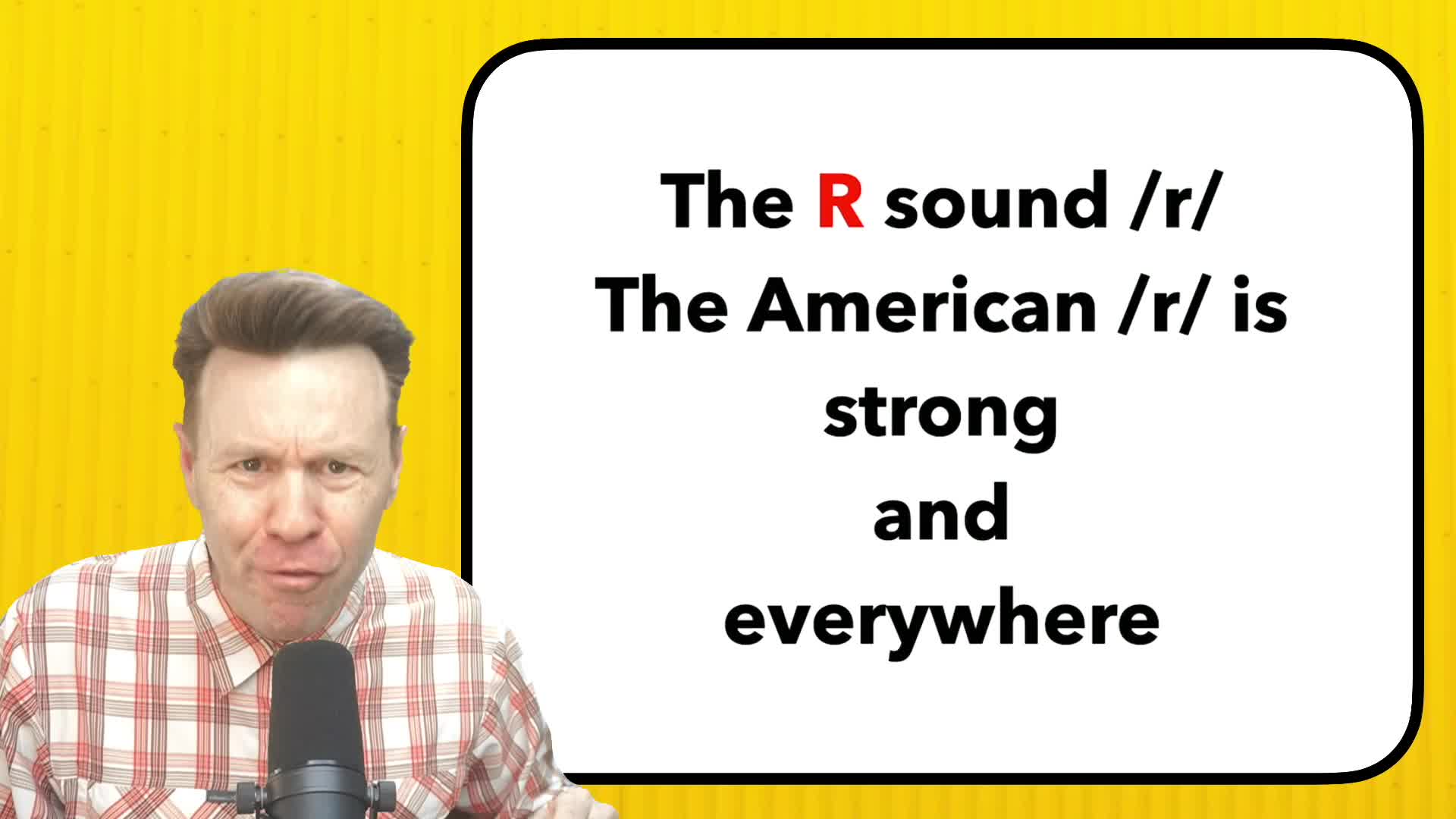
The R sound, the American R is strong, strong and everywhere.
It's everywhere.
It's strong.
It's American.
All right.
The er, er sound, er, as in her, work.
Hear the er in there?
Work, work.
Word, word.
Your word up.
Let's get to work.
Did you see her?
Her, work, word.
All right, let's try the R sound.
R, car, start, part.
Car, start, part.
That one's easy.
All right, the or sound.
Or, for, more, story.
For, more, story.
For more story, continue.
Or.
All right.
Good.
Let's go through these quick.
Car.
Car.
Part.
Part.
Work.
Work.
Early.
Early.
Girl.
Girl.
Girl, right, right, around, around, right around the corner.
There was a girl.
She was working early.
On part of her car.
Oh, look at that.
I made a whole story with those words.
On the spot.
Ad-libbing.
All right.
Here's some pairs here.
Cod.
Card.
Cod.
Card.
Cod.
Card.
Cod.
Card.
Caught, caught, caught, caught, caught.
This one's a longer sound.
Caught, caught, caught.
Walk, work.
Walk, work.
I walk to work.
Do you walk to work?
Yes, I walk to work.
I try not to get caught when I sleep on the cot.
All right, here's a T sound.
Water, water, water.
What?
It's not a T sound.
It's a D sound.
Water becomes water, water, water.
Drink some water.
Better, better.
You better do it.
You better drink some water.
City.
I live in the city.
City?
I'm a city boy.
Waiting.
I'm waiting.
I'm waiting to get some water in the city.
Are you waiting?
It's better to put water in a bottle.
It's better to put water in a bottle.
It's better to put water in a bottle.
It's better to put water in a bottle.
Good.
He's waiting in the city.
Where's he waiting?
He's waiting in the city.
All right.
The vowel length is important and the quality of the vowel sound.
Cat.
We're going to exaggerate here so that we can really reduce our accent, right?
Cat.
Bad, bad cat.
Don't be a bad cat.
Jacket, jacket.
Father, father.
Father, are you hot?
Take off your jacket.
Hot, hot father.
Ooh, I'm a hot father.
Yeah, okay.
That's enough of that.
All right, here's some more vowel length and quality.
Cup, cup.
Luck, luck.
Above.
Above.
Bird.
Bird.
Her.
Her.
First.
First.
Her first bird.
Above the cup.
That's a bad sentence.
I'm just trying to make something up.
Okay now, word stress is important too right, like table table window window, american or america america, american English, American English.
I often get asked, well, where do I put the stress?
Oh, that's so hard.
There are rules, but it's so difficult.
You just need to do lots of repetition and practice and hearing and listening and it becomes natural.
You just know where to put the stress.
That's the best I can do for you there, man.
Sorry.
All right.
Misstressing a word can make it hard to understand.
For example, photography or... See, I messed up.
This is photography and this photograph.
This is a photograph.
This is photography.
Photography. photography, photograph.
You see where the stress is can change the meaning of the word, even though it's spelled the same.
All right sentence.
Stress in a sentence.
Content words, that's the nouns, the main verbs, the adjective adverbs, those get more stress.
The content words and the function words a, the to of, and can do, etc.
Those are reduced, Not always.
This is generally speaking.
I want to go to the store.
I want to go to the store.
All right, so we're comparing that to, we're stressing want, go, store.
Those are the important words.
These are not so important.
Well, they are important, but less.
So they're reduced a bit, huh?
I want to go to the store.
This is a general advice, not standard across everything.
Let's look at some connected speech.
Native speakers don't pronounce every word separately.
They connect words together.
You know this, right?
Like linking patterns.
Go out, go out, go out.
I'm going to go out.
Are you going to go out?
I'm going to go out.
See it?
Do you see it?
Do you see it?
I see it.
I see it.
Take it.
Take it.
Here, take it.
Do you see it?
Yeah, I see it.
Go ahead and take it.
Take it and go out.
Go out.
I'm going to say this nice and slow.
I was going too fast.
Go out.
Go out, see it, see it, take it, take it all right, so you can also re reductions for two, four and these, these are common, you know these.
Right going to gonna, are you going to go?
I'm gonna go.
Want to want, I want to go.
For becomes for in fast speech.
What for?
What for?
That sounds weird.
What for?
I'm going for, I'm going for a walk.
I'm going for a walk.
Do you want to come with me?
I'm going to go for a walk.
There we go.
I'm going to go for a walk.
Do you want to come with me?
Rock and roll, baby.
Rock and roll.
So the and becomes in.
Rock and roll.
I can't think of any other ones right off the top of my head.
Yeah.
Hot and cold.
Also, here's some advice when practicing speaking English in my videos.
Pay attention to connected speech, common linking patterns and reductions.
Then, gradually include them in your own speech. as you become more comfortable using them.
It takes time, it takes lots of exposure, it takes lots of listening and it takes lots of trying to mimic and repeat to finally get the feel for it.
It takes time.
So how do you reduce your accent?
You want to reduce your accent.
Use focused imitation.
That's what we do.
Imitation you imitate me, you shadow me.
You try to copy me.
You try to reduce your accent.
You build your muscle memory the way your mouth moves.
You have to listen carefully to the sound i'm making and then mimic that sound.
That's muscle memory buildup in your mouth.
Listen carefully to the sounds, the rhythms, the stress and intonation and then mimic what you hear.
This is basic good advice, right?
You know this.
And that was our basic review of american accent training.
Thank you so much for practicing with me again today.
This has been an english coach.
Chad presentation boom, good workout.
Keep moving forward one step at a time, having some fun while we practice english.
Hey, i'll see you in the next english speaking video.