This is The Indicator from Planet Money.
I'm Waylon Wong.
And joining us for the next three months as co-host is Stephen Basaja from the Gulf States Newsroom.
Welcome aboard, Stephen.
Yeah, thank you, Waylon.
I'm joining you from the new official indicator, Birmingham Studios.
Ooh, very exciting.
And you're here just in time for Jobs Friday.
Yay!
And you know, it's another weird one because we should be getting updated numbers from the Bureau of Labor Statistics.
However, the government shutdown means we are not getting the BLS jobs report for the second month in a row.
Instead, we'll look at the numbers from the companies ADP and Revelio Labs.
ADP says private employers added 42,000 jobs in October.
Revelio Labs, which also factors in public sector jobs, says the US economy actually lost 9000 jobs.
And the Chicago Fed forecasts the unemployment rate at 4.36 percent.
That's up from 4.1 percent last year.
So we've got other data sources partly filling the void left by the BLS.
But there are other government functions that are much harder to find alternatives for and jobs that can't really be replaced.
One example, TSA agents.
Earlier this week, our colleague here, Sierra Wada, spent three hours just in the security line at George Bush Intercontinental Airport in Houston.
We called her as she was about to board her flight.
So how long have you been at the airport?
So I got here at 5.30 this morning.
It's 1 right now.
So brain's not working at this point.
I can't think about how many hours.
Long, long day.
Yeah, not a fun day at the airport.
No.
The administration said this week that it will start cutting traffic at 40 of the country's busiest airports.
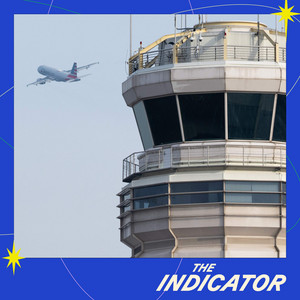
And this puts the spotlight on another important federal job, air traffic controllers.
They are the workers in the control towers and radar rooms that help aircrafts keep a safe distance from each other.
There are around 13,000 of them working without pay.
Air traffic controllers were also main characters during the 2019 shutdown.
Today on the show, we look at why this group of federal workers is such a big pressure point.
And one air traffic controller tells us about his experience during the shutdown.
This message comes from Capital One.
Banking with Capital One helps you keep more money in your wallet with no fees or minimums on checking accounts.
What's in your wallet?
Terms apply.
See CapitalOne.com slash bank for details.
Capital One N.A.
Member FDIC.
This message comes from NPR sponsor Capella University.
Learning doesn't have to get in the way of life.
With Capella's game-changing FlexPath learning format, you can set your own deadlines and learn on your own schedule.
That means you don't have to put your life on hold to earn your degree.
Instead, enjoy learning your way and pursue your educational and career goals without missing a beat.
A different future is closer than you think with Capella University.
A big part of the government shutdown is a battle over the political narrative.
Like, who's to blame?
Sarah Binder is a professor of political science at George Washington University.
She says there needs to be an issue that makes everyday people care.
What are the spillovers of the shutdown that get people off the sidelines and, as we say, into the game?
Like... telling reporters, pollsters who they blame.
So what type of issues are those?
Like the clearest one from 2018, 2019, and we're seeing it yet again, are air traffic delays.
We see it on TV.
We see lines at airports.
That is like immediate pain and lawmakers recognize it.
In January of 2019, during the previous shutdown, the Federal Aviation Administration ordered a ground stop at LaGuardia Airport in New York.
The agency said shortages of air traffic controllers were causing delays.
The shutdown ended that same day.
And that's where this story was born, that controllers were the key to resolving the impasse.
The National Air Traffic Controllers Association, however, rejects this idea.
What?
They don't want to be the shutdown saviors, the heroes here?
That is not how they see it.
Union President, Nick Daniels, told CNN recently that he does not want the group to be cast in that same role again.
Air traffic controllers didn't ask to be thrust into this spotlight.
We are the rope in this tug-of-war game that's going on.
Still, Sarah Binder says that a tidy story tends to override reality.
Politically, the narrative is that those air traffic delays push those lawmakers to go to the table right at the end.
Now, whether or not A causes B, it doesn't matter in politics.
It's how we interpret past events.
And certainly the case that if you ask me, oh, what ended that last shutdown?
Air traffic delays, right?
Even if it wasn't specifically the only thing that mattered.
Now the government is facing the prospect of air travel delays stretching into the Thanksgiving holiday.
The shutdown is putting a lot of stress on controllers like Nicholas Matthews.
He works at the Savannah Hilton Head International Airport in Savannah, Georgia.
And the last thing a controller needs is stress.
The job requires calm and steady communication with pilots.
They will react to your tone of voice or how you sound.
So if you sound like someone who's in training, Everybody on the frequency responds to you that way.
It can mean they ask more questions, making sure that what you're saying is what you really mean.
Do you have like an air traffic control voice and is it different than like the voice you use at home?
I just try to keep it very consistent at work.
So it's always the same tone.
You're sort of trying to not remove all emotion, but maintain a very level sort of emotion.
Yeah.
Most people do talk about their controller voice.
What if you said, like, I'll have a ham sandwich, please, in your controller voice?
I'll have a ham sandwich, please.
All business.
Yes, absolutely.
Get that man a ham sandwich.
Who could deny that voice?
I don't even know if he likes ham sandwiches.
Nicholas got his initial training in the Air Force and served in the military before going to work at the FAA in 2014.
He says the job requires hundreds of decisions every day, some of them involving high-stress situations like a plane that has equipment failure.
Definitely we're going to for one.
Offer them all the nearby airports so they may be able to divert to an airport different from what they planned.
The other thing is helping them maybe visually locate landmarks, obstacles or runways so that they're able to find them quickly.
And then obviously we prep that airport wherever they're going.
The job of the controller is to control all these things.
And then something like that happens and you no longer have control of that situation.
All you can do is try to get them as much help as you can.
Ooh, I do not want that stress in my life.
That is so much responsibility.
No, I can't imagine having that job, honestly.
And, you know, now Nicholas and his coworkers are in another situation they can't control.
Nicholas lived through the previous government shutdown.
That one lasted 35 days.
The current shutdown has surpassed that and is now the longest on record.
Air traffic controllers are required by law to keep working, even during a shutdown.
The union doesn't condone employees calling in sick at a protest.
But Transportation Secretary Sean Duffy said controllers are calling in in larger numbers than usual.
And others are taking on second jobs to replace lost income.
Nicholas and his co-workers collected a partial paycheck a few weeks ago.
They missed one entire paycheck last week.
And they'll miss another one next week if the shutdown drags on.
So they're dealing with a stressful job and the stress of putting food on the table.
Nicholas was able to get a zero interest loan from USAA because he's a military veteran.
But he worries about the trainees at his airport.
They're new on the job and may not have a financial cushion.
Nicholas himself is anxious about how long the shutdown will last.
One thing that was the same then and now was that we didn't know when it was going to be over.
I know I can try to stretch what I have available to me so far.
But I don't have an end date.
I don't know how far I have to make it stretch.
That's the worst part of all of this is really not knowing you know what's the end of this look like.
The Controllers Union has been clear on the toll the political situation is taking on its members.
The system was already under strain before the shutdown.
The union says the FAA has around 11000 controllers and needs about 4000 more to be properly staffed.
The shortage means experienced controllers like Nicholas have already been working long hours.
He says he's been putting in six-day weeks since 2021.
Now he's doing this without pay.
Fatigue plus the anxiety over this lost income, that's a dangerous combination.
Every day you kind of have to take a little self-evaluation.
You have to go, am I really prepared to go in and do this job today?
The problem with the shutdown is it adds that additional stress where I have to also go.
OK, are my financial concerns also a reason that might cause me to say hey, I just don't have it in me today to be responsible for the safety of everybody else.
One job that Nicholas definitely doesn't want is fixing the political stalemate.
He says that is the responsibility of the decision makers above him.
This episode was produced by Julia Ritchie with engineering by Sina Lafredo.
It was fact-checked by Tyler Jones.
Kate Kincannon is the show's editor, and The Indicator is a production of NPR.