Big announcement.
Planet Money is publishing a book.
And as of today, it is finally available for pre-order at planetmoneybook.com.
The book is called Planet Money, a guide to the economic forces that shape your life.
It has lots of stories, all that can help you use economics to make life a little richer.
From work and career to retirement and food to business. dating and family.
And, of course, we'll be doing some episodes about the behind the scenes things we learned while reporting and publishing this book.
Things like this.
Pre-ordering a book helps the author so much more than waiting to buy it.
It sends a signal to the booksellers to stock up, to promote it, to put it on that front table when it does publish.
So, And thank you.
NPR.
For almost as long as there have been financial markets, there have been people trying to manipulate those markets.
People who made money off unsuspecting investors by artificially influencing the price of a stock or some other security.
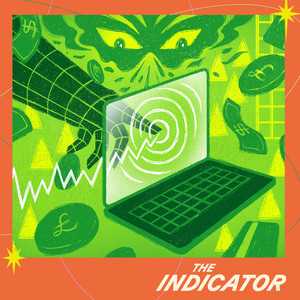
But what happens when the people perpetrating these market manipulation schemes are not people at all?
What if they're computers powered by AI?
This is The Indicator from Planet Money.
I'm Waylon Wong.
And I'm Adrian Ma.
Today on the show, we continue our series on the evolving business of crime with a look at a fast evolving brand of financial chicanery AI-enabled market manipulation.
And market manipulation can be bad enough when done by humans, because it means bad actors profit, innocent folks lose money and the whole financial system is undermined.
But as one AI researcher told us, AI puts that process on steroids.
From deepfakes to robot cartels.
We'll learn why we should worry about AIs causing market mischief and why the law is already behind in preventing it.
This message comes from LinkedIn ads.
One of the hardest parts about B2B marketing is reaching the right audience.
That's why you need LinkedIn ads.
You can target your buyers by job title, company, role, seniority, and skills.
All the professionals you need to reach in one place.
Get a $250 credit on your next campaign so you can try it yourself.
Just go to LinkedIn.com slash NPR pod.
That's LinkedIn.com slash NPR pod.
Terms and conditions apply. only on LinkedIn ads.
What happened in Iowa today?
Probably a lot.
Hey, I'm Megan McKinney.
It can take a while to follow all of the news, but it doesn't have to.
Have you tried Here First?
It's a daily news podcast from Iowa Public Radio, part of the NPR network.
It's your quick stop for Iowa news, culture, and community.
Listen where you get your podcasts.
There are a lot of ways that AI can be used to manipulate financial markets.
But to help us wrap our heads around it, we're going to sort them into two basic buckets.
The first is what you might think of as human-led manipulation.
And to help us explain, we called up Nicole Turner-Lee.
She's director of the Center for Technology Innovation at the Brookings Institution.
When we talk about artificial intelligence today, we're probably talking about it in ways that are attainable for everyday people.
You know, what AI looks like in retail or how AI affects employment.
But when you begin to get into the markets and trading area, AI is so much more opaque.
A couple of years ago, Nicole was asked to research how the increasing adoption of artificial intelligence could shape financial markets.
I have to admit, when I did this project, out of all the projects, this one was the most scary.
Because any AI that goes awry has the potential to shut down the whole market in ways that I think would be unforeseen and consequential.
Nicole outlined ways AI could be used to mess with markets.
One big one is by spreading misinformation.
And as we all know, information moves markets.
We see this every day in the analog world.
Announcements get made by the president on tariffs.
The market goes awry.
When you have something that's embedded in the technical system.
What's even scarier about this area is you may not know where it emanates from.
Ghost in the machine.
Generative AI makes it super easy for bad actors to manufacture misinformation.
With a few keystrokes, anyone can make a fake news article or a deepfake recording.
And with the help of bots, they can easily spread that misinformation across the internet.
So those are examples of how humans can use AI to manipulate markets.
But what if AI could use AI to manipulate markets?
What?
What we're talking about here is AI-powered trading bots run amok.
Now, trading bots are not an entirely new thing, of course.
For years, hedge funds have been using them to carry out high-frequency trading.
But, as finance professor Ekaterina Svetlova says, those bots still require a lot of human input to tell them how to trade.
In case of high-frequency trading, you give a machine clear rules what to do.
And now we have algorithms which don't receive clear rules from humans.
At the University of Tevente in the Netherlands, Ekaterina studies how technology shapes financial markets.
And she says these new algorithms have given rise to a more intelligent kind of trading bot powered by AI machine learning.
In particular, something called reinforcement learning.
That's where an AI agent is given a goal, like maximize long-term profits.
And without any further instructions from a human, the AI goes to work, figuring out, through trial and error, the best trading strategy to achieve that goal.
And they are not programmed to do this directly.
One way to think about it is that the old trading bots are like Roomba, while the new trading bots are more like R2-D2.
So friendly and helpful.
Maybe not as friendly as R2-D2.
But with that amount of intelligence and autonomy.
Exactly.
Okay.
And yet Katarina acknowledges that it is hard to say right now just how many firms are employing these new kinds of bots.
But she thinks soon financial markets could be filled with them.
And that could cause some problems.
Trading bots could start to mimic each other's behavior, unintentionally buying and selling stocks in tandem, causing wild swings in the market.
Or, as a recent study suggests, these AI super traders could even engage in collusion.
Yeah.
Researchers at the University of Pennsylvania ran a simulation to see what would happen if they unleashed a bunch of AI bot traders powered by reinforcement learning into a marketplace.
And what they found was that, instead of trading against each other, like you would expect in a competitive market, these bots started colluding with one another to manipulate the market.
Itak Goldstein is a finance professor who worked on the study.
Collusion.
Here is a situation where they kind of understand over time that they should trade less aggressively against each other because this is going to help others' profits.
And then they kind of start acting like a cartel, right?
What is a cartel?
A cartel is basically when...
Instead of each one of them making their own decisions, they're making decisions collectively.
And the surprising thing here is that these bots were not explicitly communicating with one another.
Instead, each of them is using their own machine brains to crunch the data and come up with the best investment strategy.
And it just so happens that the best investment strategy turned out to be for them to act like a price-fixing cartel.
Now, in some of the simulations that Itai ran, there'd be a bot that did not want to cooperate with the others.
And this did not sit well with the cartel bots.
If they see that someone deviated then there will be some punishment that others are going to start trading aggressively to punish the party that deviated.
Vicious.
Yeah, they sent out some digital bots to break their digital bot legs.
Oh, goodness gracious.
I mean, what's wild about this is that if humans engage in this type of financial market collusion and manipulation, they'd be breaking the law.
They might get in trouble with the Securities and Exchange Commission or the Department of Justice.
But the crime of collusion and market manipulation has historically required human intent, you know intent to do the crime.
So here's where things get kind of philosophical, right?
Because can autonomous trading bots even have intent?
And more to the point, who's responsible if a gang of trading bots go on a financial crime spree?
Nicole Turner-Lee of the Brookings Institution says that's a question we don't have good answers to right now.
When things go wrong because AI is not a person, who do you sue, right?
Who holds the liability for these things?
Who is actually liable when you're actually overusing or dependent on AI systems in this marketplace?
And how do you do it in a way where, again, everyday people still have levels of protection?
This is a legal gray area, and Nicole says regulations are probably needed to fix that.
Like all the experts we spoke to, Nicole says AI is not inherently a bad thing for financial markets.
It can be used, for example, as a tool for detecting fraud.
But with regulators still playing catch up.
That means a lot of power rests with the financial firms, who are experimenting with these AIs and still discovering what they can do.
Nicole's advice to them?
Put this on your radar and have literacy around it for your employees and your customers, so that you can ensure if there are bad actors, it's not you.
Are we the baddies?
No.
I don't know.
I mean, are we... You're not the baddie, Adrian.
If we have to ask ourselves that question, what does that say about us?
Tomorrow we bring you the final episode in our Vice series, where each of the Indicators hosts will share their favorite true crime stories, with some economic lessons.
This episode was produced by Cooper Katz McKim with engineering by Sina Lafredo.
It was fact-checked by Sierra Juarez.
Kate Kincannon edits our show and the indicators are production of NPR.