Discussion keeps the world's turning.
This is Round Table. You're listening to Round Table.
With myself, young, I'm joined by Yushun and Steve Hatherley in the studio coming up.
Sky's the limit for modern farming.
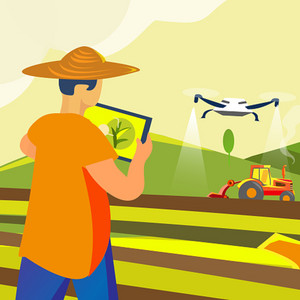
With China's drone revolution soaring to new heights, how are these buzzing, gadgets, redefining farming from sky to soil as we know it?
Now let's move on to the next topic discussion today.
Ever wondered how the skies above our fields are changing the face of farming?
With nearly 200,000 individuals with valid drone pilot licenses in China by the end of 2023, the agricultural landscape is evolving faster than ever from precision spraying to boosting crop yields.
These agricultural drones are transforming the way we grow our food.
And the rise of drones has increased the demand for licensed pilots to operate them.
With drone pilots now working across various fields, agriculture seems to be the particular fertile ground for job opportunities.
You shouldn't tell us more about this emerging profession and its impact on the farming industry.
Yes, actually in recent years, this is an emerging profession right now in China.
Drone piloting was only officially recognized and added to China's occupational classification code in 2019.
But in recent years, we can see more and more people are applying for it and being a pilot.
And according to data from the Civil Aviation Administration, there were 929,000 registered drone users.
Only the 1.3 million registered drones and 194,400 valid drone pilot licenses in China by the end of 2023, the cumulative flight hours of drones surpassed 23 million hours throughout the year.
It's a lot of time in the air.
I remember when drones became a new thing, right?
It was very, very exciting.
You could see them in the shops for sale.
Little tiny ones were quite cheap and then they had the bigger, bigger, bigger ones that got a lot more expensive.
Then the issue became, where can you fly these things and where can you not fly these things?
I don't know if people saw the potential industry possibilities when drones first came out and became popular at the time.
Now various industries, film industry, obviously, right?
But also the agricultural industry.
I don't know if people saw this coming or not.
Many farmers did and they are reaping the rewards now.
I mean, you know, that is why I'm a little curious about this being considered a profession.
Because as you said, we know that these small, I mean, small drones with cameras on it, that's kind of an entertainment thing that people would do.
But as a profession, I'm a compare it to a driver's license.
We've simply obtained a certification that qualifies you to operate a drone.
But then again, if it is in agricultural area, maybe just like being a taxi driver is also a profession.
So, yeah, perhaps makes sense.
Yes, you get a study, you practice, you get your license and then you're free to operate.
Yeah. And in China, there are some pretty strict roles for the people who are allowed to fly these buzzing gadgets.
And I think it might even make people feel a bit safer knowing that, oh, is people who know exactly what they're doing who are flying these aerial objects into the sky.
And how is it being used in agriculture these days?
The using scenario is more and more diversified right now with the rapid development of drone technology, the 2021 DJI agriculture, who is a giant in manufacturing drones in agriculture, published this agricultural drone white paper and it revealed that agricultural drones are not only used for spraying pesticides, but also for various types such as spraying
fertilizers, seeds and feeds, meet the diverse needs of both farmers in improving production efficiency.
We've seen drones before, right?
They have the four little pads and they have the blades that lifted up into the air.
And in the middle, maybe you've seen the non-commercial drones where people will attach their smart phone in the middle of the drone, something like that.
Mostly with a camera on it.
Yeah, exactly. Something with a camera and then it'll fly into the air.
Now, take that camera away, take your phone away from that image and put in like a 10 gallon jug that is holding pesticides or that's holding seeds or holding fertilizer.
Now, these drones are huge and they're heavy and they carry those gallons of fertilizer and seeds up into the air.
They fly over the fields and then they disperse the fertilizer, disperse the seeds just as a farmer would do except they're doing it from an elevated location.
Have you ever seen a real one?
That's exactly what I saw in Xinjiang, Uyghur, Tarnam's region back then when I was on a business trip.
Yeah, you went there, right?
Yes. So, I went as actually the real drone spraying and when I actually saw that massive drone over a meter white and about waist high, I can't help but be amazed by this sci-fi feel of it, but more realistic sci-fi.
Realistic, futuristic all at the same time.
It's the big market, isn't it?
Absolutely. The drones there, the usage there is incredibly widespread.
What one required five or six people to spray pesticides or soil seeds in the fields now, my only need one or two people to operate and the efficiency is even higher right now.
Right. It's kind of alluded to that drones is no longer something that we find as a strange object.
I think it's increasingly being folded into different aspects of our lives.
We've talked about drone delivery.
We've talked about now drones being used in agriculture and a few years back just as when the drone pilot has been recognized as a profession in the national code.
There seem to have been the spur and job opportunities, but apparently now in 2024, I think this is also worth people's attention that you're not really expecting a fat paying job in this profession anymore because of the market saturation.
What are some of the reasons and how did it contribute to the situation today?
I think it's more likely to be more people entering this industry and with more pilots, we will say, getting to this area, maybe the salary or the wage that they can get is getting down.
Basically, we can see back then, is a farmer that used this drones to actually do the agriculture he began in 2017 and the standard fee was above 10 yuan per mou, which is about 666 square meters, so you will get paid if you operate a drone to do the farming things in the farmlands, but now the price has nearly halfed.
Oh, dropped near half of the...
50% less pay. Yes, he said they previously charged about 5.5 yuan per mou and many farms, but they gradually dropped to 4.5 yuan and now it's even as low as 3.5 yuan.
So how would one person feel about getting into this field, I suppose, because these are some fast-changing realities in the industry and I think it kind of deserves fuel attention?
It happens in a lot of industries, doesn't it?
When something's new and you get your license to operate this new piece of technology, the drone, then you're one of the only people who can do that task.
You're going to get paid a lot of money, but then somebody else is going to learn that skill and then 200 people are going to learn that skill and then 20,000 people are going to learn that skill.
Then you can't demand as much money anymore because the person needing the service can go to a cheaper company.
That's what happens here, but it happens in a lot of different places.
Yeah, and even with agriculture, people tend to think that this is a labor intensive industry and also just having technology to replace laborers actually working in the field.
It is a pretty good thing in the sense that it increases productivity and in the past, maybe you need three people now.
You only need one person, but it seems like, yeah, the demand for these personnel aren't really all that much, but we're also seeing that the farmers are actively embracing this kind of technology.
Makes life a little easier for them if not a lot easier.
Because this drones can be more efficient and safer and maybe cheaper, agricultural drones, for example, offer undeniable advantages over these manual crops, spraying, including improved spray, fertilization for 30 to 60 times greater efficiency than manual spraying.
That's according to China's leading drone manufacturer, DJI, as I said, they are also safer, requiring no human contact with fertilizers during application.
I mean, the pesticides too.
Yeah, you need to pour these into the tank of these drones, but compared to a person who is actually spraying it, it is safer and agricultural drones can reduce labor costs, of course, as we said.
Fewer laborers are needed compared to the manual laborers.
I was reading a story from the media outlet in America called NBC, and they were in the state of Maine.
Maine, if you're not familiar, is the most northeastern state in the United States, it borders Canada, and it was talking about one particular farmer and one particular community.
He was the only licensed agricultural drone pilot in the community.
He was taking care of his own farm, but he was also taking care of the farms down the road, if you will.
There were a few quotes from him that stood out to me.
The number one advantage, according to him, was that he doesn't have to worry about whether anymore when he's using an agricultural drone.
What he means by that is when it rains a lot, right?
If farmers have a particularly wet season, then they can't bring their tractor out onto their field where their plants are planted or where their crops are.
Why? Because the tractors are so heavy, it'll damage the soil.
It'll compact the soil.
The soil management, according to him, for farmers, is ultra, ultra important.
During a heavy rain season, the drone can get to places that the tractor can't go, and it can seed in places that the tractor can't seed.
That's really important because that gives the farmers more growing time during a season that they would have lost, that they wouldn't have been able to grow crops at all.
That's one of the biggest advantages of drone agriculture.
Yeah, and it's really interesting to see the role of the weather in agriculture, even with the help of technology.
Because definitely, I think Steve, you paint a bright picture in that sense.
But there's also other farmers, apparently, complaining that drones have their own limitation when they're at the mercy of the weather as well.
Because when drones are spraying chemicals, pesticides, or whatnot, and if it's raining, if they're strong wind, then the rain will dilute the pesticides or whatever you're spraying if it's a chemical thing.
And also, if it's strong winds, then it grounds the drone.
And so it's really, it's quite complicated.
That farming is no easy task.
And also battery life. Battery life of these drones, these are huge.
The one in the story I was reading, this is huge drone.
And they're constantly recharging the battery of this thing or changing the battery out.
It only lasts the drone in the story that I read.
The battery only lasted for about five to ten minutes.
And then they have to recharge it or they have to change the battery again.
It's still labor intensive, I suppose, for the farmers.
It's just maybe a different type of labor than what they're used to.
And also, as you said, actually in China, it's quite the same.
The one pilot need to go through a lot of fields to operate this because of they need to basically fly the drones to a lot of places.
So for drone pilots who serve all parts of the country, the year is divided into different crop spraying seasons and work begins with wheat sowing followed by a short break after two spring cycles.
And June makes the start of rice season with fertilization and pesticide application continuing until September.
And this coincided with corn cultivation leaving many pilots needing to juggle jobs between regions and seasons.
And also early mornings and late nights, long working hours, apparently are some of the things that agricultural drone pilots say about the more arduous side of their job.
And I wonder is it that maybe the market, well, this is definitely a market mechanism in play, I suppose, if they have to work such long hours, it probably insinuates that it doesn't really pay that much and therefore they need to rack up the hours to make enough money to make it a worthwhile outing to work like migratory birds to these different places than working
these long hours. I was looking at a website called salary.com and that's a website that looks at different salaries for different jobs in different industries.
And they broke down the drone pilot industry and they said the average income is about $43,000 to $53,000 per year.
Now that changes a little bit depending on the industry.
Agricultural drone pilots tended to make a little bit more because that's a very specialized industry.
You're right, with market saturation, with more pilots having licenses now and with other considerations too, looking at different drone pilot industries like the film industry.
Now, for example, they can have stock footage on the internet that companies can use for free as opposed to hiring a drone pilot.
But still, it's a decent salary.
It's just you have to find your own path within the industry to find your own success.
It's very competitive now.
Maybe it's because compared to the workload and the working environment to other jobs that has the same payroll, it is something that people would consider that if I am going to study this area and then learn how to control a drone, but I'm still getting in the pay just like my classmate who is not doing this.
And then maybe they will consider it the whole intensity of this job.
Yeah, and one other interesting thing about this profession is, okay, I suppose a tech job in the sense that you're operating a machine, but improved technology actually weakens the role of pilots.
This just makes me think of all these emerging professions as technology advances and progressives.
And then you see, okay, there's a new job opportunity or even a so-called new profession.
But just in a matter of a couple or a few years' time, this job might not have much demand or even disappear.
Maybe a year ago, there was all this talk about prompt writers.
Is it like people who would help you to write the best prompts or the requirements to an AI large language model to generate the best kind of results?
But I had serious doubt about the longevity of a job like that.
It's almost like, you know, maybe just in a fleeting few years.
And then after that, a wonder if that kind of job does have a future or not.
Yeah, I mean, you talk about some of the challenges and one of them, you said the improved technology.
As these drones get smarter, you know, the role of a pilot might just be to press play if you will.
And the drone goes off and does everything by itself and then comes back like a robot vacuum cleaner can find its way back home.
Maybe a drone will be able, an agricultural drone will be able to do the same thing in the future.
And also, you may need more related knowledge and improve your work during the whole process of controlling these drones pilots.
They need to understand the different spraying approaches for different crops, different growth stages and different diseases and pests.
So, you know, that is why, you know, it actually require a lot of not only technological, technological knowledge in this area, but also in agriculture.
And that is why there are some obstacles and difficulties and thresholds for people to get into this area.
And apparently drone related careers are still on the rise, but just one must sort of pay attention to the new trends in one's job.
Because like you guys said, with improved technology, for example, that maybe you need to learn more technology or how to better use this drone or a different drone to stay in the business.
And there is also one aspect about agriculture here that I'm interested to know.
So, let's say if drones have been widely implemented and a lot of these programs are actually government funded as such so that farmers can, without, you know, putting down a lot of investment, can use these equipment.
Does it mean that more farmers are going to be freed up from their land to do other things?
Right? Because you don't need so many people working the fields anymore.
Oh, like having a second job, for example.
Yeah, that's actually what I learned from my trip to Xinjiang.
So the farmers, they used to be farmers and they owned the farmlands.
And then if the whole, I mean, the two pilots, if they can manage their farmlands and then they don't need to get into the farm fields to actually work on it.
And then they can get another job, maybe in the county level city or in other cities.
And then they are not only getting the divideons of their own lands, but also get another job to have a second or multiple income in this way.
In that case, we might see more farmers in the future as well.
Right? We know that there are physical demands to being a farmer.
We know that it is a lot of the hours of the day.
You wake up super early in the morning before the sun comes up and you're working all day long.
That puts people off. I'm sure from getting involved in the farming industry, if we get to a point where technology is allowing us to work quite comfortably and also do other things, then we might see more people inspired to leave the big cities, move out to the countryside and start their own little farms.
That is very interesting.
When it comes to smart technology, yes, using drones is becoming increasingly common and there are other advanced technologies and data-driven farm operations that are being used in all these farms across China.
And what are some of the interesting advanced technology that caught your eye?
Of course. Artificial intelligence and Internet of Things is something that we will talk about when we're speaking of this smart agriculture.
When you can actually monitor the whole situation of your farmland just by looking at the screen in your control room, that is something that we can imagine in nowadays.
We can see information and communication technology is being used.
The US Department of Commerce's National Institute of Standards and Technology defines information and communications technology as the capture, storage, retrieval, processing display, representation, organization, management, security, and a lot of things of data and information.
Talking about Internet of Things and IoT and smart farming, things like this in Texas, one of the things they do.
They call it smart soil sensing for water optimization and in Texas, the sensors are linked to a smartphone app.
So it's on your phone. And the farmers have an app on their phone where they can gather real time information on soil conditions.
I mentioned a few minutes ago about how important soil conditions are to a farmer.
They can include information on soil moisture as well.
Then the app does all the work.
It combines all the information with other data like weather forecasts.
And then it puts forth this AI-powered analysis and it results in watering recommendations.
So the app combined with the smart soil sensors combined together and then they tell the farmers water at this time.
It's the perfect time to do it.
This is great for us too.
I don't know if you've thought about that.
I was thinking about this before the show today.
If we can have drones that can seed in locations where tractors couldn't otherwise get and farmers can have extra harvest, this is good for us because vegetables fruits will be cheaper.
It's more cost effective for the farmers.
Therefore, they make more money.
Therefore, we save more money when we go to the supermarket.
Same with water optimization.
In Texas, when they're doing this, it means they can grow more crops.
They know how to perfectly do it so that they can maximize their yield.
And this is going to benefit us when we go to the stores and pay for cabbage and carrots and onions and things.
Yes. It actually reveals how important weather or climate it is when we're talking about agriculture.
That is how people create an artificial environment for these crops to grow.
Aside from that, one thing I would like to mention is that of course, when we are speaking of technologies, they can create an environment suitable for crops to grow, but still the natural environment.
I mean, created environment is important, but they're expensive.
And when we are also relying on the natural environment, what we need to concern is the climate change.
Climate change really put a huge influence on agriculture.
That is a whole other topic for a whole other day.
That's a big one too. Yeah.
And when we're using all these technologies, I hope that they're being powered by green or new or reusable energy, and then once you're applying all these technologies, and then it's not adding to the carbon emissions to the outside world and not to exacerbate the climate change situation that we're already in.
As drones continue to revolutionize agriculture, the lines between technology and traditional farming are blurring.
The future may hold even more innovative ways to integrate aerial data and automation into our fields.
How will the evolving role of drone pilots shape the sustainability and efficiency of global farming practices?
Some of it we talked about, and also we always want to hear from you.
Share with us your thoughts.
We can send us an email or a voice memo to eZFM around table at Foxmail.com.
That's it for today. I'm Ha Young, and thank you.
You shouldn't. And Steve for joining the discussion.
We'll see you next time.