This message comes from Progressive Insurance.
Progressive makes it easy to see if you could save when you bundle your home and auto policies.
Try it at Progressive.com.
Progressive Casualty Insurance Company and affiliates.
Potential savings will vary.
Not available in all states.
The director, Luca Guadagnino, has been quite busy.
Last year he released the campy tennis love triangle challengers with Zendaya and the hazy period romance queer with Daniel Craig.
And now he's back with After the Hunt with Julia Roberts, Andrew Garfield and Ayo Adebri.
Roberts is a professor who finds herself in a hard place when one of her star students makes an allegation against another faculty member.
Who's telling the truth?
Who's the victim?
Is there a victim?
The film poses a lot of questions, but are any of them answered?
I'm Linda Holmes.
And I'm Ayesha Harris, and today we're talking about After the Hunt on Pop Culture Happy Hour from NPR.
This message comes from BetterHelp.
As a dad.
BetterHelp president Fernando Madeira relates to needing flexibility when it comes to scheduling therapy.
I have kids under 18, so time is very limited.
That's why, at BetterHelp, our therapists try to have sessions, sometimes at night, depending on the therapist, or during the weekend.
So I think that's what we need to tell the parents.
You're not alone.
We can help you out.
If a flexible schedule would help you visit BetterHelpcom.
Slash NPR for 10 off your first month of online therapy.
This message comes from NPR sponsor Adobe.
Introducing the all-new Adobe Acrobat Studio, now with AI-powered PDF spaces.
Need to turn 100 pages of market research into five insights with a click?
Templates for a sales proposal that'll close that deal?
Or an AI specialist to tailor the tone of your market report?
You can do all that with the all-new Adobe Acrobat Studio.
Learn more at adobe.com slash do that with Acrobat.
I'm Ira Glass.
On This American Life, we tell real-life stories, really good ones.
My mother said I'm sorry that you weren't here, because Father Sager was here visiting and he found a very nice orphanage for you.
And I said, but I'm not an orphan.
Surprising stories in your podcast feed, This American Life.
We all wonder about life's big questions.
Why are we here?
What are we to do and how to make sense of it all?
On Ye Gods with Scott Carter.
I talk with politicos priests, actors and atheists on how they wrestle with life's mysteries.
Their stories will spark reflection, challenge assumptions and maybe even bring you some clarity on your own journey.
Listen to Ye Gods, part of the NPR network, wherever you get your podcasts.
It's just the two of us today.
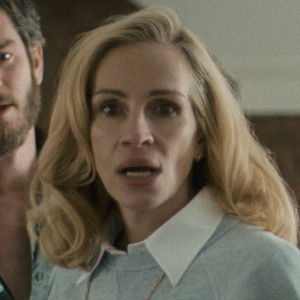
So in After the Hunt, Julia Roberts plays Alma, a philosophy professor at Yale who's blurred the lines between the personal and professional.
Her obvious favorite student is Maggie, played by Iowa Debris.
Alma also has a very intimate, flirtatious dynamic with her colleague Hank, who's played by Andrew Garfield.
Now Alma hosts dinner parties for students and faculty, and Maggie alleges that Hank sexually assaulted her after walking her home from one of those parties the night before.
Hank vehemently denies it and Alma finds herself unsure of who to believe and what to do about it.
We should note that After the Hunt is being released by Amazon MGM Studios.
Amazon supports NPR and pays to distribute some of our content.
It's in theaters now.
So Linda, there's a lot to talk about here.
I actually don't have any idea how you feel about this, because we have not talked about it ahead of time.
So tell me, how did you react to After the Hunt?
I had mixed feelings, which is consistent with a lot of the reviews that it's gotten.
I think Julia Roberts is very good in this.
I like this performance a lot.
I think this is one of her more straightforward dramatic performances where she's accessing a kind of a patrician perspective distance that she's actually better at than maybe some of her other more kind of affable giggly for lack of a better phrase early roles might have suggested I really like her in this.
In the theater.
When I saw it I thought, you know, I think To this movie's credit.
I don't think this is supposed to be like a lesson for our times.
I think it's supposed to be about these very specific people who are in this very specific situation, which obviously grows out of some things that are sort of a thing of the moment or whatever.
But I got the impression they were not trying too hard to...
Like say something about anybody else except these people.
And then I read the production notes.
And if you're not familiar with production notes, they're basically they're part of the kind of publicity process that they send them out.
And it'll be like interviews with the cast and the director talking about their intent and information about the movie that you can use as you're reviewing it.
And in the production notes it became clear that they all really think this is a statement on our times or a provocative opportunity for everyone to talk about, cancel culture and all the things that I kind of hoped it wasn't supposed to be.
Because I don't think it's nearly as effective or interesting as that, as it is a story of mostly Alma, this woman who has set up all her relationships to be so transactional that when they are suddenly kind of upended in a way, she doesn't know whether to do the right thing or the most transactional thing, and she doesn't know what the most transactional thing is.
Right, yeah.
Look, the thing about this movie that I found most fascinating is that within this entire I don't know if it's fair to call it a genre at this point, but there's a collection of quote-unquote Me Too movies, or movies that are supposed to be about the Me Too movement and are representing it in some way.
And what I found most interesting about this is the fact that most of those stories tend to be from the perspective of the person who was the victim, whereas this is from the perspective of someone who actually can't say for sure, although we get kind of a hint of how they may feel about it.
This is about what to do when you are told that someone else has been the victim.
And I think that's an interesting entry point into this because it's very thorny.
It's very complicated.
It's definitely not black and white, or it couldn't be in this case.
Where I struggled with this as it unfolds is the fact that, as you said, it did feel to me like this was trying to make some sort of statement, but it doesn't really take a stance in any way.
I also just like.
I looked at the production notes afterwards and Guadagnino, he said something along the lines of like you know, I found this as a way of exploring how to tell a story, showing all the possibilities of truth, without saying one point of view is most valuable, which to me kind of reads like I'm just going to make sure that I don't actually take a stance.
I'm just going to kind of all sides this thing.
And that comes through in this way that I found kind of like a cop-out and kind of like not necessarily needing all the pieces to fit together perfectly.
And I don't need it to be sort of black and white, but I do want some sort of point of view that clarifies, even if it's not for the characters themselves.
Like it's not necessarily black and white, but I feel like this movie ends up being especially when we get to the end of the second act, into the third act, I guess, where there's this big reveal about Alma that kind of like turns everything on its head.
Yeah.
And I was just very baffled by that choice and didn't quite understand it myself.
It's very intentional that you get to the end of this movie.
You certainly do not have a clear impression of exactly what happened.
You know on the night that these two left the party and the allegation of abuse has happened.
Yeah.
The real reason for that is that it is an Alma POV story.
So that makes sense, right?
She wouldn't know.
You know, I think sometimes people think well, maybe she'll get the clarity of absolute evidence.
You know one way or the other.
She doesn't, right?
And in reality, you might not.
And so that makes sense.
The problem that I have is that I think this...
Kind of muddy unclear, lots of information, missing approach starts to spread to other parts of the story that she would have access to more information.
And it just seems like the movie isn't telling us like.
You get the outcome of, you know, the university says we're going to do an inquiry or whatever.
You get the outcome of that inquiry sort of, but it's not clear like what they did.
Because the way it goes down is essentially that she makes this accusation against him.
His response is that's not what happened.
What happened is I discovered that she was engaged in academic dishonesty.
I confronted her about that.
And that's why she's now making this accusation to protect herself, right?
Yeah.
But you can watch this whole movie and to me it's like did he make that allegation as part of the inquiry?
Did they talk about it?
Did anybody investigate whether it's true?
Like it's all kind of jumped over.
And I understand that the point is not to lay out every individual thing but, like from Alma's point of view, there are things that she does that that makes sense if it's one way and not if it's another way, right.
Yeah.
And so what they're really trying to do is show that Alma is somebody who is always to some degree calculating, because both of these people are relevant, not only as people she knows well but in her career, because Maggie is a student who you know potentially can complain about her, particularly because we learn that Maggie's family the Iowa debris character, her family is very rich and gives a lot of money to this school.
So they're powerful in that way.
And so, you know, Maggie is a person that Alma might not want to make angry.
Hank is obviously somebody that she has a relationship with.
And it's almost like for her, what actually happened is not the thing she's most thinking about.
And that makes sense to me, right?
That's a fair thing to put into that character's Well, yeah, she's also up for tenure too, right?
She is.
She's up for tenure.
But it's like she would be thinking about these other things, like the academic dishonesty.
Stuff gets kind of thrown around in a way that, like you know, you get the feeling like maybe there's some truth to it, but it's not clear whether it has anything to do with the accusation or not.
And then...
I understand not being totally clear.
It's the same thing with Doubt, right?
The John Patrick Shanley play and later movie, where the entire title Doubt is about both the fact that, A you might not actually know what happened as somebody who finds out about an allegation like this and, B how people respond to that sometimes has to do with a lot of other things going on in their lives other than the truth or not of whatever the allegation is or the details of whatever the allegation is.
Yeah.
I love that you brought that up.
And I can't believe I didn't think about that before.
I think for Doubt.
It's been a few years since I last saw it, but I still think it's a very good movie.
And I think it does a good job of handling that murkiness in a way that this movie falls short on.
And I want to kind of pull out a little bit more on this idea that you brought up about, how We don't really understand how much Hank and or Alma have told the administrators about their suspicions of Maggie because, on top of everything, Maggie obviously played by Io Debrey is a black woman.
She's portrayed as queer in this film.
That's also kind of leveraged against her in some ways within the script and also through some characters in this film.
Because it's not just that she's like the favorite student of Alma, but also there's like a suggestion that maybe Maggie might have a crush on her.
So there's that as well.
And I think it's interesting to have a black character who's not perfect and who we don't necessarily like.
It is a very fine needle to thread, especially now when DEI has been attacked and basically dismantled.
But it made me think of the show Industry which you know this is the HBO series that It's set in a very high-stress financial industry world.
And one of the main characters played by Myhala Harold is Harper.
She's a character who's super cutthroat but is often questioned like are you actually good at what you do?
And I think that show does a really good job of sort of like putting that out there but also showing.
You know, does that even matter?
Because when you're in this world, everyone in this world is there for reasons that are other than their actual talent.
It's like they know someone, whatever.
And this movie.
It just kind of puts it out there in a way that felt to me accusatory of like maybe she doesn't deserve to be here.
Like, you know, almost talking to her husband, Frederick, who really does not like Maggie.
Frederick is played by Michael Stuhlbarg.
And at one point she's like, Maggie's brilliant.
And he's like, is she or does she think you're brilliant?
Like, are you just attracted to this and how she kind of fawns over her?
And I found myself being like, okay, cool.
I like that she's not exactly perfect.
But at the same time Maggie's just this kind of collection of isms and everything that people rail against.
And there's this sense that she's just putting on a show and pretending that she's all these things and doesn't really deserve to be there.
And when you mix that up with, was she actually a victim?
And it doesn't actually clarify any of that.
To me it just felt again like you're going to wade in these waters, but you don't actually want to make any sort of clear point of view.
And I think this is a type of movie where you have to take some sort of stance if you're going to make a statement like this.
And I don't think we've mentioned, but the screenplay was written by Nora Garrett.
This is her first credited feature film, and I think she's done some acting work before.
You know I'm curious to see what she does next.
But it also made me a little worried that, like It just feels like a first-time script.
And I wanted more of a sense of like an understanding of what they wanted to say, for me at least.
I think it gets very muddled along the way.
And I, you know sometimes, after I see a movie once, I'm pretty sure that I kind of know my own mind about it.
I will go and look at a couple of pieces of writing about it.
That's what happens is that there are some things that are really interesting, that get seeded, particularly in this opening sequence of this party at Julia Roberts and Michael Stuhlbarg's house.
When did offending someone become the preeminent cardinal sin?
I mean, I don't have a date exactly, but maybe it's around the same time your generation started making sweeping generalizations about ours.
Yeah.
Are you scared that we're going to think less of you if it isn't perfect?
And I know this is a thing that happens at Ivy League schools that the professors are having like a dinner party and everybody's drinking and all the students are there.
You know, because Maggie is a PhD student.
She's not an undergrad or anything like that.
But, you know, you have these students there.
And I just looked at this scene just thinking all of this is such a bad idea.
Yeah.
All of this is just such a bad idea.
And I understand, for a lot of these folks it's part of kind of the I don't know the adulthood process of joining the community of scholars or whatever.
But I just looked at it like, you should not be doing this.
You should not be doing this.
And when I was in school, we did not do this.
I just, uh-uh.
Yeah.
The movie does take pains to specify that this is taking place in 2019.
So there are no hints of that.
And then later it fast forwards to five years later, which I thought was also interesting because it still wasn't satisfying to me, but it does kind of hint at 2019 was a different place to be in versus now in terms of how we think about inclusion and all of that stuff.
And what the incentives are to behave in different ways around that.
Yeah, exactly.
So The first scene, that opening scene, as cringy as it was the whole time, it was like this is a great scene.
I love the way it's establishing these relationships just through glances.
Right.
And looking and small touches.
And I loved that first scene.
But then the final scene is like this weird... Linda, we can talk about this offline.
We'll talk about this offline because I don't want to spoil it.
But it's a really difficult scene to understand to me.
Yeah.
It's kind of surreal.
And I don't understand what that was trying to say.
Yeah.
There's interesting ideas here.
But the execution was just not there.
And on top of that, I just... I found this kind of boring.
I think I could forgive it if it was a little bit...
It's weird to say not like fun, but a little bit more weird and just like had a little bit more energy.
It just feels like a slog in a way.
And you know Guadagnino has queer that I had some issues with that movie, but there was still something about it that moved and just felt kind of, you know, otherworldly in a way that was very transfixing.
And here, maybe it's just that it's Yale, it's an Ivy, it's kind of stuffy.
It just feels claustrophobic in a way that I also found really boring.
Yeah, I get that.
You know, I think there are individual things that, from a filmmaking perspective, work well about this movie.
I like the way that Guadagnino uses editing and different shots.
There are a couple of kind of abrupt shifts to the kind of straight on Face into the camera Errol Morris, Spike Lee style that I thought were very well used.
There are a lot of close-ups of- Hands, so many hands.
Hands, and also sometimes of like a place where a person just was or is about to be that I thought were effectively used.
This is a Trent Reznor and Atticus Ross score that I think is very interesting in a bunch of different places.
I do like what they did with the score and what they did with the sound design.
And so there are a few things like that that I really liked.
But ultimately, I think what I walked away from is like this is what I think of as like a yeah man, that's the point.
Movie right.
Where you come to the end of the movie and you're like, but I didn't really understand like, what was she talking about at this point?
Yeah, man, that's the point.
Yeah.
I couldn't really figure out what the purpose of this scene was.
Yeah, man, that's the point.
Well, on top of it, there are philosophy professors and students.
So it's like, there's a lot of that.
I'm like, okay, all right.
Like, I like philosophy as much as the next person, but, like, come on.
I think it comes off being just a skitch on the nose, maybe because they are constantly talking about, like the ethics of different things that they do.
And you see yes, there's a story here about hypocrisy and people who study ethics but don't have any, and that's all true.
I just think the whole thing, like, it has some powerful moments.
There are a couple of scenes.
I think there's a late scene between Julia Roberts and Andrew Garfield that I think does get some real... like drama into it i think it does get some meat into that conversation but a lot of the rest of it i think they just felt like i liked it okay when i was watching it but the more i think about it the less i like it that's the point man yeah well tell us what you think about after the hunt let us know if you get the point i don't know maybe you do Find us on Facebook at facebook.com slash pchh and on Letterboxd at letterboxd.com slash nprpopculture.
We'll have a link to that in our episode description.
That brings us to the end of our show.
Linda Holmes, thanks so much for being here.
Oh, of course.
We got enough of the point, I guess.
We did.
We did.
This episode was produced by Carly Rubin, Janae Morris and Mike Katzeff and edited by our showrunner, Jessica Reedy.
Hello, Come In provides our theme music.
Thanks so much for listening to Pop Culture Happy Hour from NPR.
I'm Ayesha Harris and we'll see you all next time.
In the U.S., national security news can feel far away from daily life.
Distant wars, murky conflicts, diplomacy behind closed doors.
On our new show Sources and Methods.
NPR reporters on the ground bring you stories of real people, helping you understand why distant events matter here at home.
Listen to sources and methods on the NPR app or wherever you get your podcasts.
Keeping up with the news can feel like a 24-hour job.
Luckily, it is our job.
Every hour on the NPR News Now podcast.
We take the latest, most important stories happening and we package them into five-minute episodes so you can easily squeeze them in between meetings and on your way to that thing.
Listen to the NPR News Now podcast now.
Making time for the news is important, but when you need a break, we've got you covered on All Songs Considered NPR's music podcast.
Think of it like a music discovery show, a well-deserved escape with friends and yeah, some serious music insight.
I'm going to keep it real.
I have no idea what this story is about.
Hear new episodes of All Songs Considered every Tuesday, wherever you get podcasts.