This BBC podcast is supported by ads outside the UK.
If journalism is the first draft of history, what happens if that draft is flawed?
In 1999, four Russian apartment buildings were bombed.
Hundreds killed, but even now we still don't know for sure who did it.
It's a mystery that sparked chilling theories.
I'm Helena Merriman and in a new BBC series I'm talking to the reporters who first covered this story.
What did they miss the first time?
The History Bureau, Putin and the apartment bombs.
Listen on BBC.com or wherever you get your podcasts.
This is the Global News Podcast from the BBC World Service.
I'm Will Chalk, and in the early hours of Saturday, January 24th, these are our main stories.
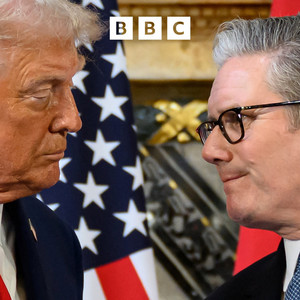
The White House has made its first comments since President Trump started a row by saying NATO troops had stayed a little off the front lines during the war in Afghanistan.
The issue of territory takes centre stage at trilateral talks between Russia, Ukraine and the US in Abu Dhabi.
The UN urges Tehran to end brutal repression after thousands were killed during anti-government protests.
Also in this podcast, I'm going to be freestyling Taipei 101, one of the tallest buildings in the world.
No ropes, no gear, just me and the building.
Rock climber Alex Honnold is about to go sky high, but not everyone's impressed.
Well, the angry reaction to Donald Trump's comments that NATO allies didn't pull their weight and stayed a little off the front line during the war in Afghanistan doesn't seem to be dying down.
The British Prime Minister, Keir Starmer, normally treads carefully around the US president, but he called it insulting and frankly, appalling.
Around a third of coalition soldiers who were killed during the Afghan conflict were non-American.
Mick Mulroy is a former US Marine who served in Afghanistan and Iraq and was Deputy Assistant Secretary of Defence during Donald Trump's first presidential term.
He thinks the US should be grateful for the input of NATO allies during these conflicts.
And I can say from firsthand that we saw not only the bravery and courage of our NATO allies but the professionalism and, quite frankly expertise, particularly of the combat forces and special operations.
They were as good as we are, and we like to think that we're pretty good.
I think everybody, especially in my country, should take the time to really understand the sacrifices that were made by our allies during the course of those two conflicts.
Our defence correspondent Jonathan Beale has more.
British troops fought and died in Afghanistan, right on the front line.
For eight years in Helmand, the most dangerous province of all, Taliban heartland.
There to answer America's call in 2001 to join its war on terror.
Hundreds of British personnel died.
Hundreds more were injured, among them Ben Parkinson.
He lost his legs and is still in need of constant medical care and support.
His mother, Diane Durney, left to express their anger at President Trump.
It's disgraceful.
It's disrespectful.
These are the rantings of a child.
This is somebody who is deflecting from other things that he's said and it's not acceptable in a supposed leader of the free world.
Andy Reid was another casualty of a roadside bomb.
He lost three limbs.
I think it's extremely disrespectful.
Some of my colleagues and 457 other people made the ultimate sacrifice for that conflict that we was in.
And thousands of guys like myself were injured and are still bearing that sacrifice every single day.
457 UK military personnel never came back alive.
Rifleman William Aldridge.
The youngest British soldier to be killed was just 18 when he returned in a coffin.
His mother, Lucy Aldridge, says there's no excuse for President Trump's comments.
Trump isn't known for his historic prowess, but this isn't just misspeaking.
He has deeply offended, certainly, the families of those who never came home.
Britain was with America from the start of the war in Afghanistan right up until the chaotic end, 20 years later.
But instead of expressing gratitude, as have previous US presidents, this one has caused outrage and offence.
I asked our North America correspondent, David Willis, what response there have been from the White House to Keir Starmer's angry words.
Defiance, I would say.
Well, the White House Deputy Press Secretary, Anna Kelly, released a statement which says as follows
President Trump is right.
America's contributions to NATO dwarf that of other countries.
And his success in delivering a 5 spending pledge from NATO allies is helping Europe take greater responsibility for its own defense.
And the statement goes on to say the United States is the only NATO partner who can protect Greenland, to the president himself, is advancing NATO interests in doing so?
Well, that statement really takes no account, does it, of the outrage and the indignation that's being expressed across the political spectrum in the UK and elsewhere over Donald Trump's assertion that NATO troops shied away from the front lines in Afghanistan.
The figures show that whilst 2,356 US servicemen and women died during operations there...
Britain lost 457 of its own, and other NATO countries made similar sacrifices, of course.
Now, the BBC has heard from the former US National Security Advisor, H.R.
McMaster, who served in the first Trump administration, and he called President Trump's remarks insulting.
That sentiment was echoed by the former US ambassador to NATO, Kirk Volker, who said that the president simply didn't know what he was saying.
Well Well, there have been numerous calls for an apology, but that's not traditionally Donald Trump's style, is it?
Not really, and I think the chances of that are slim to non-existent.
This is a president who is given to shooting from the hip, who doesn't relish being seen as weak and who doesn't like to back down.
And over the course of the last week he's railed against supposed allies and friends on a variety of different fronts, not least over his desire to acquire Greenland, reserving particular disdain for NATO, claiming that fellow allies Member nations haven't been pulling their weight and floating the view that, whilst the United States will be there for NATO in times of crisis, NATO may well not be there for the United States.
The fact of the matter, of course, is that the one and only time that NATO has ever enacted Article 5 was after the attacks of 9-11, and the alliance came resolutely to the support of the US And in response to the White House's contention that it was President Trump who forced that enhanced commitment in NATO defense spending.
There are many, I think, who would argue that Russia's invasion of Ukraine did as much, if not more, to focus mines than did the chiding of Ukraine of President Donald Trump.
But there's a feeling, I think, that the president's latest comments have crossed a line prompting the very strong suggestion that he apologise.
And that, of course, could always have completely the opposite effect, giving what we know about this president, prompting Mr Trump effectively to double down and giving rise to a new war of words with allies such as the UK.
David Willis speaking to me from Los Angeles.
Russia, Ukraine and the US have held their first trilateral talks to try and bring an end to the war.
Negotiations in Abu Dhabi will resume on Saturday, and the issue of territory is very much at the top of the agenda.
Our correspondent Sarah Rainsford has been following developments from Kiev.
The format for these talks is new.
The delegates are senior.
But the starting positions haven't changed and they don't bode well for any breakthrough to peace.
Because Russia is still demanding Kiev surrender the rest of the eastern Donbass land Ukraine's troops have been defending for years.
And for Kiev, that's impossible.
It is still too early to draw conclusions.
We will see how the conversation goes tomorrow and what the results will be.
But it needs not only Ukraine to want to end this war.
It needs Russia to show a similar desire.
Instead, Russia is destroying power plants across Ukraine that should supply homes, hospitals and schools.
Round-the-clock repairs can't keep up.
And this week, it's minus 11 in Kiev.
There's talk of a humanitarian catastrophe here.
The attacks on the power supply in Ukraine have been so extensive that when night falls now there are really big areas of Kiev where the lights don't come on anymore.
There's no heat either in people's homes.
It is really debilitating.
And that's why so few Ukrainians really believe Vladimir Putin can want peace when he's doing things like this.
So families now huddle in heated tents in the yards of their flats.
Lydia hasn't had electricity for five days.
This place is a lifeline.
But I ask her about doing a deal with Vladimir Putin.
And she tells me Ukrainians curse him in their hearts.
People here do want peace.
They're exhausted.
But not peace at any cost. even if they're being frozen in their own homes as punishment.
That report by Sarah Rainsford.
Next, reconsider, pull back and end the brutal repression.
That's the message from the United Nations' human rights chief to the Iranian government.
Volker Turk said thousands of people have been killed during the crackdown on anti-government protests, including children and bystanders.
Iran has blamed the unrest and deaths on terrorists and rioters.
The UN Human Rights Council has voted in favour of opening an inquiry into the crackdown.
Our diplomatic correspondent, Caroline Hawley, is in Geneva.
This urgent meeting was meant to send a message and a warning to Iran's leaders that the world is watching.
Mr Turk said its security forces had used excessive, unnecessary and disproportionate force, firing live ammunition at demonstrators.
Specific facts are hard to verify, he told the chamber, because of the continuing communications shutdown and because UN investigators have no access to the country.
But they are already gathering evidence that it's hoped could one day be used by international courts.
Mr Turk told me the Iranian authorities had to end what he called their brutal repression.
We can only hope that the current crisis leads to a reversal of the policies that have not worked and will never work, because we know that this type of repression never yields the results that they think it will.
It won't.
The regime continues to blame the unrest and deaths on terrorists and rioters.
Iran's representative at the meeting in Geneva said his government didn't recognise the legitimacy of the session.
And then, once his short speech was over, he promptly walked out.
But a former UN prosecutor said what had happened at the hands of the regime was the worst mass murder in the contemporary history of Iran.
And he gave an account of one family who searched for three days for their son, finally finding him in a body bag peppered with bullets, but alive.
He'd apparently played dead to survive.
That report was by Caroline Hawley.
If you follow rock climbing at all, you'll have heard of Alex Honnold.
His speciality is the frankly terrifying art of free soloing.
It's climbing rock faces alone without ropes, harnesses or protective equipment.
When he became the first person to free solo the 900 meter face of El Capitan in California in 2017, the New York Times called it one of the greatest athletic feats of any kind ever.
And then the documentary about his achievement, Free Solo, that went and won an Oscar.
What he's attempting this weekend, though, is slightly more controversial.
It's been a lifelong dream of mine to climb a skyscraper.
So I'm going to be freestyling Taipei 101, one of the tallest buildings in the world.
No ropes, no gear, just me in the building.
This skyscraper climb of one of the world's tallest buildings is being streamed live on Netflix, albeit with a 10 second delay.
Still, if he falls, millions of people will know about it near instantly.
He was due to be doing this climb as we recorded this podcast today.
But with minutes to go.
Netflix announced it was rescheduling by 24 hours, saying due to the weather, we are unable to proceed.
The streamer added that safety remains its top priority.
To get a sense of how this is being viewed within the sport, I spoke to Hannah Smith.
She's now a retired climber, but she used to represent Great Britain at youth and senior level.
Free Solo was pre-recorded.
So all of us that were watching it knew what we were getting into.
And we knew they obviously weren't going to show us anything.
That was potentially going to go really badly wrong.
Whereas live streaming.
I think there have been a lot of conversations around our community, but also elsewhere, about the sort of ethical questions around this and whether it's responsible even for him to be taking on this feat.
Yeah.
If it were to go wrong, it's being broadcast worldwide.
And not only would that be a really traumatic thing for some people to witness if it were to go terribly wrong, but the damage it could potentially do to our sport long term in terms of people getting involved with it or trying it themselves, could be quite detrimental to us as a community.
But even just the commercialisation of such an event and offering someone something A contract or some sort of money to go and put themselves in a really life-threatening situation live on TV in front of people is not without its questions as well.
Dare I say it to me.
There's a little bit of the if you take a boxing analogy the Jake Paul Anthony Joshua type of spectacle over purity of sport going on here.
Yeah, exactly.
So most rock climbers never even consider doing anything that isn't a natural structure outside.
So a piece of rock or a sort of cliff face.
But buildings are seen as a separate entity.
Things like parkour and things are closely linked to climbing, but we wouldn't call them the sort of raw climbing that most of us think of.
So it does seem more like a sort of stunt action rather than him trying to do something like in Free Solo that had never been done before in the climbing community.
Rock climber Hannah Smith. still to come in this podcast.
You also have the rump and kidney men who are fiddlers at a wedding.
Now, they wouldn't have been there in earlier collections of slang.
We delve into the ambidexters and ninnyhammers of a 300-year-old slang dictionary.
If journalism is the first draft of history, what happens if that draft is flawed?
In 1999, four Russian apartment buildings were bombed, hundreds killed.
But even now, we still don't know for sure who did it.
It's a mystery that sparked chilling theories.
I'm Helena Merriman and in a new BBC series I'm talking to the reporters who first covered this story.
What did they miss the first time?
The History Bureau, Putin and the apartment bombs.
Listen on BBC.com or wherever you get your podcasts.
This is the Global News Podcast.
Donald Trump has made no secret of his support for white farmers in parts of southern Africa.
In Zimbabwe, many white farmers who were displaced when their land was seized in the 2000s see him as their key to the compensation they've been promised but not yet received.
The group hopes the Trump administration can help fast-track payments that the government in Harare has delayed because of economic constraints.
Shingai Nyoka has the details.
This compensation stems from a very controversial period in Zimbabwe's post-independent history where, in roundabout the year 2000, the then leader, Robert Mugabe, decided that he was going to take over white-owned farms, and do so forcibly, as a way to redress the colonial era land seizures.
Many of the white farmers that were taken off the land were were never really compensated, or there was a compensation to a few of them.
There was subsequently an agreement that was signed in 2020 between local white farmers and the government to pay compensation for 35 billion.
Last year, the government made an offer of compensation via government bonds. to the local farmers.
About a quarter of them have signed onto this.
The majority have rejected this.
And so the group that has signed onto this we understand now, through a filing that came out in Washington, is that they have now engaged a company via South Africa, a company in the US with ties to President Trump, in what they say is an effort to try to lobby Washington, as well as the Trump administration, to support Zimbabwe's economy, to encourage new financing to come in so that Zimbabwe's economy can grow and that that compensation can be paid.
But I think, given the fact that President Trump and his response in South Africa has really created political tensions, I think there was a lot of surprise there that the farmers have decided to go this route.
Shingai Nyoka in Harare.
One for you now, if you've ever been in an argument and you couldn't think of quite the right word to throw back.
We've got some suggestions for you.
There is ambidexter.
That's an untrustworthy double dealer.
Or, my favourite, ninnyhammer for a fool.
Or even boraccio for a drunkard.
They're all words found in the first English dictionary of slang, which was published in 1699 by an anonymous author.
A rare first edition of the book called A New Dictionary of the Terms Ancient and Modern of the Canting Crew is about to come up for auction.
Its contents were apparently aimed at helping the more polite classes learn the language and methods of the thieves, beggars and cheats of London.
With more on the significance of this book, here is Jonathan Green.
He's the author of a more modern slang dictionary.
It's a very important dictionary because it's essentially the first dictionary although you mentioned crime to bring in non-crime stuff.
So you'll have the usual types of the hedge priest who literally worked from his hedge to marry beggars.
But you also have the rump and kidney men who are fiddlers at a wedding.
Now, they wouldn't have been there in earlier collections of slang.
The interesting thing, of course, is we don't know who did it.
All we know is it's by somebody called B.E., that's his initials, Gent, as in gentleman.
I would imagine it was written for the same people as his source material.
A lot of it would have come from what were called beggar books.
The language of criminal beggars and they were pamphlets and crime always paying.
They were put out by various writers, and it was look, here's the vocabulary of those rather sordid men across the tavern who might cut your purse, might even cut your throat.
I would imagine he would have had the same audience, a bit of a thrill, a bit of insider language.
It was the language people talked.
But slang has been recorded to one extent or another for 500 years.
It just gets bigger and it's thematic.
Making love is always going to be basically some play on man hits woman.
That's the way slang sees it.
But as the centuries go by, there have evolved nearly 2,000 synonyms for that.
It's a repository of synonyms, of many ways of saying what is essentially the same thing.
Definitely not a ninny hammer.
That is lexicographer Jonathan Green.
It's been quite a week.
The international order, underpinned by the NATO military alliance that's prevailed since the end of the Second World War, has never looked more shaky.
Relations between the Trump administration and European governments are fragile.
And, as we heard earlier, President Trump's comments about NATO allies in Afghanistan have put them under further strain.
But it was the threat to take Greenland by force that really shook the foundations.
For the moment at least, Mr Trump says that's off the table, but it was enough to prompt the Canadian Prime Minister, Mark Carney, to warn that the whole edifice was already coming down.
There was, he said, a rupture, not a transition in the rule-based international order.
So how worried should we be?
Well, let's hear from the American political scientist Francis Fukuyama, the author of The End of History and the Last Man, about the victory of liberal democracy at the end of the Cold War.
He's been speaking to my colleague James Menendez.
After the threats to Greenland, it's very hard to see how any European ally is going to trust the United States again.
The problem is deeper than Trump.
Trump has created a very toxic nationalistic right.
And his successor, whoever that may be is, I think, going to continue some of this anti-European policy.
So I think that Europe has a really big problem on its hands.
There has been a sense amongst some that if we they can just ride it out for the next few years, then normal business can resume after that.
But from what you say, that's very unlikely.
You know, Biden tried to do that when he won the 2020 election.
And, you know, you still have this reversion to this kind of Trumpian mentality.
And so I think that the allies have to begin to see the United States, you know, in a way as a threat.
And then, in the longer run, I think they need to do various things to strengthen their ability to act independently.
That begins with building up military capacity so that they're no longer as dependent on the US as they have been.
That's a really long-term issue that is going to take a lot of investment and a lot of time.
And I think the EU needs to strengthen itself in a number of ways.
But in the immediate term, I mean, it is a dangerous game, risking a rupture with the US, when Europe depends on the US so much for security, intelligence and of course, needs the US right now if Ukraine is going to hold off against the predations of Russia, doesn't it?
Basically, the United States made the decision to cut off Ukraine and side with Russia over the past year.
It's a danger that things could get worse, but they're also pretty bad right now.
And I think that without having a tougher response.
I mean, Trump is a, you know, he's like a mafia don.
He respects power and he despises weakness.
And I think that Europe has basically demonstrated a lot of weakness so far in responding to him.
And I think the way to change his attitude is to get tougher responses.
Can I ask you this?
You, of course, will forever be associated with your book The End of History and, to paraphrase appallingly, the victory over liberal internationalism, over communism, at the end of the Cold War.
Is that liberal internationalism with the perspective from 2026?
Is that much more fragile a system than you thought at the time when the suggestion was that humanity had found its natural course and this was going to prevail forever?
Yeah, we're obviously in a very different period in history where we've had democratic backsliding now for about 20 years and nowhere greater than in the United States itself.
That was the creator of this liberal international order.
So I guess the question I would raise is is there an obvious destination that goes beyond this liberal order that anyone has put forward?
And I'm not sure that I actually see that.
There's no better alternative, do you mean?
Well, there's no better alternative.
And in the long run.
Liberalism still has certain advantages, such as the fact that you can hold leaders accountable, that if they get into big trouble and do stupid things, that there's a way out.
Russia and China don't have a way out, but the United States does.
And I would not discount the checks and balances that are built into the American political system.
I think they can still work, and I expect them to.
Is it also a product of the fact that as we move further and further away from the end of the Second World War, that that urgency towards greater cooperation between nations to avoid another catastrophe fades and people start to take what they've known for granted?
Oh, that's absolutely the case.
I think that most young people today have no memory of communism or what that represented.
And they can then go on to believe that the EU is a totalitarian dictatorship or that liberal hegemony in the United States is a dictatorship.
They don't understand that the alternative is really a lot worse.
And I think that does create a certain amount of taking for granted liberal institutions and the prosperity and peace that arises from them, and hoping for something better.
What is remarkable is that if you look at the objective economic and social facts on the ground.
Yes, it's true there's been inflation.
Yes, it's true that working classes in industrialized democracies have suffered, but it's really nowhere on a scale of what happened in the Great Depression, when you really did have the rise of fascism.
We've not really experienced that, and that's what makes me think that there are other factors like technology, which allows people to believe things that are really disconnected from the empirical reality around them, and that this kind of extremism wouldn't have happened in a pre-internet world.
That was Francis Fukuyama.
Use the hashtag Global News Pod.
This edition was mixed by Chris Ablakwa and produced by Stephen Jensen and Wendy Urquhart.
The editor is Karen Martin and I'm Will Chalk.
Until next time, goodbye.
If journalism is the first draft of history, what happens if that draft is flawed?
In 1999, four Russian apartment buildings were bombed, hundreds killed.
But even now, we still don't know for sure who did it.
It's a mystery that sparked chilling theories.
I'm Helena Merriman and in a new BBC series I'm talking to the reporters who first covered this story.
What did they miss the first time?
Listen on bbc.com or wherever you get your podcasts.