I'm Aisha Roscoe and this is a Sunday story from Up First, where we go beyond the news of the day to bring you one big story.
It's hard to remember a time when we weren't talking about America's homelessness crisis.
It's a vast crisis and in many U.S. cities, one that is becoming increasingly visible.
In West Coast cities like Los Angeles, Portland and Seattle, homeless encampments are a part of the urban landscape.
They sprawl over city blocks and are a point of tension for local residents, business owners, housing advocates and elected officials.
During the COVID lockdowns of 2020, reporter Shana Shealy spent a lot of time walking around her neighborhood in Oakland, California.
On her walks, she'd pass people sleeping under underpasses and in makeshift tents, on the sidewalks, under piles of blankets, in the woods and in parking lots.
And she wanted to talk to those people.
Then, in 2021, she heard about a group of people who had barricaded their tent encampment in the face of a city eviction.
They lived at a park along the water called Union Point.
Sheely is a producer for the podcast Snap Judgment.
At the time she was searching for stories for the show, so she went to meet people from this tent encampment.
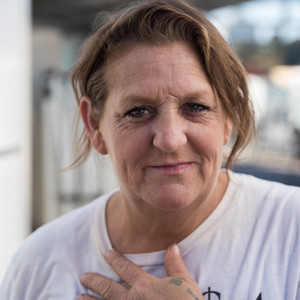
One of the first people she spoke to was a woman named Deanna Riley.
We was a family.
We was a community. that wouldn't let nobody come in and take that from us.
Deanna was around 45 and had been homeless for about a decade.
People at the park called her Mama D. Even grown adults called her Mom.
Mama D was a force.
When the park had a rat infestation, she planted spearmint and peppermint around people's tents to try to keep the rats away.
She had six tents at the park, and she tried to make them feel like home.
I had to have one for my bathtub.
Your bathtub had its own tent.
Yeah.
And how'd you get hot water in it?
Boiled it.
You had like a little stove?
Like propane.
I had one of those and I used to just put big pots of water on.
Shealy got to know more of the people who'd made a home in Union Point Park.
And before long she was visiting regularly and documenting the community's struggle against eviction and their fight for a better option.
She ended up hosting a five-part podcast series called A Tiny Plot with KQED's Snap Studios.
The series follows a group of homeless people in Oakland California, as they fight for their own small plot of land from the city where they could live in community and set their own rules on their own terms.
My conversation with Shana Shealy about what she discovered after the break.
This message comes from Progressive Insurance.
Do you ever think about switching insurance companies to see if you could save some cash?
Progressive makes it easy to see if you could save when you bundle your home and auto policies.
Try it at progressive.com.
Progressive Casualty Insurance Company and affiliates.
Potential savings will vary.
Not available in all states.
BetterHelp is thanking the therapists who change people's lives all around the world by providing accessible mental health support.
With over 12 years of experience matching clients with therapists, and one of the world's largest online therapist networks, BetterHelp can help you find the right therapist.
Visit betterhelp.com slash NPR for 10% off your first month.
This message comes from Progressive Insurance and the Name Your Price tool.
It helps you find car insurance options in your budget.
Try it today at progressive.com.
Progressive Casualty Insurance Company and affiliates.
Price and coverage match limited by state law.
Not available in all states.
We're back with the Sunday Story.
I'm here with Shaina Shealy, host of A Tiny Plot.
Welcome to the show.
Hi, Aisha.
I'm so glad to be here.
So Shaina, you learned about this community at Union Point Park and you ended up following them for about a year as they tried to find a place for themselves in the city.
But first, take me back in time a little bit.
Like, what was the original encampment at Union Point Park?
Like, what was that like?
Sure, yeah.
So first of all, the park itself is pretty special.
It's along a working marina with sailboats and grassy lawns and benches and bathrooms.
And if you're at the park, you can actually hear the clink of sailboats and waves lapping up onto this little sandy shore.
And when people who live there described it to me, it sometimes didn't sound like they were talking about a tent encampment.
Sometimes at night, over in the sun setting in the summer, you'd forget where you were.
You think you're in paradise almost, you know?
That was Mike Newman.
Everyone called him Mustache Mike.
And here's his girlfriend, Rachel Rodriguez.
It's beautiful right by the water.
I liked it there.
That's one thing I liked, the sunset.
It was very cool, you know.
It was almost like picnicking or stuff like that.
Because everybody knew each other, so that was a big deal, you know, good thing.
So there was this group of people who lived at the park together for years.
And while a lot of them described the park as this little paradise...
There were other people who saw the encampment as a problem.
You know, there were actually parents who were dropping kids off nearby at school.
And there were boat owners with sailboats docked just yards away from the tent encampment.
And over time, there were a lot of complaints.
A lot of them actually made the news.
Here's a couple of clips from the local Bay Area Fox and NBC channels.
It's been the source of constant complaints about filth and crime.
Several boat owners are calling an East Bay Marina a lawless harbor, where homeless people are threatening boaters and breaking into their bathrooms.
Now they're calling on the city of Oakland to do something about it.
It really wasn't safe for anyone.
Deanna Riley, or Mama Dee, as she prefers to be known.
In the first three years she was at the park.
Park goers and residents reported over 215 violent incidents at the park, including a hatchet attack.
There were four separate murders in the parking lot in just one year.
I mean, that's really scary to hear.
Sounds really dangerous.
These are real issues for the people who live near these encampments.
And there's this tension between how to deal with the issues of like crime while also respecting the dignity of the people around you.
You know, this just seems like to be a microcosm of that.
Yes, and nearly a third of our country's homeless population lives in California.
It's such a big issue here that nearly all politicians in the bigger cities have some sort of plan for dealing with homelessness as part of their platform.
With all of these complaints coming in, how did the city respond?
Well, the city tried to clear this tent encampment in Union Point Park.
The people who live there, they actually told me that the city made a few attempts at clearing it.
But these people always came back.
Once the city kicked them out, they'd come back later with their tents.
And this effort to clear the encampment, it was actually part of a larger trend.
Just in a few years 2018 through 2020 the city of Oakland reported that it had closed or cleared encampments around the city about 500 times.
But by the end of 2020 complaints about the encampment were so overwhelming that the city set a very final cleanup deadline for February of 2021.
Tell me, like in Oakland, like what does it look like when a city clears an encampment?
What happens?
Yeah, so the city usually sets a deadline for when people need to be out.
But a lot of time people don't leave voluntarily.
And so when that deadline comes around, public works employees often show up with law enforcement and garbage trucks and these small claw tractors called dingoes.
One of the people living at the park, Edward Hansen, he described the scene this way.
They brought in these weird machines that they stand on and, like, big giant claws.
And munchies and crunchies and rips and tears, everything in his path.
He looked like Lang the Leers.
Lang the Leers.
You ever seen a Stephen King movie?
They, like, eat time and they have big old teeth.
Like Pac-Man or something.
And they're eating the sky away.
I mean, that's a description.
The Langoliers.
Oh, my goodness.
I know.
Yeah.
And when he says, you know, eating the sky away, it's true.
A lot of stuff often gets thrown away.
You know, essential things like tents or medication, but also sometimes sentimental, irreplaceable items like a loved one's ashes or photos.
This guy Edward, who we just heard from said A lot of his artwork has been thrown away by the city.
And also, people get split up from their communities.
These are their support systems.
It sounds very traumatic.
And, you know, this has been happening like all over the country.
There was a lot of focus on it in in dc, um and and using the premise of crime.
It can be really abrupt right, you know the the tents are gone, um.
But even when that happens, it's just kind of maybe it gets rid of some of the the tents, but it doesn't get rid of the people.
Right, when people are uprooted from their communities, it's not like the problems they face just go away.
So where are people supposed to go after the city of Oakland throws away their things and clears their encampments?
So the city of Oakland actually has this policy that they must offer some sort of shelter to people when they clear them from an encampment.
And when I was reporting this story, the standard shelter they offered it was a city-run temporary site called the Community Cabins.
But when the city made that offer to the people sleeping at Union Point Park, one of the group's leaders, Matt Long, who people called President Matt he told the city no.
Matt was in his early 30s.
He was a DJ and he struggled with substance use.
And he came to the park during the COVID lockdown when he ran out of friends' couches to crash on.
I sort of showed up there with my tent one day and just kind of like poking around.
And I just sort of started setting it up and I bought these foam panels.
And I built myself like a little tiny house out of foam.
The other people in my neighbors would saying like I had the mansion on the block.
Matt actually told the city he'd rather live in his styrofoam hut than the city's community cabins.
And he also told me it's not so uncommon for homeless people to reject these transitional housing offers from the city.
These community cabins.
They're typically these 9-by-12-foot sheds where you might have to bunk up with strangers.
There's often no running water or real place to cook.
Plus, according to a performance audit on the city's homelessness services, almost half the people who move there just end up back on the street.
But the heart of the issue was There's all these rules, and that runs counter to a lot of people's strong desire to have a certain degree of freedom in their life.
You know, all people want to have some sort of self-determination, right?
It seems like you know Matt, he leads this charge to reject the city's offer.
But they're in a public park.
Couldn't the city just... clear them by force, right?
Like couldn't they just come in and just with the tractors, with the heavy equipment, with the police, get them out?
Like, what was the plan?
Yeah, so when Public Works showed up at the park to clear it out, President Matt and Mama Dee and you know the whole community at Union Point Park they had barricaded the encampment to keep the city out.
Here's Matt and Mustache Mike talking about building this barricade.
There was just a couple of us who went around and collected stuff, anything we could find in the area, and we just piled it up in a big heap.
Garbage bags full of garbage.
Dishwasher that someone had thrown out.
Piles of dirt.
The refrigerator, a mattress.
Seats, anything to slow down their progress.
Bed frames and lions and tigers and bears.
And they stood around their encampment with actual shields.
You get some thick, thick wood that you can't bust, because if you hit a thin piece of wood you're just going to go straight through it.
So we was holding these shields like go ahead, try to come through, because we're not letting you in.
They see we're not going to back down.
That was crazy.
They were not prepared for that level of resistance.
I mean, this is sounding like something from Game of Thrones or something.
You know, picturing everybody stand, stand, you know, with the shields and everything.
So this is a face-off, right?
What did they think would happen?
Like, okay, you stand, you say, we're not leaving.
Did they think the city would just say, okay.
So this was all actually part of a strategy to bring the city to the negotiating table.
When we come back, the negotiation.
Get up to 55% off your Babbel subscription right now at babbel.com slash NPR.
Spelled B-A-B-B-E-L dot com slash NPR.
Rules and restrictions may apply.
This message comes from homes.com.
When you're shopping for a home, you want to know as much about the area around it as possible.
Homes.com has got you covered with a comprehensive neighborhood guide from local experts.
Homes.com.
We've done your homework.
This message comes from Mint Mobile.
Starting at $15 a month, make the switch at mintmobile.com slash switch.
$45 upfront payment for three months.
Five gigabyte plan equivalent to $15 a month.
Taxes and fees extra.
First three months only.
See terms.
We're back with the Sunday story.
So Shana, the community at Union Point Park was defying the city's order to clear the encampment.
What was their strategy?
So a core part of their strategy was getting organized.
As I mentioned before, they had elected a president, Matt Long.
They called him President Matt.
Matt, he knows how to talk to the police and all that you know and the legal things to say and whatnot.
So President Matt held meetings under a pop-up tent to talk about the kind of housing the people in this group actually wanted.
Run of water.
Showers and a bathroom.
A parcel for three to five years.
Weekly trash pickup.
A tiny house community of our own.
And there was this other thing that the group had learned about.
The Bay Area shoreline, it's actually monitored by this conservation agency.
And this agency.
They gave the city a cease and desist order to close the tent encampment for good, in order to protect the shoreline.
Or the city would have to pay a fine of 6000 per day each day that people stayed there indefinitely.
So this group actually had leverage.
And they knew it.
So they knew they could run up the bills on the city by staying there and dragging out the process of them being put out.
It would be more costly for the city.
And so they have some leverage.
What did they want from the city long term?
Yeah, so if they were going to leave the park, they wanted a better housing option than what the city was offering.
At the time, there was this homeless intervention model called co-governance that had been floating around city council meetings.
Students at UC Berkeley had written about it and this guy, Daryl Dunston, who was Oakland's homelessness administrator, had been talking about it with other city employees for months.
He'd even studied how it went down in other cities, like Seattle and Eugene.
The key features of co-governance are these resident-led agreements about how homeless people can live together in community.
Things like how they'll pick leaders and make their own rules, all in cooperation with the city.
And Darielle thought this group might be the perfect one to pilot this co-governance idea in Oakland, because they were already organized.
They seem to already have identified who the leaders in the groups were.
They seem to have a certain level of respect for one another.
On one of the last days of the standoff, Darielle made a move that surprised everyone he climbed up the barricade.
Like he actually climbed up this pile of junk and he sat down on this sort of busted mattress next to President Matt.
Here's Matt talking about that moment.
When it came to a head with me and Darielle on the barricade, he cited this co-governed model, which sort of addressed the concerns that we had had.
I was very much elated that there was someone who came to us with a model for something that we were already asking for.
So it really seemed very positive, like there was a light at the end of the tunnel.
What's the main difference between this co-governance model and the traditional one that the city of Oakland deploys?
There are a bunch of differences, but ultimately it boils down to autonomy.
In city-run temporary housing, the city sets these strict rules about how residents live.
But with co-governance, the idea is that the city gives the residents a budget and then it's the residents who get to set their own rules, without the city workers calling the shots.
What you have is the power to be your own security.
Make sure your community stays clean, make sure you're getting the resources that you need to build or whatever it is that you want to accomplish within your co-governancy.
This model hadn't been tried in Oakland before and this group believed that if they were successful you know, if they figured out how to do this right, they could create a model that could be replicated for other homeless communities in Oakland.
We could really see ourselves doing this in Oakland, becoming the first being able to Have it done and succeed.
When Matt and Dario shook hands, we could tell.
It was like, yes, something is about to happen for us.
Now let's see how much further we could go.
It sounds like this kind of David versus Goliath story, these underdogs, and they won.
They got what they were negotiating for.
But I'm listening and I'm like, it's probably more complicated than that.
Definitely, definitely.
This is actually just where the story begins.
Like, everything that we just talked about, it happens just in episode one of our series.
It was remarkable.
Honestly, like, kind of unbelievable that this group chose to fight the city.
And it was also like, okay, you can fight the city, but even if you win, then what?
After the barricade and after the negotiation, I actually stuck with this group for over a year.
I went to their group meetings and recorded them as they fought for this sort of radical experiment.
And each time I was with them, something happened that was not at all what I had expected.
There was just one roadblock after the next.
Like there was this one group meeting after months and months of waiting for a plot of land for their experiment, when the city finally announced that they had found a spot.
This piece of land was actually in a really nice location and I thought the group would be thrilled.
But it was quite the opposite.
Here was Mama D at this meeting.
The site period is an issue for me.
And they know this.
And this is Adam Garrett-Clark.
When we went through this process a couple months ago, it was like, where can we go?
He was hired by the city to be sort of the liaison between the city and this group of people.
We just didn't have a site for a long time.
And the thing is guys, if you remember, if you go back and think about it, you listen to our conversations.
There was no place.
There was no place for us to go.
But Mama D was not hearing any of what Adam had to say.
Why was Mama D so upset?
Mama D's son was murdered across the street from the plot of land the city had chosen.
And I mean, imagine waking up every day to that reminder.
Well, I mean, that's that is horrific.
It also just brings up the difficulties of doing anything with more than one person, trying to get everybody on the same page, meet everybody's needs, everybody's concerns.
It sounds like they're in a tough situation.
Yeah.
And, you know, a lot of the other residents were initially super jazzed about this plot of land.
But it was kind of amazing.
They said they wouldn't go without Mama D. They didn't want to be separated from their community.
This instance.
It was just one of many, many things that made me feel like this experiment was going to completely fall apart.
But every time it felt like things could not move forward, this group came back together to fight for their experiment.
They persevered.
And in that fight they did actually win some things for themselves and for other homeless people in Oakland.
And these were things that seemed sort of impossible at the start.
I'll leave you with this quote from Mama D I'm not going to lie and I'm not going to sugarcoat.
Nothing for nobody.
Being homeless is the worst.
But on the other hand, I feel proud of us as a community sticking together and getting through what people didn't think we could do.
We're still going to stay at it, going until the end.
And it's not over.
I'm eager to listen to the rest of the series and hear more about those twists and turns.
Thank you Shaina, for bringing us this really complex portrait of a community fighting against the odds.
Thank you, Aisha.
It was a real honor.
All five episodes of Shana Shealy's series A Tiny Plot are available wherever you get your podcasts.
We'll have a link to the series in the show notes.
This episode of The Sunday Story was produced by Justine Yan and edited by Liana Simstrom.
Mastering by Robert Rodriguez.
A Tiny Plot is a production of Snap Studios out of Member Station KQED in Oakland.
The series was produced by Shaina Shealy and edited by Anna Sussman.
The Sunday Story team includes Andrew Mambo and our senior editor, Jenny Schmidt.
Irene Noguchi is our executive producer.
I'm Aisha Roscoe.
Up First is back tomorrow with all the news you need to start your week.
Until then, have a great rest of your weekend.
This message comes from Jackson.
Let's face it, retirement planning can be confusing.
At Jackson, we're working to make retirement clear for everyone, starting with you.
Our easy to understand resources and user friendly digital tools help simplify your entire experience.
You can have confidence in your retirement with clarity from Jackson.
Seek the clarity you deserve at Jackson.com.
Jackson is short for Jackson Financial Incorporated.
Jackson National Life Insurance Company Lansing, Michigan and Jackson National Life Insurance Company of New York.
Purchase New York.
This message comes from Warby Parker.
What makes a great pair of glasses?
At Warby Parker.
It's all the invisible extras without the extra cost, like free adjustments for life.
Find your pair at warbyparker.com or visit one of their hundreds of stores around the country.
This message comes from Mint Mobile.
Starting at $15 a month, make the switch at mintmobile.com slash switch.
$45 upfront payment for three months.
Five gigabyte plan equivalent to $15 a month.
Taxes and fees extra.
First three months only.
See terms.