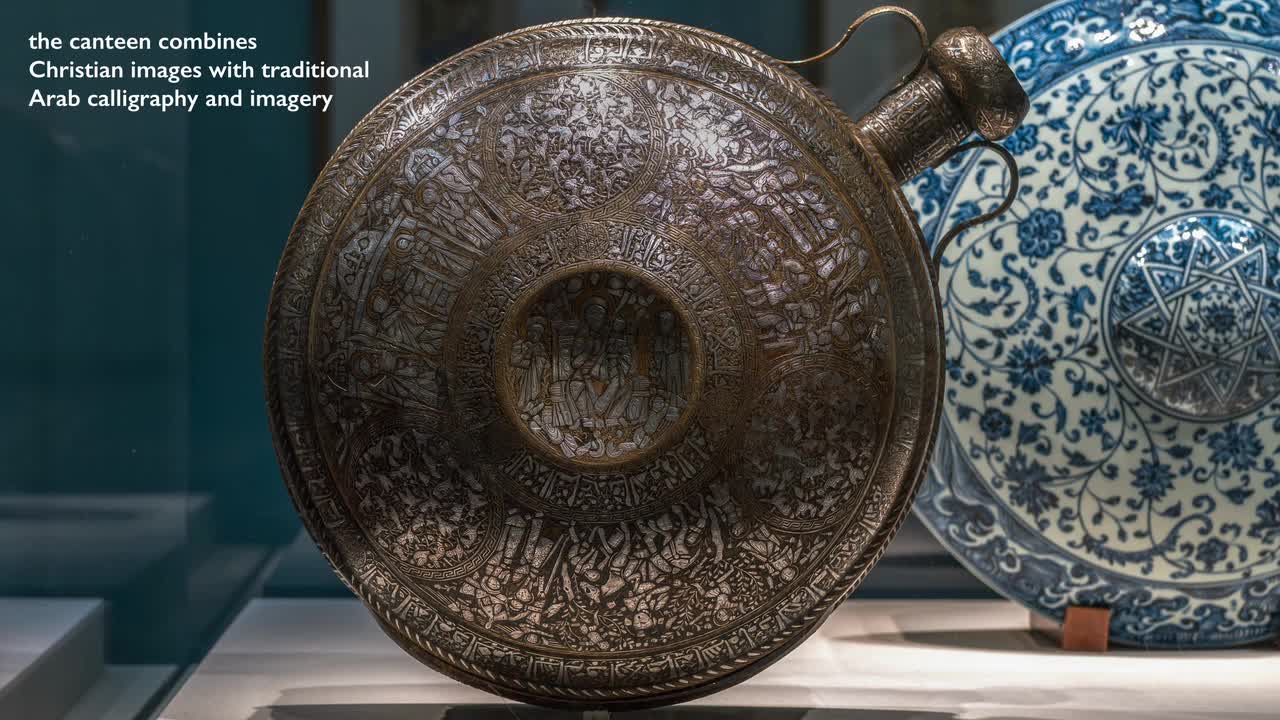
We're standing in the galleries at the National Museum of Asian Art and we're looking at an object called a canteen.
It's one of the greatest pieces of metalwork that has survived and one of the most mysterious in many ways.
What makes this special is that it combines both Christian images as well as traditional Arab calligraphy and imagery that you find on other inlaid metalwork.
Recent scholarship has argued convincingly that it's made in Mosul between 1240 and 1250.
I think of a canteen and i think of something light and small that i can carry water in.
And this is a very heavy object.
It's about 10 pounds.
It has two handles, probably later editions, and there's no way that you can lift the canteen with those two handles.
It's also in almost pristine condition, So this was probably brought out rarely for important occasions.
Right in the center, you have the Virgin and Christ enthroned.
The throne is kept afloat by two angels and their figures on either side.
And if you look very closely, the silver is not only Inlaid, but then on the silver the artist has drawn features the folds of the rope, the cushion that the Virgin is sitting on, and then, of course, the angels and their draperies.
So right here in the center, this iconic Christian image, instantly recognizable.
And right around it is an inscription.
So this balance between Christian imagery and traditional Arab art.
Those words are blessings, good health, et cetera, to the beholder or the owner, but they don't tell us anything about the central medallion or about the rest of the canteen.
Normally we would have some indication of the patron.
You would think that an object of this size, of this intricacy, would be something that was a special commission.
And as we continue to look closely, we see roundels with beautiful decorative patterning in them and in between those additional christian scenes.
If we move clockwise, we have the Nativity.
It combines two different scenes.
So you have the birth, the Nativity, a tiny baby Jesus in the manger with the animals behind, and then you have the three Magi arriving.
One of the magi wears a very tall hat that was typical of the Turkic people of the period.
So it helps to anchor the canteen in that particular milieu.
Interestingly, right below it, you have another scene, the bathing of Jesus.
So you see him in this deep bowl, figures standing next to him pouring water.
And then you have other figures around him, a shepherd with animals.
Again, this richly detailed and very lively scene.
These were probably inspired by manuscript paintings.
We know of manuscripts that were created in the area of Mosul in the 13th century that use very similar iconography.
It tells you that the artist had a model and that he worked closely, probably with a Christian colleague.
They borrowed iconography or imagery from each other in order to develop the images for the canteen and translate a painting into metal.
And then we have two more Christian scenes the presentation of Christ in the temple and then the entry of Christ in Jerusalem.
With the presentation at the temple, it takes place in a tripartite building.
The domes have crosses on them.
If you're in a Jewish temple, you wouldn't have a cross.
So it tells us that the artist must have used a model, but somehow wasn't quite clear of the iconography which tells you this wonderful relationship of these artists while they worked together and were aware of the Jewish tradition, the Christian tradition, the Muslim tradition.
But some of the details fell between the cracks.
We seem to have a theme emerging of the Holy Land.
Well, this was the time of the Crusades.
Jerusalem was very much contested.
And it's a theme, but it's an indirect theme.
So perhaps the patron was someone who had recently visited Jerusalem, wanted to remember Christian sites in Jerusalem.
Perhaps this was made for a crusader who wanted to take a souvenir back to Europe.
That was suggested for many decades, but it has been replaced by another theory that the patron may have been somebody who was aware of Jerusalem, knew about Christian, Jewish and Muslim traditions.
But given that the object seems to be rooted in northern Iraq, it would be more likely that it was done for a local patron.
Let's talk for a minute about the incredible interlacing designs that we see on the canteen.
The three scenes from the life of Christ are punctuated by these circles filled with twittering birds.
It's almost as if you can hear them.
And this is something that is very important to understand about works of art that have been created in the Islamic world is the fact that they really appeal to your senses.
So it becomes this intimate relationship between the viewer and the object.
This is an absolutely spectacular object.
And why not have excited birds that share in the joy of what is going on?
So as we continue to move outward, we come across a band on the outside with a Kufic inscription.
And like the other inscription, you hope that it will tell you something about the canteen.
But alas, it doesn't.
If we continue down the side, we see a band of very animated figures, writers of animals dogs, sheep which is sort of unusual to have on an object like this.
But then, when you look very carefully, you see that it is actually writing.
It is written in a different script, one that is called nest, And NAS is a script that has always been praised for its legibility but in this case is completely illegible.
We call this script the animated script, because the letters have been animated, have been made into figures, both human and animal, and It adds tremendous playfulness to the object.
It becomes sort of a visual puzzle.
It's a way to arrest your attention, telling you, look at me.
This third band has a number of entertainers and musicians.
Typical figures that you find on other pieces of metal work during this period.
Traditional in terms of its iconography, in terms of representing a life of leisure and pleasure.
I realize we've been talking about the figures and the roundels, but around those roundels are these beautiful decorative forms that fill in that space and add to that sense of liveliness.
So you sort of have these two layers of decoration.
You have the figural decoration, but then underneath you have this small swirls that provide the background.
And they do really draw us in.
Let's talk about the decoration on the back.
It's absolutely remarkable and fills the entire surface.
So you have two bands.
The outer band shows a group of priests, saints, and warriors.
And if you look at one o'clock, there are two figures who are facing each other the Virgin and the angel Gabriel.
You have the Annunciation, which is quite remarkable in this band of both saints and warriors, as if the Virgin is being protected.
The Virgin plays a very important role in the Quran.
She is the only woman whose name is used as a chapter heading, and it falls almost in the middle of the Quranic text.
It underscores the reverence that Islam has for the Virgin and for Christ.
And here we have this architectural setting.
You have this arcade that frames each of the figures, and they're each separated by a column.
And I find myself wanting to look at each one of the figures.
The figures are quite static and formal, but there is slight movement in each of them.
So it's almost sort of like this rippling effect around the outer circle, but there are still quite static, especially when you compare it to the next band, where you have a group of men racing around and clearly involved in jousting or some medieval hunting event.
It has been proposed that the central cavity was a space for a container, perhaps a cup or a small bottle that would fit into it.
We do have another canteen in the case, but this one made out of blue and white porcelain.
What is interesting about it is that it has a central roundel.
It does not have figurative decoration.
And on the back it has an indentation that is very close to the cavity on the metal canteen, but it's filled and because it's filled it is possible to think that originally the metal canteen was also filled, whether it had a little door or whether something sat inside of.
It seems possible when you compare it to the chinese blue and white.
Is it also possible that the space that we see in the back of the canteen held something that was very precious?
Whatever sat in there was of great importance.
And it has been suggested that the vessel may have included a relic, perhaps a relic from Jerusalem.
And then, whatever the canteen was filled with would have had that extra sanctity through its association and proximity with a possible relic.
There are still many questions to be answered about it.
While the object remains an enigma, it also tells us a great deal.
It gives us a number of fascinating leads and hopefully scholars in the future will continue to examine it.
Visitors will look at it closely and enjoy its intricacy and really allow it to tell them a story about our past.