It's approaching midday.
A fringe-toed lizard is hungry.
He's on a stakeout.
Flashy scales reflect some of the sun's rays.
Nevertheless, the heat is almost unbearable.
His prey hasn't left home all day.
The lizard is the last animal still out on the dunes.
But even he can't take it anymore.
To survive longer, you'd need a space suit.
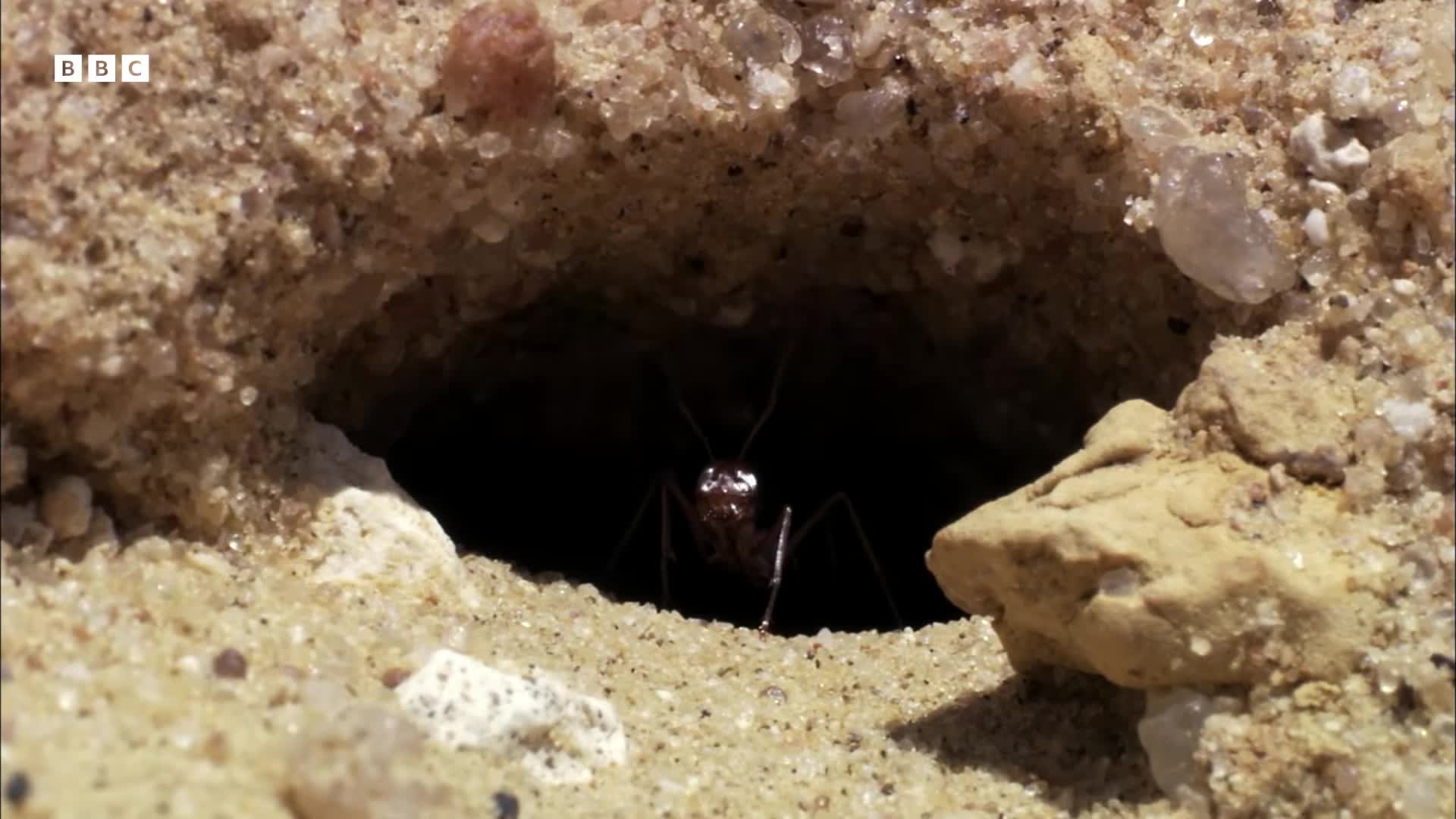
And in a way, that's what these insects have.
Silver ants' armored skin reflects light.
They can tolerate temperatures that would kill any other land animal.
Even so, they can only survive for less than 10 minutes in the midday sun. is precious.
The ants race to find food as soon as their predators go to ground.
They can't afford to waste a second getting lost, so they spin to take a bearing from the sun.
They log every change of direction, every footstep, in order to know exactly where they are and where their nest lies.
Only four minutes to spare and they found a victim of heatstroke.
A meal.
But it's going to take a monumental effort to get it home.
Three minutes to go and they're nearing their maximum temperature, an astounding 53 degrees Celsius.
But there are already casualties.
One minute left and they're not going to make it.
Something has to change. a lone, creviced zebra.
He weighs close to half a ton and could go for three days without drinking.
Like the macaques, his forebears were refugees from the advancing Sahara.
The land is scrubby and dry.
But this stallion has claimed it as his own.
He's been waiting months for visitors.
Female visitors.
If they like his territory, they might stay a while.
It's his first chance to mate for a very long time.
Hardly a success.
Perhaps his visitors are looking for a more impressive partner.
There's another setback.
The females were being followed.
A posse of young males.
Everyone a rival.
It's time to separate the men from the boys.
One by one, the stallion sees them off.
The females had ringside seats.
And his prowess has not gone unnoted.
Machismo gives way to tenderness.
This oasis is fed by a hot volcanic spring.
Slightly away from the stream of near-boiling water, it's cooler and fish can live.
These are tilapia.
Hatchlings stick close to their mother.
There are other dangers here beside the scalding water, particularly at night.
And the tilapia are almost blind in the darkness.
In panic, they all leap to escape the hunter's approach.
But this female can't abandon her brood.
The crocodiles won't be thwarted.
They too can leap.
With first light, the crocodiles lose the element of surprise, and the battle is over for now.
The mother fish has survived, but where are her young?
All present and correct.
They spent the whole night sheltering in her mouth.
The contest will be repeated at sunset.
There is nowhere else to go.
These bizarre little birds are baby ostriches.
They're just a few days old.
In time, they'll become superb desert survivors.
But in the Kalahari, these early days are perilous.
Like leopards and meerkats, adult ostriches can extract all the moisture they require from their food.
The chicks, however, won't survive much more than another day without water.
But there's none in sight.
How can their parents conjure up water out here?
The youngsters follow their parents as they head out onto a featureless wasteland.
It seems like a suicidal journey.
The Etosha salt pan.
Here, water is more often a mirage than reality.
It's now well over 40 degrees centigrade.
Their father shades his chicks from the midday sun.
Another mirage?
No.
The ostrich family is not alone out here.
Surrounded by the vast expanse of sun-baked mud, sweet, fresh water wells up from deep below ground.
Like a miracle.
Below lies a secret.
One that was discovered only 25 years ago.
Humid air rushing to the surface gives this place its name, Dragon's Breath Cave.
The shaft descends for 60 meters until it meets...
Here there is a massive chamber big enough to swallow three jumbo jets, nose to tail filled with cool, fresh water.
The world's largest underground lake.
This is fossil water.
It's been trapped here undisturbed for thousands, if not millions, of years.
We have no idea how deep the lake is.
Divers have been down to 100 meters, and still there's no sign of the bottom.
Remarkably, Dragon's Breath is part of a vast cave system that extends beneath the Kalahari for thousands of kilometers.
Even here, in this lonely cave, there is life.
Golden catfish, only found in this one cave.
They're the rarest and most isolated fish in the world.
Life down here is as challenging as it is in the desert above.
There's no food, except the debris that occasionally falls onto the surface.
And these catfish are totally blind.
The only world they know is the one they sense through touch.
A blind fish living in perpetual darkness, deep beneath one of the most arid regions of Africa.
The old bull won't tolerate a rival.
Pushing and shoving, they size each other up.
The young rival seems to think he has a chance and attacks.
The first few blows usually settle things in such battles, but here the stakes are high.
To lose means exile in the desert.
Neither will back down.
As the fight intensifies, they change tactics.
The young male aims for the rump.
The old bull targets his rival's legs.
The old bull is down.
Is this the end of his reign?
He knows a knockout blow is coming.
But the old bull ducks.
And strikes a blow to his rival's underbelly.
Out for the count.
The old bull is victorious.
But only just.
There's a secret to surviving in this world.
It's right in front of him.
Brine flies, salt specialists.
They pass the salt out of their bodies, leaving them sweet and juicy.
All the lizard needs to do is catch them.
To get the equivalent of a teaspoon of fresh water, he has to eat 400 flies.
This fly ridden shoreline is a paradise.
And that's the problem.
There's a new guy in town.
And this territory isn't big enough for the both of them.
The defender puffs himself up.
Perhaps looking larger than life will make the intruder back down.
Owning a stake in this shoreline is the difference between life and death.
Bad news for the intruder.
For the victor, the prize is an endless supply of flies, and many animals here choose the simplest option of all.
Staying hidden all day and only venturing out in the cool of the night.
As darkness falls, animals appear from seemingly nowhere.
And among them, inevitably, are hunters.
One of the most voracious nocturnal predators is also one of the hardest to see.
This mysterious creature hardly ever appears on the surface of the dunes.
But there are signs on the sand that can give it away.
It lives only here, where the sand grains are so perfectly dry and polished that they flow almost like water.
It's no bigger than a ping-pong ball.
A golden mole.
It's totally blind. but there's nothing to see underground anyway.
Instead, it has superb hearing.
Its entire head acts as an amplifier that picks up vibrations through the sand.
So to locate prey on the surface of the dune, it has paradoxically, to thrust its face into the dune.
Not easy to catch when you're blind.
Far better to go into stealth mode.
Once below the sand, it can detect the slightest movement.
Allowing it to strike with pinpoint accuracy.
Well, most of the time.
It can travel a kilometer a night in search of its dinner.
And right now, it has just detected its main course.
Little wonder it's sometimes called the Shark of the Dunes.
It's July in the deserts of Nevada in the Western United States.
The hottest time of the year.
Bands of wild horses, mustang, are converging on one of the last remaining water holes around.
Now water not only offers them the chance to drink, it can also bring power.
If a stallion can control access to water, he will have secured mating rights to the entire herd.
So stallions try to dominate these pools, fighting off rivals who venture too close.
A stranger.
He's traveled 15 kilometers to be here because the pools where he's come from have already dried up.
With him come his females.
If he can't provide them with water, they will leave him for the White Stallion who already dominates this pool.
So he will have to fight.
All right.
There is everything to lose.
A broken leg or a shattered jaw would mean a slow and painful death.
A missed kick, and it's all over.
The new arrival has won.
And his prize is more than just a chance to drink.
He has provided for his herd and in the process stolen his rival females.
The White Stallion's rule is over.
And now the snakes are on the alert.
This is the best feeding opportunity they will get all year.
On flat ground, a baby iguana can outrun a racer snake.
But others are waiting in ambush.
Another hatchling has its first glimpse of a danger.
A snake's eyes aren't very good, but they can detect movement.
So if the hatchling keeps its nerve, it may just avoid detection.
A near miraculous escape.
The lucky survivors could begin learning the unique way of life demanded by this hostile island.
This mother has three young cubs, just eight months old.
It's autumn and the family needs to fatten up before the winter hibernation.
This year the oak trees are laden with acorns, an important source of fat.
The bears have plenty to eat, but their challenge here is finding enough to drink.
The limestone mountains soak up the rain, so there are no permanent streams.
Fortunately for the bears, there is another source of water.
Serranillas del Burro is prime cattle country and the ranchers provide year-round water for their herds by tapping into underground springs.
The water tanks are a magnet for all.
Mother bear, with her young calves, must approach with caution.
Bears occasionally kill cows, so the ranchers let their cow's horns grow long as a natural bear deterrent.
The family gets the message, loud and clear.
The cattle have had their fill.
Now it's the family's chance.
But someone else has got his eye on the tank.
A big male.
He's best avoided.
This male wants more than a drink.
He wants to cool off in his tub.
Over millions of years, these flowers have developed an unusual relationship with a very colorful character the orchid bee.
For just a few months each year, when the orchids are in bloom.
The orchid bees visit them in droves.
Not to sip their nectar, but to sweep up fragrant oils using brushes on their front feet.
They scrape the oils into a special pouch on their hind legs.
These orchid bees are mixing their own cologne, made from up to 80 different scents collected from the forest.
This complex fragrance helps the males attract the females.
The most fragrant oils are produced by one very special kind of orchid, Stanhopia.
This orchid blooms for just one day each year.
In these crucial 24 hours, it must spread its pollen far and wide.
As soon as it opens, the flower emits a hypnotic perfume that smells like freshly ground cinnamon, sending the orchid bees into delirium.
But Stanhopea's sweet smell belies a cunning purpose.
Its petals are covered in slippery oil droplets.
And their intricate shape forces the bee to walk backwards.
The bee slips and the orchid sticks a packet of pollen onto its back, which it will unwittingly carry to other Stanhopia flowers.
With its pollen distributed in just a single day, The flower's job is done.
As the sun sets, the petals wilt and die.
The secret mountain world is home to an abundance of rare creatures, many found nowhere else on Earth.
High in the canopy lives the alligator tree lizard.
And the horned one. the last survivor of an ancient bird family.
It's been evolving independently for more than 30 million years.
In forest clearings, male long-tailed manakees dance to entice females, a ritual that may take a decade to perfect.
Travel deeper into the heart of this cloud forest and you might discover the true spirit of El Triunfo, a mythical creature rarely seen, sacred to the ancient Aztecs who treasured its feathers more than gold.
It's considered the most beautiful bird in the Americas. the aptly named Resplendent Quetzal.
It's the mating season, and this male's three-foot long-tail feathers have helped him successfully attract a mate.
Now he has a young family to feed.
He works tirelessly for a month to satisfy his brood's voracious appetite.
His lush Mexican home is brimming with fruit and insects.
At the end of the mating season he will drop his spectacular tail feathers.
But the quetzal grows a new train every year.
Each cenote is an oasis.
The surrounding forest remains lush. even at the height of the dry season.
Filtered through the limestone, the water is full of minerals.
It supports a unique community of plants and animals.
Some fish in the Yucatan cenotes are found nowhere else on Earth.
Within the dense forest, a cenote can remain hidden even when close by.
But the Maya had an almost surefire way of finding them the distinctive call of the turquoise-browed motmot.
Virtually every cenote has its own colony.
Elsewhere, motmots prefer to nest alone, digging their barrows along riverbanks.
Here in the Yucatan they're forced together, sharing limited space on the cenote's soft limestone walls.
Before a male can start looking for a mate, he needs to secure a nest site.
But this cenote is already crowded.
17 other pairs are nesting here.
If he's to fit in, this new arrival must use the right body language.
A raised turquoise brow is intended to intimidate rivals.
The pendulous tick-tock of their tails has earned Mot-Mots the nickname Clockbirds.
This male must persevere if he wants to breed this year.
At last, he's earned his own little ledge of limestone.
With a gift of food, he can get down to the business of attracting a mate.
Sam Meacham and Fred DeVos are part of an international community of cave divers that has been exploring the Yucatan since the 1980s.
I started out for the thrill of being able to explore something.
And from a young age, I just was imbued with the desire to go out and explore this world.
Each new cenote adds another piece to the puzzle.
Wow, look at this, Sam.
Wow.
The moment of discovery, right?
You can't beat it.
In the last 30 years, cave divers in the Yucatan have revealed something extraordinary.
The cenotes are not isolated wells.
Each is connected by an intricate network of caves and passageways, spreading like a spider's web across the peninsula.
Divers have discovered over 350 caves and nearly a thousand miles of flooded tunnels, including the two longest underwater cave systems on the planet.
Thank you.
Many of these caverns have seen fewer visitors than the moon.
The great majority remains uncharted.
For the ancient Maya, the labyrinth of caves was out of reach, but not beyond imagination.
This secret underworld was held sacred.
Home to the 12 gods of Xibalba, it was a place both feared and revered.
In the heart of the Yucatan, there's a cave the locals call El Volcán de los Murciélagos.
The Bat Volcano.
Every day, an hour before dusk, it erupts.
More than three million bats exit the cave.
The ancient Maya associated bats with death.
This was a swarm straight from the underworld.
But bats are vital to life in the Yucatan, keeping its insect population in check.
Each can eat its own body weight in insects every night.
While the bats are focused on the insects, others are watching them.
Gray hawks and bat falcons.
These birds are skilled aerial predators.
Their talons perfectly designed to snatch the bats from the air.
There are other, more surprising hunters here.
Brown jays.
They normally eat insects and fruit.
But the brown jays here have developed a taste for bats.
The jays don't use talons to catch their prey.
They use their beaks.
The loss of 10 or so baths barely makes a dent on the swamp.
Tonight, the colony will consume around 30 tons of insects, a vital service that keeps the entire forest healthy.
The black-tailed prairie dog.
They live in extensive colonies comprised of dozens of families, each with a dominant male, several females and their offspring.
In May, their six week old pups take their first steps above ground.
Grasses and other prairie plants provide all the food and moisture these vegetarians need.
But feeding in this open terrain comes with risks.
Their barrows offer an escape from birds of prey and coyotes.
But they're no protection from one of the prairie's most persistent hunters, the bull snake.
This powerful constrictor could easily suffocate an adult prairie dog.
But it's Bob's he's after. and they're hiding somewhere in their burrow.
Their father would be foolhardy to follow this predator underground.
The snakes found nothing down this hole.
So he's on to the next.
To save his pups, their father must somehow drive the snake away.
He stands to warn others where the snake is.
Repeated strikes may just drive it away.
The snake concedes defeat.
On the open prairies, there's safety in numbers in this prairie dog town.
Thanks to their father's bravery, the pups are safe again.
Most of these pools, known locally as pozas, are fed by thermal springs, where underground water is forced to the surface by geothermal heat.
Millions of years ago, when this region was much wetter, Ancient waterways brought fish into this valley.
As the climate dried, the waters receded and fish became isolated in pools, evolving into many new species.
16 species live here.
Half of them found nowhere else on Earth, including this one, a Cuatrocyanigas cichlid.
This female has a family, and she's the most devoted mother.
Stirring up the sediment, she exposes tiny plankton for her fry to feed on.
But the biggest challenge isn't feeding her babies.
It's protecting them.
Some cichlids have evolved into predators.
And in this small pool, there are few places to hide.
From dawn until dusk, she must defend her brood.
She has no time to feed herself and is getting weaker by the day.
But it's worth it.
Without her help, her young would never survive.
When they're a centimeter long, they will fend for themselves.
Until then, this mother must give her all.
Mexico is home to the greatest diversity of scorpions on Earth, and the Sonoran Desert is a stronghold.
But even fearsome predators must tread carefully.
Others are listening in.
In the desert, you've got to grab any opportunity for a meal, no matter how dangerous.
Pallid bats have become scorpion hunting specialists.
Their large ears are especially sensitive capable of hearing the footsteps of their prey.
As long as the scorpion stays still, it's safe.
But this bat has another way of increasing its chances.
It stalks its prey.
The slightest flinch will give the scorpion away.
Its sting is no defense.
Pallid bats are immune to scorpion venom.
By learning how to hunt one of the desert's most common creatures, these bats found a unique way to prosper in this difficult environment.
It's a big meal, too, and a vital source of moisture in such a dry place.