Support for The Splendid Table comes from Starbucks.
Hey, congratulations.
You have made it to the fall, which means it is officially pumpkin spice latte season at Starbucks.
Embrace fall with the seasonal classic PSL.
It's handcrafted with Starbucks signature espresso, steamed milk, and real pumpkin.
Then top with whipped cream, cinnamon, and nutmeg for a taste of fall in every sip.
Starbucks pumpkin spice latte.
Get it while it's hot.
Or iced.
Abercrombie denim is everything right now.
Denim should feel like this.
Confident, easy, like your butt has never looked better.
If you didn't know, Abercrombie's Curve Love denim went viral in 2019 for eliminating waist gap and it's still a game changer.
Between that and their classic fits with a straighter line from waist to hip, the perfect denim does exist.
Shop Abercrombie denim in the app, online, and in-store.
I'm Francis Lam, and this is The Splendid Table from APM.
When you go to the farmer's market.
This time of year, when summer and fall blend together, it's just the best.
I just love it so much.
And maybe you're thinking of tomato sandwiches, or you're looking at the hearty greens and you're thinking of a comforting braise.
But maybe you're basking in all this glory and getting a little overwhelmed.
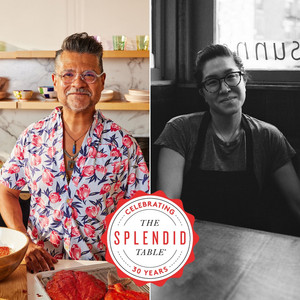
Well, later in the show we'll talk with Chef Sunny Lee of the instantly beloved new restaurant Sun's in New York City, a place specializing in banchan the many delicious produce-forward side dishes that are key parts of a Korean meal.
She'll answer the question of, what do I do with all of this?
And here's another question you should be asking.
How can I make all this produce melt my face off?
Well, the answer to that is make salsa.
Salsa is always great, but it's never better than when you have peak produce.
It's not just a dip or even a sauce.
It's its own food group, according to our good friend Rick Martinez.
Rick's new book is called Salsa Daddy, and you're about to find out why.
Hey, Rick, it's great to see you.
So good to see you, too.
Happy end of summer.
I know.
I'm not ready, but we can pretend like we're ready.
Well, luckily where I am, summer really never ends.
Stop.
Don't even start.
Don't even start.
Oh, we have 10 months of summer.
It's fine.
Exactly.
Okay.
Well, for those of us who are not so blessed to live in the Pacific coast of Mexico, you know, I actually something I remember distinctly thinking, when you first actually started talking to me about wanting to write a book about salsa is.
It was such a simple thought, but it really crystallized in my mind in a particular way.
When you said, you know, salsa literally just means sauce.
And, you know, there are salsas of all kinds.
But when you wrote that, there was a particular salsa that changed your life.
And it made you realize that the possibilities with salsa were endless.
Kind of infinite.
So I love your story of that revelation so much and I actually love the salsa that gave you that revelation so much.
Why don't you tell us about that recipe?
Sure.
So, you know, I obviously grew up with salsa.
My parents had salsas that they made.
There was always salsa in the house.
There were always salsas at family gatherings.
So, you know, I was very much used to the idea of table salsas existing.
And I wasn't really aware at that time of the idea of, you know, salsa as sauce.
Like.
We obviously also had guisos and moles and pipianes, but I didn't, I never thought of those as salsas.
And yeah, I have a friend in Mexico City who has this amazing taqueria and he had made me this torta that was really just like, smothered in this incredible chicharron tomato chili de arbol salsa.
And As if that wasn't enough, he then brought out what was essentially this tower of salsas, with these beautiful little ceramic bowls about probably 12 of them.
And they were all filled with different salsas.
And so, of course, I was like I'm just going to taste all of them, because I want to make sure that I get the perfect salsa for this torta.
And there was one that...
Basically, it wasn't really a liquid.
It was kind of, you know, just holding its own form.
And I was like, what is this?
And he basically told me it's caramelized onions and serranos.
And I was like, wait, what?
Like, he's like, yeah.
And I tasted it.
And imagine the most sublime French onion soup, but with like a really sharp kick of a spicy caramelized serrano.
So you got all the sweetness and caramelization of the onions, but then like this very Mexican note of a deeply charred serrano.
And it was so incredible.
And it just sort of blew my mind.
And like – so –
The onions were just chopped.
So it wasn't, you know, it wasn't pureed.
It wasn't pourable.
It was, you know, basically like a little spread.
And I was just like, had you had this before?
Did you, like, what is the genesis of this?
And he's like, no, I just like caramelized onions.
And so I'm like, okay, well, that's, yeah, I get it.
I mean, so do I. And why not?
Like, I put that out as a salsa.
Yeah.
And I was just like you know – it's so funny because I had become so accustomed in the United States – people saying oh, that's not the way that my family did something right.
You publish a recipe for tamales or for a pozole or a guiso.
And, you know, there's always someone that's commenting, that's not the way that you do it.
That's not the way they do it in this state or this city or in my family or in this state in the US.
And And the freedom of this gentleman.
You know a taquero in Mexico City to just say you know what?
I love this.
I'm going to make it.
I'm going to put this out for my customers.
And it just it really kind of floored me.
And I wanted to capture that, not only for myself, but for my fans and my followers who cook my recipes.
I wanted them to have that same feeling of freedom to experiment and cook what they like and then use that as a salsa as well.
Yeah.
So now that it's depending on sort of where you are, but it's late summer, early fall, you know this is the best time of year at the farmer's market, for me anyway.
It's like when you're getting all the amazing produce of summer, you're starting to get a little bit of the fall stuff coming in.
And, you know, I walk around, I'm thinking not just what can I do with this produce?
What salads can I make?
What like roasted vegetables can I make?
It's totally changed my brain.
I'm thinking all the salsas I can make too.
So I walked past my peach orchard farmer the other day Stan, and it reminded me of your salsa Tejana, the Texas salsa, the Texan salsa in your book.
Tell us about that one.
So this one was really an ode to my father.
My father, when I was growing up, he had a pecan orchard and a lot of peach trees.
And you know so every summer we picked the peaches and my mom used to make these amazing peach pies and peach cobblers.
And then later in the fall, like right around Thanksgiving, my dad and I would walk the pecan orchard and pick and taste all of the different varieties of pecans that he grew.
And I remember thinking –
It was incredible because you know like I mean, as a younger kid, I just thought you know right nuts, it's just nuts.
You buy a bag of nuts at the store and that's that.
But when he started growing them he actually grafted different varieties onto native Texas stock of the trees and then basically grew like hybrids.
And, you know, some of them were like really meaty.
Some of them were a little bit more oily.
Some of them had really thin shells and each one had a very distinct flavor.
I mean, they still tasted like pecans, but some were a little sweeter.
Some were a little bit more nutty and more savory, and So I wanted, you know, basically to pay homage to that of my father.
And I remember thinking, I have no idea if this is going to work or not.
And it's either going to be really amazing or really horrible.
Like for me, pecans and peaches are, like I equate with peach cobbler and pecan pie desserts, right?
Your brain automatically wants to go in that direction with whatever you're used to eating.
So if you're used to eating strawberry shortcake and you want to make a strawberry pico de gallo, you have to make sure that you pull it into the salsa direction.
So that means using onion and garlic and really tempering the sweetness with those sharper flavors.
And so I used a lot of lime juice, some orange juice, some charred abaneros.
I grilled the peaches.
I toasted the pecans and then ground it up.
And it was really, really amazing.
The toasted nuts gave this really beautiful counterpoint to the peaches.
And then the fruitiness of the abanero and the citrus really played into the fruitiness of the peaches.
But because you know, it obviously had like charred red onion and some charred garlic as well, it definitely played in the salsa space.
Yeah, it's more savory.
Yeah.
Yeah.
And it was, I mean, I think at that moment, the fact that it was to me such a successful salsa.
It was another moment for me where I was like I can basically turn anything into a salsa.
I've decided.
And also that strawberry pico de gallo I mentioned.
That is not in the book, but I have done that this summer.
The strawberries were so incredible in Mexico this summer.
And I was like, you know what?
I'm just gonna, I'm gonna do it.
Why not?
It was really, really delicious.
Highly recommend.
If you have good strawberries, make a pico de gallo.
Just replace the strawberries with a tomato.
And that's the Rick Martinez salsa daddy origin story.
That's how you became the salsa daddy.
I can do this with anything.
Well, actually funny you mentioned pico de gallo because I think for a lot of people who you know didn't grow up with a lot of Mexican culture or cuisine, you know that's their first impression of what salsa is.
And obviously tomatoes are such an important part of that at this moment in the market.
Living in New York you know plenty of people get amazing tomatoes far earlier but, like our, tomatoes really don't get really good honestly, until September.
September, yeah.
So they're amazing now.
And rather than make a pico de gallo, we just talked about your father, your mother's salsa de mesa.
Table salsa is so simple and so classic.
And it's mostly tomato, right?
Yeah.
Yeah.
And she would make this, you know, this was normally a summer version.
I mean she had like the same basic recipe or formula for her salsa and then would just change it depending on the season.
So my parents had a big garden.
So they grew jalapenos, they grew onion, garlic, tomatoes.
And so when everything was fresh, she would just go pick it.
And there was a little salsa pot.
I mean, it wasn't I mean, it was just a little saucepan.
But that was typically what she made her salsas in.
And so I knew, when that That little pot was on the stove, that it was time to refresh the salsa in the house.
And I remember being able to hear when the tomatoes and the jalapenos and the onion were boiling in the water.
The lid would kind of like bounce up and down and you know, make this little clicking sound.
Yeah.
But yeah, like it was just so simple, you know, and I don't think I mean, I know she didn't have that recipe written down.
It was just like you know.
She picked a couple of tomatoes and used a piece of onion and threw in a bunch of jalapenos and covered it in water and then, just you know, boiled it until it was soft.
And then she had a mocajete and she just like smashed it.
And she strained it out of the water first and then just smashed all the vegetables.
Yeah.
Yeah.
I mean, it wasn't even really strained because, like you're not cooking them until they like disintegrate.
It's just to soften everything up.
So it's probably like about 10 minutes, you know, until the tomato is soft and the skin is starting to crack.
And then, you know, you can use a little bit of that water as well.
You can actually save that water, because it's basically like a vegetable broth, and use that for soups or rice or pasta.
We're talking to Rick Martinez, author of Salsa Daddy.
More with him in a minute.
I'm Francis Lam, and this is The Splendid Table from APM, American Public Media.
Exactly.
That right there is the sound of fall.
Now, you can't really hear the leaves falling yet, but you can hear it's coming home from school.
And when it gets closer to fall season, I start thinking about apple picking, with my kid stressing out, watching my team on Sundays and all the people who are going to be getting their PSL on.
That's right, the pumpkin spice latte is officially here from Starbucks.
It is handcrafted with Starbucks signature espresso, steamed milk and real pumpkin, then topped with whipped cream, cinnamon and nutmeg for the perfect taste of fall.
And it's true, there actually are real pumpkins in the pumpkin sauce which is used in both the PSL and the pumpkin cream cold brew.
So fall is back, and so are the warm sips and comforting moments at your neighborhood Starbucks.
It's time for coffee lovers everywhere to grab their favorite drink soak in the autumn vibes, because when the leaves are falling, lattes are calling.
Starbucks Pumpkin Spice Latte, get it while it's hot or iced.
Isn't always obvious, but it's real.
And so is the relief from Epglus.
After an initial dosing phase, about four in 10 people taking Epglus achieved itch relief and clear or almost clear skin at 16 weeks.
And most of those people maintain skin that's still more clear at one year with monthly dosing.
EBGLAS, libricizumab, LBKZ, a 250 milligram per 2 milliliter injection, is a prescription medicine used to treat adults and children 12 years of age and older who weigh at least 88 pounds or 40 kilograms with moderate to severe eczema.
Also called atopic dermatitis that is not well controlled with prescription therapies used on the skin or topicals, or who cannot use topical therapies.
EBGLAS can be used with or without topical corticosteroids.
Don't use if you're allergic to EBGLAS.
Allergic reactions can occur that can be severe.
Eye problems can occur.
Tell your doctor if you have new or worsening eye problems.
You should not receive a live vaccine when treated with Epglys.
Before starting Epglys, tell your doctor if you have a parasitic infection.
Searching for real relief?
Ask your doctor about Epglys and visit epglys.lily.com or call 1-800-LILY-RX or 1-800-545-5979.
I'm Francis Lam, and this is The Splendid Table, a show for curious cooks and eaters.
We're talking about the best ways to use the produce from the best time of the year right now.
And let's get back to talking about fresh salsas with Rick Martinez.
That cooking step is so it's so simple.
I mean literally, you just kind of boil it in water to soften the vegetables, and then you take them out and then you mash it up, or you can put a food processor or whatever.
But that boiling step, I think, is for so many people who haven't made salsas or made many salsas.
It's such a simple thing, but that is what completely transforms, I think, a salsa from that sort of raw, almost salad-y pico de gallo flavor to to these sort of like deeper, more homogenous, sort of more harmonious um flavors that i think, like in so many other salt like often i'll go to a mexican restaurant be like this is like a very simple sauce.
You can tell because there's not that many ingredients in it.
Like just tasting it you can tell, but like, why does this taste so different than if i just threw this stuff in a blender?
It's like oh, just that simple stuff of boiling the vegetables and we don't think of boiling as a a sexy cooking technique at all, but it totally does this magical thing.
It really does.
It rounds out all the flavors.
And that's one of the things that I love about salsas is that you can take the same ingredients right.
So tomato, onion, garlic, and chili.
And you can either chop them or grind them or blend them and make a fresh salsa.
So that's one version.
So the same four ingredients and boil them and then smash them or blend them.
And that is a completely different flavor profile a rounded, more rounded, almost a more cohesive version flavor profile.
I think the fresh salsas tend.
Each ingredient wants to scream and shout at you like taste me, taste me.
When you boil them, the flavors sort of round out and they play more harmoniously with each other.
And then you can take the same ingredients and char them.
And now you've got bitter notes.
You've got caramelized sweetness.
It's, again, a completely different salsa and eating experience.
You can even saute them or roast them with a little bit of either lard or olive oil.
And now it's much sweeter.
Again, you still have the more rounded, harmonious flavors, but now it's almost caramelized and you know it's a much sweeter tasting salsa.
And again, it's like four ingredients and you have four completely different salsas.
Yeah.
And they all just differ in literally one little step between them.
Yeah.
It's such a cool thing.
I want to get to this idea of blending.
Many of the sauces in the book you prepare simply throw in a blender and turn on.
But you have a great tip on blending.
It's a little bit more technical than just throwing the blender on.
And I think of the... In particular, I think it makes sense.
You have a cucumber salsa, which is very cool and not something I ever thought of.
But when I think of... If I'm making a smoothie...
And when I'm making a smoothie, you know it's just like oh, whatever vegetables or fruits we have lying around.
And sometimes I'll throw a cucumber.
And there's something about cucumber that will make a smoothie super frothy and airy.
And like, I actually don't like that.
There's something that I find like disconcerting about that.
Yes.
So you have a technique with the blender that prevents that frothiness.
And I think the cucumber sauce in particular is a good way of showing this.
Yeah.
So you know, and just like full disclosure, like I have been a victim of, you know the high speed blending of salsas and have achieved not only the frothy level, but you know, I think what's actually even more offensive is the activation of pectin.
Um, when you blend salsas and then it basically becomes jello right, so literally like tomatillos, like we'll sometimes turn yes, damn right, but even even the tomatoes, so like literally it's like liquid in the blender, but then when you pour it out, you let it sit for like two minutes and then all of a sudden you can cut it with a fork.
It's like thick yeah, Yeah.
And so, you know, it tastes good, but basically you need to melt it a little bit.
So if you treat it, I mean, because this does happen a lot.
And I get I get this question a lot in my DMs.
Like, how do I how do I save this jello mold that I've created?
And you know this is what you slide into your DMs with.
Yeah, i know that's what salsa daddy gets, but basically you can just throw it in the microwave, stir in a little bit of warm water and it will like again, come back into a liquid form.
But to avoid that so avoid the frothiness and the pectin um, you basically just start out the lowest speed of your blender and never go above a medium low, And so it's not probably going to ever get super smooth, but I personally prefer a salsa that's more chunky.
But I think the benefit is that you won't get the air bubbles because like –
Not only visually.
Air bubbles in salsa is just a little bit weird, but it's just kind of an unpleasant eating experience, I think.
Yeah, there's something about it that's not that great when you're tasting it.
Again, for me, it makes me think of a morning smoothie.
And not a delicious salsa, yeah.
Right.
I don't want my salsa to be the consistency of my morning smoothie.
So that is a big no-no for me.
I think we have a couple more minutes and I actually want to get to this whole other section of the book on cooked salsas.
And one of these is one of my absolute, like the base of one of my absolute favorite dishes, enchiladas suizas, which is hilarious because the name is Swiss enchiladas.
So you have salsa suiza, Swiss salsa.
Tell me about this salsa and why it's Swiss.
Yeah.
So there are a lot of theories about this.
I think the one that I like to believe the most, just because I love this visual, is that because it is one of the few enchiladas that has – that's covered in white cheese and then melted over the top.
It looks like the Swiss Alps, or at least to the Mexicans in the 1930s who saw it.
They thought it looked like what they believed to be the Swiss Alps covered in snow.
And so that is one of the theories of how it achieved its name.
It's figural.
I love that.
Yeah.
Yeah.
And so anyway, so that's what I choose to believe.
I just, I like that version.
There's some others, but I really really like that salsa a lot because I think at least the original version.
And so when I was, there are a lot of versions of this salsa.
And what I tried to do for the book was really look back at the, the origin of this.
And so there are.
There was a restaurant in Mexico City in the 20s and 30s that had developed this recipe.
And the original version.
At least, what I was able to find is that it included sesame seeds, like actually a pretty decent amount of them.
And that is something that I don't think a lot of contemporary recipes have in them.
But what is interesting to me is the way that they temper and change not only the texture of the salsa but also the acidity and the flavor.
So when you toast your sesame seeds and then you grind them up, it becomes a counterpoint to the tomatillos, which can be really acidic.
And sometimes, if used in really large quantities, can be really aggressive and almost harsh.
Right.
But that toasty, you know, sesame flavor plus like the richness and the oils within the sesame seeds, just create this really velvety, unctuous salsa.
That to me is very well balanced because you have those like really bright, tangy flavors from the tomatillos.
But then that really lovely, like you know nutty, toasty sesame flavor.
And then obviously, when you like, covered in cheese and you know, run it under the broiler delicious.
Fabulous.
There's another cooked salsa.
And you mentioned this earlier.
I have never thought of mole as a salsa, but you know, mole is a sauce and salsa literally means sauce.
So you have a recipe for mole, but your mole is a simple mole, mole sencillo.
Yes.
And you have a secret ingredient.
Wait, I do?
What's the secret ingredient?
Well, a lot of mole is you know.
I think people would think of mole as like oh, that's that chocolate sauce.
And like, maybe it looks chocolate if you're thinking of like a really dark mole.
But it's primarily not made of chocolate, right?
It's primarily chilies and nuts and seeds and all these other things.
But often there's a piece of toasted bread. or some like old tortillas that you've toasted.
But there is a sweetness.
And you use instead animal crackers.
Oh, right.
That's a secret ingredient.
Sorry.
I was like, wait, what's a secret ingredient?
So it's not... I mean, actually, it's very common.
So yes, there is always...
Not always, but there is in a lot of cases a starchy or carbohydrate element to a mole.
You want to have some bit of thickness that comes from a carbohydrate.
So in some cases, it's a bolillo or some kind of bread.
In some cases, it's old tortillas or tostadas.
The animal crackers are very common, not only in Puebla for mole poblano, but also in Oaxaca.
And then in some places, like along the Gulf Coast, they actually use corn.
Um, so it's, it can be like just the nixtamalized, uh, uh, boiled corn.
So that's not made it, it's before it's actually grounded to masa.
Or you can actually just like take a you know a tablespoon of of masa and throw that in to your mole or giso and thicken it with that.
Um, so, and I, I really, what I wanted to do with this particular recipe is, um, Yeah.
Yeah.
Yeah.
What I wanted to do is really teach the technique and have a recipe that had a few ingredients 10 ingredients, all easily accessible, that you can find in probably your pantry but definitely in your local grocery store.
And then just learn the technique, like the frying and the toasting and the blending and then the frying of the blended mole.
Those to me are the quintessential mole making techniques.
And once you have mastered those, you know and I think it's a lot easier to master those when there's only like 10 ingredients you can make a 54 ingredient mole with no problem at all.
Because again, it's like the same basic techniques, right?
Um.
But you know the other thing that really kind of blew my mind with this, cause you know I it took me a while to get to the right ingredients because you know, like I started from a point of like, so in mi cocina, you know there's a uh, there's a mole recipe in in that cookbook that has a long list of ingredients.
Yeah.
And I kind of started from that point and just started to whittle down.
And it's like, okay, what is every component adding, right?
So like the nut is adding this, the chili is adding that, the carbohydrate is adding this.
And then just like paired it back, paired it back until I got to like a really small number.
And then once I made it, I was really blown away at the flavor of it.
You know, like to me, it should not have tasted that complex with that few ingredients, but it did.
And I think a big part of that is, you know, the method of preparation.
You develop so much flavor in every step, whether you're frying or toasting, or then frying it again, the blended mole, and then simmering it and then adding the chocolate at the end.
It, just it creates something that is really complex, really robust, really flavorful, with a lot fewer ingredients and frankly, a lot less effort.
Yeah.
Well, I am going to make it this summer.
We have started a tradition in my home with this other family that we hang out with a lot.
And when we get together, we have mole together.
So maybe this year it's going to be Rick's Simple Mole.
The other thing I love about this is you know you mentioned your first book, Mi Cocina, and the longer mole you had there.
And I just know, like you know, the experience for you of writing that book was really about for you as a Mexican-American, really immersing yourself in Mexico and Mexican cuisine and also feeling like Hey like, do I belong here?
Um, how do I make myself belong here?
And I love that in this book, you've decided that you, you feel the confidence in yourself now to say Hey, I can, I can put my own spin on this.
And I love that for you.
It's been so great to talk with you, Rick.
No, thank you so much for having me.
And I can't believe it's been a few years since we had the same conversation about mi cocina.
Yeah.
Rick Martinez is the author of Salsa Daddy.
He left us with that peach and pecan salsa recipe, Salsa Tejana.
You can find it at splendidtable.org.
If you've ever been to a Korean restaurant, you've had banchan.
They're the little side dishes that come alongside pretty much anything you order.
And they can be as simple as a little dish of pickles or kimchi, or they can be an elaborate spread of marinated fish, spring onion pancakes, vegetables of all kinds.
You know, half the time I think, man, I'd just be happy with these banchan and a bowl of rice.
And well, Chef Sunny Lee's restaurant Sons in New York City lets you live that dream.
You can order killer main courses too, but what's striking about her banchan is that some of them are very traditionally Korean and some of them are inventions that draw on other cuisines, but all of them are about what's deliciously in season right now.
We visited Sunny at her restaurant.
Have a listen.
So Chef Sunny, thank you so much for having us.
Thank you so much for inviting me.
This is the cutest restaurant.
It's impossible to get in, I have to tell you.
That's probably not what you want everyone to hear.
But only because it's so popular.
People love it so much.
And you have such a cool restaurant because it's so small.
Everyone talks about it being so intimate.
And it's a Korean-style restaurant, but you really focus not on barbecue, which I think a lot of people love Korean barbecue and they love spicy stews and things like that but you really focus on banchan.
So maybe just to start, tell us, for those of us who don't know, what are banchan?
So banchan, they are all of the Korean side dishes that you get when you go to a Korean restaurant.
And they kind of are meant to accompany you throughout your meal.
It's like the refresher.
Or, you know, if your palate is a little bored, you get like a little.
It's supposed to kind of have it so that by the time you get to the end of your meal you feel like you're not missing some craving by the time you get to the end.
It's like the panchen has been making your meal more robust.
Yeah, yeah, yeah.
It's so interesting.
When you say robust, because typically they're very small plates and very small portions.
So it's not like you necessarily eat a whole ton of them.
But...
I remember a million years ago, like actually when I was a kid, I was watching food TV as a kid.
I was like a little weirdo.
But I remember this French chef saying people always come to France.
They say the portion is so small, but no one feels hungry here because we concentrate so much on the flavor.
And there's this really amazing idea that like you need to be satisfied in some way.
And sometimes it's quantity of food that satisfies you.
And sometimes it's just how much of an experience you had.
So you saying that actually makes me think like panchang.
The experience is always so fulfilling and satisfying because you've had so many different tastes and textures and experiences.
Part of the meal.
I mean, I would definitely agree with that.
And I would say it plays a huge role in the philosophy of how we serve food at Suns, where we want you to feel physically satiated when you leave here.
Sure.
I think that there is like a visual, there's like a textural, there's like acidic and like playing against fatty and bitter that all play into whether you feel satiated at the end of the meal also.
Okay, so what are some typical banchan you would find in a Korean restaurant today?
Um, so i would say my favorite classic banchan, you know is, is like uh, the kimchi, of course um, and then there's always like a salty crunchy, like dried fish thing you know like, whether it's like or like the candied squid um, it's literally squid that's almost like jerky, and then like Candy, like stir-fried in Or like massaged with, like sugar or syrup and gochujang.
Oh, so it's spicy and savory and sweet.
Exactly.
And chewy.
Kind of like eating savory candy.
And then there's the one that I never eat.
I always leave it alone, even though everybody I eat with loves it.
It's the potato salad at the Korean restaurants because I'm really not a mayo person.
But it's like big chunks of like potato and apple and like carrots and cucumber, sometimes just like tossed in mayonnaise.
Yeah.
What is the story with that?
I mean, it looks like American picnic potato salad.
Exactly.
Like every Korean restaurant.
What is the story with that?
I have to do some deep research into this, but I do think it's like post-Korean War American soldiers coming in and their influence on Korean cuisine.
Because I mean, I know mayo, mozzarella cheese, American cheese spam.
Those were all ingredients introduced post-Korean War.
We're talking to Chef Sunny Lee of New York's panchan and wine restaurant, Sun's.
Back with her in a minute.
I'm Francis Lam, and this is The Splendid Table from American Public Media.
Prime delivery is fast.
How fast are we talking?
We're talking puzzle toys and look pad delivered so fast you can get this puppy under control fast.
We're talking chew toys at your door without really waiting fast.
P-pads, clothing mat, and peg hammer fast and fast.
And there's training T-R-E-A-T-S faster than you can take a sip fast.
And now we can all relax and order these matching hoodies to get cozy and cute fast.
Fast free delivery.
It's on Prime.
On top of building this fake volcano.
For months I give my daughter Smarty Pants vitamins to support her brain health, so her science fair project sounds more like and less like.
And while I may say it's not a competition, of course it's a f***ing competition.
Choose Smarty Pants Vitamins to support your kids' brain health and save the science fair.
Shop on Amazon, smartypantsvitamins.com or at Target today.
I'm Francis Lam and this is The Splendid Table, a show for curious cooks and eaters.
We are mid-visit to New York City, chef Sunny Lee at her restaurant Sun's, where we're getting a lesson in the delicious Korean side dishes called banchan.
Let's get back to it.
So you just mentioned these very different things, right?
It could be as simple as a little dish of cabbage kimchi or it could be this potato salad.
Are there rules?
Like is there something like what makes a banchan a banchan?
Or just something that you serve along the side of something else can be a banchan.
I would say there are no, like, specific rules.
I would say, you know, there's different categories of banchan.
And I guess there's like an expectation that you would have something from like each of the categories.
You have kimchi.
You have a namul.
So you have, like, a simple marinated green or simply marinated vegetable, whether it's, like, you know, like sesame oil on, like, seaweed or spinach or kongnamul, which is, like, soybean sprouts.
Mm-hmm.
With just a little garlic.
Oh, I love that.
Super, super simple.
Kind of meant to just reset and then to keep going.
It shouldn't really taste super seasoned.
You don't want to eat a big bowl of it.
Kind of crunchy fresh.
A little bit of sesame oil and then a little salt, and you can move to the next bite.
And then you would have like a muchim.
So you might have like spicy bellflower with gochujang and vinegar.
And that's going to be spicy and chewy and bitter.
And then, you know, you have a bite of that, you know, and it's just kind of going back and forth.
And then you have jeon.
So you have all the different kinds of Korean pancakes, which are super different than I would say like the Western version of what we know as a pancake.
This is like things that are tossed in flour, sometimes not tossed in any kind of flour, but then battered in egg and fried, served room temp cold, hot.
And it's kind of perfect, you know, with the rice and all the other penchan.
Yeah.
And meanwhile, like if you ordered a main dish and you have your main dish to eat with all this stuff too.
Your food is very seasonal.
And, you know, it seems like you're drawing inspiration from not just typical Korean food, traditional Korean food, but kind of wherever.
And you go to the farmer's market a lot.
I'm looking at the spread right now of nine different banchan you're offering.
And tell us what some of these things are.
You know, I draw inspiration not just from Korean cooking techniques.
I...
I feel like what I associate with Korean cuisine is this like deeply maternal kind of like enveloping you in, like her arms, kind of cooking.
So the overlap with that would be like how I would imagine, like a Sicilian grandmother, like a Nona just cooking for you.
You are a New Yorker.
You know you have the big pot and you're just cooking things down and you're like adding ingredients, whatever's available, what is at its peak, and finding a way to preserve it for, you know, a week or so.
That is kind of what I think of like adjacent to making kimchi jjigae or preserving kimchi.
Like I have these beautiful summer squash and sun-gold tomatoes I'm getting from Hog Farm in Long Island.
And I just like cooked it down.
There's sesame oil.
There's a little dobanjang and gochujang.
So doubanjiang is like a super savory Sichuan broad bean paste, really spicy, kind of playing with the gochujang, which is the classic Korean sweet chili paste which also has a little bit of heat.
But it also has a lot of sweetness and this kind of, like, depth.
Yeah.
Yeah.
And I'm not the world's biggest gochujang fan.
And I know that's kind of a hot take, you know, as somebody who has a Korean restaurant.
It, like, can just... I love it in its moments, you know.
But you know, I don't have that much of a sweet tooth which I think Like I would always go salty over sweet.
And...
During the pandemic, I really got into trying to cook different kinds of Sichuan food.
And like I basically tried to cook my way through Fuchsia Dunlop's cookbook.
Oh, cool.
She's such an amazing author.
And, you know, great, great teacher.
And so I really fell in love with doubanjiang.
And I love how it like just using a little bit of it can kind of balance out the gochujang a bit.
Can we taste this?
I'm so curious about this.
Absolutely.
There's also some tomato paste in there, too.
Yeah, it's... But it's like, honestly, it's more Italian.
I don't know, it feels Italian.
I spent a week in Sicily two years before the pandemic and I was just watching these nonas braise.
Like cauliflower hearts, you know, like potatoes, like just basically every scrap vegetable that most chefs that I know would throw into the compost bin.
So this is summer squash and sun gold tomatoes, which are like super sweet little cherry tomatoes, just stewed together.
Cooked down.
It's not saucy.
So it's just kind of like cooked down with sesame oil and gochujang and doubanjiang, which is the Sicilian.
The other Sicilian.
But it's Sichuan chili paste.
Yes.
Okay.
So it's going to have a kick.
Mm-hmm.
And then there's some rice here, too, if you need a little.
Oh, God, it's so good.
It's so fresh.
And I love that it's cold.
Because the chili heat comes through, but the vegetable is cold.
Oh, it's so nice.
So what's the technique for making this?
Do you just slice up the summer squash and...
Slice up the summer squash.
And then so I start with the – like I make the base in the pot.
So I have – I finish with sesame oil, but I begin it with olive oil.
Olive oil and I cook down garlic.
I really caramelize the doubanjiang and the gochujang in the pot.
And I also added some tomato paste because I want to bring like –
I'll use caramelized tomato paste as a way to bring in depth without adding meat to something.
Yeah, yeah, yeah.
Because you get so much umami from tomato paste.
Especially as you just keep caramelizing it, it kind of will start to replicate the crustiness of a steak.
And so I really cook that down.
And then I fried a bunch of perilla leaves.
And it reminded me of like when Nona will like fry the basil leaves when she's making the sauce.
Yeah, yeah, yeah.
And so then I added the zucchini and then I just salt it and I just keep letting it cook down.
And I just fold it every so often.
And it just starts to kind of break up into pieces.
It's like silky tender.
Yeah, yeah.
And then I add the sun-gold tomatoes halfway through.
So they kind of will start to like pop as it's cooking down.
And then I'll add sometimes like I'll add a little bit of raw tomato at the end in place of acidity, just to kind of, you know, brighten it up.
Instead of vinegar or something, yeah.
Exactly.
And that's it.
And that's it.
It's so simple.
And then the sesame oil at the very end.
Yeah, yeah, yeah.
So it has, like, the raw nuttiness of the oil.
It's so delicious.
I can totally imagine eating it with rice, as you have here.
And it is like it tastes like Korean slash, Sicilian slash Szechuan food, but it's.
But it's also so simple.
It's so complex in flavor, but you can eat this every day.
It's great.
And this looks like a dish of mushrooms, I think.
I can't really entirely tell, but it looks like oyster mushrooms.
Tell me about this one.
So these are roasted oyster mushrooms that are then pickled in rice vinegar and a little black vinegar and sesame oil.
And then it's just tossed in a ton of tahini.
Oh, wow.
And the tahini just kind of coats it and makes it super velvety.
Oh, cool.
So the mushrooms are roasted and then pickled and then covered in the tahini.
Yes.
And they're preserved in vinegar and tahini.
Okay, I'm going right for this.
Oh, my God.
And this technique, I think, would work for so many different types of vegetables, like raw cooked grilled boiled, like just any vegetable.
And that technique is something that I want to continue to explore.
The sesame, the sesame oil and tahini combination is amazing, because tahini has that raw sesame sort of richness, but the sesame oil is a toasted sesame flavor.
So you have these two sesame flavors but meanwhile you have this like really beautiful sort of bouncy, kind of mushroom and that's like vinegar, just kind of like hanging out, to make sure the whole thing doesn't ever feel like, oh it's, it's feeling heavy or feeling intense, really delicious.
Yeah, My husband's Jewish, and so once I met him, I started kind of being exposed to different— I'm really eating the entire dish right now.
You know, I hadn't really used tahini before I had met him.
And what I love about it is it's very unctuous.
You know, once you eat tahini, if you're just eating straight tahini, it just—it's like— It just covers your entire mouth.
It's over.
You're going to need like—
You're going to need that whole plate of kimchi after.
But I wanted to bring bitterness into the banchan selection.
I wanted something that was going to kind of make you salivate a little bit and go back.
And part of it was I wanted to kind of stop using just sesame oils, just stop using olive oil.
What are other types of fats?
How do you bring like a sense of like feeling full and satiated?
And then I was, you know, as I was exploring, like you know, middle eastern food.
I'm like i love all the ways tahini gets used and it's such a versatile product, but it's i don't even, you know, want to tell you how easy it is to make.
Yes, because people come in and they're like, oh my god, i want the tahini mushrooms.
I'm like, oh yeah, it's so hard for us, amazing.
I'm going to poke at another thing here.
And even though you said – you started by saying you're not a big potato salad person.
Here's your scoop of potato salad.
Tell me about this potato salad.
And do you just make it because people want it and you like give up on your mayo aversion?
Or what do you do here?
So plot twist, that is like there's very little mayo in there.
It's mostly creme fraiche.
So I was, you know –
Being very honest when I said I'm just really not a mayo person.
And so when I was thinking, this set of banchan needs something that is going to cool you down when you take the spicy bite.
Like when you go from spicy zucchini to acidic kimchi, you need to cool your mouth down.
And I just I thought, like, I love potatoes just dipped in sour cream or creme fraiche.
And so I was like, you know, make something that kind of looks looks like potato salad.
It's so good.
It's OK.
Boiled potatoes.
Yep.
And then just dressed with a lot of creme fraiche or sour cream, creme fraiche and mayo.
And then um, a ton of asian pear like chopped, like big chunks of asian pear as a tribute to the classic korean potato salad that has big chunks of apple.
And then it's such a cool texture that you don't expect in it's a standard potato salad that that crisp pear crunch and also the sweetness.
Oh, it's so good, it's so simple, just those things.
And then the last plot twist is I guess maybe this is just me, living in New York since 2008.
I love a B&G pickled pepperoncini.
Anytime I'm out of a jar, it's like BG or Mazetta.
I swear to God, they have created a perfect product.
So I'll use the peppers.
We save the juice.
The juice makes its way into so many dishes because it's like – I hate having this food be called fusion food, because fusion has such a connotation.
But –
I love playing around with different foods.
I've loved eating my whole life, especially since I've moved to New York and different techniques I've learned.
It is peppered into everything that you see in front of you.
There's definitely pepperoncini juice in here.
In this cucumber mucin.
Cucumber mucin.
Which is like a pickled cucumber, right?
Tell us about this one.
It's salted cucumbers that are like garlicky and just lightly marinated with vinegar and sesame oil.
And then we'll finish it with some black pepper just for like a little warm heat.
That's meant to be the namul.
So this is literally just cucumbers sliced, salted, a little garlic, sorry.
And we'll be your pickled pepper juice at the jar.
Little pickled pepper juice mixed in with rice vinegar or leftover pickling liquid from the changhaji here.
We'll constantly be repurposing the leftover vinegars from um previous pickles.
Olive brine makes its way in here just like a delicious juice.
Well yeah yeah, yeah.
And then just finish with sesame oil.
And that it's that sesame oil and vinegar combination with the cucumber that just makes it so you want to keep coming back for it because it's refreshing from the tartness, but that sesame oil just makes it like so nutty.
It makes it feel really grounded.
I feel like the combination of the vinegar with the garlic and the sesame oil makes it taste Korean, no matter what the vinegar, whatever your acidity is.
Like I've also, you know, done it with lemon juice.
You know you do it with lemon juice, or you just.
I just think about how you know.
My big Korean cooking influences were the women in my family my grandmother, my aunts.
And they...
Just kind of use what's available to them.
And then you kind of think about just how people, whether willingly or unwillingly, have had to just migrate around and readapt their cuisines wherever they're living.
It doesn't make you less Korean.
You're just creating a new type of Korean food.
And so that's why I don't think I'm cooking fusion food.
I think I am still cooking Korean food because I'm still using all the techniques that I've learned from aunts, my grandmother, my dad.
My dad is a phenomenal cook.
Well, using their techniques with new ingredients.
Yeah.
I mean, I will tell you, my aunt would not have ever thrown away something if she could reuse it.
And that to me is like the ultimate harmony, ajumma, nona, bubby cooking.
Like nothing is getting thrown away.
You're repurposing it in some way.
Yeah.
Turns out it's a long tradition and that's what eating seasonally is all about.
It's what's available.
So thank you so much.
This has been so fun.
Yeah, thank you.
Thank you so much for letting me talk to you about something that means so much to me.
I've really loved getting to share this with you.
Thank you.
Sunny Lee's fantastic little restaurant is called Sun's here in New York City.
She left us with a recipe for pickled mushrooms and tahini.
It's at splendidtable.org.
Well, that is our show for this week.
We hope you enjoyed it.
We'll talk to you again next week and go make something delicious today.
Splendid Table was created by Sally Swift and Lynn Rosado-Casper and was made this week by technical producer Jennifer Lupti, producer Maria Wartell, digital producer James Napoli and managing producer Sally Swift.
I'm Francis Lam and this is APM.