The Splendid Table is supported by Broad & Taylor, creators of tools for bread bakers designed by bread bakers.
Broad & Taylor is dedicated to innovating products that simplify the process of making wholesome food from scratch. Tools like the folding proofer offer home cooks perfect temperature and humidity control for consistent dough rise.
It folds down to less than three inches to keep your kitchen counters clear for other goodies.
Visit broadandtaylor .com slash splendid for recipes and more.
I'm Francis Lam, and this is The Splendid Table from APM.
I honestly feel that dining in L .A.
is to see the promise of America, this incredible place where people come with impossible dreams and infinite grit.
You see their hard work.
You see their creativity, the bounty of the Southern California land, and, of course, the awesome mix of people and cultures that make up our country.
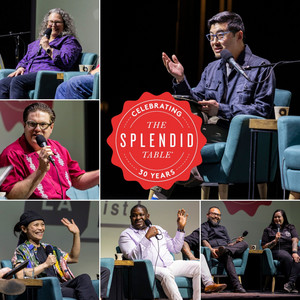
We got to do a live show in LA a few weeks ago as part of our tour of shows in celebration of our 30th anniversary, and we're delighted to bring it to you today.
For our first segment, our guests were Evan Kleiman and Gob Gibran.
Gob is the Associate Editor of Food and Culture at LAist, and is constantly scouring the city in search of amazing foods and the stories of the people behind them.
He was a James Beard Award finalist last year for this work.
And Evan Kleiman is, well, Evan's a legend, allotted chef and restaurateur, six -time cookbook author, and the iconic host of LA's very own public radio show, Good Food, which also is turning 30 this year.
Evan told me that before we got on stage, but said, we're just not bragging about it.
Just so funny to me because, you know, the Splendid Table, we're the Midwesterners, so we're supposed to be the passive -aggressive ones?
Anyway, JKJK, love you, Evan.
Let's head to the stage with them.
Hi, Francis. Hello, everybody.
No stranger to the microphone.
No, I'm so grateful that you asked me to join you on this tour.
It's so fun. I'm so grateful you're here.
I am also super excited to invite to the stage Gab Trabant.
So, Evan, let me start with you.
Okay. Because... I'm the oldest. It's a matter of seniority.
You know, your own story of how you got into food is, if I'm getting it right, in some ways it started with a teenage trip to Europe where you said for the first time in your life you saw adult men talking about something they wanted to eat.
but I wanted to ask you actually you know fast forward some time from there and there was a period here in LA where you started to see a transition from a youth where you know going out to eat was going to drugstore counters to there being like something that you could call a restaurant scene here how did that change?
Well restaurant wise we were still living I think, in a post -war world until the 70s maybe, maybe the 60s somewhat, but it was bifurcated.
So you had the very high -end, very clubby restaurants that were patronized by the wealthy and celebrities, you know, old stalwart places.
And then you had neighborhood restaurants, little diners.
What started to happen is the middle started to fill in, the idea of like a bistro, something a little more casual, but with more considered food than your average neighborhood restaurant.
And it happened within the context of a whole cultural shift. So those high -end restaurants were all carpeted.
You wouldn't say an architect was involved at all.
It was all a lot of interior decoration.
And all of a sudden, it was like somebody opened the door and realized we were actually in Southern California and they opened windows and the sun came in and it was a different kind of vibe.
I mean, it became a California vibe.
And in the late 70s, early 80s, you had, you know, the huge people.
You know, Wolfgang comes on the scene.
Michael's opens. And all of a sudden, the template for the high end changes.
Art is really important.
You have local artists, art on the walls.
Outdoor dining becomes something that isn't an afterthought.
It's this recognition of everything that California is, this really creative, open, freewheeling kind of place that then becomes married to this farm -to -table movement that one could say started in Northern California but became something else down here.
what do you mean by that um I think we had a bit more harder edge it was less purist less um precious maybe um I I always think about music too music and celebrity because after all we are a town built on fame and so it's the first time really that chefs become stars they become come people you recognize rather than the guy in the big tall hat it was this huge transition away from a very kind of stodgy um intimidating way of dining to a more like let it all hang out you know let's all be stars together kind of situation it was the 80s was crazy in a way crazy time.
There's a lot unsaid in that sentence.
Okay, let's talk about the 80s because then you opened your restaurant.
Yeah, I opened in 84 the first one, yeah.
So in this right in this period.
Yeah. And you say, oh let's all be stars together.
But it was also a time where young people who had had the opportunity to go to Europe, backpack it was like something structural happened in the airline industry that allowed young people to go to Europe for the first time with a backpack pack, and you didn't have to have a lot of money.
And a lot of us did that and traveled all over.
And those of us who were interested in food and cooking wanted to come back and recreate what it is we made.
So like Campanile, you had Mark Peel, you had Nancy Silverton, you had Mary Sue Millikan and Susan Veniger, all of us were just exploring and sort of figuring out where we belonged and and expressing something that wasn't in a canon handed down from a French brigade system, more or less.
And women, it was like the first explosion of women in the kitchen.
We were lucky, we were represented and we got attention.
So we got a lot of support.
That's super interesting because I think that as we look at the history of different restaurant scenes around the country, the story of L .A.
is unique in a lot of ways.
but one thing that really stands out to me is the the prominence of women chefs and women restaurateurs in that moment where things really started to take off why do you think that is what i think about is why were we brave enough to say to her parents no i don't want to finish my college education or i'd rather go to cooking school in my case i i got a college education but and I got a BA and a Master's and then I just wanted to cook and my mother was just she used to sit at a table watching me cook and sob I mean just the tears would be coming This was before she had the food or after?
Touché Touché But I think there was more freedom and women certainly took advantage of that and it wasn't easy I mean, getting money to open a restaurant for us was harder.
And I think we tended to lean on friends and family, maybe more than people that were able to go to an investment group or get money from a bank.
But we were also tight.
I mean, it was a community.
And the customers, I mean, the clientele.
Such great customers.
And you had great customers.
I mean, at the end of the day, that's kind of what the story is, right?
Well, you know, it's so funny because boomers are so reviled now.
But it was a period of time when the economy was in this mega expansion mode.
There was money. People hadn't married yet.
They didn't have kids yet.
They were going out, like, every night of the week.
And it was, like, music, restaurants, clubs, and repeat customers.
I mean, we would have regulars that would dine out three nights a week.
and you know my place was very very casual but even you know at the high end you saw that I mean Wolfgang there was nobody like Wolfgang Puck I mean he changed everything for everybody in LA that's interesting actually can I tell you about my first time visiting LA as a food writer sure as a food writer but also really one of the first times I came as an adult it was like 20 you know 20 plus years ago or something like that around 20 years ago and I had you know heard of Spago, obviously, for so many decades, and I was like, I'm going to go check this place out.
And I was so struck by the look of the restaurant.
Was it the one in Beverly Hills or the one on Sunset?
In Beverly Hills, and there was, like, this giant stained glass window with, like, grape vines and, like, a giant, like, garlic bulb, like, larger than me, as if it was, like, tumbling out of the walls and there were like these trapezoid cutouts in the walls that were like neon blue and neon red and I remember sitting down and just being like oh my god this place is so stuck in the 80s it's like unbelievably 80s and I was kind of like joking to myself like haha and then I order you know some iconic dishes and I'm eating like the beet and goat cheese salad and the smoked salmon pizza I'm like oh
my god these are so 80s and I take a bite I'm like like this is time immemorial like this is the greatest thing i've ever eaten and in that moment i realized i had like a total revelation and it's not that this restaurant was stuck in the 80s but it's that in the 80s the entire universe wanted to be like this restaurant and it didn't exist until then it sprang up for the first time that way and i mean when i think of splago I think of when it was perched above sunset in that very provisional space and everybody was sitting on plastic chairs and their audience was an audience that was used to being
cosseted like all the chairs would be upholstered like I said you're on carpet a lot of times the walls were upholstered everything was hushed and then all of a sudden this restaurant comes out of nowhere when you look at Wolfgang during that period of time you see how young he was yeah and it's like my restaurant what was I serving things that you find in any Italian trattoria you know insalata caprese spaghetti aglio olio but nobody else was doing that then it was like a big deal my food was so simple and I was like why are people standing in line like waiting for this it was very strange yeah
but I mean I think it's so important that this was happening in the city that you said is like the city that's built on fame and again my my revelation my let's talk about my revelation uh but my revelation was like again that idea that like oh it's we as a country and like by extension like as a world have like been so deeply influenced by this city by that moment in this city in particular again we're like the entire aesthetic of the 80s that i think of now i realize like it came from here like it was actually a regional aesthetic that became an aesthetic of a period and that's incredibly powerful.
And it was brave. It was wild.
It was brave because like Barbara Lazaroff Wolfgang's first wife was the designer.
She did all that and she was a big, brassy bold woman and she just put it out there.
Her design aesthetic was that and like I had an architect design my restaurant who decades later won a Pritzker comprised, but when I met him was just, you know, a small design group.
So it's like we were, we were also physically creating spaces that were such a 180 from everything that came before.
That's Evan Kleiman, host of Good Food, and Gob Trebron from LAist. More from the stage in Los Angeles in just a minute.
I'm Francis Lam, and this is The Splendid Table from APM, American Public Media.
Our show is supported by Broad & Taylor, dedicated to innovating unique products that simplify the process of making wholesome food from scratch. We all know baking bread isn't simply a recipe.
It's a process. And when it comes to sourdough starter, temperature is everything.
Tools like the Sourdough Home will heat or cool your starter and adjust starter feeding times to meet your schedule.
The folding proofer provides perfect temperature and humidity control for consistent dough rise and it folds down to less than three inches so you can put it away and keep your kitchen clear.
And when it's time to bake, Broad & Taylor's ultralight baking shells trap steam, creating that perfectly crisp golden crust everyone can't wait to get their hands on.
No more lugging around a heavy Dutch oven, simply pop on a baking shell, no preheating required.
For recipes and more, visit broadandtaylor .com slash splendid.
by L .A. or Southern California like avocados which are you know botanically native to South America but functionally from Southern California the Haas avocado was developed here and that's like La Havre Heights that's like the close to Whittier universal avocado it's in Whittier well next to Whittier yeah like there's like an actual birthplace of an avocado there's like a particular gentleman's backyard and sushi I mean the story of sushi is just such a bizarre strange story it like was one guy who was asked to come over by a businessman in LA.
One guy from Japan comes over and he sells everything.
He sells the accoutrements of serving sushi, right?
And bankrolls a restaurant.
And it becomes like we were hungry for this.
It just exploded. And then the 80s was the time of Matsuhisa Nobu.
And from there, the rest of the country was like...
And from there, the rest of the country.
And didn't the same thing kind of happen with Thai food, too?
too? I mean, I'm thinking about Hollywood in the 80s, and you guys were talking about the design aesthetic of that time, and as an extension, Thai immigrants would come to the area to start cooking Thai food, right?
I mean, that was one of the first places in the country.
Absolutely, yeah. We were very lucky that immigration had opened up at that point, and we were the recipients of this great culinary largesse, and of course, Jonathan was everyone's guide, and so it was also this combination of of the high end becoming a different thing, more bistros.
I mean, it is really hard to overstate the influence of Jonathan in a pre -internet era when you couldn't just open an app to tell you where to go eat.
This extraordinary writer with this amazing gift who was in his truck just driving everywhere and inviting us to leave our neighborhoods and experience L .A.
from a different point of view.
so Jonathan of course is Jonathan Gold legendary food critic I think is the way that like most people would put it but I think he was more than that you know it's a first name basis for you first name basis for those in this room for those listening to this show across the country probably 45 % of them will know exactly who you're talking about even without the last name interesting thing about Jonathan or many interesting things about Jonathan but one of them was that he was originally a music writer and i'll turn to you gob because you were originally a music writer before you turned to food
yeah yeah i wrote for a publication called la record where i would do live reviews and also reviewed records too as well and i didn't get paid i my payment was either getting into the show for free or getting you know a download of the album and that was perfectly fine with me i was like this makes total sense you know i'm gonna go ahead and invest you know my entire weekend in just because I got to go see a band that I liked.
If you put the CD between two pieces of bread that's a meal too.
You can live on that.
There was a lot of CDs back in the day.
You know there was a lot of CDs.
I'm so glad you asked about music because music was such an important part of the whole scene.
Definitely. Definitely yeah.
And I was chatting with Bill Addison from the LA Times and he was I overheard him talking to somebody else and he was talking about how food and music are you know kind of side by side with each other in that respect and that really kind of informed formed my process, making the transition to writing about food felt sort of synchronous in that, in that respect.
What do you mean? I mean, for me, my process, when I think about food, basically it comes down to, it's all experiential, right?
And to me, eating a good dish is simply like a symphonic experience.
You know, you're getting elements of a little bit of everything thing as far as that goes you know and Alex and Elvia of Evil Cooks is a perfect example you know they'll be out here in a little bit to talk about their experience but they are a heavy metal taqueria you know I mean they can make that connection and they pioneered the idea of being a roving group of chefs like you would be a touring band or something like that traveling all around concert t -shirts all of that kind of thing yeah obviously we've mentioned Jonathan.
When I first moved to New York City, I remember the only part of New York City I knew was Chinatown because that's where my parents worked when I was a kid and all of New York City was just Chinatown for me.
So when I moved there I was like, I actually don't know anything about this place.
And I was intimidated and I just didn't know It just seemed vast. And I remember reading The Village Voice which was like our alt weekly at the time and Jonathan's sort of counterpart on our coast was Robert Sitsama weirdly also a former music writer who had turned into a restaurant critic and his very similar mission to Jonathan in that he just really wanted to find all this food from all these different communities, all this vernacular food, this like local people food.
And I remember just like reading his column week after week and that's what sort of drew my map of New York City.
Like, I just, I never heard of Elmhurst Queens, but oh, now I know there's a Thai restaurant in Elmhurst Queens I want to try.
So I'm going to get on the train and go there.
And while I'm there, I'm walking around and, Oh, now I have a little bit of sight line into this neighborhood in this community.
And, you know, bit by bit, that's how I drew New York City in my mind.
So, Gob, you are obviously a wittier booster.
You're like, we got the avocado.
I'm contractually obligated.
We have a college there.
Yeah. And I was born there.
Yes, that's right. We were neighbors.
We have the birthplace of Evan Kleiman.
Yeah. So, you know, you're a lifelong resident, but you still had to learn the city in some way.
Right, right, right.
Well, I'm going to draw it back to Whittier, too, and Jonathan, too, at the same time.
So one of the more memorable reviews that Jonathan wrote in the LA Weekly was about a restaurant in Whittier, which is no longer there, called the Golden Triangle.
And they specialized in Thai, Burmese, and Laotian food.
food. It's one of my favorite reviews of his.
The fact that he came to our town and, you know, really kind of saw what this wonderful restaurant was doing.
And in the article, he mentioned MFK Fisher, who was also from Whittier.
He mentioned Richard Nixon, who also was from Whittier.
It was like he saw us in a way, you know, and he contextualized us in that respect, you know, never downplaying it or anything like that.
We're 18 miles southeast of Los Angeles on the border of L .A.
and Orange County. So a lot of people, if you didn't grow up in the area, you don't really know it.
But I think it was the fact that he took the time to go out there and talk about this beautiful restaurant that I still have very fond memories going to as a child.
So I like to think I try to embody some of that spirit when it comes to trying different places, going all over Los Angeles.
And I'll tie it back to music.
I'm a big vinyl collector.
I worked in a record store in my early 20s, and that's when I kind of started collecting records.
Essentially, what it is when you're traveling to the outer lands of Los Angeles and looking for all these great places to eat, it's a form of crate digging.
You are looking for the deep cuts in that respect.
That's such an awesome metaphor.
and uh your fingers might get a little dirty in the process from flipping through all the vinyl and all of that kind of stuff but then you'll have these amazing dishes and it'll all kind of click and make sense you know in a perfect representation of what's going on at that exact time and the the people who are who are preparing it and most of the time in many cases are coming from immigrant backgrounds too yeah we're what are some other places that you have encountered in your work that make you feel like god I love living here oh man I mean those taquitos that we had from Los Dorados yesterday
I mean that was a great example you know because they're doing something that's familiar but they're also kind of paving their own way in that respect I mean I've been eating taquitos since I was a child but here I can take the concept of the taquito but then really experience it in this sort of you know technicolor level um i think that's a lot of what people look for in food you know they're looking for comfort they're looking for familiar experiences and the chefs and restaurateurs and cooks the ones who can really kind of channel that and also kind of bring it to the next level i think is really
what it's all about yeah los dorados the taquitos are unbelievable yeah so good they're incredible They're individually sauced with their own salsa, super crispy, crunchy, and the chorizo and the chorizo y papas, the potatoes, super smooth potatoes, little bits of chorizo, and this electric salsa verde on top.
It was phenomenal. And the bean and cheese as well, too.
The bean and cheese was killer.
Yeah. Anyway, all that said, I think our love of restaurants, our love of food people, is infinite as I've been here the last few days as I've talked with people talked with you talked with others it's pretty clear that it's also a difficult time um in Los Angeles for many people not least restaurants the economy is shaky uh downturn in entertainment production a lot of people with less money to spend um obviously the fires were incredibly devastating still are the rebuilding is going to be a very long road it's a hard time but i want to ask both of you through like your deep experience and like
traveling and constantly talking to people and also through like the arc of history what do you see now that gives you hope that makes you think it's going to be rough but we're going to we're going to come out on the other side of this I mean the response to the fight I'm going to start crying the response to the fires the mutual aid was unlike anything in my entire life of living in Los Angeles on display the generosity and I knew the minute that it was happening what the chef's response would be and that just shows us the best of how people can be and I think the resilience the resilience and the generosity
gives me hope applause I would second those remarks You really got to see How the community of LA Sort of came together And the amount of restaurants That were just offering free meals Even restaurants like Pasha Lee It wasn't performative at all It was just pure generosity Exactly Exactly and a few people started doing it And then more businesses started doing it And then bigger chain restaurants started doing it It was also extremely heartwarming to see everybody You know sort of come together like that I don't think I've as in my adult life Ever experienced something along those lines And the reason I
have so much hope out of that Is a whole different type of community formed You know not just of people affected by the fire But also within the industry People who came together to work together other to feed people and that kind those kind of um links when you're like in the trenches those are lasting yeah yeah it's beautiful well thank you so much ladies and gentlemen gob trebron evan clyman gob trebron is associate editor of food and culture at laist and evan clyman is the host of good food la is nothing i'm not full of buzzy restaurants but at the end of the day ask any restaurateur and they'll
tell you the same thing you can't survive on hype you have to have regulars you have to be part of a community but what does that really mean we wanted to talk with a few chef owners about that question him with lei who makes delicious vietnamese comfort food at her takeout bay uh keith corbin twice a james beard award nominee is executive chef and co -owner of alta adams and best -selling author of the memoir california soul and elvia and alex garcia are the chef owners of evil cooks probably the first pop -up taqueria to be nominated for a james beard award let's get on the stage all right well
thank you all for joining us i i have to note that elvie and alex are wearing cool clothes but these are the cool clothes they cook in because they were literally selling food at smorgasburg right before this they are here to drop knowledge on you and then go back to keep selling food.
And actually let me start with you.
You've always said that you're from the streets, that you belong to the streets.
Yes. What do you mean by that?
Thank you for having us, first of all.
Yes, I always say that we belong to the streets because I'm originally from Mexico and I started selling donuts in Mexico when I was five.
So for me being on the streets It's something that made me feel free, made me feel back in my roots.
And I always said, like, if I always do anything, I'm going to do it on the streets.
And we did it already for seven years.
We were a pop -up here in L .A.
We did a lot of concerts, events everywhere, and it was fun.
But at one point, like, so many ideas that you cannot make when you're in a pop -up.
You need an actual kitchen, you need equipment, and, you know, like, if you don't get those ideas out, you become crazy.
so somehow you need a place to give birth to those ideas and we end up in a restaurant last November.
Two blocks away from home.
It's really nice. The commute is unbeatable.
But this is interesting, right?
Because you love the idea of going to the people and how you meet people and how you connect with your customers in a different way.
Tell us about that and why is that so important to you?
I always used to think about my career like being like a clown, being like in a circus and move around and go find those people to laugh about you.
Yeah, scary clown, why not?
So cooking for me was like that, going around L .A.
and find who liked your food and that was comfortable.
that was like the best thing but unfortunately like at some point you need to settle we're getting old to be honest and carrying the things in our van it gets hard so at one point we're like you know what let's just settle down we're not gonna look for anything if he comes he comes and we'll take him we didn't really search for it it actually came to us yeah yeah it was like a random call from another fellow vendor.
He was like, I found this spot by your house.
I'm like, where? We know everything here in El Sereno. He's like, no, probably like two blocks away.
Go check it out. I told her.
I was like, no way.
She grew up there. She cannot leave El Sereno. She's like, I know the spot.
It's super small. I'm like, let's go and check it out.
We went. We got in.
I'm like, no, it's super small.
It was just like a six seat in the counter and that was it and the lady told us like no it's a patty in the back we're like oh my god i didn't know about this so we went to the back and we're like this is it this is home that's great so the nomads finally settled down so you were you were cooking in different pop -ups people would come to your house you would vend at smorgasburg in all those years you know every restaurant needs its regulars right and all those years from you going out into the world and selling to people like where they were did you find regulars are they coming to you now most
of our regulars come like three times a week every week so so basically we start as a t -shirt company I was a chef for a lot of restaurants before and I got bored of the executive chef position and it was like you know what like I need it to de -stress so I start drying and making shirts and go sell to my friends to their restaurants and at one point somebody asked like can you do like a private dinner for us?
I'm like you know what let's do it so we did that transition and we start traveling especially we try to focus on rock concerts and all that kind of stuff to bring like that same vibe but we find a lot of people who actually love fall in love with the food and until now we have people from back then who owns all the shirts and who comes to eat like two or three times out of the week.
We have customers who bring like different people every time that they come.
So I think somehow the food is good.
So, okay, so if y 'all have never tried their food, you should.
You should also get ready for it because it's maybe unlike anything you've ever seen.
One of their signatures is an octopus al pastor.
store. So, I don't know, like 35 octopi skewered on a trompo, you know, spinning around, being roasted, and it's covered in this beautiful black recado negro, so like a black paste of burnt chilies.
It's super delicious, but it's highly unusual.
Also, one of your signatures is a flan taco, which, I mean, come on, that sounds amazing.
But Elvia, you grew up in El Sereno, right?
Yes. And amazing to have the restaurant in the neighborhood where you grew grew up where you live but you also know all the people there yes and i think you know sometimes you know how people kind of want things a certain way like you know they're like what are these people doing here with these like weird tacos it's almost like that thing where it's easier maybe to reinvent yourself when you go far away from home so let me ask you how has it been serving your neighbors food that they don't necessarily quite understand yet uh we'll have people come in intimidated and i'll be like i'll buy you
your taco because i'll be like oh um what's a weird thing we have our cheeseburger taco you're like that's weird i'm like i'll buy you your first taco and they'll take the offer and then they'll buy more and then they come back with friends but it was something that multiple business models that operate like that i don't know i feel like It makes them feel welcome.
It makes them feel like, oh man, they really do care for my service.
But it was something that I always wanted to do was bring something different to my community.
And being able to, I feel like I've accomplished something.
I checked something off.
I love that. That's Chef Alex and Elvia Garcia from Evil Cooks.
We'll be back with Wynne Leigh and Keith Corbin with more of our live show from the Arutani Theater in Los Angeles.
I'm Francis Lam, and this is The Splendid Table from APM.
There's just something about family road trips.
Windows down, music up, snacks everywhere, and stories that turned into inside jokes for years.
And now there's one more thing to love, pulling over for a chicken sandwich that makes the whole car happy.
Culver's new chicken sandwich lineup is made with 100 % whole white meat chicken breast, topped with fresh lettuce, ripe tomato, creamy mayo, and our fresh, crunchy pickles, all in a toasted brioche bun.
Our new crispy chicken sandwich is coated in our very own Southern -style breading, seasoned with onion, garlic, and a pinch of cayenne.
Looking for more heat?
Add some kick with our new spicy crispy chicken sandwich, Bringing more flavor than ever before with a three pepper blend of spices or enjoy a twist of our classic grilled chicken sandwich fresh off the grill.
Pair your favorite with a refreshing cold Sprite and you've got a lunch stop worth remembering.
It's the kind of meal that keeps spirits high and seatbelts buckled a little longer.
So wherever you're headed, make a stop that brings everyone together.
Find a restaurant near you or order online at Culver's .com.
I'm Francis Lam, and you're listening to The Splendid Table.
We're coming to you from Los Angeles, a city with a world -class restaurant scene, but where the heart of its food is still in its many diverse communities.
Let's get back to the stage at the Arutani Theatre with Wendley, Keith Corbin, and Alex and Olivia Garcia. Keith, let me move to you for a moment.
It's your turn. um now when we talked the other day you said something that was really profound you said to me a community is built by the people who participate in it absolutely and you said it's the customers who design my restaurant yes now i want to talk about your food because the food at alta is often referred to as soul food and when i came the other night your collard greens were spectacular the fried chicken was top notch but i think the dish that i actually want to eat again like right now now well that's you but actually even weirder is the salad oh because well it's it's beautiful
you know beautiful lettuces and vegetables but the dressing was made with beriberi yes an ethiopian spice blend yes and you had a bone marrow special that was made with suya which is a nigerian spice blend usually used on barbecue yeah like grilled skewers meat skewers in nigeria and so i want to to ask you how did you get inspired to look at African flavors for your food do you see what color I am you set yourself up I'm sorry um no I just I like to turn things on his head and when it comes to soul food right I'm black if I created a soul food okay what it is right I'm not going to be defined
or marginalized with just like collard greens mac and cheese and fried chicken so just like the bone marrow dish you know my purveyor had some bone marrows that they were trying to get rid of and he was giving me a good price and you know as chefs or as cooks you know you take these things and it's your job to make it delicious and I just wanted to do something different with it and so I just looked up African bone marrow dish and no but it came back as a African bone marrow and pepper soup mm -hmm and it's like I don't know soup here like I can't pull that off but I saw I went deep into like the flavor profile
and the spices that they use and I'm like oh I've never ever played with that.
That would be interesting.
So I imported some in.
And so the pepper that's in Africa, it has this black pepper and allspice and their nutmeg is more floral.
And so those things took it in a different direction.
Instead of using olive oil, I ordered some palm oil and played with those flavors, then I got lucky.
I got lucky. But I just like to just try to flip the dishes on their head and just have fun in the kitchen.
One of the reasons that I got in the kitchen is because I was starting to feel like everybody was doing the same thing.
And so me calling my food California soul food allowed me to deframe it and reframe it using the beautiful bounty that California has to offer, not just in produce, but in culture, in race, in people.
And so I use ingredients that if my grandmother was alive, she would say, get that out of my kitchen.
What is that? Let me ask you a similar question which is like, you know, when you have customers come in, especially if there's a label on your food, like it's being labeled as soul food.
So people come in with a certain kind of expectation and that kind of expectation is also like, people get protective.
If it's food they associate with their memories, with their family.
But that memory, that thing that they're attached to says southern soul food.
You're walking into a restaurant that says California soul food.
Leave the attachment at the door.
just come in and enjoy the food right um because even that southern soul food was food created off of techniques and familiarity with new ingredients from west africa right gumbo is not new in louisiana you know like you have a nigeria okra stew that's made out of okra like these dishes are these techniques are these ideas didn't start in the south and so why do i have to stop there why can't i continue that tradition and create food soul food from the ingredients that surround me when i think about soul food it is food created out of love with the intent to nourish sustain and carry you over
a day right and so when this food was getting created they were were feeding each other to carry them over in the fields right to get through a day I'm still sticking to that I'm still creating soul food it doesn't have to be the same food that's created in Louisiana if you tell me it's too much fat anyway man you are from California but you I love that so you're you're sort of completing the circle right because if southern food is really in large part west african food well creators are from there right and so from their ideology philosophy their techniques from what they knew they just was presenting
new ingredients they didn't recreate the wheel right like yams stools one pot meals using meat to flavor dishes like when you're in africa like the meat is a flavoring agent right um cooking with an open fire like these things it's not new they just did a new ingredient so i'm just following that trend i'm following the example yeah no shade on the people that want to keep recreating alabama louisiana mississippi right but california has beautiful produce beautiful product and beautiful influences and like i want to create food with that represent that yeah you bring it all the way back around
so when I want to turn to you now hello hello so when and I have actually known each other for almost 20 years before she was a chef we met on the Gulf Coast of Mississippi in a town called Biloxi about six months after Hurricane Katrina demolished the region and we were both working working in disaster relief and recovery, Wynne was a community organizer, also super brilliant.
I was blown away by this young woman who was just out of college organizing this Vietnamese immigrant community and refugee community who worked in the seafood industry there.
A lot of them were fishermen.
And after you finished your time there, we kind of lost touch a little bit, but I heard that you had gone to grad school and went to MIT.
I told you she was a real smarty.
next thing i know like years and years and years later i'm like listening to evan's show and i hear this familiar voice and i'm like who's that voice and evan you know in her beautiful back and out he goes that's win lay i was like you gotta be kidding me why would you become a chef you have the whole world in front of you why would you become a chef so why did you become a chef we mostly talked about food even though we're in our in our in our very few off hours in our off hours we mostly talked about food and i it's just been a big part of my life um being a refugee from vietnam and growing
up in vietnam i felt very close to the food and how the food brought communities together and very much particularly to street food which felt very inclusive one but but the flavors were just always so bright.
And I felt like in some ways that the Vietnamese food in America in restaurants were presenting one version or some versions of Vietnamese food, but I felt like there was so much out there in the diversity in the country itself that I wanted to share.
And it was also important to me to present something different both from a food perspective, but what is the responsibility of a community -based business, and how do we, sort of as the Southern California community, how do we embrace each other?
And so when I got into my 30s, I was like, okay, all right, all these recipes have just been living rent -free in my head.
I need to get them out.
So that's what happened.
I gave up benefits.
I gave up retirement benefits.
I gave up health benefits.
I went and worked for minimum wage, doubles, you know.
You have to be a good cook before you can be a good chef.
I sincerely believe that.
Okay, so you did that.
Yeah. But how does that career, that previous career in social justice and community organizing, how does that influence you today as a restaurateur, as a chef?
I opened the business with intention to serve fresh, flavorful food food made from the heart at affordable prices in our rent -controlled neighborhood, and also to pay people what I thought was livable wages, and I've continued to increase the wages over the last few years as the cost of living has increased, and pooled tips.
And we try to, you know, recycle as much as we can, repurpose, compost, etc., and it's the idea of community as well, And it's the idea of running a kitchen that is accountable to the community, but could also be there, like, during the fires, you know, that can step in immediately, and I can be the one to make that decision.
And be like, you know what?
Is my staff safe? Am I safe?
Can they get to work?
Let's do free food.
I was able to make that decision in about 15 minutes.
and I think that because of where we're located in Silver Lake there were fires that you can see coming from different sides but we're relatively secure and so it was just like there were people with some produce they need to get rid of you know there were some people who had referrals of friends that didn't have access to food and there are also people in our community that were willing willing to bring food out to those areas, just volunteers in our community because we've really gotten to know our neighbors, you know, and they show up and be like, okay, I'll deliver to the fire stations, you
know, I'll go to this zone.
So just get some food together.
So it felt like we created a free economy overnight in Los Angeles in many ways.
Not us, but the community of Los Angeles created a free economy and we did it overnight.
And I'm really proud of us for that.
yeah yeah you know obviously you and I met in a disaster zone yeah um and it's there is a not to romanticize it at all by any stretch obviously this is a nightmare um but there's this god who wrote this book was Rebecca Solnit maybe Rebecca Solnit a paradise built in hell and I mean the title of the book sort of says it all like this idea that in these incredibly challenging and devastating moments you can see people reconfigure the world around them it's not just oh what am i doing what's my work what's my restaurant doing but they're reconfiguring the world around them and that gives opportunity
for people to do something real for one another and something good for one another so uh i don't want to uh be a downer but there is again i don't know if you you were able to hear backstage but the last question I asked Evan and Gob about was the fact that we're here in celebration of you of your work and what you bring to us but you know I and we know it's a it's a challenging time for restaurants it's a challenging time for chefs and restaurateurs right now it's never easy but it's maybe especially challenging now for a lot of reasons so let me go down the line and ask all of you what keeps
you energized right now and what keeps you hopeful and looking forward to the future I think that having a community and having people come back multiple times a week I've never eaten anywhere three times a week week after week and there are people who do this at my restaurant as well and it's such an honor for that and then to see them kind of bring their family when they come in from out of town.
I think there's a lot of joy I get as a chef that folks get to experience this food.
And then when it's gone, it's gone.
You have to start again the next day.
But in that moment, there's this moment where they're sharing food with somebody they love and they get to have a conversation.
And it's like my food.
And I think there's a special joy to that that makes so much of everything else worth it.
And so I also encourage I encourage folks to go eat out instead of like ordering delivery or something, which I, you know, I think there's a time and a place for it, but I think through the pandemic folks have gotten really adjusted to that.
But I think there's a lot to be said about being out and being in the community and then sharing food and then kind of just being around other people that makes L .A.
so amazing. And I really encourage people to do that.
Keith, what about you?
Well, for me, I just take it one day at a time.
And I know restaurant is not going to make me a millionaire.
I do this out of love and passion.
Restaurants, for me, is a place to restore people.
And so what keeps me going is just to give you somewhere to come outside of home and work that can be stressful.
To give you a place to come.
If I close my doors, where else do you have to go?
yeah there's other options I'm speaking like in terms of restaurants like if we didn't exist like what else do you have like just to get away and like commune and so that's what I do it for like I open the doors every day because you are looking for somewhere to get away from the world and just be in that third place and I get up every day to give you that I love that LV and Alex for me family vacation that's what keeps me going and we have so many ideas that we want to bring out so many dishes so many recipes and that is what keeps me going for me what keeps me going is the fact that I just want
to be happy I remember that kid selling doughnuts in the street or was dreaming to do something, become someone.
And finally, after so many years working for so many people and giving my ideas, I'm able to do my own thing and create my own demons in a plate somehow.
And that's what keeps me going, happiness and the fact that I'm doing it with the love of my life.
I can't say anything better than that, so let's call it a show.
Thank you so much Alex and Elliot Garcia Keith Corbin Win Le and thank you thank you, thank you for coming Win Le is the chef owner of Baeoo, Keith Corbin is chef and partner at Alta Adams and Alex and Elliot Garcia are the evil well that was our show from Los Angeles produced with our friends at LAist we had a blast we hope you loved it we'll talk to you again next week APM Studios are run by Chandru Kavati and Joanne Griffith the Splendid Table was created by Sally Swift and Lynn Rosoto Casper and it's made every week by technical producer Jennifer Lukey producer Erica Romero managing producer Sally Swift our digital producer this week is Jordan and Lauren
Humpert is our senior podcast production manager.
I'm Francis Lam, and this is APM Studios.
and you can save up to 60 % off hotels and up to 50 % off flights.
So don't just dream about that trip.
Book it with Priceline.
Audio happy price, Priceline.